
Dena Igusti | Member Spotlight
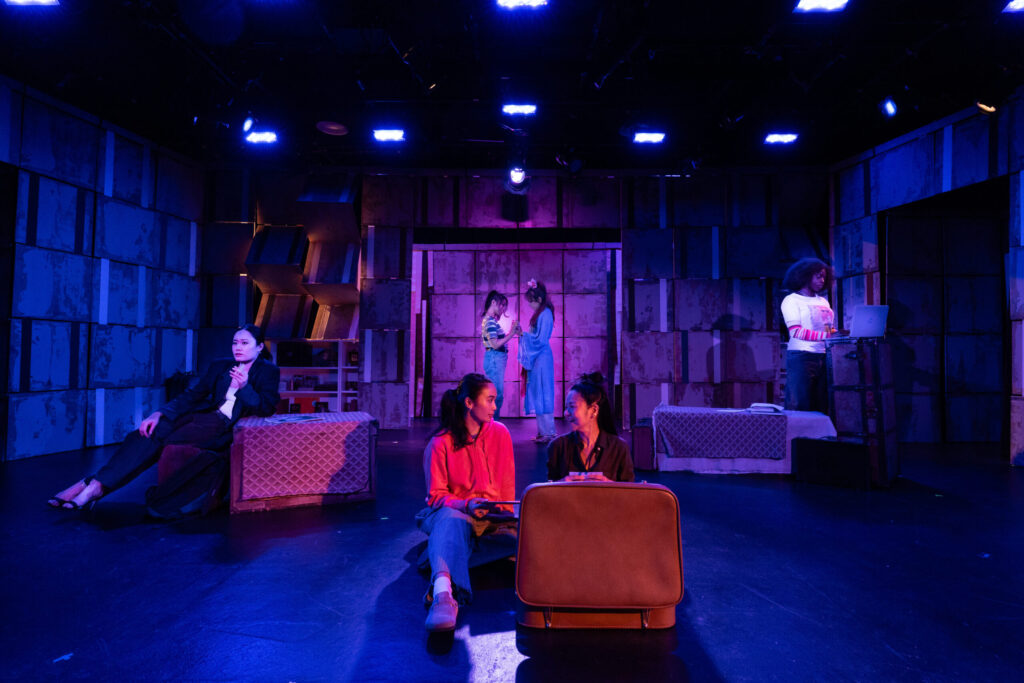
Poet Dena Igusti’s journey as a queer Muslim first-generation American of Indonesian descent, born and raised in Elmhurst, Queens, is a tale of self-discovery, identit(ies), and perseverance. Igusti’s play What You Are to Me was part of this year’s National Queer Theater’s Criminal Queerness Festival and shares a story of resistance and survival against two different governments trying to censor and/or erase their community story and history.
Igusti, whose latest book ecdysis: cacophony of skins is out with fourteen poems, sat down with Aryo Wicaksono, senior manager – Membership & National Engagement, to share their stories, with the hope of encouraging their peers – especially BIPOC queer literary professionals – to continue telling their own narratives.
We recently attended your really wonderful and special, touching, personal and also very well-researched play, What You Are To Me. Could you tell us about this most recent work of yours?
I think there are several tiers in terms of understanding that play. For the general readers and those who don’t know, the play What You Are To Me centers around an aspiring singer named Sarii who is trying to be this emerging pop star in the underground lesbian party scene in Jakarta, Indonesia. She comes across this student journalist who later becomes an underground magazine (zine) editor and both of them along with her best friend kind of become this hit hot item and these essential socialites in the zine movement and the underground lesbian scene in Indonesia. But when the 1998 riots ensue, Sari is pressured to move to America, specifically New York. Further … and because of all the dynamics of the fall of the dictatorship, including the fall of the value of the Indonesian currency (Rupiah), as well as injuries from her mother, she’s pressured to marry a family friend and have a child with a family friend. Years later, her own daughter who is navigating her own queerness as an Indonesian Diaspora navigating her own culture and queerness finds archives of not only the zine movement but also her mother’s past, not realizing the whole time that she’s actually studying her own mother
Your play, your storytelling was just so natural: You were able to combine and present all of the research as if it was your own personal story. How do you manage to achieve this, or what is your secret or method?
The short answer is that it’s a mix of everything you said. It’s like a yes and no. And it’s both yes and no and not at all all at once, right? A lot of the dialogue and the initial formation of the characters are based on a culmination of interviews I had with queer Indonesian women who were affected by Suharto’s dictatorship during the ‘90s and also afterwards most of them mainly based in Queens or they had some part of their immigration story involved being in Queens. So each character is a culmination of multiple women at once. And I think also kind of coinciding with the ways that I understood the things that my aunties and my mother like in terms of pop culture and karaoke and even for the contemporary queer Indonesians I know that are my peers, they also are very heavily into zine and very into disco and the shopping centers / malls in a lot of ways. A lot of the research I did was leaning into just reading over lesbian zine archives and also using queer Indonesian archive which is a website that has archived a lot of Indonesian documents and trying to independently contextualize the interviews but also the other aspect of including my own personal anecdotes and my main takeaway of trying to have this format of making it more so fictional rather than this autobiographical hero culmination of interviews.
I was also very mindful of the fact that for even myself – within the community – the idea of being out as a queer writer and a queer Muslim Indonesian writer isn’t necessarily something that I’ve done directly and a lot of that is because I have to be considerate of not only myself but also the rest of my family and in a larger context especially with the Indonesian Muslim community. This community has had to navigate several things: being queer Indonesians (and Muslims) AND having to navigate two systems of government who conduct various surveillance into the (Indonesian) community in one way or another.
What do you mean by navigating two systems of government who conduct active surveillance into your community?
My community experienced either its surveillance as a result of Suharto’s dictatorship before the 1998 riots in Indonesia or post 9/11, in which Indonesia was listed as a CIA ethnicity of interest; A lot of our places of gathering were surveilled in some ways, which led to mass interrogations, mass arrests, (and even) mass deportations. So, I think I wanted to essentially protect and anonymize everybody in a particular way and utilize fiction to tell this community story.
Why is it important for the world to know about the Indonesian-American community, especially the ones in Elmhurst, Queens?
I want to tell and archive these community histories –all of its facts, thoughts, opinions, and feelings – and have a place to both connect where Queens and New York City falls in line with queer Indonesian diasporic history, but also doing it in a way that is also quintessentially an American community story. … It is a shared story of community truth, of common universal values that all American communities have gone through in one way or another through history.
Do you intentionally include criticisms on authoritarianism and censorship in this play, or in general in lots of your literary works? Was this something that you grew up with as part of your everyday reality?
I’ve written this play for about four years, the initial draft of this was around 2020. It has been such an interesting journey to see that the play is being produced now, and a lot of people would ask “How did you know this (censorship – current political climate) was going to happen?” This is such great timing given what is going on not only in the U.S. right now in which under our current administration we’re being mass censored because of the defunding of arts programs as well as right now with Indonesia, where the most recent, new president is trying to rewrite the official history of Indonesia and deny the 1998 riots along with the 1965 genocide. It wasn’t something that was intentional: All the source material was already written within the first draft of this play, and there was no intention of necessarily giving a forewarning, but it was the fact that the subject material was a result of classic, timeless playbook censorship acts to these (hidden) archives. The play was a direct response to that act.
It is a shared story of community truth, of common universal values that all American communities have gone through in one way or another through history.
You started in a totally different – but oh-so-common among Asian Americans – career track: pre-med / biology major. You did a major pivot, and developed your literary skills, and bagged a lot of grants and awards along the way.
That’s right! I majored in pre-med, biology, and I did not intend to be a writer. When I first came to the school, which was predominantly 80% white, that was the first time I had that experience being in that kind of space, being outside of my own BIPOC, LGBTQ+ community from Elmhurst, Queens. A friend took me to go to an open-mic poetry event one night, and I got hooked, and in order for me to stay and continue to attend the open-mic I had to sign up for the poetry workshop. This workshop was my first time writing poems just for myself or writing it outside of the context of academia. I ended up writing poems to just have something to perform every week. From there I found out that my college had a slam team. So I ended up joining the team. Poetry slam, for me, is a very interesting genre in that, yes it is poetry, but also it does not rely just on paper and print and publishing [because] you have to perform it with your body. You have to use your voice. You have to use emotion. You have to physically move. Sometimes there was choreography, especially with group poem performances. So much of my understanding of the arts and writing was always inherently collaborative. … And that ended up fostering a lot of how I navigated my literary career in that it made me very open to feedback all the time. It made me very open to the beauty of editing instead of writing this first draft and it has to be perfect. I have gotten away from the notion that if it’s not perfect, it’s bad. I also looked up to these poets I met at these poetry events – who were maybe10 years older than me – who were also coaching these teams. So I started following their literary path, finding out about their publications and publishers, and that made me want to get published in those same (online) magazines or publications. And then I started to research their fellowship or grant funding sources.
Last question for you – what is your mission, goal, or dreams?
To keep telling and sharing stories of my community, to really to lean into wonder and curiosity as much and as wide as possible in order to commemorate all of my loved ones beyond my own memory, to try not to let myself specialize or be categorized into a specific genre. To have the responsibility to archive all of my community’s journey and hopefully be able to transfer this timelessness in art, for example to write a play or poem that discusses the aspects of 1998 riots in Indonesia but at the same time criticizing Western governments’ censorship and/or involvement in those same riots. Sure, any government in some ways can censor this play or poem or even myself, but then also these works can be viewed, listened to, enjoyed, and even published somewhere else and it can exist in another life in another publication in another journal that extends beyond the borders of the country. Case in point: National Queer Theater Criminal Queerness Pride 2025 Festival tells stories about individuals who have been mass censored, detained, or even murdered by their home countries and governments, but their stories continue to exist! There are New Yorkers now who know our stories because it exists within art and therefore it exists beyond the borders of the countries that we are subjected to and further, the discrimination of the governments that we are subjected to. To be able to just do that as a writer and artist, in itself, is a great honor and responsibility.
Dena Igusti (they/them/their) is an Indonesian Muslim writer born and raised in Queens, New York. They are the author of CUT WOMAN (Game Over Books, 2020), which has been listed as a 2022 Perennial Award Winner, 2020 Harvard Bookstore Staff Pick, and Entropy Mag’s Best Of 2020-2021. They are the Inaugural 2023 NYFA Ryan Hudak Playwright Award Winner. Their work has been featured in BOAAT Press, Peregrine Journal, The Margins, and other publications. Their work has been produced and performed at LA Times, The Brooklyn Museum, The Apollo Theater, Women Deliver, the 2018 Teen Vogue Summit, Players Theatre, The Public, and more. They have been featured in Business Insider, Teen Vogue, American Theatre Magazine, and more. They are a More Art Engaging Artist Fellow, NYSCA Grant Recipient, Asian American Writers’ Workshop Open City Fellow, Baldwin for the Arts Resident, Best of the Net Nominee, and more. They have been commissioned by The Miranda Family Fund, for the production and creation of Everything You Need To Know About Abortion in One Hour or Less. Their forthcoming poetry collection Ecdysis: Cacophony of Skins released in May 2025 with fourteen poems (London).