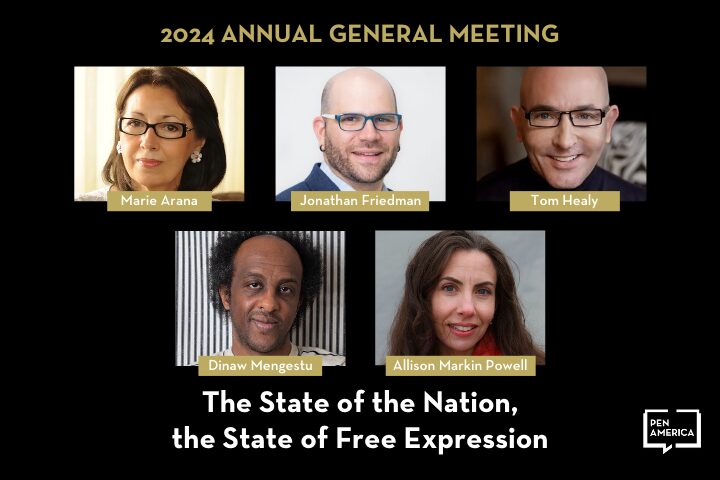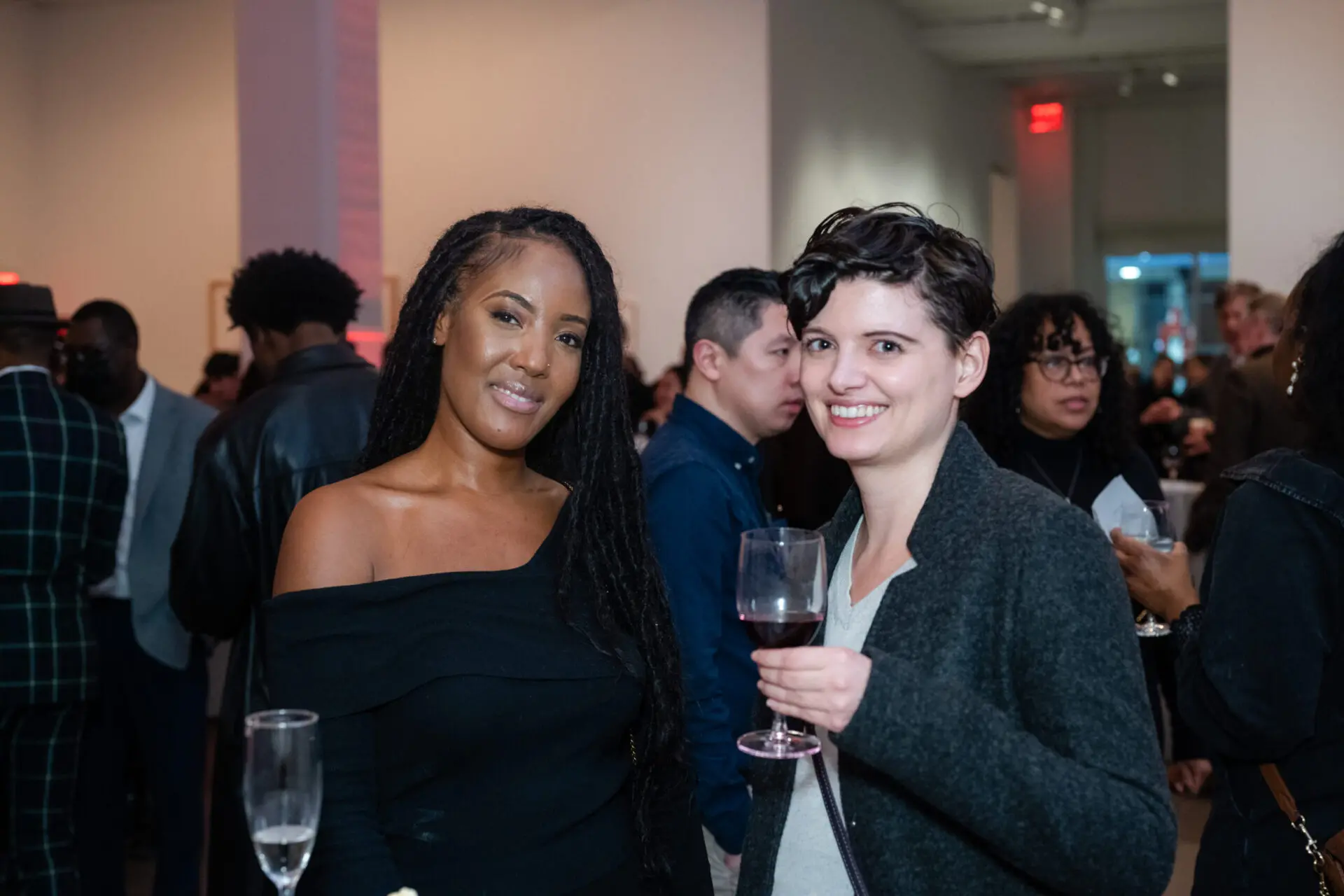
PEN America’s professional members approved a new slate of board members and elected a new president, critically acclaimed novelist Dinaw Mengestu, at the organization’s annual convening, and writers described their dual role as artists and activists during times that demand both.
Jennifer Finney Boylan, completing her term as board president, noted the challenges the last year presented. “We are seeing what happens when people in power become afraid of the truth. Books are disappearing from shelves … librarians are being fired for doing their jobs … subjects are being censored in classrooms; identities are being erased; writers are being harassed everywhere you look, targeted and silenced. … Faced with all this, we ask ourselves, how do we meet this moment with clarity, with courage, with imagination? Well, the good news is that PEN America was created precisely for moments like this.”
Interim co-CEOs Clarisse Rosaz Shariyf and Summer Lopez detailed PEN America’s many accomplishments over the last year in uplifting literature and combatting censorship. Rosaz Shariyf remarked that in spite of the challenging political climate, “it was also a year in which we felt galvanized by the relevance and urgency of our work. The importance and purpose of our mission has never been so clear. … We have been committed from day one to standing up, speaking out, and fighting back against the ever growing threats to free expression, and we have done so on many fronts, often with involvement and support of you, our members.”
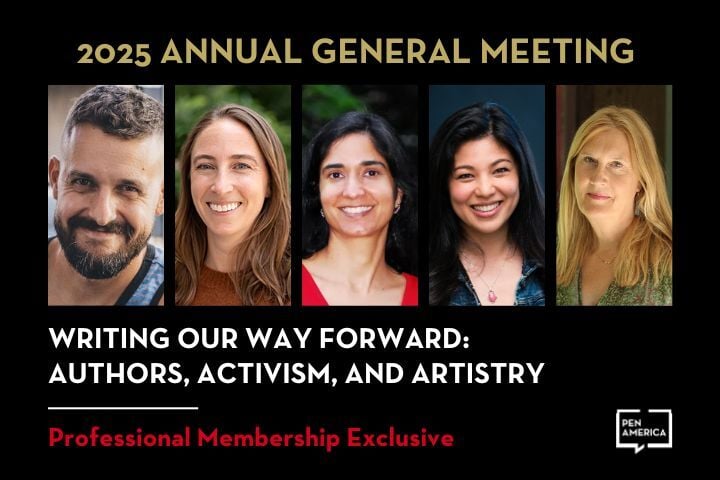
In a conversation moderated by PEN America Freedom To Read Program Director Kasey Meehan, authors Rex Ogle, Maggie Tokuda-Hall, and Padma Venkatraman explored the dual role as artists and activists that many authors take on – often in ways they hadn’t anticipated but as demanded by the times.
Rex Ogle spoke to how stories themselves can be a kind of activism, simply by giving kids a chance to see their own, often difficult lives reflected back in an unvarnished way. “For the last 20 years, I was trying to write horror and fantasy, but it wasn’t until…I published Free Lunch, which is about poverty, domestic violence and home instability, which I dealt with all through middle school, and I got this reaction from librarians and teachers being like, ‘there are so many kids who are going through this. They needed this kind of book’… It’s more important now than ever for kids to be able to see themselves.”
Both Tokuda-Hall and Venkatraman discussed how, despite both public and critical success, they had actually set aside their writing in order to be more vigorous advocates in the public arena.
Tokuda-Hall said “In terms of balancing art and activism, I actually have quit writing for the last year in order to get Authors Against Book Bans off the ground…. We only started about two years ago, but it became clear that there was a real, urgent need for us to be operational. … I really look forward to being able to pick up a pen again and to write with the same honesty that I’ve always written, but I haven’t gotten to do it for this year.”
Venkatraman added that after five of her six titles were banned or challenged, “I started to really feel the freedom of speech was just so important because … there’s so many causes that I have fought for, but if we don’t allow ourselves to communicate freely … we will not even know what is going on.” She described how she had spent the last year advocating for a Freedom to Read law in Rhode Island. “The thing that was most important to me was that authors would actually be recognized as parties … that were hurt or harmed by censorship. And none of the other laws that we have in this country did that until the Rhode Island law … to protect … not just books, [but] the people who are actually alive today producing the books.”
Tokuda-Hall said today, authors and artists need to do more than just focus on their craft: “I think one of the mistakes of the modern era for creators … is to think that the activism ends with the art. … And I really wish that were how it worked. But I think unfortunately, we’re at the stage where we have to be frank that this nation is a group project and we each have homework to do. … It is not a point in time where we have the luxury anymore of not being directly involved in things like our local politics or school board elections or even state houses. …It doesn’t matter if you flip the whole school board if the State House has voted to say that government speech is protected and they get to ban books in the library because of it.”
Tokuda-Hall added “Absolutely art has the possibility to inspire us into action. That is why authoritarians often target authors, creators, artists and educators in their first line of people who they want to villainize.”
Ogle reinforced the necessary role that books play in cultivating understanding of different experiences, especially for young people: “These are the books that kids need, and these are also the books that are being challenged. Because…there are people out there who, it’s like they don’t want their children to develop empathy towards those who are living in different ways. And it’s so alien to me…so, yeah, no one’s going to stop me from writing books. I don’t care if they get banned. I’m very happy to be writing books that actually make a difference in the world.”
Undaunted by the challenges 2025 presented, and indeed inspired to meet them head on, Jennifer Finney Boylan concluded the meeting and her term as Board President by reinforcing her determination to pursue PEN America’s mission with renewed vigor. “This moment demands that none of us back down. It demands that we protect every voice. It demands that we continue to tell the story…Thank you for being here tonight, thank you for your commitment to PEN America, thank you for standing with all of us in the fight for free expression.”