Found in Translation: A Reading List Featuring the 2020 PEN Award for Poetry in Translation Honorees
To celebrate National Poetry Month, we invite you to read the collections from the 2020 PEN Award for Poetry in Translation Longlist. Selected by judges Michael Eskin, Forrest Gander, and Pierre Joris, these collections remind us that in times of crisis, poetry has the power to cross borders to unite and uplift us.
Forrest Gander, a writer and translator whose 2018 collection Be With (Hudson, IndieBound) won the Pulitzer Prize, says:
Yes, it was Nezahualcóyotl, the poet-philosopher-ruler of the Nahuan people in pre-Columbian Mexico, who warned us that “like a cape made from the feathers of a zacuan, / that rare, rubbernecked bird, / we start to come apart / the moment we leave the house.” But housebound as so many of us are now—and inside a reality that seems filled entirely with the feeling of unreality, like an ocean filled with withdrawal—I wonder if some of us can stake claim to this moment as an opportunity for restoration. It’s a rich time for traveling across borders in our minds, for taking literary translations as our field guides, for tapping into imaginations that expand our experience of what it means to be human, among others, connected by a common plight. As we always have been, even when we didn’t notice. Now we might ask translation to bring us closer.
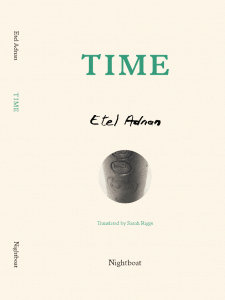
Time, Etel Adnan (Nightboat Books)
Translated from the French by Sarah Riggs
Hudson | IndieBound
Adnan’s collection of poetry was first inspired by a postcard of a palm tree she received from the poet Khaled Najar in 2003, who she met in Tunisia in the 1970s. These poems manipulate time in a way that captures broad swaths of memory and history while crystallizing the singular moments that dance between them.
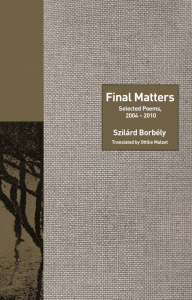
Final Matters: Selected Poems, 2004-2010, Szilárd Borbély (Princeton University Press)
Translated from the Hungarian by Ottilie Mulzet
Hudson | IndieBound
Hungarian folk songs, religious hymns, classical myths, and police reports interact in this volume of poetry, which features selections from Borbély’s last books, Final Matters and To the Body. Readers are transported into a fragmented prayer book, through which they can follow the original Hungarian text alongside the translation.
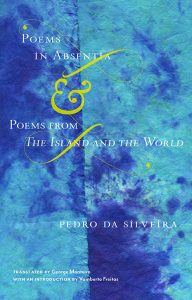
Poems in Absentia & Poems from The Island and the World, Pedro da Silveira (Tagus Press)
Translated from the Portuguese by George Monteiro
Hudson | IndieBound
Pedro da Silveira’s poems explore an islander’s yearning for migration, drawing from his experience as a native of the insular mid-Atlantic islands Azores archipelago. Da Silveira delves into concepts of place and home, capturing hope and loss with accessible language and adventurous spirit.
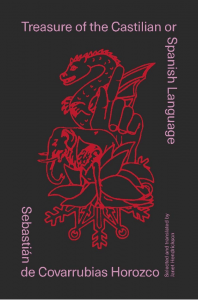
Treasure of the Castilian or Spanish Language, Sebastián de Covarrubias Horozco (New Directions Publishing)
Translated from the Spanish by Janet Hendrickson
Hudson | IndieBound
Language lovers will rejoice with this reissue of Covarrubias’ famous encyclopedic dictionary, originally published in 1611, and now available as a series of poetic selections. A contemporary of Cervantes, Covarrubias explored etymology and its connections to the everyday meanings of words, which have been given new life through Hendrickson’s translations.
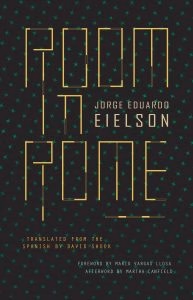
Room in Rome, Jorge Eduardo Eielson (Cardboard House Press)
Translated from the Spanish by David Shook
Hudson | IndieBound
In this long-awaited translation, Eielson is revived as an essential voice in contemporary Peruvian poetry, who constructs images imbued with myth, dreams, and melancholy. A poet and artist who was known for depicting the anguish of modern life, Eielson reinforced the power of words, especially when sculpted as incisively as he did.
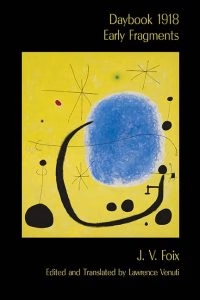
Daybook 1918: Early Fragments, J.V. Foix (Northwestern University Press)
Translated from the Catalan by Lawrence Venuti
Hudson | IndieBound
This first substantial selection in English from the prose poetry of influential Catalan writer J.V. Foix features a core of 45 prose poems from the beginning of Foix’s career, interspersed with additional literary works. Readers are immersed in the experimental nature of these works, which provide a valuable glimpse into the world of Catalonian revolutionary politics in the era preceding Franco’s dictatorship.
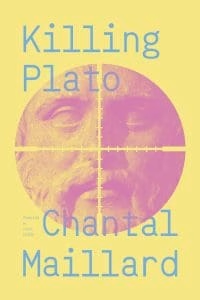
Killing Plato, Chantal Maillard (New Directions Publishing)
Translated from the Spanish by Yvette Siegert
Hudson | IndieBound
This two-part collection features a number of recognizable figures—the philosopher Michel Serres, Robert Musil, the Spanish poet Jesús Aguado, but also a man who has written a book called Killing Plato about “a woman who has been knocked over by the force of a sound.” The second part of the book serves as a lyrical meditation on mortality and literary production.
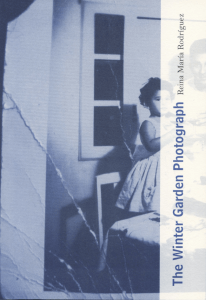
The Winter Garden Photograph, Reina María Rodríguez (Ugly Duckling Presse)
Translated from the Spanish by Kristin Dykstra and Nancy Gates Madsen
Hudson | IndieBound
Winner of the 2020 PEN Award for Poetry in Translation, The Winter Garden Photograph is a meditation on the power and limitations of images. The collection began as an homage to the magazine The Courier and its images of faraway places, which Rodríguez drew on to portray the mental landscapes of contemporary Havana.
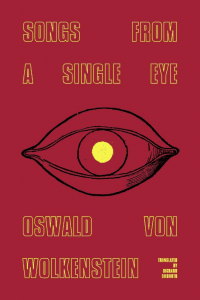
Songs from a Single Eye, Oswald von Wolkenstein (New Directions Publishing)
Translated from the German by Richard Sieburth
Hudson | IndieBound
Von Wolkenstein was a one-eyed singer, songwriter, and knight errant whose verses were lost to history until the 1970s, when he was finally recognized as the German language’s first truly autobiographical lyric voice. In this new translation, which includes facsimiles of his musical compositions, von Wolkenstein is revived as a luminary whose songs double as poetry.
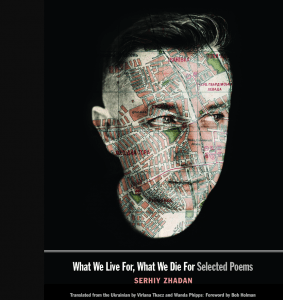
What We Live For, What We Die For: Selected Poems, Serhiy Zhadan (Yale University Press)
Translated from the Ukrainian by Virlana Tkacz and Wanda Phipps
Hudson | IndieBound
Zhadan’s narrative poems hone in on poverty and loss in war-torn Ukraine, where death is rampant and romance is a distant memory. In language that’s accessible and familiar, yet not without magic, Zhadan creates new poetics of loss in the tradition of Tom Waits, Charles Bukowski, and William S. Burroughs.