PEN America is delighted to announce the 2026 literary grant winners for works-in-progress. Juried by panels of esteemed and award-winning writers, editors, translators, and critics who are committed to recognizing their contemporaries, these winning works-in-progress show the potential for lasting literary impact. The following grant winners will be supported as they continue their important work. We look forward to seeing these bold and thought-provoking examples of literary excellence brought to the world.
Publishers, agents, and editors who wish to learn more about these projects are invited to contact the PEN America Literary Awards team at [email protected].
PEN/Jean Stein Grants For Literary Oral History ($15,000)
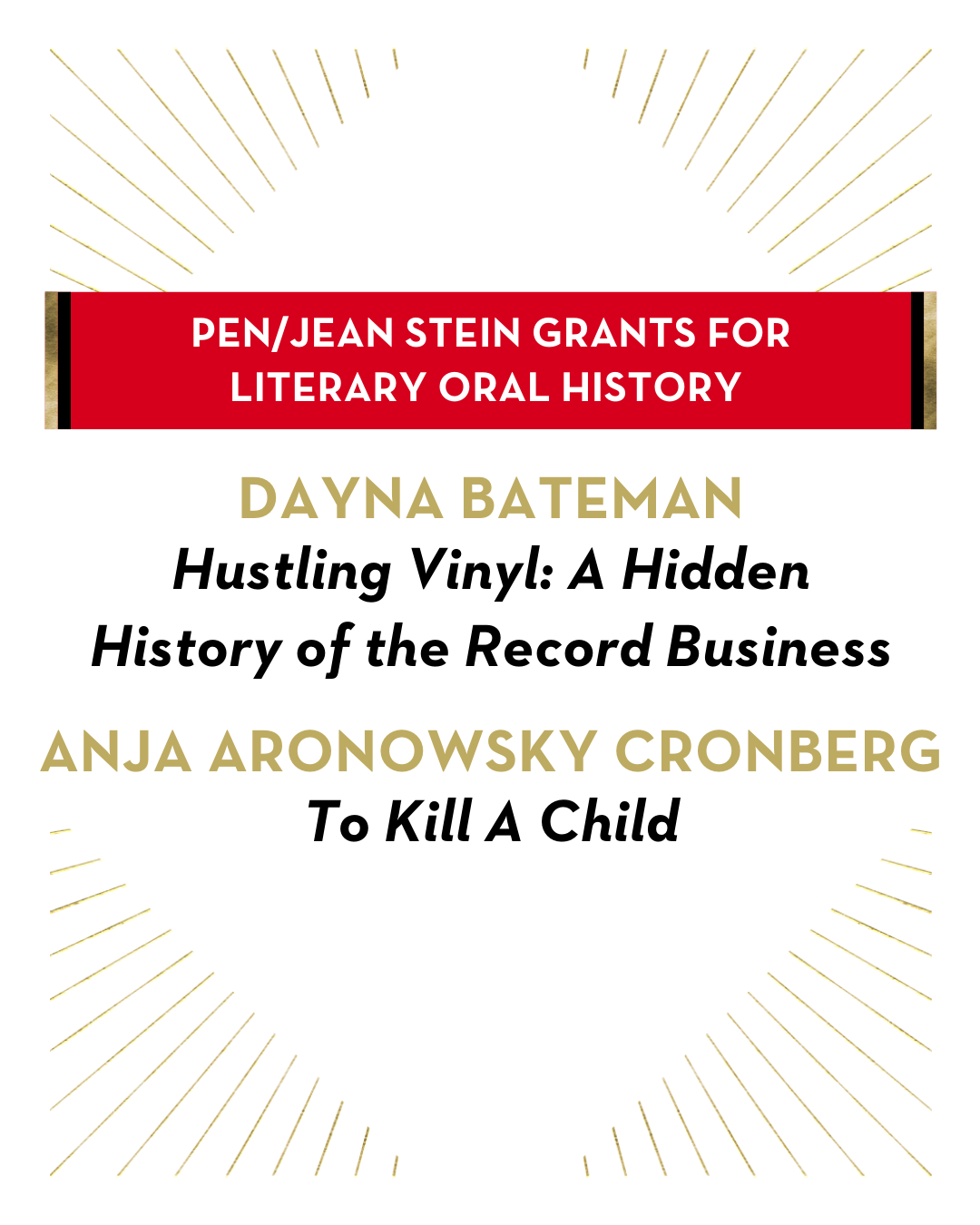
The PEN/Jean Stein Grants for Literary Oral History recognize literary works of nonfiction that use oral history to illuminate an event, individual, place, or movement. The grants are made possible by a substantial contribution from American author and editor Jean Stein, whose groundbreaking work helped to popularize literary oral history. Since 2021, PEN America has conferred two grants with cash prizes of $15,000 each.
Judges: Katie Singer, Deborah Taffa, Raj Tawney
Dayna Bateman, Hustling Vinyl: A Hidden History of the Record Business
A personal examination of the music industry as it transitions from physical to digital formats, Dayna Bateman’s Hustling Vinyl: A Hidden History of the Record Business transcends a mere management chronicle by weaving together grief, cultural memory, and broader questions about exploitation in creative circles. From shame over her father’s career to recognition of its importance, the author’s project exposes the invisible labor that sustains artistic production while also reconciling her family legacy. With archival documentation and access to a group of historically exploited industry experts, many of whom launched rockstar careers, Bateman brings an analytical framework to what could otherwise be merely nostalgic. As the author notes, many key witnesses are aging or deceased making their voices a crucial archive. This book will fill a genuine gap in music industry literature by centering the experiences of those who made the record business function yet rarely received recognition or fair compensation for the joy they brought to millions.
Anja Aronowsky Cronberg, To Kill A Child
To Kill a Child by Anja Aronowsky Cronberg brings forward a subject that many of us might prefer to avoid. And yet, as Cronberg argues, the fact that filicide is not an uncommon occurrence should be reason enough for us to attempt an understanding, of both the crime and of those who commit it. A mother herself, Cronberg sits with a number of incarcerated women convicted of killing their own children. Contextualized alongside interviews of family and myriad professionals, we learn of lives lived before the crimes, and come to see just how seamlessly a “normal life” can ultimately turn to the deeply abnormal. While educated in Design History & Theory, Cronberg’s oral history project illustrates a practiced and empathetic interviewing style along with some incredibly literary writing. This will be a hard read for many, but in the end can speak to the humanity in all of us.
PEN/Phyllis Naylor Grant For Children’s And Young Adult Novelists ($5,000)
The PEN/Phyllis Naylor Grant for Children’s and Young Adult Novelists is offered annually to an author of children’s or young adult fiction for a novel-in-progress. The grant is made possible by a substantial contribution from PEN America Member and prolific author, Phyllis Reynolds Naylor. The award was developed to help writers whose work is of high literary caliber and assist in the novel’s completion. The author of the winning manuscript is selected blindly by judges and will receive a $5,000 grant.
Judges: Chris Grabenstein, Lesa Cline-Ransome, Padma Venkatraman
Emily Whitman, The Fire Cub
This middle grade fantasy showcases excellent writing, sensory descriptions, and world building. The author’s decision to employ multiple points of view adds interest and the readers are provided with insights into the characters’ failings and humanity.
Mima, a 12-year-old orphan, lives with her aunt and uncle, who warn her to stay away from “Dreadwood” – a forest that borders their farm. But something about Dreadwood calls out to Mima and she sneaks in whenever she can. Surrounded by the bushes and trees, watching the woodpeckers and worms, Mima feels safe there – until one day when she hears something roaring near the riverbank in Dreadwood. Like all intrepid adventurers, Mima isn’t scared away; instead she goes closer to investigate the source of the roar – and discovers a tiny treasure chest. She opens the chest – and sparks fly out. Unknown to her, one of the sparks enters her pocket… and out of her pocket emerges a lion cub with wings! Lonely Mima bonds instantly with this magical creature, and as it grows into a full-fledged lion, so does Mima’s courage and her ability to question the tales she has been told all her life about Dreadwood and the world beyond. Will she someday be so bold as to defy not only her uncle and aunt but also her king and country by escaping into the unknown on the back of her winged lion, in pursuit of freedom?
With language that sparkles, a feisty female protagonist whose character springs to life, a three-dimensional supporting cast and ambitious storytelling structure, The Fire Cub is a fantasy novel that we hope will enchant middle grade readers for many years to come.
PEN/Bare Life Review Grants ($5,000)
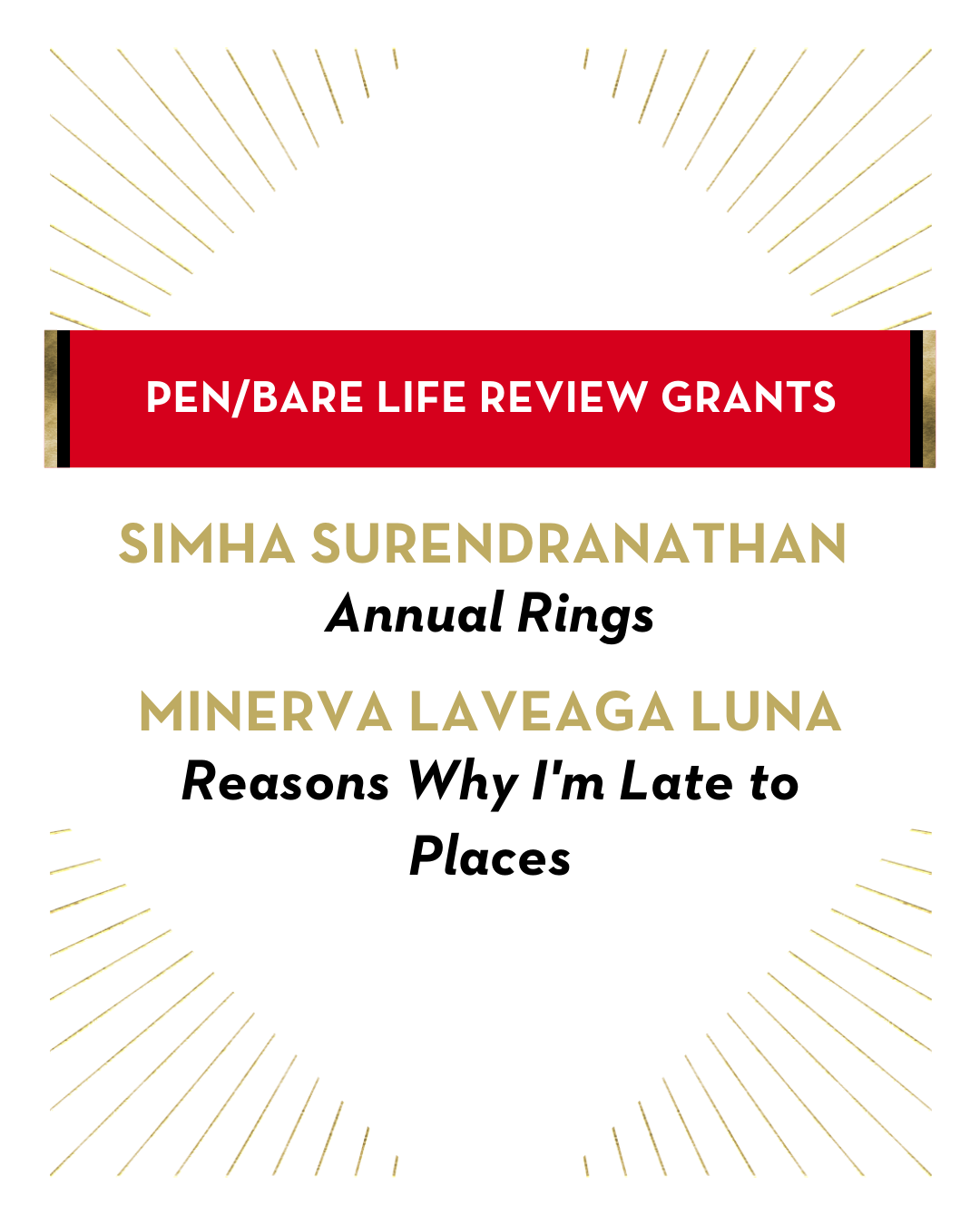
The PEN/Bare Life Review Grants support literary works in progress by immigrant and refugee writers, recognizing that the literature of migration is of inherent and manifest value. As of the 2024 grant conferral, PEN America confers two PEN/Bare Life Review Grants of $5,000 each.
The grants are made possible by a substantial contribution from The Bare Life Review, which celebrates world literature and has been a champion for migrant and diasporic arts.
Judges: Maria Kuznetsova, Rania Mamoun,Novuyo Tshuma
Simha Surendranathan, Annual Rings
Annual Rings is an impressive collection of powerful, moving poems. With a refined sensitivity to language, Surendranathan juxtaposes the daily brutalities of incarceration with the unbounded landscapes of the psyche. Here, thinking, feeling and dreaming become profound acts of freedom. Language becomes a mighty tool, metaphor and symbolism bringing into stark focus the human figure caged in the American prison cell. The prose is precise and sensuous, urgent and languid. Surendranathan takes us on epic migrations, from places private where language weaves delicate dreamscapes, to the prison block where public humiliations bludgeon the tongue. These poems move; they travel across cultures and languages—from Urdu to Malayalam to America’s various lexicons—excavating the ravages of confinement on the lofty human spirit. Here, poetry becomes a lifeline for the incarcerated subject, as life-giving as water. Through capturing life behind prison walls in such an exquisite register, Surendranathan invites us into a profound witnessing—at times a profound weeping—choosing life, life, life, at every turn.
Minerva Laveaga Luna, Reasons Why I’m Late to Places
Reasons Why I’m Late to Places is a memoir-in-essays that follows a Mexican-American author through her childhood during the devastating 1985 earthquake in Mexico City to her adulthood in America, where she navigates the challenges of immigration, premature menopause, misdiagnosis, and the way that women, especially immigrants, are often ignored or not heard correctly when they are suffering physically and emotionally. Through the themes of the passage of time, living out of time, and being late to places, the author not only tells her own story in a gripping, experimental, and unflinching way, but she also shares the narrative of any person who is struggling to be heard and truly known. Through her sensitive and life-affirming narrative, Luna demonstrates that we shouldn’t be sorry about being late to places–rather, we should celebrate that we have shown up at all.
PEN/Heim Translation Fund Grants ($4,000)
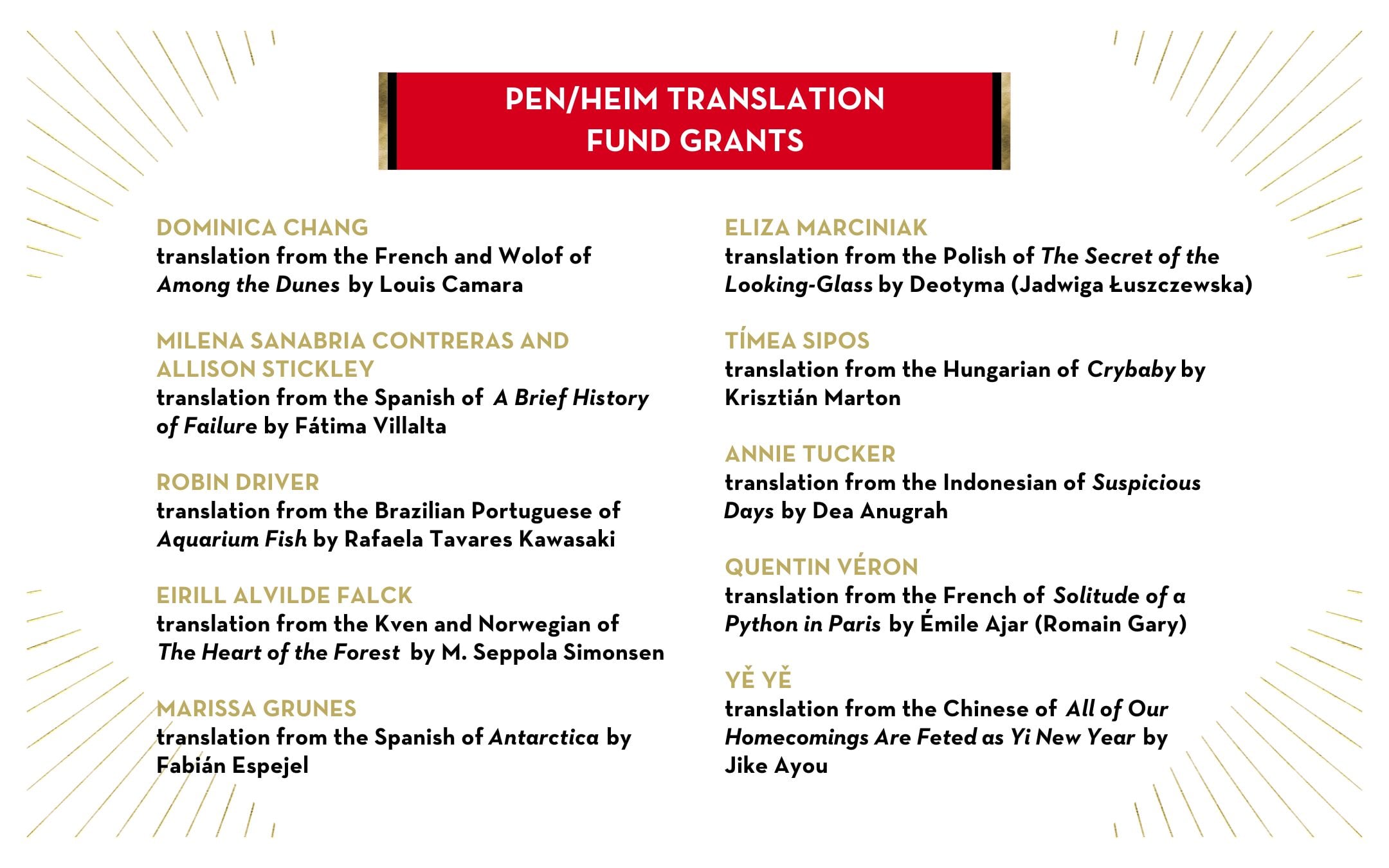
Now in their 23rd year, the PEN/Heim Translation Fund Grants promote the publication and reception of translated world literature into English. Established by a gift from Priscilla and Michael Henry Heim in response to the dismayingly low number of literary translations appearing in English, the fund has supported more than 200 projects since its inception.
For the 2026 cycle, the judges reviewed applications from a wide array of languages of origin, genres, and time periods. Selected from this vast field of applicants are 10 projects, including Indonesian, Wolof, Kven, Brazilian Portuguese, Chinese, and more. Each project will receive a grant of $4,000 to support the translation’s completion.
Judges: Elvira Blanco, Ezra Fitz, Denise Kripper, Elizabeth Lowe, Jenny McPhee, Mario Pereira, Shuchi Saraswat, Declan Spring
Dominica Chang’s translation from the French of Among the Dunes by Louis Camara
Among the Dunes is a novel by the Senegalese author Louis Camara narrated by Nestor, a stray dog in Saint-Louis who recounts his life and that of his master, offering sharp, satirical, yet compassionate critiques of human society and behavior. From a novel as polyphonic as this—written in French, rooted in Senegalese culture, and layered with traditional Wolof oral idioms—Dominica Chang has produced a pitch-perfect translation, one that retells the story in English while hitting all the right notes. A challenging task expertly handled with a keen ear and a deft hand. Fans of canine characters from Garth Stein’s Enzo to Graciliano Ramos’ Baleia will find, in her attentive rendering, much to love and reflect on.
Milena Sanabria Contreras and Allison Stickley’s translation from the Spanish of A Brief History of Failure by Fátima Villalta
Fátima Villalta was born in Nicaragua in 1994 and currently lives in exile in Mexico. Breve Historia del Fracaso (A Brief History of Failure) is a collection of short stories that takes the reader through one hundred years of Nicaraguan history, beginning in a not-too-distant future and ending with a story set in the early 1900s. This will be Villalta’s first publication to be translated into another language. Milena Sanabria Contreras and Allison Stickley’s translation is remarkable for how it renders the voices of the everyday Nicaraguans populating these stories—foot soldiers, small bureaucrats, young people, and artists. While retaining the intimacy of the stories, Contreras and Stickley deftly put forward a history that isn’t as well known in the anglophone world. Their absorbing translation will find new resonances in our politically unstable times.
Robin Driver’s translation from the Brazilian Portuguese of Aquarium Fish by Rafaela Tavares Kawasaki
Aquarium Fish (original title: Peixes de Aquário), a debut novel by Rafaela Tavares Kawasaki is a contemplative, female-focused family saga about the lives of Japanese immigrants and their descendants in the Brazilian state of São Paulo. Published in 2021, the book was shortlisted for Brazil’s Prêmio Mix Literário, a prize focused on literary works that deal with subjects related to the LGBTQ+ community, later the same year. Translator Robin Driver deftly captures the elegiac, but never too sentimental, tone of Kawasaki’s lyrical prose. The English translation will bring an important work of Japanese-Brazilian fiction to the English-speaking world, which has little knowledge of this overlooked community.
Eirill Alvilde Falck’s translation from the Kven and Norwegian of The Heart of the Forest by M. Seppola Simonsen
The Heart of the Forest is an award-winning poetry collection written in both Norwegian and Kven— the Kven people are a Finnic ethnic minority in northern Norway whose language is spoken by fewer than 10,000 people. M. Seppola Simonsen, a nonbinary poet, is from the Norwegian island of Senja, and their exquisite, short poems explore the Kven heritage and the intersection of identity, language, and geography. Eirill Alvilde Falck’s translations have appeared widely in anthologies and literary magazines. Her translations vividly capture Simonsen’s imagery and their ability to render the power and complexity of nature and humanity’s place in it.
Marissa Grunes’ translation from the Spanish of Antarctica by Fabián Espejel
Antarctica by Mexican poet and translator Fabián Espejel, winner of the Aguascalientes Fine Arts Award in Poetry, takes us on a geographical and imaginative journey that inversely mirrors the expeditions of Norwegian explorer Roald Amundsen, joining the long legacy of cultural fascination with Antarctica in the global south, and taking the reader through scenes of desire, loss, and the wild delight of language. This award will support an emerging translator bringing a new voice in Spanish-language poetry into English. Marissa Grunes’s translation is as musical and lyrical as it is experimental and bold and, above all, urgent.
Eliza Marciniak’s translation from the Polish of The Secret of the Looking-Glass by Deotyma (pen name of Jadwiga Łuszczewska)
This visionary work of speculative fiction by 19th-century Polish female writer, poet and early feminist Jadwiga Łuszczewska (writing as Deotyma) combines elements of science fiction, Gothic horror, adventure story, and philosophical dialogue to address numerous issues still current today such as the dangers of technology and the boundaries between genius and madness. Eliza Marciniak’s translations of Polish authors have won various awards and been widely published. Her translation here successfully brings across the sparkling prose, the impeccably crafted narrative, and the erudite nature of the discussions between this novel’s forward-thinking characters.
Tímea Sipos’ translation from the Hungarian of Crybaby by Krisztián Marton
Krisztián Marton’s autobiographical debut novel, Crybaby, follows Marci, a biracial gay man growing up in the extremely homogenous society of Szeged in southern Hungary during the 1990s. In this raw and moving coming-of-age story, Marci navigates racial identity, fatherlessness, queerness, and complex relationships. In her translation, Tímea Sipos, a Hungarian-American writer and translator originally from Budapest, captures the tenderness, honesty, and nuances of this urgent narrative of identity, belonging, and emotional survival. With a sensitivity to the specificities of the Hungarian social and linguistic context pervading Marton’s novel, Sipos brings readers this candid exploration of race, masculinity, vulnerability, and LGBTQ+ experiences.
Annie Tucker’s translation from the Indonesian of Suspicious Days by Dea Anugrah
Suspicious Days is a sharp, funny, and self-aware novel that follows a young, directionless writer in Yogyakarta who stumbles into a literary mystery–and a violent quest for revenge–while searching for a missing poet. In a voice that shifts effortlessly between irreverent humor, cultural critique, and genuine yearning, Dea Anugrah offers a portrait of Indonesia’s contemporary literary and political landscape, filtered through the eyes of a disaffected youth. Annie Tucker’s clear and assured translation captures the novel’s fast-paced blend of autofiction, metafiction, and cultural commentary without losing its specificity to Indonesia’s literary world. With extensive experience translating contemporary Indonesian literature, Tucker brings both deep linguistic skill and cultural understanding to this project. Her work delivers the full force of Anugrah’s voice to English-language readers, introducing a fresh and fearless talent in contemporary Indonesian fiction.
Quentin Véron’s translation from the French of Solitude of a Python in Paris by Romain Gary (writing as Émile Ajar)
Romain Gary’s Gros-Câlin, first published in 1974 under the pseudonym Émile Ajar, occupies a unique and fascinating place in French literary history. When the author’s true identity was revealed after his death, it was hailed as one of the great literary revelations of the century––unmasking the only writer ever to win the prestigious Prix Goncourt twice. Gros-Câlin (“Big Hug” in English) tells the story of Michel Cousin, a lonely and eccentric Parisian statistician who adopts an eight-foot python in his quest for affection. With sensitivity, wit, and creative daring, Quentin Véron recreates in English the puzzling “foreign” language that a bored Cousin invents for himself, through which themes of affection, alienation, and rebirth take on renewed resonance. Navigating the “deluge of amusing malapropisms, puns, literary allusions, and warmly pathetic situational comedy” (translator’s words) of Gary’s signature “Ajarism,” Véron deftly renders the novel’s humor, pathos, and linguistic playfulness without losing its peculiar absurdity and tenderness.
Yě Yě’s translation from the Chinese of All of Our Homecomings Are Feted as Yi New Year by Jike Ayou
Jike Ayou, born in Puge county of Sichuan province, is the first migrant worker poet of Yi ethnicity and one of six poets featured in The Verse of Us, a documentary film on Chinese migrant worker poets. His collection of poems All of Our Homecomings Are Feted as Yi New Year was published in Chinese by Taibai Literature and Art Publishing House in 2019. His works have appeared in publications such as Selected Poems, Liangshan Literature, Workers’ Daily, and China Youth News. Like the ancient Chinese poets, Jike Ayou writes beautifully about Shanshui (landscapes) to lament his personal and political struggles. Translator Yě Yě carefully distills his delicate lines into terse English verse that echoes the lived experience of millions of migrant workers in China.
PEN Grant For The English Translation Of Italian Literature ($5,000)
Administered under and judged alongside the PEN/Heim Translation Fund Grants, the PEN Grant for the English Translation of Italian Literature honors a translator for a book-length translation of narrative prose and seeks to promote the publication of Italian literature into English. The winner will receive a $5,000 grant to aid in the project’s completion.
Lauren Green’s translation from the Italian of Adoration by Alice Urciuolo
Adoration is a fierce and absorbing novel set in the reclaimed marshlands south of Rome, where five teenagers struggle to make sense of a friend’s murder and the suffocating models of masculinity and desire that surround them. With shifting points of view and a keen eye for the rituals and violences that shape adolescence, Alice Urciuolo explores how a place saturated with Fascist history and patriarchal norms produces its own forms of rebellion as well as complicity.
Lauren Aliza Green’s translation reflects the urgency and intimacy of Urciuolo’s prose, capturing the novel’s polyphonic voices and its precise rendering of place, class, and coming of age. A novelist and poet herself, Green is well equipped to convey both the emotional range and the structural ambition of this compelling novel. Green’s English version delivers the novel’s full force: a clear-eyed and unsettling portrait of contemporary Italian youth, and the cultural legacies they inherit and resist.