Three of PEN America’s judges spent the past several months getting lost in translation — or, more accurately, in quite a few translations.
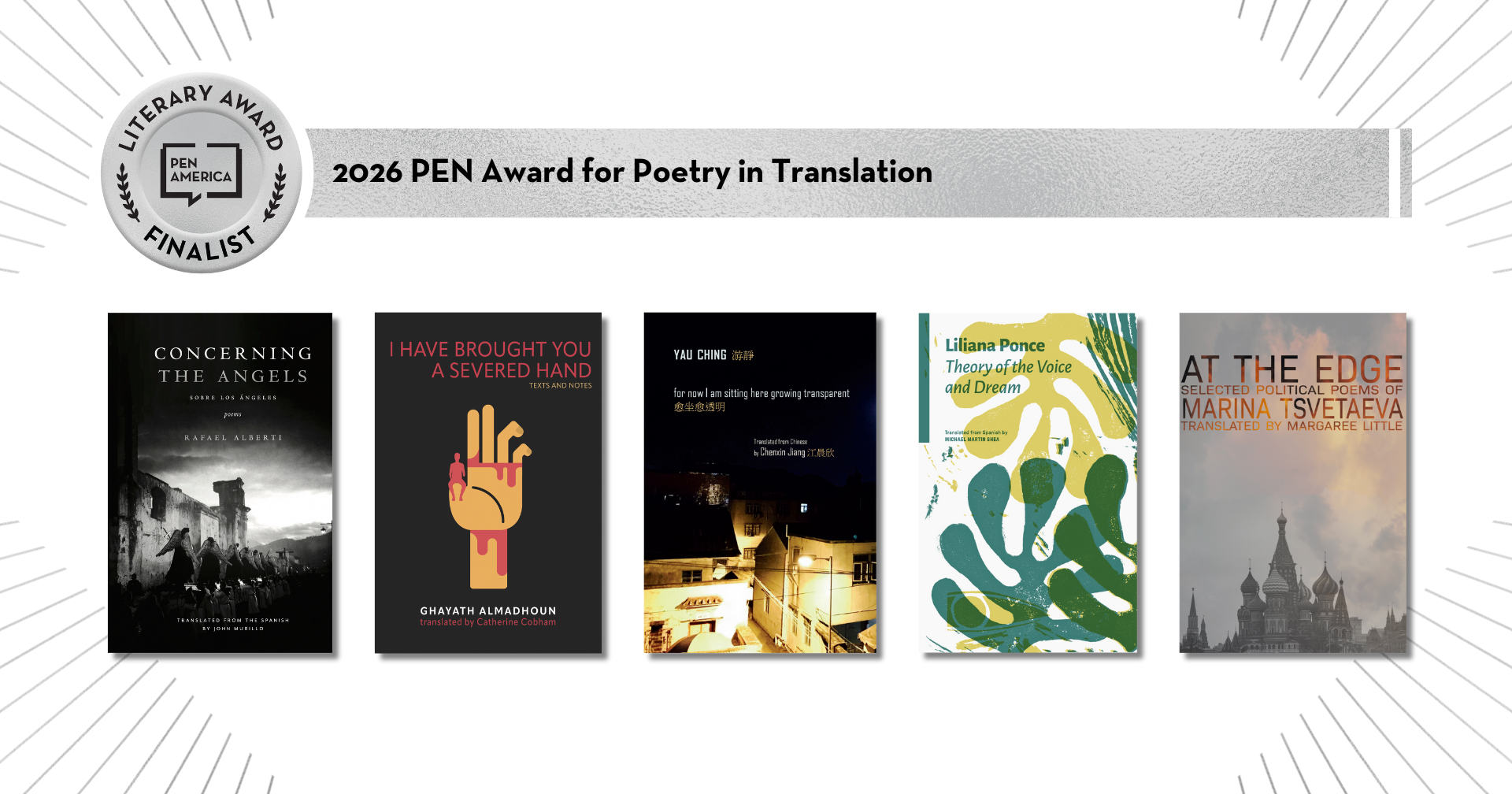
Miriam Calleja, J. Kates, and Alta L. Price, all of whom are accomplished translators themselves, recently completed their mission to find the next recipient of the PEN Poetry in Translation Award. They’d been hard at work since early fall, when they were each tasked with reading a third of this year’s submissions and choosing a few standout candidates from the mix. The judges then caught up on one another’s top selections and, after careful deliberation, picked 10 books for the longlist, then five finalists, and ultimately one winner.
Established in 1996, the PEN Poetry in Translation Award honors a book-length translation of poetry from any language into English, conferring $3,000 upon its winner. But aside from a few specific guidelines, it’s up to the judges to figure out how to evaluate the wide-ranging submissions — which, they emphasized, was no easy task.
“The hardest part about it, of course, is that art is not a horse race. There are no winners or losers,” Kates said. “Especially in translation, every reading is different. What happens is that every time we read a text, we talk about it, and then we read it differently.” Still, the judges were all eager to sing the praises of the winning work, which will be announced at the Literary Awards Ceremony on March 31.
PEN America recently sat down with Calleja, Kates, and Price to inquire about the criteria they developed for the award, the qualities of the winning work that impressed them most, and the unexpectedly rewarding aspects of the judging process. This interview has been edited for length and clarity.
Tell me about what you were looking for in the works that you read.
Calleja: It was partially about relevance right now. How important is it for the English-speaking world to have access to this text in 2026? That was definitely one of the questions.
Kates: As we’re looking at the individual translations and the quality of the translations, in the back of our minds is, ‘How needed, how necessary, is this particular translation of this poet in this way at this moment?’ And that affected the way we looked at the texts.
Price: Not just how needed or how necessary but also how novel. In debating whether a work was a serious contender for the longlist, [we asked,] ‘Has this work ever been translated before?’
I will also say in my first reading, a lot of it was pure aesthetic pleasure: enjoyment or shock, the aesthetic experience of it. That is the hardest to qualify and quantify, but is so important. I was in complete awe of some of the things I read — even those that didn’t make it on to the shortlist.
Calleja: I think we all felt, or at least I definitely felt, like, ‘Who am I to judge who deserves this prestigious prize out of all these mostly genius translators?’ There were no books where we said ‘This one? Definitely not!’ immediately. It was very humbling. Also, we kept in mind that this could really make a difference in the career of an individual. I did not take it lightly. It’s such an honor to be asked, but then once you start thinking about it, you’re like, ‘Wow, I’m going to make a difference in somebody’s life and validate their work with this great honor of a PEN prize.’
Price: Miriam mentioned that the prize could make a difference in the translator’s career. In some cases, it could also make a difference in the writer’s career. And I think that’s interesting, serving on a jury for a prize for translation. So frequently, translators are erased. The critical apparatus, the whole ecosystem, has been in decline — there are fewer reviewers — but a lot of those few reviewers neglect to mention the translator or don’t know how to engage with translation. I didn’t want to do the opposite on our very translation-centric jury. At least for me, one of the factors was whether the writer had an important body of work that had not previously been accessible in English.
Calleja: What was interesting is that between the three of us, we have quite different tastes as individuals, and what was surprising in the end — which I was very anxious about — is that we came together, and it was so easy to choose the top book. I couldn’t believe how, with our different backgrounds, our different experiences, our different individual tastes, we agreed so easily.
Kates: The thing about the process is that our most contentious, or our most various kinds of discussions, came in the middle. That’s where we hashed out a lot of our individual differences, so that by the time we got to that final conversation, we had already integrated those into our conversation.
Can you tell me more about that? What kinds of differences did you have in terms of taste, and how did you go about accommodating those differences?
Calleja: It’s a difficult question, but one thing we had discussed at some point in the middle was that we needed to choose a text that is going to be accessible to most. So keeping in mind, with the experience that we have, the difference between what I like as an individual and what most people would have access to. Because we want people to have an in, to be able to enter the text, so I think that’s something we all discussed and kept in mind. I like it and you like it, but will it resonate?
Kates: We had to think about ourselves in different ways here. Because we’re all translators ourselves, there is also a tendency that we have to work against, which is ‘How would I have done it?’ I have experience as an editor, so I’m used to suppressing that, but it’s still there. And the more you know a language, the harder it is.
What worked in the process, and I think that Miriam was sort of alluding to this, was a kind of self-monitoring process of what our reactions were and how we would express things. There was a real overlay of, ‘Why am I saying this? Why am I thinking this? What’s going into my looking at it this way?’
Price: Yes, there were various levels of setting ourselves aside. We all had access to all of the originals, so we could, if we wanted to, dip into ones that hadn’t been assigned to us for the first round. And I did that in a couple of cases. But some of some of the books that blew me away are ones where I had no access to the originals.
I was going to ask about this, but I actually assumed you hadn’t read any of the original works. How did you make sure that you were judging all of the works fairly, if there were only some you could access in the original language?
Kates: Certainly, our panel was skewed toward Indo-European, which is something to think about and consider — and it’s not always avoidable, but it’s something to be sensitive to. The panel itself should be taking into consideration that in the process of putting the panel together and choosing things, we’re also signaling to publishers and other translators what might be acceptable and what might be viable. That’s a certain responsibility.
Calleja: I tended to focus more on the text we were judging. I remember quite clearly in one particular case where I thought the ending of a poem sounded strange, that it was an odd choice. And then I did go back to the original, and then I did think, ‘That was not the word I would have chosen.’ But I read the translation first, and so I realized even in the translation that there was something that didn’t quite gel with the rest of the poem. I tried to go to the original language only when I felt like something was out of place or it seemed like an odd choice of a word. I didn’t immediately go to the source language, because I felt like it wouldn’t be fair. But then, before dismissing something completely, I did try to look at it.
Price: I certainly approached it as, ‘For every single one of these works, it’s an absolute miracle that we can access them even in translation.’ That was my feeling.
I was also curious about the ways in which you approached reading differently as a judge than when reading at other times, such as for pleasure. Did you develop new reading habits throughout the process, and if so, do you think you might stick with any of them?
Calleja: For myself, because I write, teach, and translate, there’s not much reading just for pleasure maybe ever.
Price: Either none of it’s for pleasure or all of it’s for pleasure.
Calleja: Don’t get me wrong, there’s always pleasure, because I love poetry and I live in it. As a judge, I think there was some deeper analysis, because I knew it was an important decision, but also because I needed to make a case: Why this choice, and not this one? And so there was more markup than usual and for different reasons. Usually, I underline things that I like and want to introduce into my own work and that resonate with me, and this time it was, ‘Here’s where the text is showing some kind of innovation,’ and not necessarily because I want to introduce it into my work or my teaching.
Earlier, you mentioned that it was easy to pick the winner. What about it stood out?
Calleja: I was surprised, but it’s so wonderful, right?
I remember, also, that we felt that the winner didn’t feel like a translation, that it felt like this fixed, strong voice of its own. I remember us saying that we read this book and kept forgetting that it was a translation. There was something in it, and it’s hard to explain — there was a quality in this book where we felt like, ‘Oh, is this really a translation of the original? Because it feels so new and fresh.’
What was the most rewarding part of being a PEN America judge?
Kates: Well, that’s easy. It was fun getting to know everybody else. The conversations and the engagement with one another — even more than, or as much as with the text, was fun for me.
Calleja: The fact that we agreed, the fact that we came to a conclusion about the same book, for me, was the most rewarding part, because I felt like coming from different backgrounds, that it was a small miracle but also a testament to the strength of poetry. It made me love translation and poetry so much more. It made me appreciate the work that goes into it, the often thankless work. In discussing with other brilliant minds how we undress translation, we found something even more beautiful.