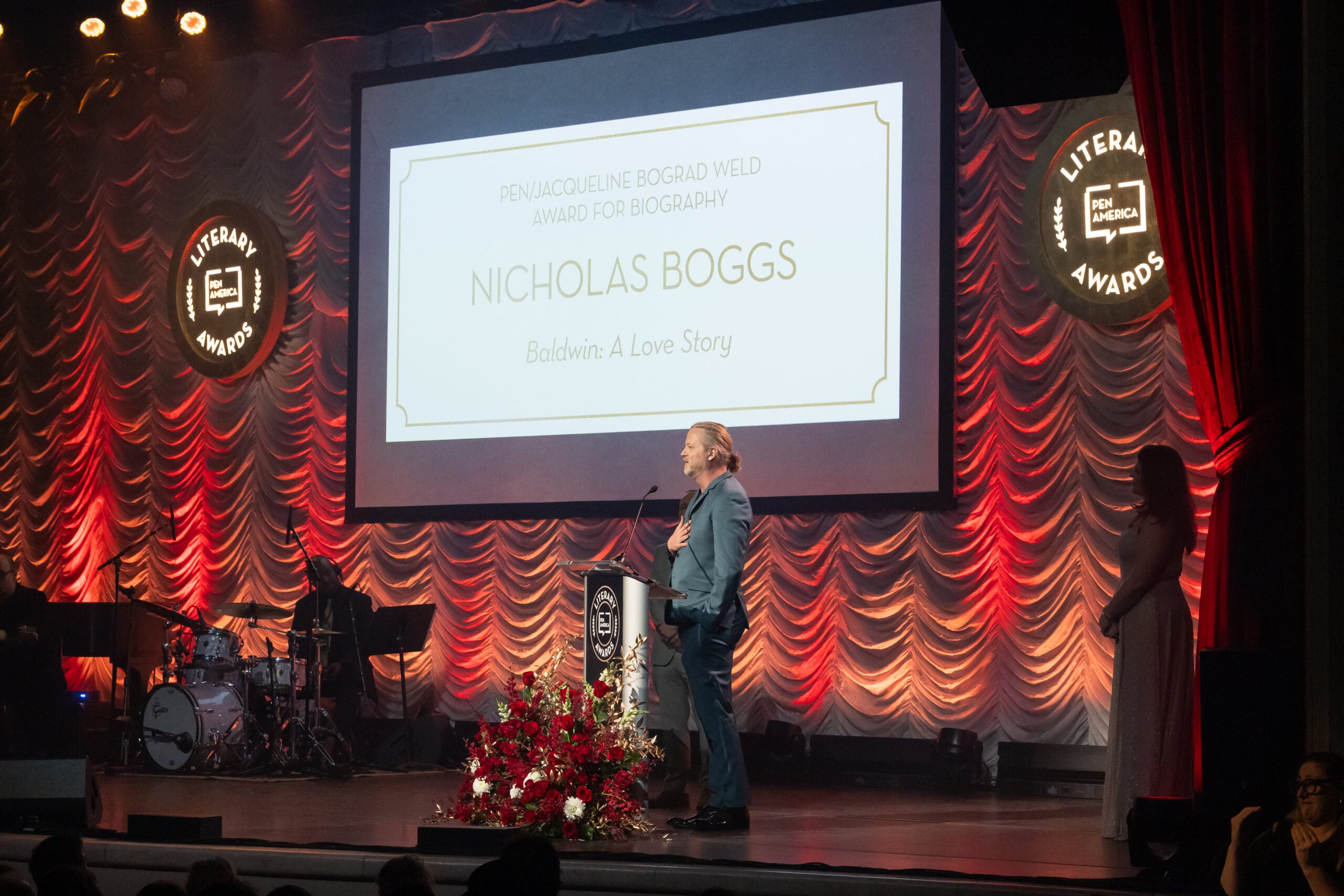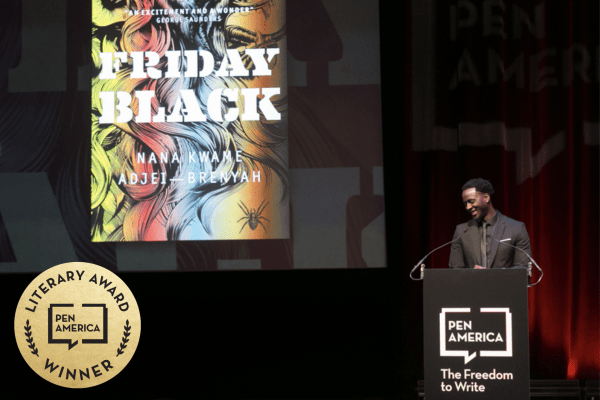
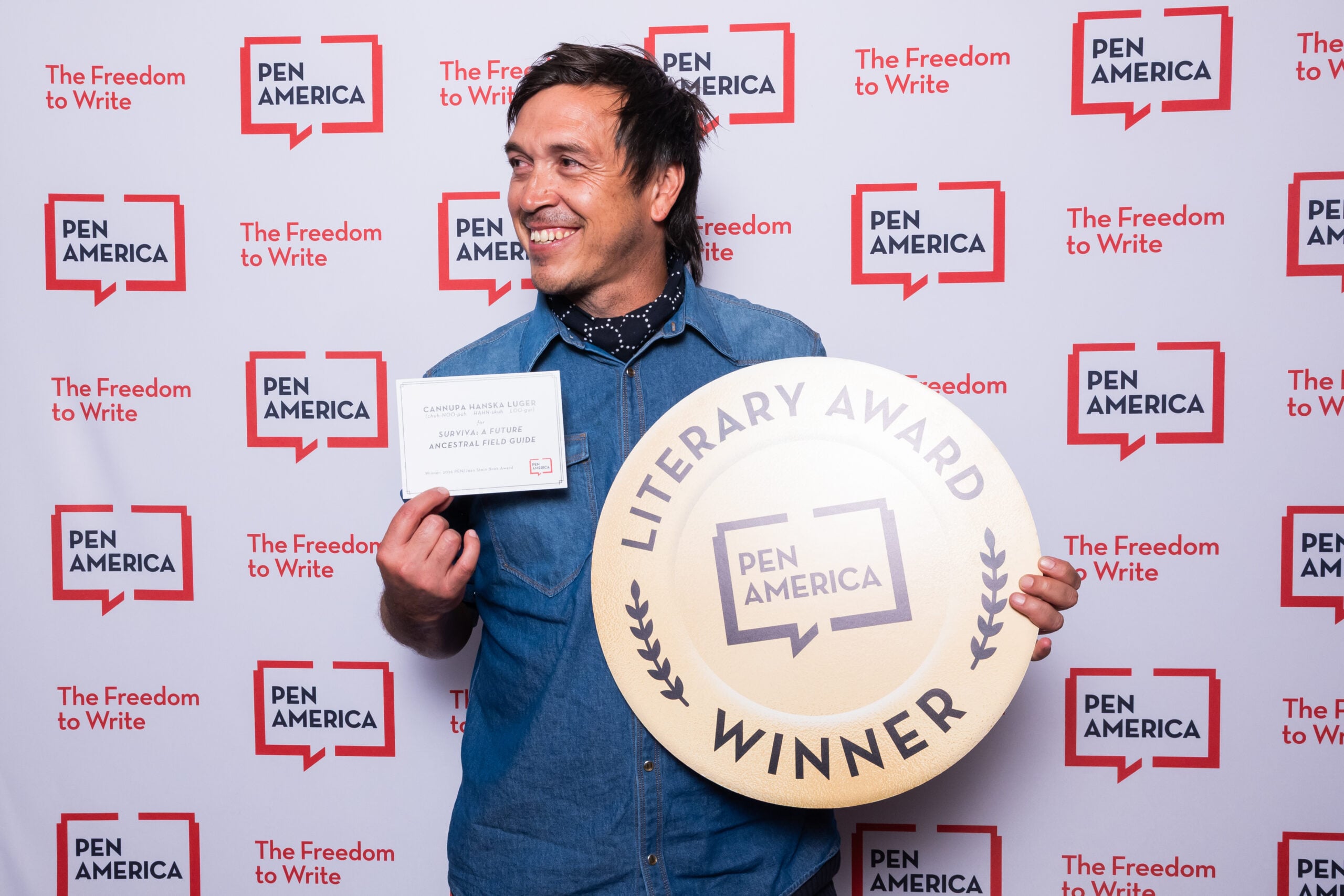
For SURVIVA: A Future Ancestral Field Guide, a genre-bending work of Indigenous futurism, Cannupa Hanska Luger clinched the PEN/Jean Stein Book Award at PEN America’s 62nd annual Literary Awards Ceremony.
Conferring $75,000 upon a writer for a work of any genre with the promise of “lasting influence,” the award is PEN America’s largest monetary prize. (“This is a lot of money, and for a writer, it’s even more money,” joked host Murray Hill before he and PEN America President Dinaw Mengestu together revealed Luger as the winner.) Previous recipients of the award include Percival Everett, Nana Kwame Adjei-Brenyah, and Yiyun Li.
Upon receiving the award, the Mandan/Hidatsa/Arikara/Lakota artist and writer thanked his wife, calling her an “invisible wave” behind him. The inspiration for SURVIVA, he explained, was a U.S. Military Survival Guide that she gifted him 10 years ago as a joke.
“There was an acrostic poem, and the A in ‘Survival’ was ‘Act Like the Native,’” Luger said. “I start going through the book, I realize that it is full of Indigenous knowledge — militarized, weaponized, and recontextualized, and I wanted to fix that. In a world where it’s hard to fix things, I thought maybe I could fix this.”
“I imagined my audience was in a future far from now,” he added. “You proved me wrong.”
At the ceremony, PEN America spoke with Luger about his reaction to winning the award, his perspective on the state of free expression in the United States as an Indigenous writer, and the unrealized power of make-believe.
Can you describe your book in three words?
It’s illustrated. I could do it in three pictures. It is a redacted manuscript of military field manuals repaired and transformed into Indigenous survivance.
We’ll count how many words that is later.
I think it’s three. If we said it in Lakota, it’d be three words. [Laughs.]
On stage, your expression of what this award means to you was, ‘Whaaat?’ Were you surprised to win?
Yes. I don’t think anybody goes in with the expectation of winning, but I’m pleasantly surprised of the outcome, for sure. It’s ‘Wow.’ I think it’s ‘Wow’ for anybody, right? It’s got to be.
You’re a visual artist. This is a literary award. What does that mean to you?
You know what? Letters are shapes. They are symbols written in space. This is what I’ve been doing the whole time. I just translated it into language more people can understand, you know? So it is visual. The core of what we’re trying to do is communicate. And I realized that there was a section, a popular part of the population, that didn’t have access to the language that I was speaking in. So I was like, ‘Well, I can speak that language too.’
I appreciated that you acknowledged your wife on stage and the labor that supports your career —
She will kill me if I don’t! [Laughs.] No, she won’t. I’ll just wither and die.
You’ve said being a father has opened up new possibilities for you. What has changed?
I didn’t have to take care of myself alone. I’ll neglect me. I will punish me. I will torment me. But having children made me recognize that there was this responsibility beyond how I feel about myself and the edge of what I can put myself through — and realize that I would never do that to somebody else. So treating my kids right treats me right.
The core of what we’re trying to do is communicate. And I realized that there was a section, a popular part of the population, that didn’t have access to the language that I was speaking in. So I was like, ‘Well, I can speak that language too.’
What is it like to be an artist at this moment?
It’s never easy to be an artist. One of the things that I’m trying to describe, in as many languages as possible, is that life is abrasive, but it is not the thing that destroys you. SURVIVA really came out of a question. I saw that peace was on the same continuum as war, and I thought, ‘The only way I can turn my back on one of them is to turn my back on both.’ And I found that the antithesis to that was survival, and survival is ours. And so if I can take the language of how to look at the land with reverence and see the bounty in which it provides, then scarcity becomes a different question, and it’s about knowledge. So if I can share that, I think, then something can be done right.
What does it take for you to speak your truth? Are you ever afraid to do that?
I’m constantly afraid to speak my truth. … There’s power in speaking a word without fully comprehending the totality of what it is that you’re expressing. You’re unleashing a spell that you may or may not be able to survive. And so I fill my mouth with blood every day by biting my tongue because I don’t know if this is the right time to say the thing, because I don’t know if I’m ready to commit to what can be said.
Is that a personal fear? Or are you afraid that there will be retribution or blowback? Why are you biting your tongue?
Context-wise, I am a Indigenous person to North America, and we are talking about 250 years of a Declaration of Independence, which is more often than not a rally of national pride. But from my perspective, it’s a flag waved in violence and anger and displacement and relocation. So there is power in a word and how you present it and how you value it, but you may not understand the cost. I come from a community who understands the cost of the Declaration of Independence — not the value. And so in that sense, I think what I can do is be careful about what it is that we put into the world when we can easily speak it if we can’t embody it and live it and deal with the repercussions of voicing wild opinions.
Can we imagine alternatives that make everything that we don’t like about today irrelevant? I think we can.
So for you, this 250 marker —
Is insignificant. … Well, it’s 250 years, and I come from a community that has a deep time relationship to this place. So 250 years is nothing. It’s really nothing. And I think there was an experiment that took place in this country, and I think we’re all living in the slow disintegration of the experiment, and we’re trying to adapt and learn how to rectify it. So my consideration is, ‘Let us make a Declaration of Interdependence 250 years later.’ Let’s recognize that we’ve never done anything alone, that the rugged individual died generations ago, and that it is us who are responsible.
What’s one hope you have for the future of free expression in this country?
My wish for the future is that we fully comprehend the power of make-believe. We have the capacity to imagine things that don’t exist, and there’s a responsibility in that process. But everything I’ve ever learned was made up at some point. And I think make-believe has been reduced to childhood storytelling and all of these sorts of things — but I haven’t done the experiments on how bright the sun is. I haven’t charted DNA. I haven’t done any of these things, and I believe them. And somebody made me believe them by presenting as much information that my own research was not necessary.
So I think we can expound upon that and recognize that there are forces of hyperstition and the future that we want to live in we have not yet imagined because we’re inundated with the pressure of our past and our history. Can we imagine alternatives that make everything that we don’t like about today irrelevant? I think we can.