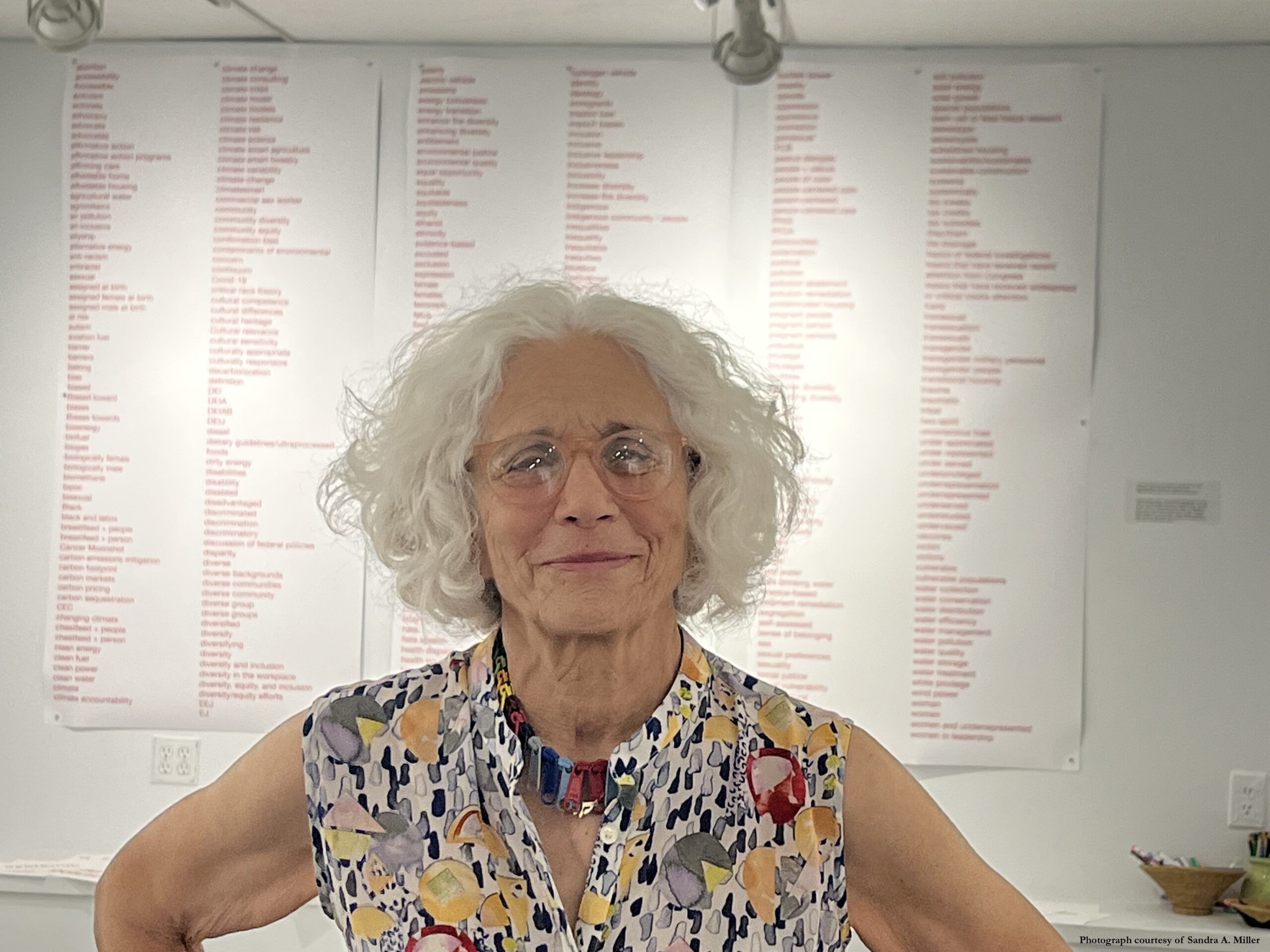
A Photographer’s Outrage Over Forbidden Words Inspired the Exhibit Unspeakable: Getting the Word(s) Out at a Rhode Island Gallery
As a photographer, Kathie Florsheim’s natural habitat is the ocean off the Rhode Island coast and its storied beaches, her visual storytelling animated in part by her concern over climate change.
This year, however, her center of gravity was pulled in another direction— to the revelation that the Trump White House scrubbed disfavored words and phrases from government websites and documents; climate change was one of those phrases.
Her outrage over the forbidden words led her to create an installation at the Rhode Island gallery where she has shown her photographs for seven years. The exhibition, Unspeakable: Getting the Word(s) Out, is part of the show, Threading Time and Place at Hera Gallery in South Kingston, Rhode Island, organized to mark the 250th anniversary of the American Revolution, through Aug. 1.
Florsheim, who lives in Providence, where she earned a master’s degree in photography at the Rhode Island School of Design, said the idea that government is erasing words makes “something of a mockery” of the historic commemoration celebrating freedom.
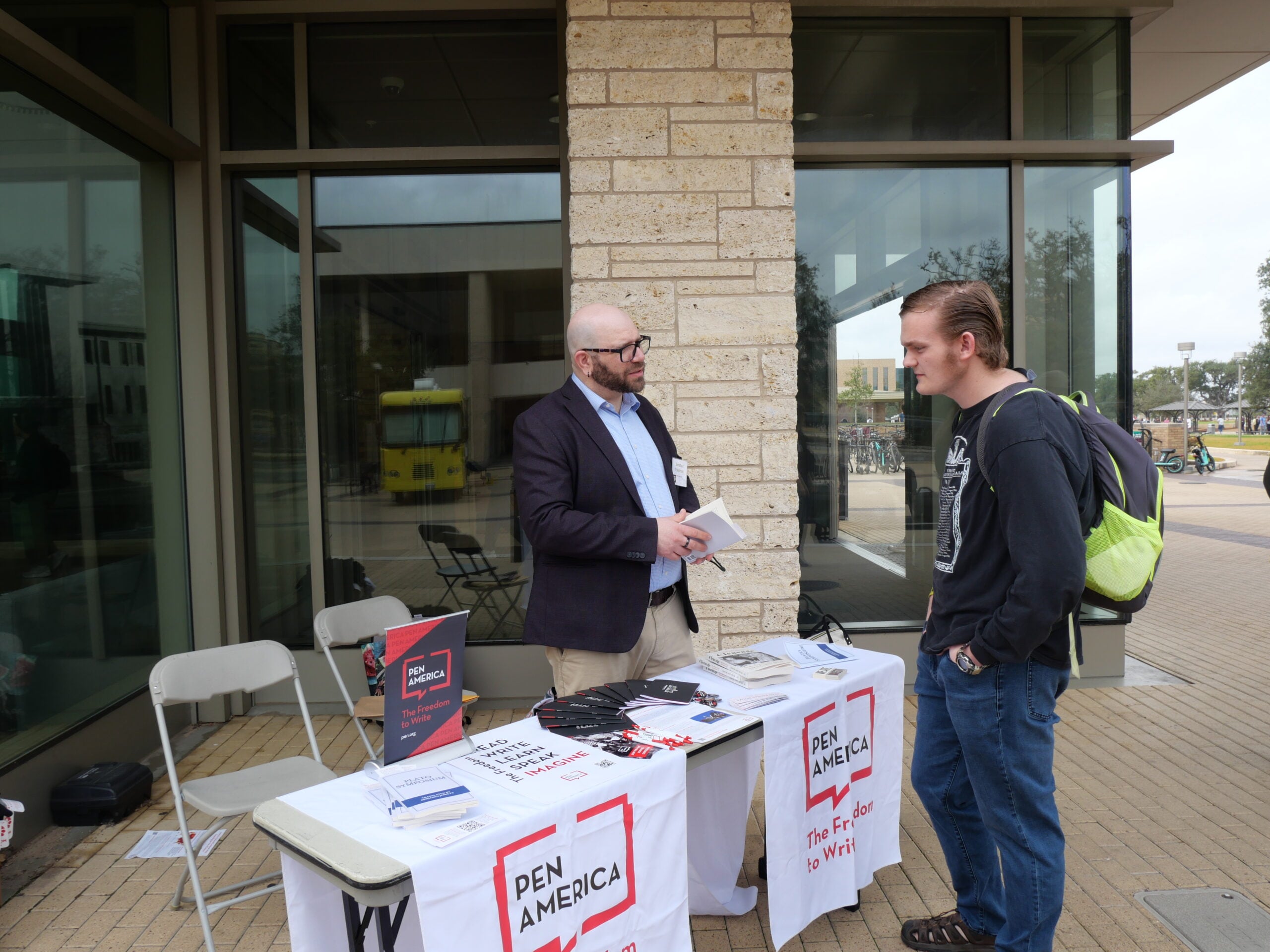
Her installation was inspired by the list of words that PEN America compiled last year. Initially 250 words and phrases were viewed as unacceptable by the White House and flagged for review by federal agencies in an attempt to remove all references not only to diversity, equity and inclusion, but also to “vaccines,” “trauma,” “measles,” and a host of other topics, from “abortion,” to “women,” and including “elderly,” “Native American” and, unsurprisingly, the “Gulf of Mexico.”
PEN America’s list of erased words grew over time to 350+ words, even expunging seemingly desirable goals like “safe drinking water.”
Florsheim can’t recall exactly where she read about the list, which was widely covered by the media, but she was appalled when she did and immediately started thinking of ways to bring more attention to the banned words visually. “It really stuck in my mind and every time I looked at the list I was dumbfounded and more angry. I knew I had to do something in response. I love language and I’m offended that somebody’s going to tell me I can’t use words I want to use. If you don’t have the language, you cannot manifest the thought.”
Her goal for the installation was straightforward: “Hopefully it will get people to talk about it and realize they are being censored.”
As the word list was unsettling her thoughts, she happened to participate in a banned books reading at the Hera Gallery, which, when founded in 1974, was a pioneer as a women’s art cooperative dedicated to gender equity, feminist discourse and social change.
“I read two children’s books aloud, and in both cases, teared up. I realized that such a simple – and to me, innocent – thing as reading about race or equality for women invoked fear, anger and overwhelming sadness that kids’ books could be deemed unlawful if the subject matter was deemed unacceptable to the regime. And further, that those books could be summarily removed from library shelves as unsavory.”
Florsheim is no stranger to being outraged over social, environmental and civic ills or being moved to action to try to bring about change. Her photographs of the ocean and beaches also subtly raise questions for viewers about the changes occurring from climate change; years spent studying the subject have helped her understand exactly what to photograph and what questions to ask, such as: “Why are we putting parking lots next to the ocean?”
“I spend a lot of time trying to figure out how I can make a difference,” she says. That motivation has led her to serve on the Leadership Council of the Silent Spring Institute in Newton, MA, which supports research to uncover environmental causes of breast cancer. She has also been a board member of the ACLU of Rhode Island and is a fellow at the Coastal Institute in the School of Oceanography at the University of Rhode Island.
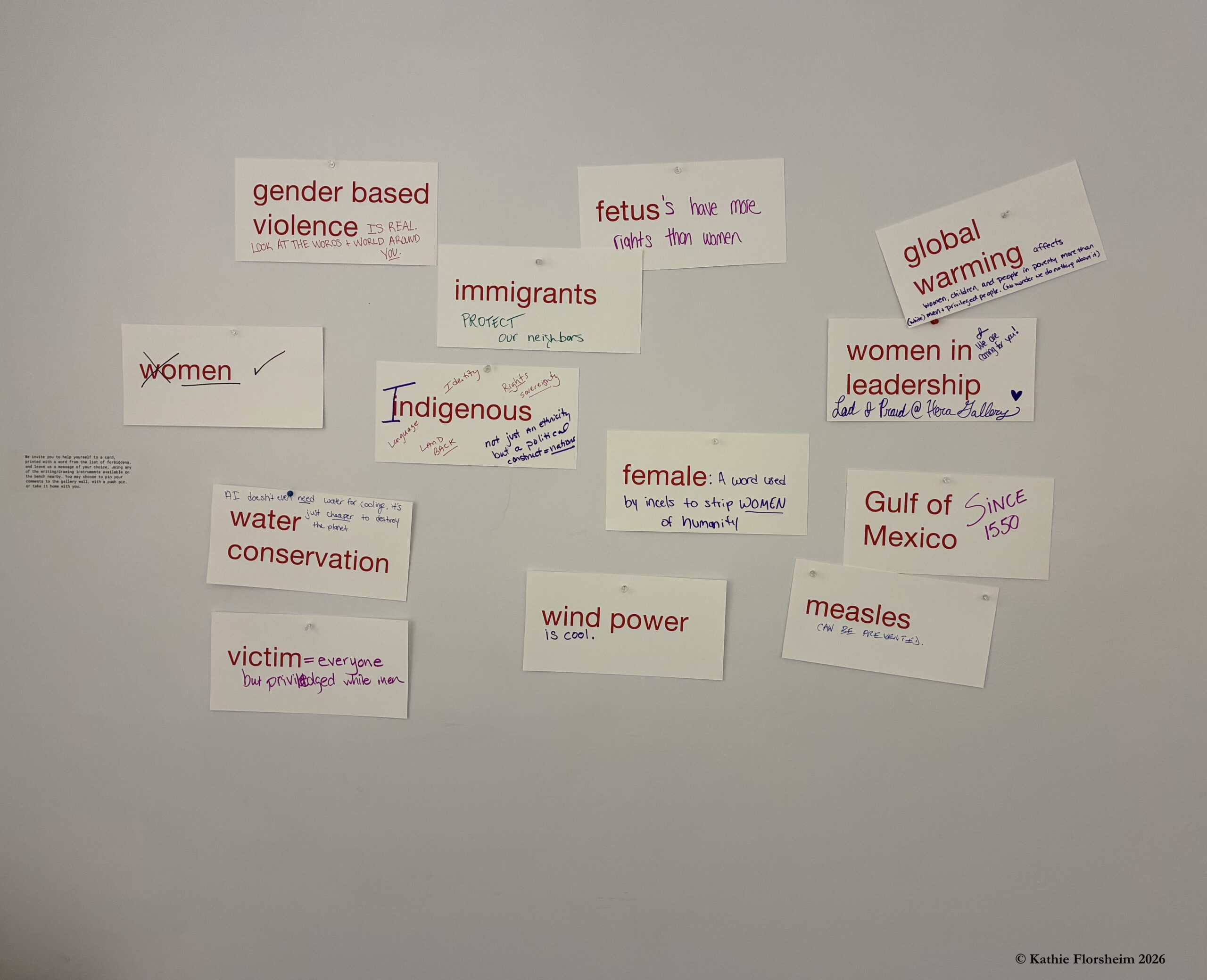
Her installation, with its huge printed list of the forbidden words spread over a wall, also includes individual 6 by 12 inch pieces of paper each with one of the words from the list printed on it. Viewers are asked to respond in their own words to the banned word they choose and pin it to the wall. (PEN America asked writers to respond to the words earlier this year.)
The responses range from witty to angry. Beneath the word “Gulf of Mexico,” a visitor penned “since 1550”; in response to “women in leadership” someone scrawled “we are coming for you,” and next to “fetus” a viewer wrote “have more rights than women.”
The exhibit also reminds viewers that banning words can have significant consequences in terms of government progress or the lack of it. To make the point, Florsheim included a page from the Women’s Health Protection Act, legislation that was first introduced in Congress in 2012, passed in the House in 2021 and now is stalled in the Senate. “The first page of the actual legislation is rife with proscribed language,” she wrote. “I have included a page of the Act, as an example of how the sense of the legislation is radically altered if specific language is forbidden. The graphic representation of censorship is shocking, and very clear.”
In her artist statement on the installation, Florsheim wrote: “As artists, the freedom to express ourselves in whatever manner we choose is critical, no matter the medium. Artists’ work is often the conscience of a society, reflecting uncomfortable truth… which is the reason authoritarian regimes are threatened by artistic expression. There is the very real possibility that we will be affected by this mandate, as it migrates into cultural arenas. Its implications are dire any time we pick up a pencil, or a brush, use a litho stone, or a camera, play any musical instrument, or even consider what our next piece might be. This issue is close to my heart because I know if I do not have the benefit of the First Amendment, I might as well close the door to my studio and my mind.”
It’s an idea the founders might well have agreed with in 1776.