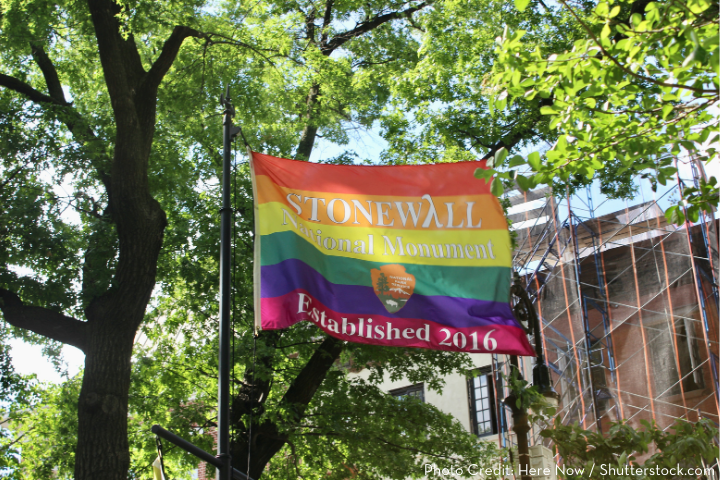
Since President Donald Trump’s reelection, his administration has issued an executive order requiring “patriotic” education in public schools, stripped history from parks and museums, and scrubbed government websites of historical and scientific data.
Before any of that happened, in September 2024, then Yale professor of philosophy Jason Stanley wrote Erasing History: How Fascists Rewrite the Past to Control the Future. Documenting the authoritarian impulse to attack historical memory and analysis in the United States and worldwide, the book rallies readers to defend themselves and their educational institutions against leaders including Trump. It was praised as timely and essential when initially published — but now, as the paperback edition hits shelves for the first time, it’s an even more urgent read.
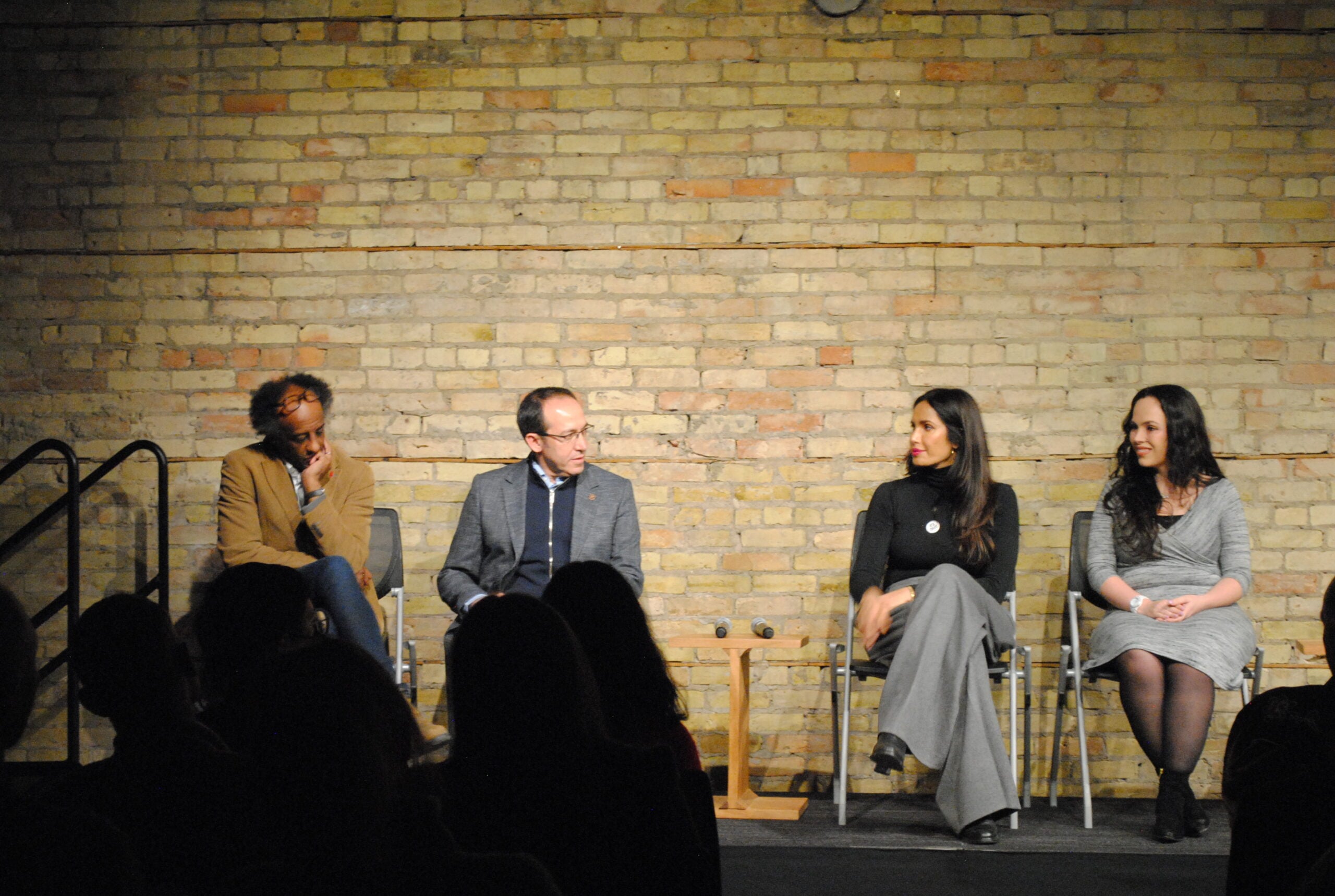
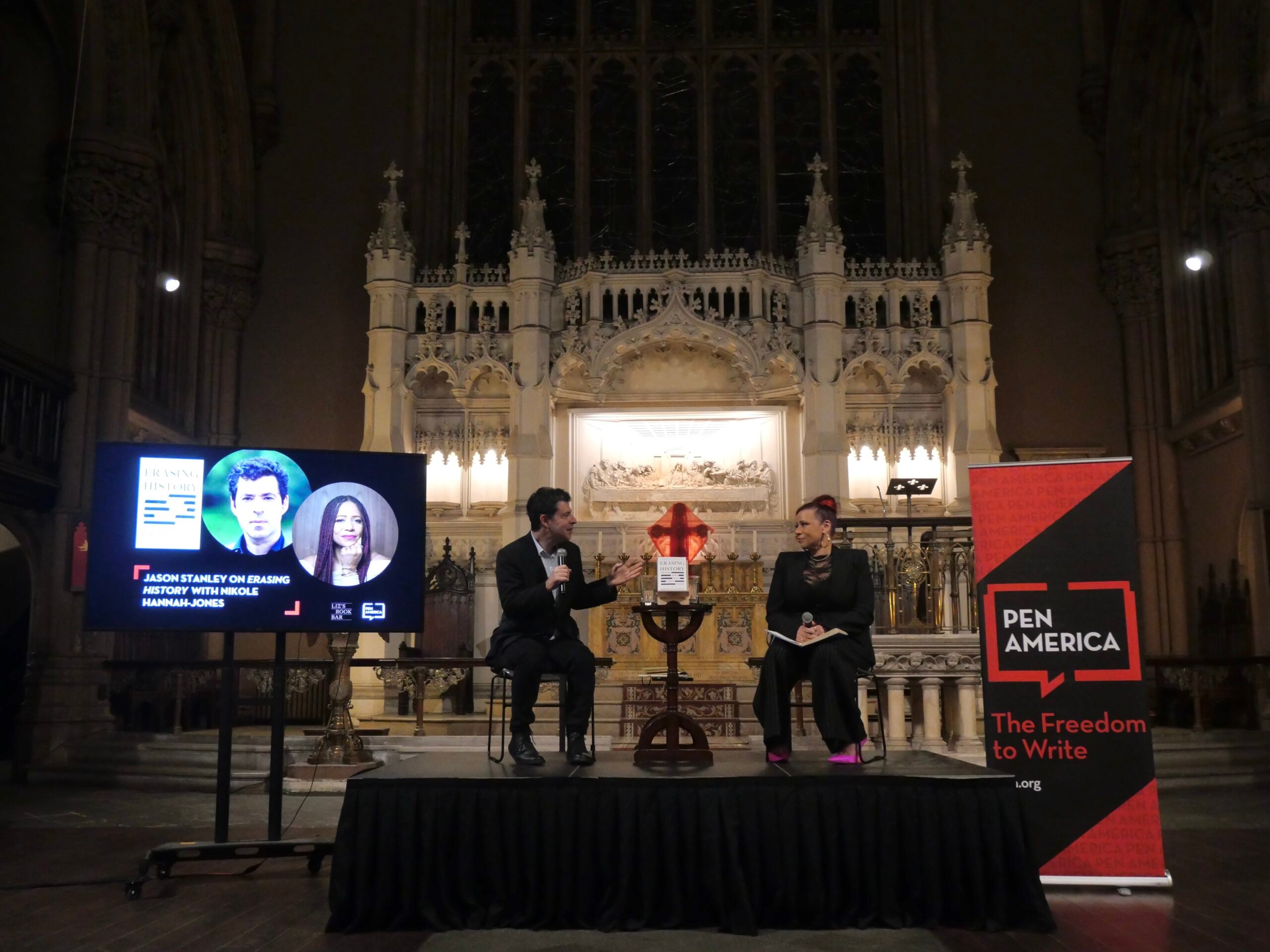
Stanley joined Pulitzer Prize–winning journalist and author of The 1619 Project Nikole Hannah-Jones for a special talk hosted by PEN America and Liz’s Book Bar in celebration of the release of the book’s paperback edition. At St. Ann and the Holy Trinity Church, the two authors engaged in a lively, unexpectedly amusing conversation about the rise of fascism, though Hannah-Jones made sure no one walked out in high spirits. “I’m a gut-punch type of person,” she told attendees. “I want you to leave a discussion like this scared to death, because this is a dangerous time.”
To open the talk, Stanley identified what he characterized as two central features of fascism in the United States today: anti-Black racism and the presence of a charismatic, cult-like leader. Jim Crow exemplified leaderless fascism, Stanley said, and now the white supremacy that defined the era has returned with a hallmark of midcentury fascism: “a crazed dictator completely obsessed with leaving his mark on history for thousands of years.”
“If you went into this thinking, ‘This is a fascist dictator who’s just using good old white supremacy to plow ahead with a fascist ideology,’ you’d get about 90% of what’s happening right,” he said.
Hannah-Jones then prompted him to discuss the theory that “excesses of the left” — which, she said, really just amounted to “marginalized people pushing for full recognition of their rights and citizenship” — catalyzed the rise of fascism in recent years. Stanley responded that the theory was untenable, in part because the left understated the centrality of racism to the identity of the United States in the first place.
“The George Floyd moment was nowhere near naming the situation enough,” he said. “How could you blame that for creating a backlash? You want to talk about blaming the victim, but in this case, the victim was extremely polite.”
Instead, Stanley went on to argue, Americans rendered themselves susceptible to Trump’s power grabs by embracing the narrative of American exceptionalism. “It sets us up for someone saying, ‘We’re the greatest nation, and I am the greatest man. I’m going to be the most powerful and be leader of this nation, and I’ll be just like we say this nation is.’”
As a point of comparison, Stanley cited Hitler’s outlook on history in Mein Kampf: “He says … it should be based on the great men of the nation, the great men of the race, and placing them on the pedestal and showing young people that these great men are the people who they should venerate.” Trump and his supporters share that vision of history, Stanley said, a point illustrated by the push to carve Trump into Mount Rushmore.
Stanley later added that this view is also exemplified by Trump’s decision to place a statue of Christopher Columbus near the White House, emphasizing that the far right knows exactly what kind of ideals Columbus embodies. Many conservatives condemned the movement to take down hundreds of Confederate monuments for erasing history — but, Stanley said, ask them about monuments or streets in Eastern Europe named after dictators, like Stalin Square, and they’ll admit that they should have been renamed.
“Given what Christopher Columbus was responsible for, it’s like putting up a statue of Stalin, and everyone knows it,” Stanley said. “The hypocrisy is enormous, and what’s happening here is that they want to create a generation of people who are proud of the worst sins so they can commit those sins again.”
Hannah-Jones observed that even scholars critical of Trump lacked the imagination necessary to predict the harm he could cause because of their faith in America and its system of checks and balances. “And then we learned that all of the shit has been held together by a promise and some duct tape, and all we needed was one person who said, ‘You know, it actually doesn’t matter what the Constitution says. … Who’s going to check me?’ The answer is no one.” Today, she said, some scholars still believe that our democratic system will survive Trump, a position she criticized for its naïveté.
If the myths we tell about our country make us susceptible to fascism, Stanley said, then our only hope for a different future begins with a sustained, careful examination of our past. When giving interviews in Europe, Stanley added, he stresses that the United States isn’t the oldest or greatest democracy. Instead, he states that the United States has been a democracy only since 1965, when the Voting Rights Act was signed, and its equivalent of the Nuremberg Laws ended only in 1967, when Loving v. Virginia struck down bans on interracial marriage.
“We have to stop saying we’re this exceptional nation,” he said. “We’re one of the world’s youngest democracies. … Part of defeating this is, I believe, learning an entirely new way to talk about who we are.”
Interested in learning more? Purchase Erasing History or Stanley’s other books on fascism and propaganda.