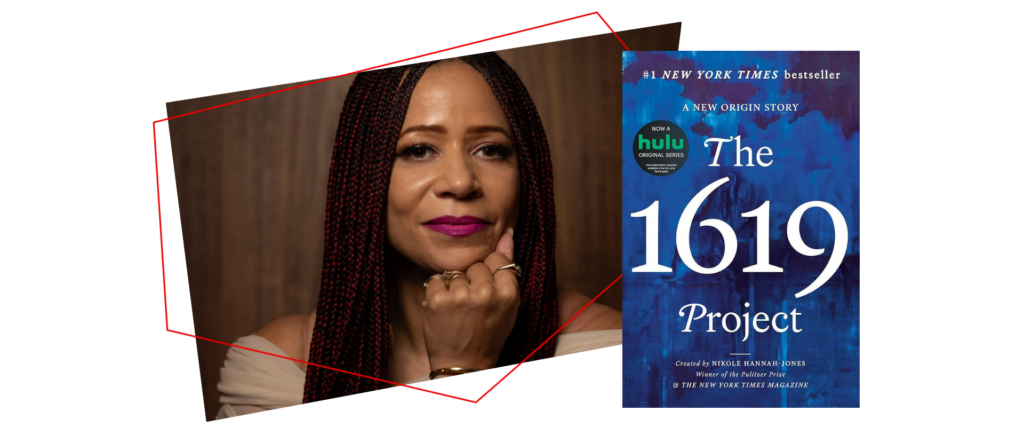
In 2019, The 1619 Project took the country by storm.
Spearheaded by Pulitzer Prize-winning journalist Nikole Hannah-Jones, The New York Times Magazine initiative retold the story of the founding of the United States with chattel slavery and its legacy at the center. It was adapted into multiple bestselling books and a Hulu documentary series, and, with the support of the Pulitzer Center, was converted into educational resources that made their way into hundreds of classrooms across the country.
But the backlash came sharp and fast, and within a year, Republican legislators were attempting to transform their criticism of the project into law. On July 23, 2020, Senator Tom Cotton of Arkansas introduced the Saving American History Act in the U.S. Senate. The first modern educational gag order, it sought to prohibit the use of federal funds to teach The 1619 Project in elementary and secondary schools. By November 2021, when PEN America released its first comprehensive report on educational gag orders, it had tracked 54 state-level bills of the same nature, 11 of which explicitly attempted to bar schools from using materials from the The 1619 Project.
“As American society reckons with the persistence of racial discrimination and inequity, and the complexities of historical memory, attempts to use the power of the state to constrain discussion of these issues must be rejected,” PEN America stated at the time. Since then, the organization has continued to track and advocate against an onslaught of higher education restrictions targeting race, gender, American history, and LGBTQ+ identities.
At the six-year mark, PEN America’s Jonathan Friedman asked Hannah-Jones to reflect on the first modern educational gag order and the appalling number of attempts to legislate what and how students can learn that have followed. It took us far too long to recognize that the Saving American History Act was “just the opening shot in a much bigger effort to shape what we can know,” she told us, but she’s empowering people to push back through events like the recent read-in she hosted in her hometown of Waterloo, Iowa, with bestselling authors Jason Reynolds, Angie Thomas, and Renée Watson.
“We are in for a long-haul fight,” Hannah-Jones said, and she’s not going to surrender anytime soon.
It’s the six-year anniversary of the first modern educational gag order, the Saving American History Act by Tom Cotton, explicitly written to prohibit The 1619 Project being taught in schools. We have seen so much censorship built on the kernel of an idea: to prohibit government funds from schools if they don’t ban certain books or ideas. Why do you think this all started with The 1619 Project?
It’s hard to believe all that has transpired in these six years and how a federal effort that was unprecedented at the time now has been completely normalized across the nation. We must put the Save American History Act in the context of the summer of which it rose. None of us could have imagined the cultural influence that The 1619 Project would have — how quickly schools would adopt it into their curriculum, how widely it was embraced. And after the murder of George Floyd, 1619 became the lexicon of that summer of resistance, as with the help of The 1619 Project and other texts critical of American mythology, many Americans were connecting what they witnessed in Minneapolis with all of the overlapping systems of injustice that had led protestors out into the street. As we seemed to be at the cusp of a national reckoning, politicians such as Tom Cotton both feared children gaining a more honest understanding of the realities of this country and saw the usefulness in using The 1619 Project as a political bogeyman.
You organized a fantastic read-in last week in your hometown. What do events like this mean, and why are they important to you?
Events like this are critical for a few reasons. One, silence is often viewed as acceptance and acquiescence. And so events like the read-in are important for those in power and everyday people in communities to know that there is resistance to these efforts to censor ideas and ban books. As you know very well, these bans are the result of a small group of highly organized people who do not represent the broader views of society. And so those of us who believe in the First Amendment and the freedom to read must organize just as fiercely to protect these freedoms as those who try to take them away.
Two, as someone who has faced unprecedented legislative challenges and bans against my work, I take these bans and educational gag orders very personally. Not only has my work been targeted by name in federal, state and local legislation, but my work on The 1619 Project was used in an effort to deny me tenure at my alma mater, The University of North Carolina at Chapel Hill, which was a precursor to the broader scourge of viewpoint discrimination and educational censorship that is spreading across college campuses. I see this as part of an erosion of democratic norms in a society with encroaching autocracy, and so see it as my responsibility to push back against these efforts as strenuously as possible.
And three, holding events like the read-ins empower people. It gives them access to information about book bans, and the ability to connect into a larger community of people who hold their values, and importantly, makes people feel like there is something they can do to push back. And lastly, I think events that affirm the humanity and worth of Black and queer children who are getting the destructive message that books about their experiences are unworthy of the classroom are so powerfully important right now, as that is an aspect of these bans that I think is underappreciated.
Six years on, what’s your outlook for what comes next in the fight against book bans and educational censorship? What gives you hope that advocates for the freedom to read can turn the tide?
I think we are in for a long-haul fight as so many institutions are being captured with not nearly enough resistance. As Dr. King said, those who wish us ill seem to use time more efficiently than those who wish us well. I do not think enough people realized the stakes when this began with The 1619 Project six years ago and it took far too long for people to understand that the targeting of my work was just the opening shot in a much bigger effort to shape what we can know and understand by limiting students’ access to ideas.
It is hard to feel hopeful in these times, but what I do know is no people will long submit to be told what they can and cannot read or discuss, and therefore, what they can or cannot think.
So, I find myself often turning to this quote from W.E.B. Du Bois, a man who himself was exiled from this country for his ideas: “There is in this world no such force as the force of a person determined to rise. The human soul cannot be permanently chained.”