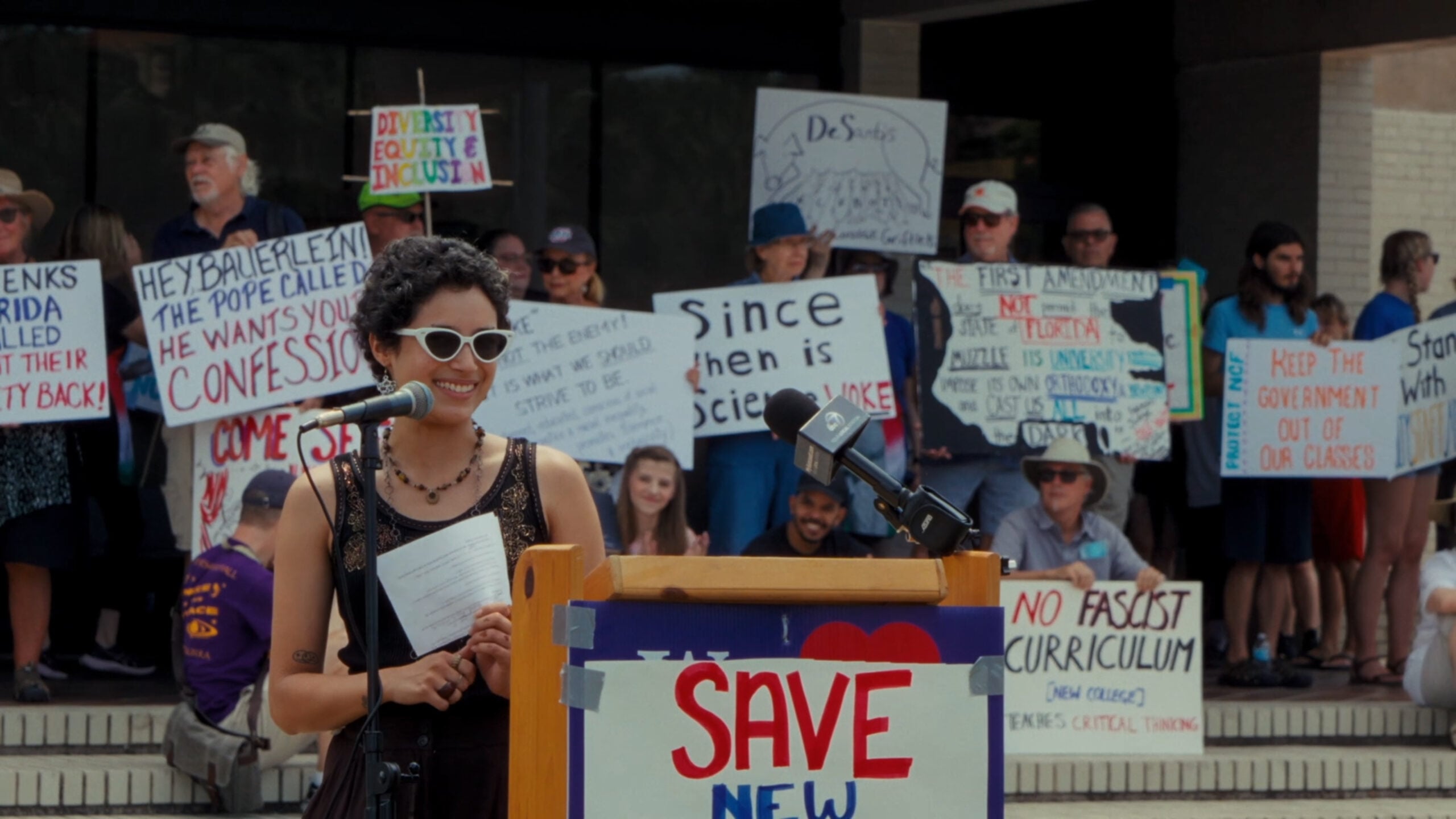
It may be difficult to imagine how changes at a liberal arts college with just 700 students could be a harbinger for authoritarian efforts to control and redirect higher education across the country. The new documentary First They Came for My College makes clear that the 2023 takeover of the New College of Florida was just that.
Based on hundreds of hours of footage filmed on and around the palm-tree lined Sarasota campus – a good portion of it shot by students themselves – the film is making its way around festivals this spring, as universities around the nation face a concerted assault on academic freedom.
As with other efforts in Florida to limit free expression and the freedom to read, the conservative movement’s push to erase New College’s quirky, queer campus culture is a blueprint for attacking colleges nationwide. In the years since the takeover was initiated, schools across the country have adopted similar techniques of suppression: take Texas’ public universities, which are similarly censoring race and gender-related content and facing widespread faculty departures as a result; or the many schools who were successfully pushed into closing DEI offices following pressure from the Trump administration.
The documentary begins in January 2023, when Florida Gov. Ron DeSantis appointed six conservative activists to the New College Board of Trustees, among them Manhattan Institute fellow Christopher Rufo, known for his longstanding opposition to diversity, critical studies, and student progressivism in education. Rufo plainly states in the first minutes of the film that the appointments were intended as a “hostile takeover” of the tiny state school; the “opening move in a conservative counter-revolution.”
New College, founded in 1960, was an appealing target. It has no traditional grades, offers students the chance to pursue independent study and research aimed at exploring their academic passions, and over the years developed a strong LGBTQ+ community.
DeSantis and his allies claimed that the school was “indoctrinating” students with left-wing values.” Rufo promised that the new board would “rebalance the hormones and politics on campus” In the lead-up to his ultimately failed presidential campaign, overhauling New College was a cornerstone of his anti-”woke” agenda.
“From the beginning, I knew a bit about some of the think tanks and organizations, like Heritage Foundation, that the new trustees were affiliated with, and had a deep sense of foreboding,” one of the film’s producers, Harry Hanbury, who earned his bachelor’s degree at New College in 1993, told PEN America. Many people, including some alumni, saw the takeover of the school as a harbinger of what was to come on other campuses, he said.
The American Association of University Professors issued a special report in December 2023 that documented the political interference and its impact on academic freedom in Florida’s public higher ed system, including a section on New College, even though it did not represent the faculty there. The union, “of course saw that this was a blueprint,” Hanbury noted, adding, “and since Trump’s reelection, that blueprint has really been put to use in state after state after state.”
The film includes footage of several raucous board meetings, including the new board’s first, where it fired the school’s popular president, Dr. Patricia Okker. Later, it installed Richard Corcoran, the Republican former speaker of the Florida House and a former Florida Education Commissioner, in her place. At subsequent meetings highlighted in the film, the board denied tenure to multiple faculty members, created new athletic programs aimed at recruiting different types of students, eliminated the college’s Office of Outreach and Inclusive Excellence and voted to abolish the school’s Gender Studies Program.
One of the most heartwrenching moments shows then-Professor Amy Reid, one of the co-founders and director of the Gender Studies Program, going through shelves of books in the program’s office, telling students to take as many as they can. But even with that effort, the camera is soon focused on a huge dumpster full of books that were discarded as the student-led Gender and Diversity Center was dismantled months later.
Reid, now PEN America’s Freedom to Learn program director, said it was clear from the beginning of the takeover that certain programs would be attacked as part of what the new administration called their creation of a “classical” liberal arts program.
“They were very explicit that they wanted to make big changes on campus — changes in leadership, in the student body, in the curriculum,” she said, noting that there were multiple women and administrators, including several who identified as LGBTQ+, who were fired during the first year. “Programs like Gender Studies that they deemed ‘activist’ were considered inappropriate,” she said.
Hanbury called the board’s plan to craft a “classical liberal arts education,” disingenuous. “Because you could study classics. I studied Plato, Aristotle, you could read Homer at New College,” he said. “You could also read African novelists. You could read LGBTQ writers. So their vision of the ‘liberal arts’ is a very cramped, conservative, a kind of crypto-white supremacist vision.”
“What New College really embodied was a kind of expansive vision of the liberal arts as an expanding field of human curiosity, which I think is really what we need to defend right now.”
Beyond New College, DeSantis installed conservatives as trustees or presidents at the University of West Florida, Florida A&M, Florida Atlantic University, Florida International University, and University of North Florida by the time of the documentary’s release. Hanbury said the new presidents “dictate what people can learn and teach, which is something right out of North Korea.”
Reid took over as New College’s faculty chair after another professor, Matthew Lepinski, resigned amid the fight over tenure denials. But while that gave her a seat at the table with the board, she found herself ignored and even subject to censorship – some emails she sent to her colleagues would go undelivered, for instance. “It’s pretty hard to be chair of the faculty when you can’t communicate,” she said.
“At the start of things, I said I would stay until the end, and I thought I could,” Reid said, reflecting on her 30 years teaching at New College. “But the pressure of it all was too much. It is very hard to work in a hostile work environment.”
She stepped down as chair in August 2024 and has used her position at PEN America to push back against censorship at universities across the country. .
In fact, close to 40% of the faculty left within the first six months of the takeover, a number that has grown in the years since. Students were also forced out, including one featured in the film who was threatened with prosecution for “assault” after she allegedly spit on the ground in front of Rufo. Dozens of students transferred to Hampshire College, which recently announced it would permanently close.
“That is the tragedy, that students lost their opportunity for an education,” Reid said.
Patrick Bresnan, the director of the documentary, observed that the board and new administration made efforts to gaslight the students, faculty, and staff amid the upheaval.
“They were just in a constant pattern of destabilizing every aspect of the university while saying, ‘We’re making this university better than it’s ever been. It’s a golden age,’” he said. “Which is a classic abuse trait.”
Gaby Batista, a 2024 graduate who both shot video for the film and is one of the students featured in it, said it wasn’t just the academics that suffered. Among the unique features of the campus, for instance, was the “Food Forest,” a student-led initiative with long pathways through dozens of fruit trees and vegetable patches, intended as both a food source and carbon sequestration project. They also spoke fondly of the campus mulberry trees, where students would gather fruit for making pies and jams.
They called the destruction of these features, in part for new athletic compounds to accommodate newly recruited students, “gut punching.”
In response to what was seen as the politicization of graduation ceremonies, with speaking invitations going to political cronies, students created a nod to the prior campus culture by establishing an Alternative Graduation in 2023, a now-annual event hosted by students and alumni that allows students to skip the cap and gowns and come as they are. “It takes a lot of work to graduate from New College of Florida, it’s not an easy feat,” Batista said. “So I’m really glad that students are still passionate about having it on their own terms, because that was sort of the tagline, that we wanted to graduate on our own terms.”
The first few months of the 2023-2024 school year, interactions between the new students and the old were difficult, especially after the coaches told the athletes that they were not welcomed by existing students. But walls began to break down as the two groups got to know each other. One of the newly recruited students who was not on an athletic scholarship agreed to participate in the film, and Joshua Janniere’s journey offers a spark of hope as he is shown adapting to campus and exploring his creative side.
The students filming and their individual journeys are what makes the documentary special, Reid said. “It shows education’s power to transform lives, and to allow students the joy of learning together as a community,” she said.
Yet Reid added that it’s deceptive to think that the strength of the culture at New College could fend off the changes that politicians seek.
“What happened at New College is reflective of broader efforts to censor education across Florida, and unfortunately that makes it a bellwether for efforts across the country to limit the educational opportunities and to limit the information that’s accessible to students.”
“While I appreciate that the film, by focusing on students, has a hopeful arc to it, watching this film is a painful kick in the gut because it’s a reminder to me of all that was lost to the folly of politicians,” she continued. “When I watch this film I’m reminded in very visceral ways of the costs.”
To learn more about First They Came for My College or to arrange for a screening, contact the producers >>