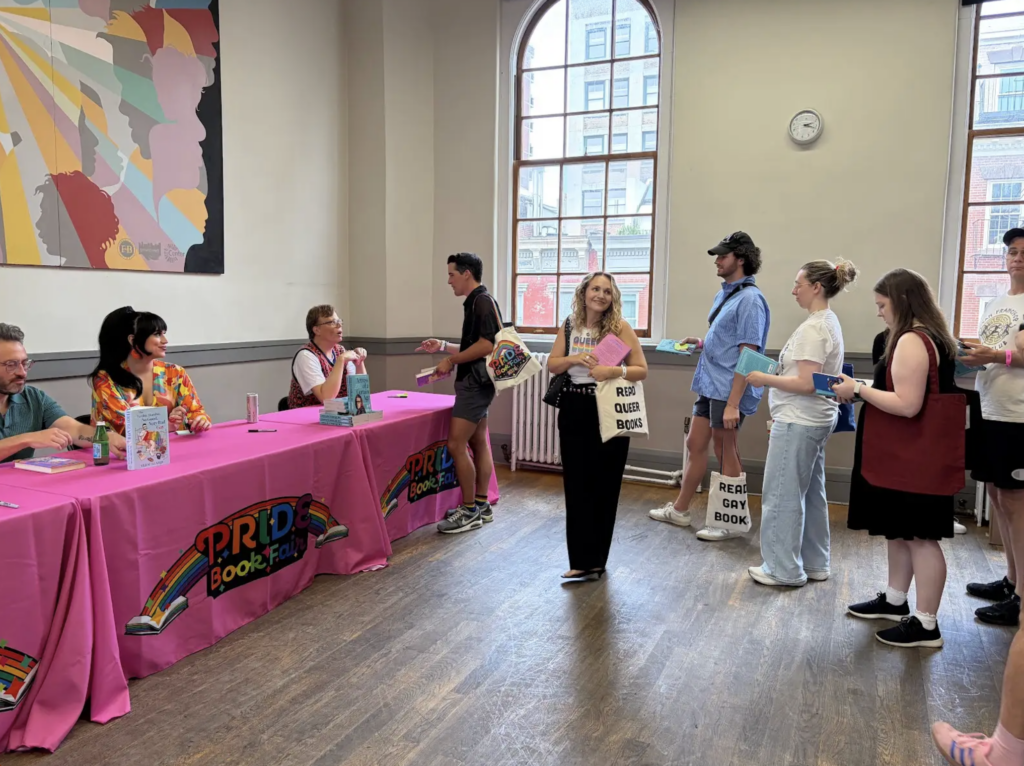
New York’s third annual Pride Book Fair was a joyous celebration of queer voices, or as the event founder described it, “the Scholastic Book Fair, but queer.” For some of the authors and readers who crowded the event, it was also a reminder that the ability to express themselves freely was a right they had to fight for.
“Our community is so free, and we fought for our freedom,” said Brazilian-American writer JD Netto. “We know what it’s like to have our freedoms taken from us, and now is the time to remind people what that really means.”
The event on Friday, June 26 featured more than 40 authors, publishing houses, bookstores, and readers at The Center on West 13th street with panels, tablings, book signings, and rainbow balloons. Founded by Garrett Gottesman, who oversees Public Figure Partnerships at Meta, the event aims to uplift queer voices and create a space where queer people can express themselves freely.
As part of PEN America’s “America Speaks” campaign, marking the 250th anniversary of the Declaration of Independence, we spoke to authors and attendees at the Pride Book Fair who told us about the escalating attacks they’re seeing on queer voices, the importance of fighting back, and what the future of free speech might look like.
Hear more perspectives on free expression in the United States and add your own voice to the mix through America Speaks.
By PEN America Communications Intern, Eleanor Belinfanti. Melissa Joskow contributed reporting.
On What Inspires Them to Use Their Voices
At the fair, attendees told us about what encourages them to speak up. Many cited their family members, friends, or the broader LGBTQ+ community. For Allison N. from New York City, the impulse to speak up about issues that matter to her comes from her family. “I come from a long line of labor leaders, and I know that was ingrained in me, speaking up and working with the community around you.”
Gottesman framed speaking up as paying a debt forward. “One of the biggest things that I try to live by is, ‘Be the role model you wish you had.’ Growing up in Texas, I didn’t have a lot of queer role models to look at, so I think that one of the best things I can do for the next generation is just be proud and be myself, and I think when you come out and live authentically you give others, and especially the next generation, permission to be themselves, too.”
Kim Topping, an artist and educator from New York City, gets her inspiration to speak up from the next generation. “I’ve worked with so many LGBTQ youth activists over the years, and their dedication to creating a better future for all of us is what motivates me.”
On Queer Voices As Resistance
The theme of survival under pressure runs throughout the history of the Pride Book Fair. “This is the third year doing the Pride Book Fair, but this is the first year doing it without a title sponsor…What I’ve noticed is that corporate sponsors are really pulling back on Pride,” said Gottesman. “But it’s also inspiring that the community is showing up for each other. We’re making Pride for us, by us, again.”
Gottesman’s experience with a lack of institutional support echoed in attendees’ fears that the queer community is under attack. “We need to fight for each other. We’ve gotten a lot of rights. Those rights could go away, though, at any moment,” said Kim Narby, a writer from Seattle.
Eliot Glazer, a writer and comedian from Los Angeles, believes that “it’s a hard time to be heard, it’s a hard time to make waves. As it often feels like things are swallowing us whole and things are getting darker, queer voices are more important than ever.”
On the Limits of Free Speech
Attendees at the fair repeatedly affirmed that queer voices need protecting and elevating, but some disagreed about the limits of free speech.
Allison N. believes that the wide scope of free speech as a principle allows it to be weaponized. “I feel like a lot of people are using free speech to do quite a bit of harm to certain communities, like the trans community or people of color, and they’re sort of hiding behind, ‘Oh, it’s my First Amendment rights,’ but you’re still causing a certain amount of violence and harm.”
On the other hand, Glazer had a more expansive view of free speech, saying, “We can never have enough.”
On the Future of Free Speech
When asked what they wished for the future of free expression, attendees responded with answers ranging from structural reform to abstract ideals. Narby said, “term limits for Supreme Court Justices.” Netto simply said that they wanted speech “to actually be free,” and New York City-based photographer Hunter Abrams said they wished “that it wasn’t penalized.”
Rose Dommu, a writer from Florida living in New York, seemed to capture the underlying sentiment behind both ends of the spectrum. Her wish for the future of free expression? “That we get to keep it.”