Freedom to Write Index 2020
This report reflects PEN America’s 2020 Index findings. For our complete, up-to-date database, see the Writers at Risk Database.
Introduction
On April 3, 2020, as COVID-19 cases surged on multiple continents, prompting lockdowns and states of emergency and casting a global pall of anxiety and grief, renowned Indian author and winner of the Man Booker Prize Arundhati Roy wrote an essay entitled, “The Pandemic is a Portal.” In what was perhaps the first great piece of writing about the pandemic, Roy did what writers, more than any other figures in our society, are uniquely equipped to do. She shined an unflinching light on humanity, on the societies and structures we have built, and how they were failing us in our moment of need. She showed us not only what was new and novel about the pandemic, but what old, long-established, and deeply entrenched inequities it was rapidly exposing. She wrote primarily about India but told a story that was true of many countries around the world—of governments too consumed by politics to mount an efficient public health response, of a catastrophic lack of planning or preparedness, of overlapping crises, and of people left in fear and uncertainty. And yet, despite the grim images in the mirror she held up for us, she also offered hope. She placed our chaotic, anxiety-ridden moment in historical context, and showed us that this crisis held the potential for a moment of great transformation:
“Historically, pandemics have forced humans to break with the past and imagine their world anew. This one is no different. It is a portal, a gateway between one world and the next. We can choose to walk through it, dragging the carcasses of our prejudice and hatred, our avarice, our data banks and dead ideas, our dead rivers and smoky skies behind us. Or we can walk through lightly, with little luggage, ready to imagine another world. And ready to fight for it.”1Arundhati Roy, “Arundhati Roy: ‘The pandemic is a portal,’” Financial Times, April 3, 2020, ft.com/content/10d8f5e8-74eb-11ea-95fe-fcd274e920ca
Writers have played an essential role during the pandemic, analyzing and critiquing government responses, documenting personal experiences, and shocking us into recognition that we must not return blindly to patterns of the past. The protest movements that spanned the globe in 2020 calling for racial justice, the defense of democracy, and a reckoning with historical wrongs also made plain the essentiality of not reverting to a static “normality,” but purposefully moving forward to build a more just and equitable future. It is no coincidence that writers and artists played an essential role in many of those movements, nor is it surprising that they were targeted for it. Not only does Roy’s essay show us the potential of this historic moment of trauma and transformation, but it also demonstrates the power that writers have to help us to make sense of this time, and to envision what comes next.
For those with a vested interest in maintaining the status quo, that power poses a threat. Political leaders the world over—in autocracies and fragile democracies alike—have used the pandemic and protest movements as an excuse to further constrain rights rather than expand them; they have wielded laws about disinformation as a means of silencing the truth; and they have specifically targeted those with the power to imagine and inspire. What lies on the other side of this portal is yet to be determined, but there is no question that the influential voices of writers are indispensable in helping us to find the path forward, and that the freedom to write has never been more essential to defend.
States of Emergency: The Pandemic, Protests, and the Persistent Assault on Global Free Expression
The climate for free expression globally continued to deteriorate in 2020, with existing challenges in authoritarian and more democratic political environments compounded by new threats. Most dramatically, the COVID-19 pandemic added unprecedented dimensions to existing crises for millions around the world and sparked new threats to freedom of expression. In the context of a global public health crisis, the ability to communicate freely and share and receive information quickly became a lifeline. Writers have helped expose truths and counter falsehoods in ways that have shaped the global public health response. At the same time, the emergency provided cover for crackdowns on human rights and expansions of government power over speech and expression. A proliferation of global protest movements during 2020 also represented a powerful unleashing of vocal public demands for change—and sparked a countervailing effort to restrict protest rights and detain those who raised their voices to demand freedom and equality. Writers and public intellectuals have played an essential role in narrating and shaping our perception of this singular moment, and in all too many cases, they have paid a price for doing so.
During 2020, at least 273 writers, academics, and public intellectuals in 35 countries—in all geographic regions around the world—were unjustly in prison or held in detention in connection with their writing, their work, or related activism.
During 2020, according to data collected for PEN America’s Freedom to Write Index, at least 273 writers, academics, and public intellectuals in 35 countries—in all geographic regions around the world—were in prison or unjustly held in detention in connection with their writing, their work, or related activism. This represents a sizable increase from the 238 individuals counted in the inaugural 2019 Freedom to Write Index. By holding these individuals behind bars, their governments are depriving them of their individual right to free speech, while also robbing the broader public of access to their innovative and influential voices of dissent, criticism, creativity, and conscience. The top three countries—China, Saudi Arabia, and Turkey—still accounted for a majority of cases, 50 percent, down from 59 percent in 2019. Meanwhile, numbers increased in Iran and Egypt, and expanded dramatically in Belarus, which accounted for zero cases in the 2019 Index, but now ranks as the fifth worst jailers of writers and intellectuals, with 18 documented cases (or 7 percent of the total), as a result of a brutal post-election crackdown on mass protests that has also targeted translators, artists, and other cultural figures.
Writers Imprisoned Globally: 2020
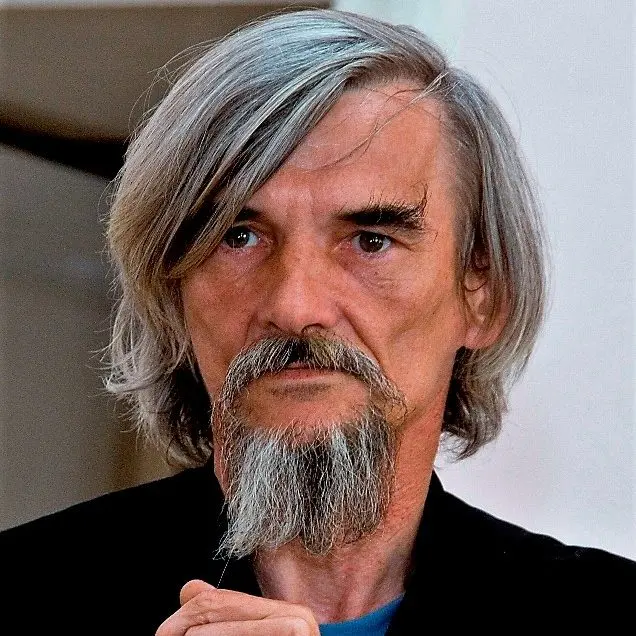
Yury Dmitriev
Russia
Status: Imprisoned
Russian historian Dmitriev was jailed in 2016 on retaliatory charges for his work uncovering the mass graves of thousands of victims of Stalin-era executions.
Photos by Medifond and Visem
While many writers included in the Index hold multiple professions and are, for example, both literary writers and poets, the most prevalent professions of those incarcerated are: literary writers (107), scholars (54), poets (57), singer/songwriters (30), publishers (13), editors (11), translators (8), and dramatists (3). Of these 273 individuals, 2 died while in custody, 3 died following their release, and 176—roughly two-thirds—remain in state custody at the time of this report’s publication.
The majority of those writers and intellectuals included in the 2020 count were initially imprisoned or detained prior to 2020, or had faced previous detention or imprisonment. Of the 273 in prison or detention during 2020, roughly 71 percent of them had also spent multiple days behind bars in 2019. This figure also includes 12 cases of individuals who were detained or imprisoned prior to 2020 but whose status only became publicly known during the past year. Such cases are common especially in environments where there is little transparency to the judicial process and limited press access; for example, in Xinjiang and Tibet in China. In many of these cases, detention is not confirmed until formal charges are made. The remaining roughly 29 percent of the 2020 Index comprises 79 writers and intellectuals, in 25 different countries, who were newly detained or imprisoned in 2020.
The largest number of new cases of writers and public intellectuals detained or imprisoned in 2020 came from Belarus, where the cultural community has played a leading role in the protests that followed the August 2020 presidential election, in which Alexander Lukashenka claimed victory despite election monitors concluding the election was “neither free nor fair,” and the European Union rejecting what it called the “falsified” results.2Liliya Yapparova, “The angry and the powerless: How the opposition protests in Belarus became a guerilla movement. Liliya Yapparova reports from Minsk,” Meduza, January 5, 2021, meduza.io/en/feature/2021/01/05/the-angry-and-the-powerless; Council of the European Union, “Belarus: Declaration by the High Representative on behalf of the European Union on the so-called ‘inauguration’ of Aleksandr Lukashenko,” press release, September 24, 2020, consilium.europa.eu/en/press/press-releases/2020/09/24/belarus-declaration-by-the-high-representative-on-behalf-of-the-european-union-on-the-so-called-inauguration-of-aleksandr-lukashenko/ Lukashenka’s regime has responded to the protests with a violent crackdown and widespread detentions, and has targeted influential cultural figures playing a role in the protests and broader movement to reject Lukashenka’s authoritarian rule. As a result, after having had no cases included in the 2019 Index, Belarus entered the top tier of the 2020 Index, ranking fifth in the world for detaining and imprisoning writers and intellectuals.
The remaining majority of these 79 new cases of writers and intellectuals have been detained or imprisoned during 2020 in countries that were within the top 10 jailers of this group in the previous Freedom to Write Index: China (12), Egypt (6), Vietnam (5), Iran (5), Saudi Arabia (3), India (3), and Turkey (2).3“Freedom to Write Index 2019,” PEN America, accessed March 15, 2021, pen.org/report/freedom-to-write-index-2019/ Individuals were also newly detained or imprisoned during 2020 in countries that held a smaller number overall, including Bangladesh (3), Thailand (3), Cambodia (2), Cuba (2), the Palestinian Territories (2), Sri Lanka (2), Israel (1), Jordan (1), Kazakhstan (1), Morocco (1), Oman (1), Pakistan (1), South Sudan (1), Sudan (1), Tajikistan (1), Uganda (1), and Venezuela (1).
Importantly, a number of these newly detained writers have also been threatened, harassed, or detained for their work in the past, with their 2020 detentions forming part of a larger pattern of ongoing governmental retaliation against them for their writing or expression over time. Writers who fall within this subset include Moroccan historian Maati Monjib, Chinese legal scholar Xu Zhangrun, Palestinian writer Abdullah Abu Sharkh, Iranian literary and arts critic Anisa Jafari-Mehr, and Indian professor of literature Hany Babu.
Many of the trends documented in the 2019 Freedom to Write Index persisted in 2020. National security remains the primary claim authorities use to justify detaining or imprisoning writers and public intellectuals: at least 55 percent of detentions were based on allegations of undermining national security or membership in a banned group. Arbitrary detentions—unaccompanied by formal charges—made up at least 20 percent of the cases, leaving the accused writers and intellectuals in a state of legal limbo, without recourse to challenge the claims against them. Cases of arbitrary detention are particularly common in Saudi Arabia, where at least 66 percent of writers and public intellectuals are held on unknown or undisclosed charges.
Charges related to organizing, assembly, and activism were used in at least 16 percent of cases against writers. Retaliatory criminal charges, defamation, and charges related to disinformation were levied against writers as well, though in fewer instances. At least 25 cases were identified of writers and public intellectuals detained for alleged disinformation crimes, including those related to spreading allegedly false news about COVID-19, demonstrating the troubling ways in which authorities have abused such laws to quash critics and quell divergent views. A relatively smaller percentage of cases were brought against writers for allegedly making threats against religious authority, producing obscene materials, or inciting violence. One of the most significant trends of 2020 has been the targeting of writers, commentators, and others who have spoken out in criticism of their governments’ responses to the COVID-19 pandemic; these cases were often brought on the grounds of national security, public order, or prohibitions against disinformation.
Governments of countries in the Asia-Pacific region continued to jail the most writers and intellectuals for their writing or expression. In total, 121—or nearly half of the global count—were jailed in Asia-Pacific, with the vast majority of those, 81, held in China. Significant numbers of writers were also held in Vietnam (11), India (9), and Myanmar (8). Countries in the Middle East and North Africa have also jailed significant numbers of writers and intellectuals, including Saudi Arabia (32), Iran (19), and Egypt (14). Countries in this region contributed to almost a third of the global count of imprisoned and detained writers, at least 81 individuals, in 2020.
Detentions and imprisonments of writers and intellectuals in Europe and Central Asia occurred largely in two countries: Turkey and Belarus. Turkey maintains its position as the jailer of the third-highest number of writers and public intellectuals worldwide, having held 25 of the 50 prisoners and detainees in Europe and Central Asia during 2020. The crackdown against those protesting Belarus’s stolen presidential election led to a startling number of writers and cultural figures being detained or imprisoned: while Belarus did not jail any writers in 2019, in 2020 the number jumped to at least 18 that can be documented—the actual number is likely higher. Countries in sub-Saharan Africa contributed to roughly 5 percent of the 2020 Index, representing 14 writers and public intellectuals detained or imprisoned. Two countries in the Americas contributed to just three percent of the 2020 Index, with six writers detained or imprisoned in Cuba and one in Venezuela.
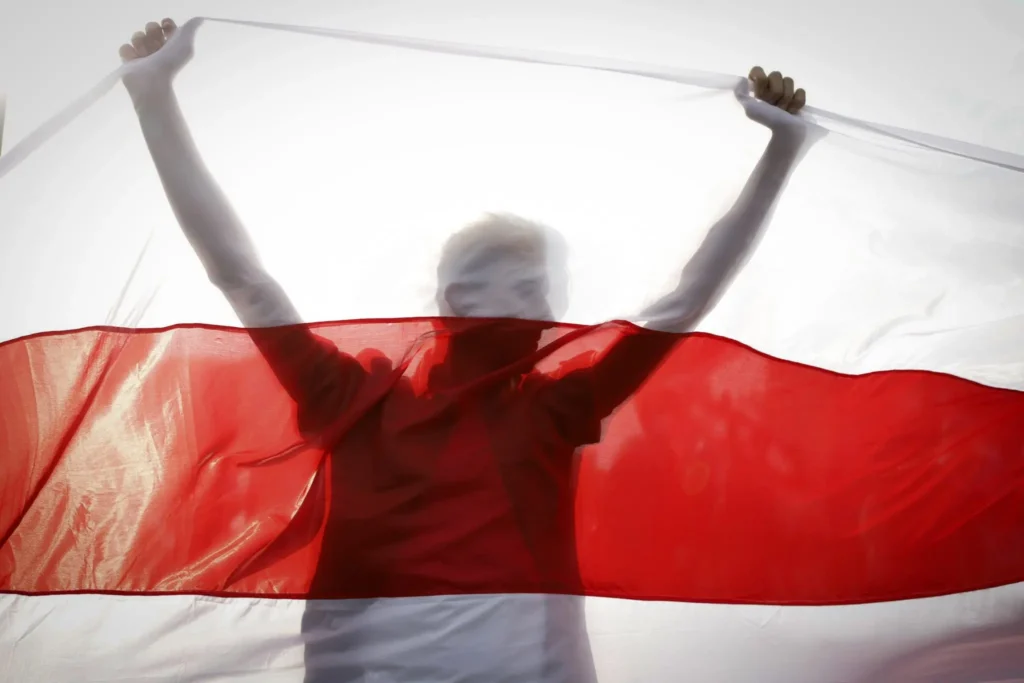
Tragically, four writers who were detained during 2020 died in circumstances that appear related to their detentions: Saudi columnist Saleh Al-Shehi died from possible COVID-19 complications on June 19, 2020, after being released from prison and then spending three weeks on a ventilator;4“Saudi writer dies from COVID-19 shortly after release from prison,” Middle East Monitor, July 20, 2020, middleeastmonitor.com/20200720-saudi-writer-dies-from-covid-19-shortly-after-release-from-prison/ Uyghur poet and editor Haji Mirzahid Kerimi died in custody on January 9, 2021 while imprisoned for publishing “problematic” books;5Shohret Hoshur, “Prominent Uyghur Poet and Author Confirmed to Have Died While Imprisoned,” Radio Free Asia, January 25, 2021, rfa.org/english/news/uyghur/poet-01252021133515.html Bangladeshi writer Mushtaq Ahmed died in a prison hospital on February 25, 2021, after nearly 11 months in detention, and after being denied bail six separate times;6“Bangladesh: UN rights chief urges transparent probe into writer’s death, review of law under which he was charged,” UN News, March 1, 2021, news.un.org/en/story/2021/03/1086002 and Egyptian writer Amin El-Mahdy died on October 11, 2020, 11 days after being released from detention.7“Egyptian writer and Sisi critic Amin El-Mahdy dies days after release from jail,” Middle East Eye, October, 12, 2020, middleeasteye.net/news/egypt-sisi-critic-amin-mahdy-dies The jailing of writers and others unjustly detained or imprisoned amid the ongoing coronavirus pandemic represents a harrowing—and life threatening—nexus between these concurrent crises of global public health and free expression in retreat.
In this report, PEN America will provide an in-depth analysis of the countries that detain and imprison the largest numbers of writers and intellectuals and explore the impact of the pandemic on the freedom to write; the role of these individuals in protest movements; and the continued threats to writers and intellectuals working in languages subject to political repression.
About the Freedom to Write Index
The 2020 Freedom to Write Index provides a count of the writers, academics, and public intellectuals who were held in prison or detention during 2020 in relation to their writing or for otherwise exercising their freedom of expression. For the past century, PEN America and the global PEN network have defended the rights of writers and intellectuals to express themselves freely, and advocated on behalf of those who have faced threats as a result of their writing or other forms of expression. The criteria for inclusion in the Freedom to Write Index thus adhere closely to PEN International’s standards for selection for their annual Case List.
The Index is a count of individuals who primarily write literature, poetry, or other creative writing; essays or other nonfiction or academic writing; or online commentary. The Index includes journalists only in cases where they also fall into one of the former categories, or are opinion writers or columnists. To be included in the count, individuals must have spent at least 48 hours behind bars in a single instance of detention between January 1 and December 31, 2020.
For the purposes of the Index and the status designations used to classify cases, imprisonment is considered to be when an individual is serving a sentence following a conviction, while detention accounts for individuals held in custody pending charges, or those who have been charged and are being held prior to conviction. Writers are, of course, also subject to other types of threats, including censorship, harassment, legal charges without detention, or physical attacks, and these are also analyzed to a lesser degree in this report.
PEN America works closely with the PEN International Secretariat and Writers in Prison Committee (WiPC), as well as the other members of the global PEN network. The Index and this report draw significantly from PEN International’s Case Lists, which in turn reflect input from PEN Centers around the world. The cases included in the Index are also based on PEN America’s own internal case list, the Writers at Risk Database, and PEN America’s Artists at Risk Connection (ARC) case list. Additionally, PEN America draws from press reports; reports from the families, lawyers, and colleagues of those in prison; and data from other international human rights, press freedom, academic freedom, and free expression organizations. The methodology behind the Index is explained in greater detail here.
The annual Freedom to Write Index has become an essential component of PEN America’s long-standing Writers at Risk Program, which encompasses support for and advocacy on behalf of writers under threat around the world. Another flagship component of PEN America’s year-round advocacy is the PEN/Barbey Freedom to Write Award, given annually to an imprisoned writer targeted for exercising their freedom of expression. Of the 48 jailed writers who have received the Freedom to Write Award from 1987 to 2020, 44 have been released due in part to the global attention and pressure the award generates. PEN America also publishes the Writers at Risk Database, a searchable catalog of the writers, journalists, artists, academics, and public intellectuals under threat around the world, including those counted in the 2019 Index and 2020 Index. This database offers researchers, rights advocates, and the public a wealth of actionable evidence of ongoing global threats to free expression.
The Pandemic and the Freedom to Write
The COVID-19 pandemic has been a world-changing event, affecting everyday life for billions. The pandemic has also deeply impacted the freedom to write, and the lives of many of the writers and public intellectuals who comprise PEN America’s case list. In many countries, the pandemic has caused not only a public health crisis, but has also caused or exacerbated crises of human rights and democracy.
Governments around the world have used the pandemic as an opportunity to further police people’s speech. The International Center for Not-for-Profit Law (ICNL) has identified 52 examples of countries introducing new laws or policies—or amending existing ones—in response to the pandemic that criminalize disinformation or otherwise limit free expression.8COVID-19 Civic Freedom Tracker, International Center for Not-for-Profit Law (ICNL), and European Center for Not-for-Profit Law (ECNL) [hereinafter “ICNL COVID Tracker”] icnl.org/covid19tracker/?location=&issue=4,9&date=&type=1,2,3,4 They have documented another 40 examples of practical crackdowns or constraints on expression.9ICNL COVID Tracker. Perhaps most widespread is the introduction of new laws, regulations, or other policies criminalizing “false information” or “rumors” about the pandemic.10E.g., Arab News, “‘As dangerous as the virus’: Middle East cracks down on COVID-19 rumor mongers,” Arab News, March 30, 2020, arabnews.com/node/1649286/middle-east
In Saudi Arabia, at least one individual has been prosecuted, facing a maximum sentence of five years, under Article 6 of the Saudi Anti-Cyber Crimes Law for “producing COVID-19 rumors and news from unknown sources that affect public order.”11Saudi Gazette report, “Saudi Arabia to prosecute rumor monger,” Saudi Gazette, March 19, 2020, saudigazette.com.sa/article/591052/SAUDI-ARABIA/Saudi-Arabia-to-prosecute-rumor-monger In Indonesia, police have arrested and charged several people for allegedly defaming the president by criticizing his COVID-19 policies, a criminal charge that can carry up to 18 months’ imprisonment.12ICNL COVID Tracker – Indonesia; ICJR Staff, “Enforcing Article on the Defamation of the President, Police sets their face against Constitutional Court’s Decision,” April 8, 2020, icjr.or.id/enforcing-article-on-the-defamation-of-the-president-police-sets-their-face-against-constitutional-courts-decision/ The Algerian government amended its penal code in April 2020 to provide for new penalties for the “dissemination of false information,” with harsher penalties during a public health lockdown or “catastrophe.” Under these new provisions, those arrested for “false information” about COVID-19 face up to five years’ imprisonment.13ICNL COVID Tracker – Algeria. In Tanzania, new ministerial regulations released in July 2020 prohibit citizens sharing COVID-19 information “without the approval of the respective authorities,” at the risk of one-year imprisonment.14ICNL COVID Tracker – Tanzania. Uzbekistan amended its criminal statutes in March 2020 to provide for up to three years’ imprisonment for the online or media distribution of “false” information about quarantine or infectious diseases.15ICNL COVID Tracker – Uzbekistan. Also in March, Bolivia’s president promulgated a decree that included the imposition of criminal charges for those who “misinform or generate uncertainty among the population,” with a penalty of up to 10 years’ imprisonment.16ICNL COVID Tracker – Bolivia. Such laws pose an obvious threat to freedom of expression, granting officials broad new powers they can wield against writers, bloggers, journalists, dissidents, or critics of any kind. Others have used the virus as a justification to dramatically limit press freedom, such as Iran, where the government invoked the virus when attempting to implement a wholesale ban on print media in April of 2020.17Radio Farda, “Iran Journalists Protest Coronavirus Taskforce Ban On Print Media,” Radio Farda, March 31, 2020, en.radiofarda.com/a/iran-journalists-protest-coronavirus-taskforce-ban-on-print-media-/30519547.html
During 2020, governments detained and imprisoned writers and public intellectuals who criticized their response to the pandemic on the grounds of national security, public order, or prohibitions against disinformation.
Some of those who have raised their voices to criticize their governments’ handling of the pandemic have found themselves targeted or imprisoned as a result. In China, for example, the Wuhan doctor who first sounded the alarm over the coronavirus before succumbing to it himself, Dr. Li Wenliang, was harassed by police for “spreading rumors” in the earliest days of the epidemic, and Chinese writers, public intellectuals, and everyday citizens have since been targeted for either sharing uncensored information or criticizing the government’s response to the virus.18Alice Su, “A doctor was arrested for warning China about the coronavirus. Then he died of it,” Los Angeles Times, February 6, 2020, latimes.com/world-nation/story/2020-02-06/coronavirus-china-xi-li-wenliang Poet Zhang Wenfang, was sentenced to six months’ imprisonment for her online poem about the coronavirus that included vignettes of people’s experiences, with lines such as “The one who died while sitting up, whose family cradled their head as they waited for the hearse/The one who starved to death in their home during quarantine.”19Joseph Brouwer, “TRANSLATION: WEIBO USER SENTENCED TO SIX MONTHS OVER WUHAN POEM,” China Digital Times, February 24, 2021, chinadigitaltimes.net/2021/02/translation-weibo-user-sentenced-to-six-months-over-wuhan-poem/ After legal scholar Xu Zhangrun wrote an essay “Viral Alarm” criticizing the government’s repressive response to COVID, authorities placed him under house arrest, then subsequently detained him for seven days on retaliatory charges that he had solicited a sex worker in 2018.20Chris Buckley, “Seized by the Police, an Outspoken Chinese Professor Sees Fears Come True,” The New York Times, July 6, 2020, nytimes.com/2020/07/06/world/asia/china-detains-xu-zhangrun-critic.html
In Turkey, President Recep Tayyip Erdoğan and his political allies implied that physician and columnist Şebnem Korur Fincancı was an “enemy of Turkey,”21BIA News Desk, “Erdoğan calls Turkish Medical Association Chair ‘a terrorist’, hints at new law,” Bianet, October 14, 2020, bianet.org/english/politics/232726-erdogan-calls-turkish-medical-association-chair-a-terrorist-hints-at-new-law# after the Turkish Medical Association (TTB), an organization that she chairs, criticized the Turkish government’s response to the COVID-19 pandemic.22BIA News Desk, “Turkish Medical Association: We stand by our words, we are on our duty,” Bianet, September 17, 2020, bianet.org/english/politics/231035-turkish-medical-association-we-stand-by-our-words-we-are-on-our-duty In Bangladesh, cartoonist Ahmed Kabir Kishore and writer Mushtaq Ahmed were among a group of 11 people arrested on May 6, 2020, for criticizing the government’s response to the pandemic. Mushtaq Ahmed died in prison in February 2021, while Kishore remains in prison where he has reportedly been tortured and is in failing health.23Julfikar Ali Manik and Mujib Mashal, “Bangladeshi Writer Detained Over Social Media Posts, Dies in Jail,” The New York Times, February 26, 2021, nytimes.com/2021/02/26/world/asia/bangladesh-mushtaq-ahmed-dead.html In Kazakhstan, blogger Aigul Otepova was placed under house arrest and later forced into a psychiatric clinic after criticizing her government’s response to the virus on Facebook.24RFE/RL’s Kazakh Service, “Kazakh Blogger Critical of Government Forcibly Admitted to Psychiatric Clinic,” Radio Free Europe Radio Liberty, November 23, 2020, rferl.org/a/kazakh-blogger-critical-of-government-forcibly-admitted-to-psychiatric-clinic/30964357.html Government figures the world over have not hesitated to respond to public criticism or even illustrations of the severity of the pandemic by punishing the messenger.
As the coronavirus has grabbed the world’s attention, it has given additional cover to autocrats to push repressive agendas, secure in the knowledge that the pandemic would depress popular turnout at protests and distract the international community from forcefully responding. The Chinese government appeared to seize this opportunity in June of 2020, imposing a draconian National Security Law that essentially strips Hong Kong’s 7.5 million people of the civic and political rights they had enjoyed under the “One Country, Two Systems” framework—including in the realm of academic freedom, freedom of expression, and press freedom.25“Hong Kong security law: What is it and is it worrying?” BBC News, June 30, 2020, bbc.com/news/world-asia-china-52765838 Just the year before, public outcry from both Hong Kong residents and the international community convinced the government to pull back from a lesser far-reaching bill, one whose principal effect would have been to allow people in Hong Kong to be extradited to mainland China, rather than applying the mainland’s draconian restrictions on all of Hong Kong. The fact that Beijing was able to impose a far more repressive law on Hong Kong, only a year later, indicates the extent to which the coronavirus has enabled authorities to take such repressive measures.
And the COVID-19 pandemic has also provided a convenient pretext for authorities to harass, detain, and arrest dissenters more broadly. In Uganda, novelist and journalist Kakwenza Rukirabashaija was detained and tortured in April, under charges purportedly related to COVID but which appear to have been motivated by authorities’ displeasure over his writing.26“Day of the Imprisoned Writer 2020: Take Action for Kakwenza Rukirabashaija,” PEN International, November 9, 2020, pen-international.org/news/day-of-the-imprisoned-writer-2020-take-action-for-kakwenza-rukirabashaija#:~:text=On%2013%20April%202020%2C%20Uganda,had%20been%20subjected%20to%20torture In China, police officers used the pretext of a “coronavirus prevention check” to find and arrest the essayist and activist Xu Zhiyong at his lawyer’s home, and to place poet Li Bifeng into “enforced quarantine” as a form of detention.27Helen Davidson, “Hong Kong arrests and Taiwan flybys: China advances its interests during Covid-19 crisis,” The Guardian, April 25, 2020, theguardian.com/world/2020/apr/26/hong-kong-arrests-and-taiwan-flybys-chinas-advances-its-interests-during-covid-19-crisis; Guo Rui, “Chinese police detain fugitive rights activist Xu Zhiyong during ‘coronavirus check,’” South China Morning Post, February 17, 2020, scmp.com/news/china/politics/article/3051000/chinese-police-detain-fugitive-rights-activist-xu-zhiyong In Cuba, police invoked a coronavirus-related “health code violation” in November as a pretext to raid the headquarters of the artistic San Isidro Movement, arresting more than a dozen members of the movement.28“Cuban police raid HQ of dissident San Isidro Movement,” BBC News, November 27, 2020, bbc.com/news/world-latin-america-55098876
Increased Urgency: Conditions of Imprisoned Writers during the Pandemic
Prisons and jails, in particular, have been severely impacted by COVID-19 and its profound and rippling social and economic effects. Prisons and other sites of detention around the world are likely to be overcrowded, poorly maintained, unhygienic, and lacking adequate medical care and equipment. These conditions, often combined with malign neglect from authorities, have made prisons breeding grounds for the virus. Human rights advocates, public health professionals, and UN officials have repeatedly warned that prisoners face a disproportionate impact from COVID-19.29Miriam Berger, “Prisons are covid hot spots. But few countries are prioritizing vaccines for inmates,” The Washington Post, January 15, 2021, washingtonpost.com/world/2021/01/14/global-coronavirus-vaccines-prisons/; “Impact of COVID-19 ‘heavily felt’ by prisoners globally: UN expert,” UN News, March 9, 2021, news.un.org/en/story/2021/03/1086802; “Prisoners forgotten in COVID-19 pandemic, as crisis grows in detention facilities,” Amnesty International, March 18, 2021, amnesty.org/en/latest/news/2021/03/prisoners-forgotten-in-covid-19-pandemic-as-crisis-grows-in-detention-facilities/; see also https://covidprisonproject.com/additional-resources/global-outbreaks/ In the United States, for example, the Journal of the American Medical Association (JAMA) found that by July 2020, the COVID death rate for those incarcerated in the United States was more than five times higher than the average U.S. death rate.30Brendan Saloner, Kalind Parish, Julie A. Ward, Grace DiLaura, and Sharon Dolovich, “COVID-19 Cases and Deaths in Federal and State Prisons,” The Journal of the American Medical Association (JAMA) 324, no. 6 (2020): 602–603, doi.org/10.1001/jama.2020.12528 In recognition of this reality, early in the pandemic, the United Nations High Commissioner for Human Rights Michelle Bachelet directly called on governments “now more than ever” to “release every person detained without sufficient legal basis, including political prisoners and others detained simply for expressing critical or dissenting views.”31Michelle Bachelet, “Urgent action needed to prevent COVID-19 ‘rampaging through places of detention,’” UN High Commissioner for Human Rights Michelle Bachelet calls on governments to take urgent action to protect the health and safety of people in detention and other closed facilities, Geneva, March 25, 2020, transcript, ohchr.org/en/NewsEvents/Pages/DisplayNews.aspx?NewsID=25745&LangID=E
This virus not only knocks down old men like myself but also all kinds of aged concepts, beliefs and ideas. We are painfully crossing the threshold of a new world and, even more important, a new kind of human being.
Ahmet Altan, “I’m watching the coronavirus unfold from a Turkish prison. Here’s why I’m hopeful.”
This is a matter of serious moral concern, warranting global attention and action, and its impacts have not been limited to imprisoned writers and intellectuals but to all those imprisoned or detained.32PEN America’s Prison & Justice Writing Program examines and shines a light on these issues in the U.S.; read more at: pen.org/prison-writing/. See also PEN America’s April 2020 statement on the use, availability, and cost of e-readers in American prisons during the pandemic, at pen.org/press-release/prison-e-readers-and-tablets-should-be-free-during-coronavirus-outbreak/ In this context, we focus on the cases of writers, public intellectuals, and others within the scope of the Index who face an increased risk of contracting COVID-19 in prison, and the subsequent increased urgency of ensuring their freedom. This is especially the case for those who are older, in ill-health, or in other high-risk categories.
Despite these risks and calls for governments to free political prisoners, many, including writers and intellectuals, have remained or been newly placed in state custody during the pandemic, while governments have simultaneously downplayed the risks and attacked those who have attempted to draw attention to them. In March 2020, the family and supporters of Egyptian imprisoned blogger and activist Alaa Abd El Fattah staged a protest in front of the government’s cabinet building to bring attention to the acute risks that those held in prison face during the pandemic.33Louisa Loveluck and Sudarsan Raghavan, “How the coronavirus is igniting riots, releases and crackdowns in world’s prisons,” The Washington Post, March 26, 2020, washingtonpost.com/world/how-coronavirus-is-igniting-riots-releases-and-crackdowns-in-the-worlds-prisons/2020/03/25/6ca94494-6aba-11ea-b199-3a9799c54512_story.html;
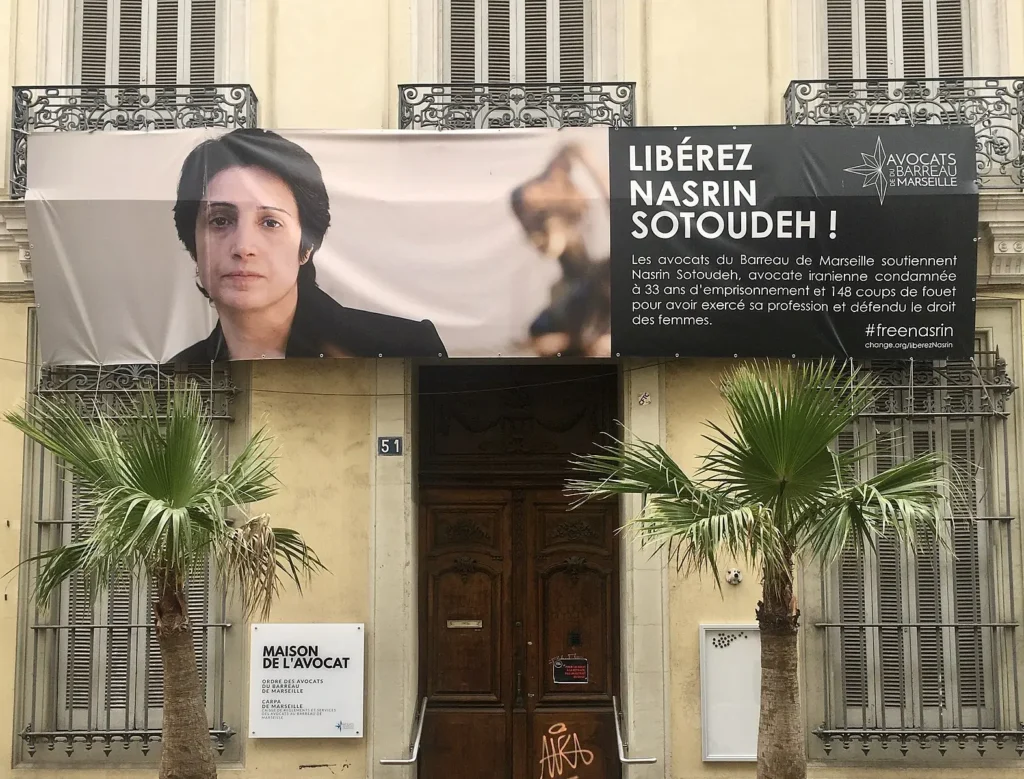
Emma Graham-Harrison, “Egypt arrests activists including Ahdaf Soueif over coronavirus protest,” The Guardian, March 18, 2020, theguardian.com/world/2020/mar/18/egypt-arrests-activists-calling-prisoners-release-coronavirus-ahdaf-soueif; PEN America, “Egyptian Writer Detained for Protesting Prison Conditions That Could Worsen COVID-19 Spread,” press release, March 18, 2020, pen.org/press-release/egyptian-writer-detained-for-protesting-prison-conditions-that-could-worsen-covid-19-spread/ Abd El Fattah’s family held a placard that read, “Underestimating coronavirus in prisons puts the lives of inmates, police officers, conscripts and all who work in prisons and their families in danger. Release the prisoners.”34Loveluck and Raghavan, “How the coronavirus is igniting riots.” In response, the protesters—including Abd El Fattah’s mother, academic Leila Soueif; author Ahdaf Soueif; activist Mona Seif; and academic Rabab El-Mahdi—were forced to spend one night in jail before being released on bail.35Loveluck and Raghavan, “How the coronavirus is igniting riots;” PEN America, “Egyptian Writer Detained for Protesting Prison Conditions That Could Worsen COVID-19 Spread,” press release, March 18, 2020. They were charged with inciting a protest and disseminating false news, and blogger Abd El Fattah remains in pretrial detention.36Loveluck and Raghavan, “How the coronavirus is igniting riots.” In protest of the unjust living conditions facing prisoners in Iran’s Evin prison, writer and human rights lawyer Nasrin Sotoudeh went on a 46-day hunger strike from August through September 2020.37“COVID-19 Fear in Iran’s Prisons: Iran Must Do More to Protect Prisoners, Summer 2020 Update,” Abdorrahman Boroumand Center, September 2, 2020, iranrights.org/library/document/3764 Sotoudeh ended her weeks-long hunger strike after spending five days hospitalized in the cardiac care unit of Taleghani Hospital.38“Jailed Iran human rights lawyer hospitalised after hunger strike,” Al Jazeera, September 20, 2020, aljazeera.com/news/2020/9/20/jailed-iran-human-rights-lawyer-hospitalised-after-hunger-strike After she was temporarily released on medical furlough in November and reunited with her family, Sotoudeh tested positive for COVID-19.39Joseph Hincks, “’It’s Like We’re Hanging in the Air.’ Iranian Activist Nasrin Sotoudeh’s Husband on Her Temporary Release From Prison,” Time, November 20, 2020, time.com/5914225/nasrin-sotoudeh-iran-covid-19/;
“Iran lawyer tests positive for Covid-19 after release from jail,” France 24, November 10, 2020, france24.com/en/live-news/20201110-iran-lawyer-tests-positive-for-covid-19-after-release-from-jail Against the advice of medical professionals, officials ordered Sotoudeh’s return to prison the following month.40Maziar Motamedi, “Nasrin Sotoudeh: Iran human rights lawyer ordered back to jail,” Al Jazeera, December 2, 2020, aljazeera.com/news/2020/12/2/nasrin-sotoudeh-iranian-human-rights-lawyer-to-go-back-to-jail
In Belarus, the mass detentions that accompanied the public protests after the August 2020 election put many at additional and unnecessary risk of contracting COVID for their free expression and dissenting views.41Associated Press, “Virus Besets Belarus Prisons Filled With President’s Critics,” Voice of America, December 26, 2020, voanews.com/covid-19-pandemic/virus-besets-belarus-prisons-filled-presidents-critics In an interim report by the International Committee for the Investigation of Torture on Belarus, analysts argued that overcrowding, medical neglect, and non-isolation for COVID-positive individuals in Belarusian prisons was a deliberate strategy of abuse and torture.42PEN America, “PEN America Demands Belarus Drop Charges Against Olga Shparaga,” press release, October 16, 2020, pen.org/press-release/pen-america-demands-belarus-drop-charges-against-olga-shparaga/ In October 2020, writer and philosopher Olga Shparaga served a 15-day administrative detention at Zhodzina prison in relation to her role in the protests against Alexander Lukashenka, who has routinely downplayed the severity of COVID-19.43Yauhenia Stepus, “Belarus: Authorities Accused of Weaponising Covid-19 Against Protesters,” Institute for War and Peace Reporting, March 15, 2021 iwpr.net/global-voices/belarus-authorities-accused-weaponising-covid-19-against-protesters; Mary Ilyushina and Nathan Hodge, “Post-Soviet strongmen prescribe vodka, hockey and folk medicine against coronavirus,” CNN, March 31, 2020, edition.cnn.com/2020/03/30/europe/soviet-strongmen-coronavirus-intl/index.html Detained at Zhodzina prison, Shparaga shared a cell with eight people—in addition to the constant transfers of people detained amid the protests.44Stepus, “Belarus: Authorities Accused of Weaponising Covid-19 Against Protesters.” Following her release, Shparaga and five other people she was detained alongside tested positive for COVID-19.45Stepus, “Belarus: Authorities Accused of Weaponising Covid-19 Against Protesters.”
Life does not exist in Qarchak Prison of Varamin, the largest women’s prison in the Middle East. And this is what could be said in a nutshell. Here you can see the depth of the catastrophe created by those who hold the positions of power… This is a full reflection of our society under an authoritarian rule.
Golrokh Ebrahimi Iraee, September 7, 2020 letter from Qarchak prison
In India, where the New Delhi–based National Campaign Against Torture has cited a direct correlation between overcrowding in prisons and positive cases of COVID-19,46HT Correspondent, “‘One-fourth jails in India report Covid-19 cases, many ‘highly’ congested’: Report,” Hindustan Times, September 16, 2020, hindustantimes.com/india-news/one-fourth-jails-in-india-report-covid-19-cases-many-highly-congested-report/story-Fb3z8MvZEtHIvXQBOYFtZK.html writer and human rights activist Gautam Navlakha was transferred in May 2020 from Tihar Jail in Delhi to a school in Maharashtra as a result of overcrowding, and described the conditions in the school as “deplorable.”47Scroll Staff, “‘350 inmates in six rooms’: Activist Gautam Navlakha kept in deplorable conditions, says partner,” Scroll.in, June 22, 2020, scroll.in/latest/965327/350-inmates-in-six-rooms-no-fresh-air-activist-gautam-navlakha-details-temporary-jail-condition Navlakha reported that, with 350 inmates crowded into six classrooms, he had to share a room with 35 other inmates and few restrooms and bathing spaces were available.48Scroll Staff, “‘350 inmates in six rooms.’” Octogenarian poet P. Varavara Rao contracted COVID-19 in July 2020 while detained and was reportedly initially cared for by co-accused academics Vernon Gonsalves and Arun Ferreira due to prison authorities’ grave neglect of his health.49Shruti Ganapatye, “Varavara Rao denied medical care: Family,” Mumbai Mirror, October 10, 2020, mumbaimirror.indiatimes.com/coronavirus/news/varavara-rao-denied-medical-care-family/articleshow/78584481.cms After his diagnosis, Rao was transferred to three different hospitals in a single week, where his existing ailments and medical conditions worsened.50The Wire Staff, “Varavara Rao’s Continued Custody Amounts to Inhuman Treatment, Says Wife in SC Petition,” The Wire, October 16, 2020, thewire.in/law/varavara-rao-bail-petition-supreme-court-elgar-parishad-case-bhima-koregaon;
K A Y Dodhiya, “Varavara Rao fell from bed, unable to do anything on his own; allow us to help: Family to state,” Hindustan Times, July 21, 2020, hindustantimes.com/mumbai-news/give-us-updates-on-health-allow-kin-to-help-him-varavara-rao-s-family-to-state/story-a2Mv5dYQTma8tokaPVQVeK.html;
Sukanya Shantha, “Varavara Rao Tests Positive for COVID-19, Moved to St. George Hospital,” The Wire, July 16, 2020, thewire.in/rights/varavara-rao-covid-19-positive-st-george-hospital
In the United Arab Emirates (UAE), where multiple detention centers faced outbreaks of COVID-19,51Human Rights Watch, “UAE: Reported Covid-19 Prison Outbreaks,” news release, June 10, 2020, hrw.org/news/2020/06/10/uae-reported-covid-19-prison-outbreaks the lengthy detention of writers including economist Nasser bin Ghaith, lawyer Mohammed Al-Roken, and poet Ahmed Mansoor during 2020 have raised serious concern, particularly as reports confirmed inhumane conditions of imprisonment.52Reuters Staff, “UN rights expert urges UAE to free jailed activists,” Reuters, February 10, 2021, reuters.com/article/emirates-rights-int/un-rights-expert-urges-uae-to-free-jailed-activists-idUSKBN2AA1U1; “Ailing Economist Confined in Jail in UAE Threatened to Contract COVID-19,” Committee of Concerned Scientists, August 3, 2020, concernedscientists.org/2020/08/ailing-economist-confined-in-jail-in-uae-threatened-to-contract-covid-19/ In Egypt, which detained the sixth highest number of writers and public intellectuals around the world, authorities at Tora prison, where blogger Abd El Fattah is held, reportedly denied coronavirus tests to detainees in June 2020 despite the reported spread of COVID-19 in multiple cell blocks.53“Egypt detainees report covid-type symptoms in 3rd cell block as virus spreads,” Middle East Monitor, June 5, 2020, middleeastmonitor.com/20200605-egypt-detainees-report-covid-type-symptoms-in-3rd-cell-block-as-virus-spreads In July 2020, when then-detained Turkish columnist Murat Ağırel reported severe tooth pain, he was taken to the prison hospital room and reportedly detained for five hours with COVID-19 positive patients.54BIA News Desk, “Jailed columnist Murat Ağırel: It is torture, I will not consent to this,” Bianet, July 14, 2020, m.bianet.org/english/human-rights/227411-jailed-columnist-murat-agirel-it-is-torture-i-will-not-consent-to-this In Iran, journalist and human rights activist Narges Mohammadi also displayed COVID-19 symptoms over the summer while imprisoned. Mohammadi, who suffers from an underlying health condition, wrote a public letter from Zanjan prison stating that she was showing symptoms of COVID-19, while one of her cellmates had tested positive.55UN experts, “Iran: UN experts call for the urgent release from prison of human rights defender with COVID-19 symptoms,” The Office of the High Commissioner for Human Rights, Media Release, July 22, 2020, ohchr.org/EN/NewsEvents/Pages/DisplayNews.aspx?NewsID=26118&LangID=E After repeated requests, prison authorities only tested Mohammadi—who tested positive for COVID-19—when her family made a direct appeal to the Zanjan prosecutor’s office, the results of which authorities withheld from Mohammadi.56PEN America, “Iran Must Release Activist Suspected of Having Coronavirus,” press release, July 16, 2020, pen.org/press-release/iran-must-release-activist-suspected-of-having-coronavirus/ Mohammadi recovered from the virus and was released from prison in October 2020 after she had finished serving her sentence.57Miriam Berger, “Leading Iranian human rights advocate freed from prison amid fear of contracting coronavirus behind bars,” The Washington Post, October 9, 2020, washingtonpost.com/world/2020/10/08/narges-mohammadi-released-from-prison-iran-coronavirus-human-rights-death-penalty/
Writers and public intellectuals facing charges relating to national security—55 percent of the 2020 Index—typically did not qualify for COVID-related conditional releases.
COVID-19-Related Releases and Their Limitations
In some cases, governments did agree to release prisoners in an effort to suppress the spread of COVID-19, although very few writers or intellectuals were freed unconditionally on health-related grounds. Specifically, imprisoned writers facing charges relating to national security—the most common category of charge used against this group—typically did not qualify for COVID-related conditional releases.
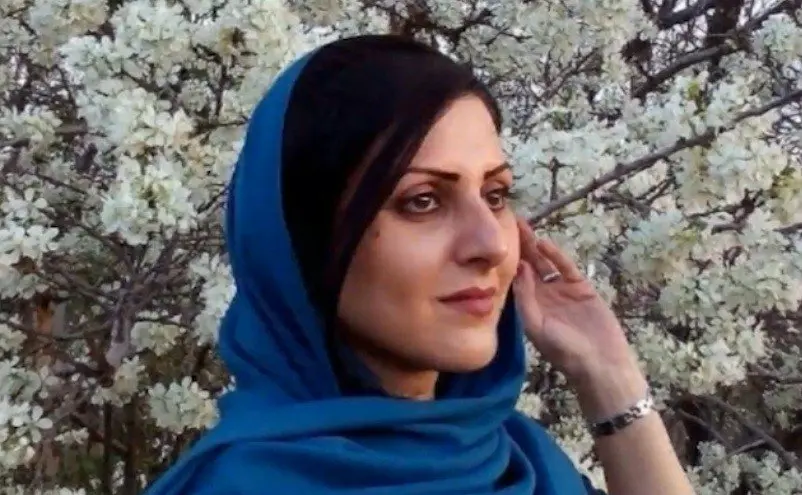
Golrokh Ebrahimi Iraee
Iran
Status: Imprisoned
While in prison during the COVID-19 pandemic, Iraee has written public letters to call attention to the conditions for women detained at Qarchak prison.
Photo courtesy of Front Line Defenders
Iran’s judiciary chief announced in March 2020 that prisons would temporarily release approximately 70,000 people; but this excluded many people accused of national security crimes, which accounted for 14 of the at least 19 writers and public intellectuals held by Iran last year.58“UN rights chief urges Iran to release jailed human rights defenders, citing COVID-19 risk,” UN News, October 6, 2020, news.un.org/en/story/2020/10/1074722 Writers and intellectuals including Nasrin Sotoudeh and Narges Mohammadi were not among those freed in the March release.59Reuters Staff, “Iran temporarily releases 70,000 prisoners as coronavirus cases surge,” Reuters, March 9, 2020, reuters.com/article/us-health-coronavirus-iran/iran-temporarily-releases-70000-prisoners-as-coronavirus-cases-surge-idUSKBN20W1E5 Cultural worker and scholar Aras Amiri was conditionally released from Iran’s Evin prison in April 2020 as part of a virus prevention measure; however, she was similarly ordered to return only three weeks later.60Patrick Wintour, “Fears rise Nazanin Zaghari-Ratcliffe may be returned to Iran jail,” The Guardian, May 5, 2020, theguardian.com/news/2020/may/05/fears-rise-nazanin-zaghari-ratcliffe-may-be-returned-to-iran-jail
In April 2020, Turkey’s parliament passed a law that reduced prison populations by a third,61Al-Monitor Staff, “Turkey to release thousands of prisoners as coronavirus sweeps through jails,” Al-Monitor, April 14, 2020, al-monitor.com/pulse/originals/2020/04/turkey-release-thousands-prisoners-coronavirus-outbreak-jail.html but this excluded people accused of crimes against the state.62Emma Sinclair-Webb, “Turkey Should Protect All Prisoners from Pandemic,” Dispatch, March 23, 2020, hrw.org/news/2020/03/23/turkey-should-protect-all-prisoners-pandemic; Kareem Fahim, “Turkish dissidents remain jailed as thousands of inmates are released to avoid prison epidemic,” The Washington Post, April 22, 2020, washingtonpost.com/world/middle_east/turkish-dissidents-remain-jailed-as-thousands-of-inmates-are-released-to-avoid-prison-epidemic/2020/04/22/8570e65a-83ea-11ea-81a3-9690c9881111_story.html As such, even writers and public intellectuals more senior in age or with existing medical conditions, such as 71-year-old novelist Ahmet Altan, were not granted release.
In India, one estimate reports that by July 2020, prisons had released approximately 61,000 people by order of the Supreme Court to reduce overcrowding,63John Letzing, “How prison populations can be protected from Covid-19,” The Print, July 5, 2020, theprint.in/features/how-prison-populations-can-be-protected-from-covid-19/453095/;
“STATE/UT WISE PRISONS RESPONSE TO COVID 19 PANDEMIC IN INDIA,” Commonwealth Human Rights Initiative, Accessed on March 18, 2021, humanrightsinitiative.org/content/stateut-wise-prisons-response-to-covid-19-pandemic-in-india but despite a plea for medical bail filed by poet Varavara Rao’s wife,64Press Trust of India, “Since Feb 2020, Varavara Rao Has Spent 149 Days In Hospitals: High Court Told,” NDTV, February 2, 2021, ndtv.com/india-news/since-feb-2020-varavara-rao-has-spent-149-days-in-hospitals-high-court-told-2361535 Rao was only granted a six-month medical furlough approximately six months after his positive COVID-19 diagnosis. Rao was released from custody on March 6, 2021, despite the National Investigation Agency (NIA) claiming that he was taking “undue advantage” of the pandemic.65Apoorva Mandhani, “2 years, 3 charge sheets & 16 arrests—Why Bhima Koregaon accused are still in jail,” The Print, October 31, 2020, theprint.in/india/2-years-3-charge-sheets-16-arrests-why-bhima-koregaon-accused-are-still-in-jail/533945/; “‘Free At Last’: Poet Varavara Rao, 81, Released After Last Month’s Bail,” NDTV, March 7, 2021, ndtv.com/india-news/free-at-last-poet-varavara-rao-81-released-after-last-months-bail-2385277 In Egypt, journalist and Cairo University professor Hassan Nafaa was released from custody on March 19, 2020, along with 14 other prominent opposition figures and political prisoners,66Gamal Essam El-Din, “Egypt: Political activists released,” Ahram Online, March 26, 2020, english.ahram.org.eg/NewsContent/50/1201/365939/AlAhram-Weekly/Egypt/Egypt-Political-activists-released.aspx a move to seemingly reduce overcrowding in the prison and avoid a coronavirus outbreak among prisoners. Yet experts estimate that Egypt continues to hold tens of thousands of political prisoners, and overcrowding and neglect threaten all those in its prisons.67Amnesty International, “Egypt: What do I care if you die,” Amnesty International, accessed March 24, 2021, amnesty.org/download/Documents/MDE1235382021ENGLISH.pdf; Ruth Michaelson, “Egypt’s political prisoners ‘denied healthcare and subject to reprisals’,” The Guardian, January 26, 2021, theguardian.com/global-development/2021/jan/26/egypts-political-prisoners-denied-healthcare-and-subject-to-reprisals
In December 2020, Eritrean authorities released 28 prisoners of conscience imprisoned in relation to their membership of the Jehovah’s Witnesses group.68Reuters Staff, “Eritrea frees 28 Jehovah’s Witnesses prisoners, group says,” Reuters, December 7, 2020, reuters.com/article/eritrea-politics-religion/eritrea-frees-28-jehovahs-witnesses-prisoners-group-says-idUSKBN28H1IE The Eritrean government, however, has not answered calls to release the several writers detained in 2001 on spurious terrorism charges, including writer and playwright Dawit Isaak and short-fiction writer Idris Said.69United Nations, “Independent Experts Denounce Rights Violations in Occupied Palestinian Territory, Iran, Eritrea as Third Committee Delegates Split over Questions of Bias,” press release, October 26, 2020, un.org/press/en/2020/gashc4302.doc.htm Saudi anti-corruption columnist Saleh Al-Shehi was released from prison in May 2020, but he was immediately hospitalized and placed on a ventilator for three weeks before passing away on June 19.70“Saudi writer dies from COVID-19 shortly after release from prison,” Middle East Monitor, July 20, 2020, middleeastmonitor.com/20200720-saudi-writer-dies-from-covid-19-shortly-after-release-from-prison/ Some report that he contracted COVID-19 in prison, while others state his health had already deteriorated after years of imprisonment.71“Saudi Arabia: Writer and journalist Saleh Al-Shehi dies following release from prison,” The Gulf Centre for Human Rights, July 20, 2020, gc4hr.org/news/view/2430; “Saudi writer dies from COVID-19 shortly after release from prison.” Al-Shehi had been arrested in January 2018 and sentenced to five years in prison for “insulting the royal court.”72“Saudi writer dies from COVID-19 shortly after release from prison.”
Isolation and Delayed Proceedings
Authorities have also invoked the pandemic to justify the isolation of imprisoned writers from their families and to delay legal proceedings. In May, Saudi prison officials reportedly invoked COVID-19 as a justification for denying Loujain Al-Hathloul the opportunity to see her family, despite her earlier contact with her family during the pandemic.73Chantal Da Silva, “Saudi Women’s Rights Activist Detained for Two Years While Awaiting Trial Must Be Released During Pandemic, Sister Says,” Newsweek, May 15, 2020, newsweek.com/saudi-womens-rights-activist-detained-two-years-while-awaiting-trial-must-released-during-1504160 In late August 2020, Al-Hathloul went on a six-day hunger strike to protest the denial of all communication with her family, with her sister noting that they had any contact with her since early June abrupt denial of outside communication; authorities finally permitted her to see her family on August 31.74MEE Staff, “Saudi activist Loujain al-Hathloul’s health ‘deteriorating’ amid hunger strike,” Middle East Eye, September 1, 2020, middleeasteye.net/news/saudi-activist-loujain-hathloul-hunger-strike Public reporting indicates that such communication denials appeared to be aimed at the kingdom’s most prominent detainees, demonstrating a political motivation.75Vivan Nereim, “Saudi Arabia’s Most Famous Prisoners Go Silent During Pandemic,” Bloomberg News, August 25, 2020, https://www.bloomberg.com/news/articles/2020-08-26/saudi-arabia-s-most-famous-prisoners-go-silent-during-pandemic?sref=p1whY86y
In January 2020, prisons in the UAE ended all in-person visits due to COVID-19 restrictions and moved to providing communication via phone calls.76“United Arab Emirates: Ahmed Mansoor denied contact with his family, remains in prison in unsanitary conditions,” The Gulf Centre for Human Rights, June 6, 2020, gc4hr.org/news/view/2408; “Covid-19 continues to spread in UAE prisons,” Middle East Monitor, June 22, 2020, middleeastmonitor.com/20200622-covid-19-continues-to-spread-in-uae-prisons/ However, for at least several months, imprisoned Emirati poet Ahmed Mansoor was not even able to communicate with his family via phone.77“United Arab Emirates: Ahmed Mansoor denied contact with his family, remains in prison in unsanitary conditions.” At Guanghua Prison in Hubei Province, China, writer Qin Yongmin was denied virtual communication ostensibly due to the COVID-19 pandemic, despite the end of the lockdown in Hubei two months prior.78Chinese Human Rights Defenders, “China: Stop Using COVID-19 for Unnecessary Restrictions on Detainees’ Visitation Rights,” Chinese Human Rights Defenders, June 22, 2020, nchrd.org/2020/06/china-stop-using-covid-19-for-unnecessary-restrictions-on-detainees-visitation-rights/ While prisons are obligated to implement reasonable COVID-19 prevention measures, these cannot justify the denial of opportunities for remote communications.
While many countries faced challenges in keeping court proceedings moving during the pandemic, the conditions imposed by COVID-19 also created a convenient excuse for drawing out the legal processes for a number of writers and intellectuals. In several countries, in-person court proceedings were stalled for long periods of time, leaving many ongoing cases in limbo and further prolonging the incarceration of unjustly detained people. In May 2020, after Saudi courts closed due to COVID-19, the trial proceedings of several women activists and writers who had already spent two years in arbitrary detention, including Loujain Al-Hathloul, Nassima Al-Sadah, and Nouf Abdulaziz, were postponed for months.79“Continuing arbitrary detention of Mses. Loujain al-Hathloul, Mayaa al-Zahrani, Samar Badawi, Nassima al-Sadah and Nouf Abdelazi,” World Organisation Against Torture, March 19, 2020, omct.org/human-rights-defenders/urgent-interventions/saudi-arabia/2020/03/d25746/ In December 2020, authorities delayed court proceedings against Sri Lankan poet Ahnaf Jazeem by several months due to COVID-19. Jazeem was arrested in May 2020 under the Prevention of Terrorism Act, with authorities speciously claiming that he promoted extremism in his book of poetry Navarasam.80“Poetic injustice: Another writer languishes in prison under PTA in Sri Lanka,” Sri Lanka Brief, December 14, 2020, srilankabrief.org/poetic-injustice-another-writer-languishes-in-prison-under-pta/; Ruwan Laknath Jayakody, “Complaint Lodged With HRCSL Over Poet Ahnaf Jazeem Detained Under PTA,” Colombo Telegraph, December 31, 2020, colombotelegraph.com/index.php/complaint-lodged-with-hrcsl-over-poet-ahnaf-jazeem-detained-under-pta/ Imprisoned Cameroonian writer and filmmaker Tsi Conrad’s appeal has been upended by COVID-19’s impact on court proceedings, to the point where Conrad received a new judge in October and was forced to start the appeals process from the beginning. In all, Conrad’s appeal has been postponed seven times, a delay of over a year.81“Tsi Conrad,” Committee to Protect Journalists, accessed March 24, 2021, cpj.org/data/people/tsi-conrad/
Countries of Concern
China, Saudi Arabia, and Turkey continue to lead in the concentrated targeting of writers and intellectuals, with each holding more than 20 detained or imprisoned writers in 2020, and China alone accounting for 81 of the writers and intellectuals held behind bars last year.
In China, which includes the Xinjiang and Tibetan Autonomous Regions, Inner Mongolia, and Hong Kong, the total number increased from the previous year, from 73 to 81. The totals for China—excluding the autonomous or special administrative regions of Xinjiang, Tibet, Inner Mongolia, and Hong Kong—and Tibet both increased, in substantial part as a result of the targeting of writers and online commentators who spoke out about the government’s handling of and response to the emergence of COVID-19.
Within China (excluding Tibet, Xinjiang, Inner Mongolia, and Hong Kong), PEN America places the number of imprisoned writers or public intellectuals at 39. Many of these writers are political dissidents who have been targeted for their criticism of the Chinese Communist Party; people like the 2020 PEN/Barbey Freedom to Write Award honoree Xu Zhiyong, who was arrested in February while in hiding from the police and after penning an essay critical of President Xi Jinping’s leadership, including his handling of the COVID-19 outbreak, and calling on Xi to resign.82Emily Feng, “Rights Activist Xu Zhiyong Arrested In China Amid Crackdown On Dissent,” NPR, February 17, 2020, npr.org/2020/02/17/806584471/rights-activist-xu-zhiyong-arrested-in-china-amid-crackdown-on-dissent Initially charged with “inciting subversion,” the charges against Xu were reportedly upgraded in January 2021 to “subversion of state power,” which carries a potential life sentence.83PEN America, “Reports: China to Escalate Charges Against Pen America Honoree Xu Zhiyong,” press release, January 22, 2020, pen.org/press-release/reports-china-to-escalate-charges-against-pen-america-honoree-xu-zhiyong/ Xu has also reported being tortured while in custody.84Guo Rui, “China arrests girlfriend of detained legal activist Xu Zhiyong on subversion charge,” South China Morning Post, March 15, 2021, scmp.com/news/china/politics/article/3125558/china-arrests-girlfriend-detained-legal-activist-xu-zhiyong Others detained in China this past year for their criticism of the Party or its leadership include scholar Chen Zhaozhi, who has been detained since March 2020 and is facing charges of “picking quarrels and provoking troubles” for his criticism of the government’s response to COVID;85“Chen Zhaozhi,” Network of Chinese Human Rights Defenders (CHRD), August 28, 2020, nchrd.org/2020/08/chen-zhaozhi/ and poet Zhang Guiqi, facing charges of “inciting subversion” after publicly calling for President Xi’s resignation in May 2020.86Taiwan News, “Chinese poet arrested for demanding Xi’s resignation in online video,” Taiwan News, June 23, 2020, taiwannews.com.tw/en/news/3951952
Others have been targeted for speaking out against official discrimination toward minority groups in China or against local-level corruption. The poet Cui Haoxin, who has consistently spoken out against the discriminatory treatment of Muslims in the country, including the abuses in Xinjiang, was arrested in January 2020 similarly on charges of “picking quarrels and provoking troubles.”87Sing Man, Ng Yik-tung, and Wang Yun, “China Detains Hui Muslim Poet Who Spoke Out Against Xinjiang Camps,” Radio Free Asia, January 27, 2020, rfa.org/english/news/china/poet-01272020163336.html Little is known about his case, his detention conditions, or even if he has received a trial date, and he has spent the last year incommunicado. Journalist Chen Jieren was sentenced to 15 years’ imprisonment in 2020, following two years of incommunicado detention, after blogging about allegations of corrupt local officials.88Wang Zhicheng, “Journalist Chen Jieren gets 15 years for ‘denigrating’ the Communist Party with corruption charges,” AsiaNews.it, May 2, 2020, asianews.it/news-en/Journalist-Chen-Jieren-gets-15-years-for-%E2%80%9Cdenigrating%E2%80%9D-the-Communist-Party-with-corruption-charges-49976.html Consistent with its broader, ever-increasing efforts to stifle dissent and control expression, the Chinese Communist Party continues to treat peaceful criticism of its rule as a heinous crime.
Yet one does not have to criticize the government or its policies to run afoul of Beijing’s criminalization of vast categories of speech. Graphic novelist Liu Tianyi remains in prison serving a 10-year sentence for her homoerotic novel Occupy, after being sentenced in 2018. Writer and photographer Du Bin was detained in December for “picking quarrels and provoking trouble,” a month before the publication of his book analyzing early Soviet Communism—seeming to indicate that even historical inquiry that touches indirectly on the Chinese Communist Party’s governance may be subject to a governmental “veto” in the form of criminal charges. Authorities also questioned Du about his previous books, before eventually releasing him conditionally after 37 days.89Gao Feng, “Author Du Bin, a writer suspected of being manipulated by foreign organizations, was released from criminal detention for more than a month,” Radio Free Asia, January 26, 2021, rfa.org/mandarin/yataibaodao/renquanfazhi/gf2-01262021085156.html (Mandarin: 高锋, “疑受境外组织操控出书 作家杜斌被刑拘逾月终获释,” 自由亚洲电台, January 26, 2021, rfa.org/mandarin/yataibaodao/renquanfazhi/gf2-01262021085156.html)
A small but important subset of imprisoned writers in China are citizens of other countries. Chinese-born Swedish poet and publisher Gui Minhai, who was kidnapped from his vacation home in Thailand by Chinese security agents in 2015, was sentenced to 10 years’ imprisonment in February 2020 for “illegally providing evidence overseas”—a charge seemingly related to Gui having been in touch with his own country’s consular officials.90Lily Kuo, “Hong Kong bookseller Gui Minhai jailed for 10 years in China,” The Guardian, February 25, 2020, theguardian.com/world/2020/feb/25/gui-minhai-detained-hong-kong-bookseller-jailed-for-10-years-in-china Gui’s case is particularly urgent as he has reportedly been diagnosed with the neurodegenerative disease amyotrophic lateral sclerosis, or ALS.91“Detained bookseller Gui Minhai had been told to seek medical treatment for ALS overseas, daughter says,” South China Morning Post, January 25, 2018, scmp.com/yp/discover/news/asia/article/3069441/detained-bookseller-gui-minhai-had-been-told-seek-medical Beijing has repeatedly ignored or denied that Gui is a Swedish citizen, at one point even claiming that Gui had conveniently renounced his Swedish citizenship while imprisoned.92Peter Dahlin, “Jailed bookseller: With Gui Minhai citizenship ploy, Beijing infringes int’l law and its own rules,” Hong Kong Free Press, February 29, 2020, hongkongfp.com/2020/02/29/jailed-bookseller-gui-minhai-citizenship-ploy-beijing-infringes-intl-law-rules/ Yang Hengjun, a Chinese-born Australian writer, was detained during a visit to China in January 2019, and officially charged with espionage in October 2020, after reportedly being subjected to hundreds of interrogation sessions.93Kirsty Needham, “Detained Australian Yang Hengjun set to face trial in Beijing,” Reuters, October 9, 2020, reuters.com/article/uk-australia-china-writer/detained-australian-yang-hengjun-to-face-trial-in-beijing-idUKKBN26V031 These cases appear to indicate an ever-more-muscular approach from Beijing toward silencing its critics, wherever they may be.
We include six cases from Tibet, a number double that of last year’s three cases. This number increased, in major part, as a result of public reporting revealing that singer-songwriters Lhundrub Drakpa and Khando Tsetan had been detained in 2019 and sentenced in 2020 on national security charges in relation to their music.94“China imprisons two Tibetans for song praising His Holiness the Dalai Lama,” Central Tibetan Administration, July 21, 2020, tibet.net/china-imprisons-two-tibetans-for-song-praising-his-holiness-the-dalai-lama/; “Tibetan Singer Sentenced to Six Years in Prison in Driru: China Committing ‘Crimes against Humanity’ in Tibet,” Tibetan Centre for Human Rights and Democracy, October 30, 2020, tchrd.org/tibetan-singer-sentenced-to-six-years-in-prison-in-driru-china-committing-crimes-against-humanity-in-tibet/ The third addition to the 2020 Index from the previous year, poet and essayist Gendun “Lhamko” Lhundrub, was detained in December.95“Tibetan Writer Arrested in Qinghai, Whereabouts Unknown,” Radio Free Asia, December 4, 2020, rfa.org/english/news/tibet/writer-12042020164144.html; “Tibetan writer arrested, whereabouts remain unknown,” Phayul, December 7, 2020, phayul.com/2020/12/07/44897/ As we discuss further within this report, it remains the case that writers and public intellectuals who advocate for Tibetan cultural expression or decry CCP policies affecting Tibetans risk being treated as national security threats for their peaceful expression.
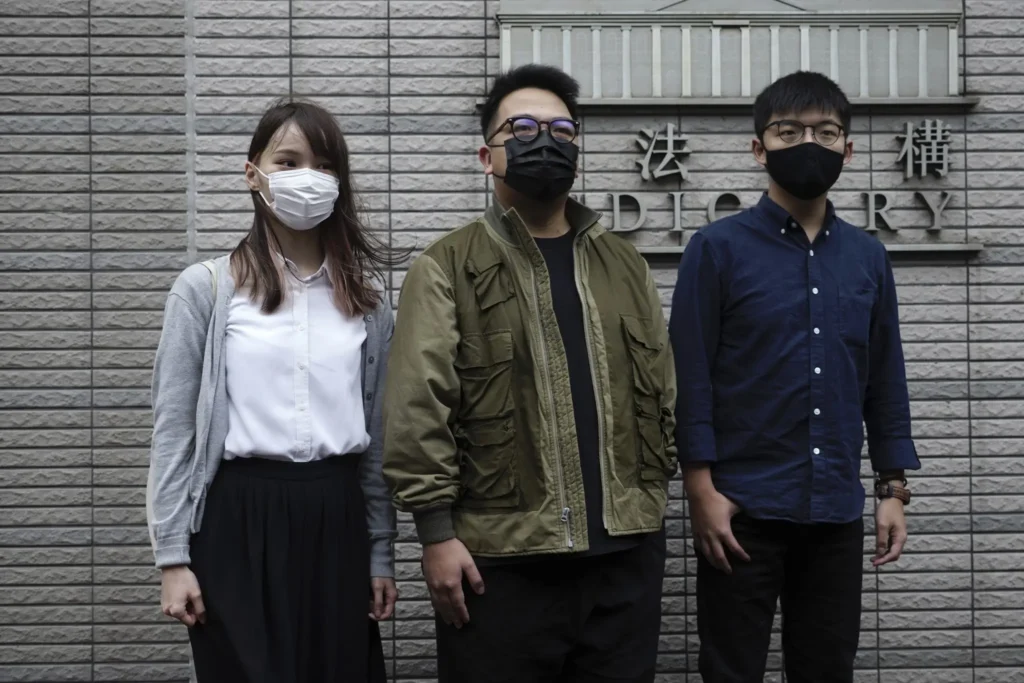
In Hong Kong, academics and writers who led pro-democracy movements in previous years continued to face severe threats. The total number of writers and intellectuals imprisoned in 2020 in Hong Kong is comparatively low—only three cases, down from last year’s six. This number, however, fails to capture the devastating and chilling effect that the passage of Hong Kong’s repressive National Security Law in June has had on freedom of expression in the city.96“Hong Kong’s national security law: 10 things you need to know,” Amnesty International, July 17, 2020, amnesty.org/en/latest/news/2020/07/hong-kong-national-security-law-10-things-you-need-to-know/ With the swift implementation of the National Security Law, writers and public intellectuals have encountered strict limitations on acceptable literature, school curriculum, and the press, while the specter of criminal charges looms over anyone who would participate in or even support the city’s besieged pro-democracy movement. The numbers for Hong Kong also do not incorporate the stunning arrest of over 50 pro-democracy leaders in January of 2021—outside the time frame of the 2020 Index—under this same law, a sweeping political purge that illustrates the draconian nature of the law as well as Beijing’s willingness to ruthlessly repress protest and civic debate in the region.97Rebecca Falconer, “Hong Kong police arrest 50 pro-democracy leaders under security law,” Axios, January 6, 2021, axios.com/hong-kong-police-arrest-50-pro-democracy-activists-under-security-law-a0cde4ca-c009-48fb-ba1c-828e47ff6736.html
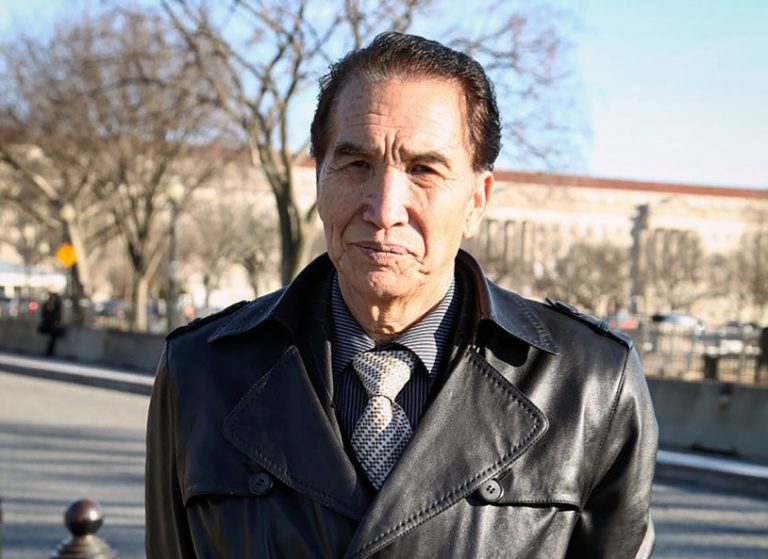
Qurban Mamut
China/Xinjiang Uyghur Autonomous Region
Status: Detained
While information about his detention is limited, the detention of Mamut, a prominent Uyghur literary and cultural figure, is emblematic of the Chinese government’s ongoing assault on Uyghur culture.
Photo courtesy of Bahram Sintash
The total for Xinjiang stands at 33, nearly equivalent to last year’s figure of 32. However, as we similarly noted in last year’s Freedom to Write Index, this figure is certainly an incomplete accounting of the real number of detained and imprisoned writers and intellectuals among the vast number of people unjustly detained in Xinjiang, given the government’s highly effective tactics to essentially cut off the region from the rest of the world—from censoring domestic media, to restricting foreign media access, to imposing totalitarian levels of control over the populace itself.98For additional information on the detention of writers, intellectuals, and other cultural figures in Xinjiang, see the following reports from the Uyghur Human Rights Project: Detained and Disappeared: Intellectuals Under Assault in the Uyghur Homeland, March 25, 2019, uhrp.org/report/detained-and-disappeared-intellectuals-under-assault-uyghur-homeland-html/; UHRP Update: The Persecution of the Intellectuals in the Uyghur Region Continues, January 28, 2019, uhrp.org/report/persecution-intellectuals-uyghur-region-continues-html/; UHRP Report: The Persecution of the Intellectuals in the Uyghur Region: Disappeared Forever?, October 2018, uhrp.org/report/persecution-intellectuals-uyghur-region-disappeared-forever-html/
The figures for Xinjiang include some of the leading lights of the region’s literary and cultural community. Chimengül Awut, an award-winning poet and editor, was sent to a “re-education camp” in 2018 after editing a novel by another Uyghur writer, until she was finally released in December 2020.99Lily Kuo, “Poetry, the soul of Uighur culture, on verge of extinction in Xinjiang,” The Guardian, December 5, 2020, theguardian.com/world/2020/dec/06/poetry-the-soul-of-uighur-culture-on-verge-of-extinction-in-xinjiang; PEN International, “We have just received new information which supports reports that Uyghur-language poet, Chimengül Awut, has been released from Xinjiang’s re-education camps’” Twitter, December 5, 2020, twitter.com/pen_int/status/1335334475258064901 Qurban Mamut, the former editor-in-chief of the journal Xinjiang Civilization, went missing in November 2017, and it took almost a year before his family was able to confirm he was being held in an internment camp—where he presumably is still located.100Shohret Hoshur and Joshua Lipes, “Prominent Uyghur Journalist Confirmed Detained After Nearly Three Years,” Radio Free Asia, September 6, 2020, rfa.org/english/news/uyghur/detained-06092020170643.html Abdurehim Heyit, a Uyghur folk musician, similarly disappeared in 2017, before resurfacing in 2019 with a “proof of life” video that is widely believed to have been coerced by government officials.101“Abdurehim Heyit Chinese video ‘disproves Uighur musician’s death,’” BBC, February 11, 2019, bbc.com/news/world-asia-47191952 Heyit similarly remains cut off from the wider world to this day.
In 2020, the world continued to learn new information about other Uyghur writers who had gone missing. Songwriter and comedian Ablikim Kalkun was handed an 18-year sentence in 2019 for crimes including “separatism” and “religious extremism” after singing songs that authorities disapproved of. Yet his sentence was only confirmed in 2020, after an anonymous source tipped off Radio Free Asia reporters.102Shohret Hoshur and Joshua Lipes, “Xinjiang Authorities Jail Prominent Uyghur Comedian Over ‘Extremist and Separatist’ Songs,” Radio Free Asia, October 6, 2020, rfa.org/english/news/uyghur/comedian-10062020124834.h The first public claims over Kalkun’s detention, of which PEN America is aware, date back to 2019, from activist Abduweli Ayup, on his Facebook page: m.facebook.com/story.php?story_fbid=2788286744540533&id=100000777053688 Similarly, poet Qasim Sidiq was disappeared by authorities in 2017 after they alleged he had incited “ethnic hatred” with his song lyrics and poems, yet his detention was only confirmed in 2021.103Shohret Hoshur and Joshua Lipes, “Missing Uyghur Poet and Teacher Confirmed Detained After Nearly Four Years,” Radio Free Asia, January 1, 2021, rfa.org/english/news/uyghur/poet-01072021174718.html
The government’s targeting of writers, cultural figures, academics, and others in the region is deliberate, and part and parcel of its larger efforts to systemically erase Uyghur culture and forcibly remake Uyghurs into obedient subjects of the state—efforts that have led to the forced internment of over a million people,104“China: Massive Numbers of Uyghurs & Other Ethnic Minorities Forced into Re-education Programs,” CHRD, August 3, 2018, nchrd.org/2018/08/china-massive-numbers-of-uyghurs-other-ethnic-minorities-forced-into-re-education-programs/; see also “China: Massive Crackdown in Muslim Region,” Human Rights Watch, September 9, 2018, hrw.org/news/2018/09/09/china-massive-crackdown-muslim-region the omnipresent and dystopian surveillance regime that authorities have set up in the region,105Chris Buckley and Paul Mozur, “How China Uses High-Tech Surveillance to Subdue Minorities,” The New York Times, May 22, 2019, nytimes.com/2019/05/22/world/asia/china-surveillance-xinjiang.html; Chris Buckley and Austin Ramzy, “The Xinjiang Papers—‘Absolutely No Mercy’: Leaked Files Expose How China Organized Mass Detentions of Muslims,” The New York Times, November 16, 2019, nytimes.com/interactive/2019/11/16/world/asia/china-xinjiang-documents.html; “China: Minority Region Collects DNA from Millions,” Human Rights Watch, December 13, 2017, hrw.org/news/2017/12/13/china-minority-region-collects-dna-millions; “China: Voice Biometric Collection Threatens Privacy,” Human Rights Watch, October 22, 2017, hrw.org/news/2017/10/22/china-voice-biometric-collection-threatens-privacy and the de facto criminalization of Uyghur cultural and religious expression.106“More Evidence of China’s Horrific Abuses in Xinjiang,” Human Rights Watch, February 20, 2020, hrw.org/news/2020/02/20/more-evidence-chinas-horrific-abuses-xinjiang
PEN America’s figures also include writers and intellectuals imprisoned before the systemic internment of Uyghurs began in 2017, demonstrating that these attacks on Uyghur culture did not originate with the camps.107“China: Free Xinjiang ‘Political Education’ Detainees,” Human Rights Watch, September 10, 2017, hrw.org/news/2017/09/10/china-free-xinjiang-political-education-detainees Gulmira Imin, a poet and Uyghur-language website moderator, was sentenced to life imprisonment in 2010 on “splittism” and other charges.108Mamatjan Juma and Alim Seytoff, “‘Gulmira Imin Must Not be Forgotten’,” Radio Free Asia, February 16, 2018, rfa.org/english/news/uyghur/forgotten-02162018163053.html She remains in prison to this day, as does Ilham Tohti, an economics professor and the 2014 PEN/Barbey Freedom to Write Award honoree, whose blog on Uyghur-Han relations served as the basis for national security charges against him.109“Ilham Tohti: Uighur activist’s daughter fears for his life,” BBC, December 18, 2019, bbc.com/news/world-asia-china-50842514 He is currently serving a life sentence. As the wider world becomes more aware of the CCP’s abuses in Xinjiang, these cases serve as potent reminders that the cultural oppression of the Uyghurs has been ongoing for many years. Writers and intellectuals from other ethnic minorities have also been targeted. Kazakh writer Nagyz Muhammed was arrested in Xinjiang in 2018, and later sentenced to life in prison for splittism.110“China: Further information: Life imprisonment for missing Kazakh writer,” Amnesty International, October 29, 2020, amnesty.org/download/Documents/ASA1732792020ENGLISH.pdf His supposed crime was to express his opinions on policies in the region at a meeting with friends, years before.
In both Saudi Arabia and Turkey, the number of writers either detained or imprisoned during 2020 decreased slightly, as compared to 2019. In Saudi Arabia, a number of dissident writers and intellectuals have been released, though often with stringent conditions that prevented them from returning to their writing or professional life; in addition, many continued to face legal charges or ongoing trials. These cases include many advocates who have supported greater women’s rights through their writings, such as academic Hatoon Al-Fassi, detained in the broad sweep of women human rights defenders in May 2018, and held for a full year until being released in May 2019, and professor and columnist Eman Al-Nafjan, also detained in May 2018 and subjected to abuse in custody before being conditionally released in March 2019. Although there were widespread detentions of groups of women’s rights activists and advocates in 2018 and 2019, 2020 saw no similar large-scale new arrests. A few writers, however, were detained for expressing their support for other prominent Saudi activists and rights defenders. Novelist Ali Al-Shadwi, writer and professor Aql Al-Bahili, and writer and economist Abdulaziz Al-Dukhail were arrested in April 2020 after expressing condolences online after the death of imprisoned activist Abdullah Al-Hamid.111“Journalists And Intellectuals Arrested For Expressing Condolences Over The Death Of Reformer Abdullah Al-Hamid,” ALQST, July 21, 2020, alqst.org/en/post/journalists-and-intellectuals-arrested-over-the-death-of-Abdullah-al-Hamid; “Saudi jailed ex-deputy finance minister, son says,” Middle East Monitor, July 24, 2020, middleeastmonitor.com/20200724-abdulaziz-al-dakhils-son-says-father-is-in-al-hair-prison/
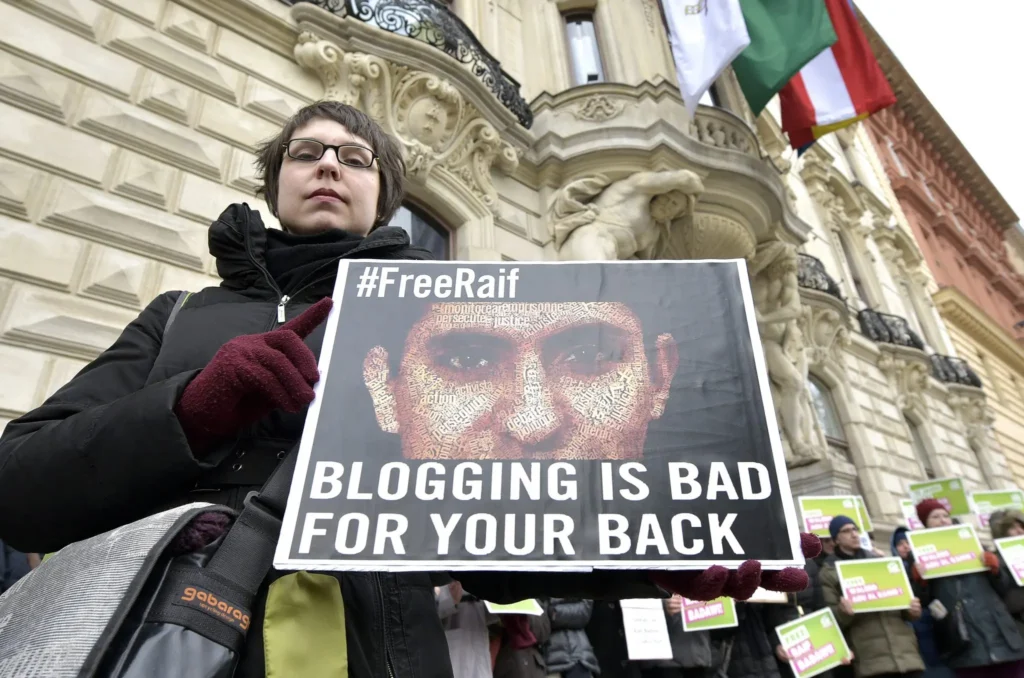
Cases of arbitrary detention are particularly common in Saudi Arabia, where at last 66 percent of writers and public intellectuals are held on unknown or undisclosed charges.
The majority of cases in Saudi Arabia this year represent writers and public intellectuals who have been in prison for extended periods of time;112“Abuses Under Scrutiny: Human Rights in Saudi Arabia,” ALQST, accessed March 17, 2021, alqst.org/uploads/Abuses-Under-Scrutiny-En.pdf many have been in custody for five years or longer. Saudi authorities have held blogger Fadhel Al-Manasef, for example, in some form of state custody since 2011,113“Case History: Fadhel Mekki Al-Manasef,” Front Line Defenders, accessed March 22, 2021, frontlinedefenders.org/en/case/case-history-fadel-mekki-al-manasef and Raif Badawi, a blogger and creator of the Free Saudi Liberals website, was detained in 2012 and sentenced to 10 years in prison, 1,000 lashes, and a fine of 1 million Saudi riyals in 2014.114“Raif Badawi,” Committee to Protect Journalists, accessed March 18, 2021,cpj.org/data/people/raif-badawi/ Women’s rights writer-activists such as Loujain Al-Hathloul, Nouf Abdulaziz, and Nassima Al-Sadah remained in detention throughout 2020. After hearings in the legal cases against the women resumed, in late December, Al-Hathloul was sentenced to five years and eight months, ostensibly on national security charges.115PEN America, “Loujain Al-Hathloul Sentenced in Sham Saudi Trial,” press release, March 15, 2021, pen.org/press-release/loujain-al-hathloul-sentenced-in-sham-saudi-trial/ Although the first months of 2021 have seen a flurry of releases, including of Al-Hathloul and Abdulaziz, the environment for free expression in Saudi Arabia remained extremely poor in 2020, with harsh repercussions directed at dissidents who dared to speak out, as well as their families; efforts to intimidate Saudi commentators based abroad through online trolling and threats, surveillance, and hacking; and ongoing impunity for past cases of grave abuse perpetrated by the Saudi state, such as the murder of exiled journalist and columnist Jamal Khashoggi.
While the numbers of writers imprisoned in Turkey during 2020 decreased from the previous year, this does not indicate an improvement in the environment for freedom of expression in the country. At least 25 writers and public intellectuals were held in detention or in prison in Turkey during 2020, once again putting the country third behind only China and Saudi Arabia. Many of the prominent writers and activists who were included in the 2019 Freedom to Write Index remained imprisoned in Turkey, including novelist Ahmet Altan and poet Nedim Türfent, among dozens of others. Several members of the activist collective and musical group Grup Yorum continue to face threats: musicians Emel Yeşilırmak, Tuğçe Tayyar, and Barış Yüksel spent time in jail during 2020, while some members fled Turkey in exile. Tragically, Grup Yorum’s İbrahim Gökçek died two months following his conditional release and after 323 days on hunger strike this year. Gökçek’s death came only one month after the death of a second hunger-striking band member, Helin Bölek, who maintained her strike for 288 days, even after her release in November 2019. Many of the writers and columnists arrested in 2016 and 2017 on charges of being affiliated with the movement of Fetullah Gülen, including Ali Ünal and other former writers for the Zaman newspaper, remain imprisoned as well.
In 2020, Turkey implemented new statutes that only further constrain the space for free expression in the country and concentrate President Erdoğan’s power. President Erdoğan introduced legislation allowing the government to replace members of civil society organizations if a member is deemed a terrorist, which is a common designation wielded against dissidents and critics under Turkey’s sweeping anti-terrorism law.116“One Man’s Terrorist: Covid-19 and repression in Turkey,” The Economist, January 16, 2021, economist.com/europe/2021/01/16/covid-19-and-repression-in-turkey; Ali Kucukgocmen, “Turkey debates law that would increase oversight of NGOs,” Reuters, December 25, 2020, reuters.com/article/us-turkey-foundations-law/turkey-debates-law-that-would-increase-oversight-of-ngos-idUSKBN28Z0S9 This new statute could threaten the free association of cultural organizations already under threat for the work of their leaders and members, including detained publisher Mehmet Osman Kavala’s Anadolu Kültür.117Hakim Bishara, “Turkey Targets Osman Kavala’s Arts Organization in Unprecedented Lawsuit,” Hyperallergic, February 16, 2021, hyperallergic.com/622473/turkey-targets-osman-kavalas-arts-organization-in-unprecedented-lawsuit/ Writers expressing criticism of the ruling party or even President Erdoğan’s family have been opportunistically prosecuted or personally maligned. Significant amendments to Internet Law No. 5651118PEN America, “Turkey’s New Social Media Law Puts Stranglehold on Free Expression,” press release, July 30, 2020, pen.org/press-release/turkeys-new-social-media-law-puts-stranglehold-on-free-expression/; Kayahan Cantekin, “Turkey: Parliament Passes Law Imposing New Obligations on Social Media Companies,” August 6, 2020, loc.gov/law/foreign-news/article/turkey-parliament-passes-law-imposing-new-obligations-on-social-media-companies/ to curb expression online came after President Erdoğan’s daughter and son-in-law were insulted on social media, and the president called for a “cleaning up” of the platforms119The Cube, “Turkish law tightening rules on social media comes into effect,” Euro News, October 1, 2020, euronews.com/2020/10/01/turkish-law-tightening-rules-on-social-media-comes-into-effect In June 2020, three months into an already unjust detention,120Prosecutors charged Ağırel with spreading national security secrets for allegedly tweeting the name of a Turkish National Intelligence Organization officer who was killed in Libya. Six other journalists were also arrested for covering the story. “Turkey charges 7 journalists over coverage of intelligence agent’s death,” Committee to Protect Journalists, May 13, 2020, cpj.org/2020/05/turkey-charges-7-journalists-over-coverage-of-inte/ columnist and author Murat Ağırel became the subject of an investigation by prosecutors at the behest of President Erdoğan’s two sons, who claimed that Ağırel “insulted” them in Ağırel’s book Sarmal.121“Prosecutors launch another investigation into journalist Murat Ağırel upon Erdoğan family’s complaint,” Duvar English, June 18, 2020, duvarenglish.com/media/2020/06/18/prosecutors-launch-another-investigation-into-journalist-murat-agirel-upon-erdogan-familys-complaint Ağırel was released in September 2020 but has since faced intense harassment, including death threats and surveillance by unmarked cars.122“Murat Ağırel: When I was with my family, they blocked me by car,” Cumhuriyet, January 19, 2021, cumhuriyet.com.tr/haber/murat-agirel-ailemle-beraberken-arabayla-onumu-kestiler-1807308
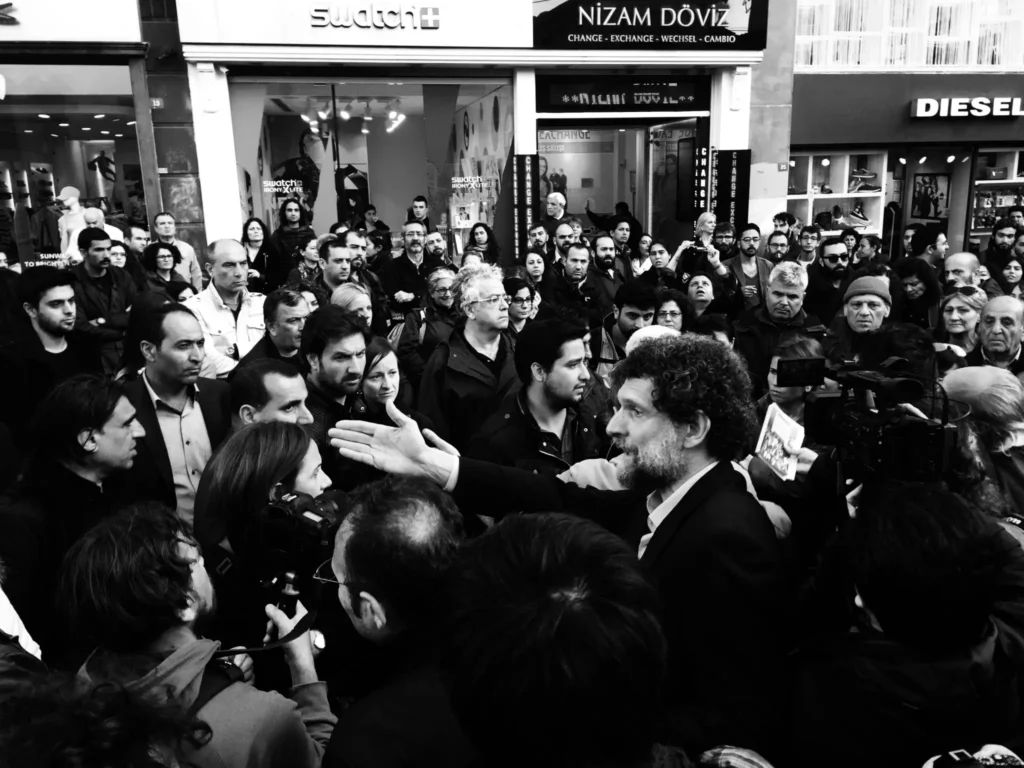
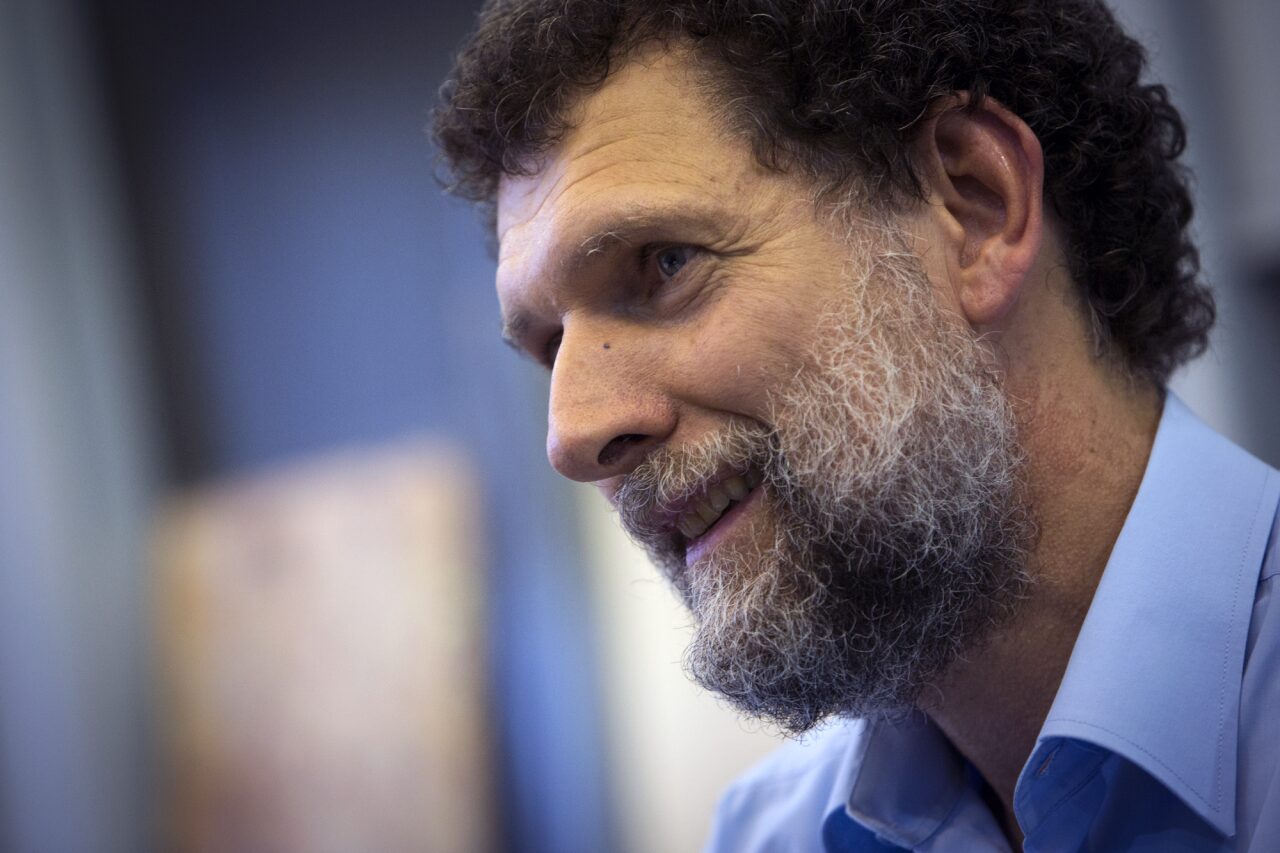
Mehmet Osman Kavala
Turkey
Status: Detained
Kavala has been repeatedly arrested on spurious charges since 2017 for his work to foster cross-cultural dialogue.
Photo by Kerem Uzel
The European Court of Human Rights (ECHR) ruled in the last year that Turkish authorities violated the fundamental rights of opposition leader and writer Selahattin Demirtaş and cultural philanthropist and publisher Mehmet Osman Kavala, that their detentions were politically motivated, and that they must be immediately released.123Levent Kenez, “Turkish judge on Europe’s top human rights court acts as Erdoğan’s Trojan horse,” Nordic Monitor, January 16, 2021, nordicmonitor.com/2021/01/turkish-judge-on-europes-top-human-rights-court-acts-as-erdogans-trojan-horse/ Despite the fact that the ECHR’s rulings are legally binding per the Turkish constitution,124Kenez, “Turkish judge.” Turkey’s courts have ignored these orders. Turkish authorities have brought additional criminal charges against both Demirtaş and Kavala during 2020 in an apparent effort to keep them imprisoned. Kavala was acquitted of several charges, notably that he allegedly conspired to “overthrow the government,” by Istanbul’s 30th Assize Court and walked free on February 18, 2020, only to be re-detained on another set of charges the same day.125BIA News Desk, “Verdict of Acquittal in Gezi Trial, Ruling of Release for Osman Kavala,” Bianet, February 18, 2020, bianet.org/5/97/220202-gezi-trial-continues-today; “Implementing ECHR judgments: Council of Europe urges Turkey to release Osman Kavala,” Council of Europe, September 4, 2020, coe.int/en/web/portal/-/implementing-echr-judgments-council-of-europe-urges-turkey-to-release-osman-kavala These baseless charges impact not only Kavala, but writers and public intellectuals around the world as well. In October 2020, American scholar Henri Barkey was also charged as a codefendant in yet another indictment against Kavala.126PEN America, “Turkey Must Release Osman Kavala and Drop Charges Against Him and Henri Barkey,” press release, October 28, 2020, pen.org/press-release/turkey-must-release-osman-kavala-and-drop-charges-against-him-and-henri-barkey/
The number of jailed writers in Iran increased in 2020 from 14 to 19, despite the welcome release of several prominent critical voices, including Narges Mohammadi, who was released in October 2020 after serving out her sentence, and French-Iranian scholar Fariba Adelkhah, who received a conditional release in October but remains under house arrest in Tehran, unable to return to France. Particularly notable in 2020 was a deepening crackdown on members of a professional organization, the Iranian Writers Association (IWA), which has been targeted in the past due to their insistence on upholding the rights to free expression and association. Several IWA board members—poet and filmmaker Baktash Abtin, writer Keyvan Bajan, and writer Reza Khandan Mahabadi—were arrested in late January 2019 for opposing state censorship policies, eventually released on bail a few days later. They were then convicted of threatening national security on May 15, 2019, and after repeated appeals to delay their incarceration on health grounds due to COVID failed, they were forced to begin serving their sentences on September 26, 2020, at Evin prison.127“Three Iranian Authors Imprisoned In Tehran’s Notorious Jail,” Radio Farda, September 27, 2020, en.radiofarda.com/a/three-iranian-authors-imprisoned-in-tehran-s-notorious-jail/30860892.html
Secretary of the IWA and writer/translator Arash Ganji was first detained in December 2019, and again in June 2020. On December 28, 2020, he was sentenced to 11 years in prison on national security charges, related to his translation of a book on a Kurdish-led uprising in northern Syria. Despite his appeal, his sentence was upheld on February 27, 2021, and he is facing a minimum of five years of imprisonment. In July 2020, poet, translator, and IWA member Milad Jannat was detained in a home raid in which authorities reportedly confiscated his books, laptop, and other personal belongings.128Maryam Sinaiee, “Iranian Writers Association Condemns Arrest of Poet, Warns About His Health,” Radio Farda, July 25, 2020, en.radiofarda.com/a/30746580.html Two weeks later, he was granted bail and released conditionally upon his payment amounting to roughly $2,000.129“Milad Jannat, a member of the Writers’ Association, was released on bail,” The Campaign to Defend Political and Civil Prisoners, July 29, 2020, kampain.info/archive/47806.htm. (Farsi: میلاد جنت، از اعضای کانون نویسندگان با تودیع قرار کفالت آزاد شد. کمپین دفاع از زندانیان سیاسی و مدنی.) The poet and IWA member Amin Moradi was also arbitrarily arrested on November 28, 2020, in a home raid, during which authorities also confiscated his devices and books, and temporarily detained him in Evin prison. He was released conditionally after over a week in detention.130“Iranian Writers Association Member Arrested,” Radio Farda, December 1, 2020, en.radiofarda.com/a/iranian-writers-association-member-arrested/30978888.ht; Niloufar Rostami, “Weekly Review of Censorship: Translator and Filmmaker Receive Long Prison Sentences,” Journalism Is Not A Crime, March 1, 2021, journalismisnotacrime.com/en/news/4619/
The largest number of new cases this past year came from Belarus, ranking fifth in the world for detaining and imprisoning writers and intellectuals in 2020.
Belarus represents the most significant change from the 2019 to the 2020 Freedom to Write Index. Having been found to hold zero writers or intellectuals in prison in 2019, and thus not featuring in last year’s Index at all, this year it has entered within the top five countries, with at least 18 writers and intellectuals detained in 2020. While Belarus has long had a deeply repressive political environment and is commonly referred to as “Europe’s last dictatorship,” writers had traditionally faced fewer threats than journalists or rights activists. However, this dynamic changed in August 2020 in the aftermath of the contested reelection of President Alexander Lukashenka, which the international community—including the European Union—and the Belarusian opposition deemed to be rigged and invalid.131Council of the European Union, “Belarus.” Cultural figures played a significant role in the movement that emerged to protest the stolen election and Lukashenka’s repressive rule, joining the protests themselves as well as participating in protest-supporting poetry readings and neighborhood concerts, and posting writing online to give voice to the protest movement. PEN America’s sister Center, PEN Belarus, has documented nearly 600 cultural rights violations in the country in 2020, with the majority of them happening after the August elections.132“With no right to the culture. Belarus 2020,” Belarusian PEN Centre, January 28, 2021, pen-centre.by/en/2021/01/28/bez-prava-na-kulturu-belarus-2020.html This includes a number of arrests and detentions, of which 18 are included in this Index.133Cases from Belarus included in this year’s Index include those individuals that fell within the parameters of the report methodology, and whom PEN America could confirm were comfortable being publicly included in our database.
Poet, artist, and musician Andrus Takindang was arrested on November 7, 2020, after his band Recha played a concert in Minsk’s Novaya Borovaya neighborhood, a popular locale for oppositional creative expression.134Yapparova, “The angry and the powerless: How the opposition protests in Belarus became a guerilla movement. Liliya Yapparova reports from Minsk.” He was arrested and sentenced to 15 days of administrative detention.135“Andrus Takindang: We Heard Cars Honking ‘Long-Live-Be-La-Rus’, It Really Cheered Us Up,” charter97, November 23, 2020, charter97.org/en/news/2020/11/23/401638/ Takindang told PEN Belarus, “Our band knew it would happen sooner or later . . . What matters is that loads of people came to our last event, and we finished it before we got detained.”136Belarusian PEN Centre, Belarusian Cultural Solidarity Fund, “More Solidarity than Arrests: What Belarusian Culture Experienced Over the Week,” newsletter, 8 (December 1, 2020), pen-centre.by/en/2020/12/01/vypusk-8.html Mikola Dziadok, a writer who regularly publishes analysis on Belarusian politics via a popular Telegram channel, was arrested in a violent home raid in November 2020.137“The Arrest and Framing of Mikola Dziadok,” The Russian Reader, November 12, 2020, therussianreader.com/2020/11/12/mikola-dziadok/ A group of law enforcement officers broke the windows of Dziadok’s apartment and physically beat him in order to force the disclosure of the password to his computer system, his Telegram messaging account, and his hard drive.138Asia Panasevich and Mediazona Belarus, “‘They threatened to rape me or drive me out to the forest’,” Voice of Belarus, November 25, 2020, voiceofbelarus.com/they-threatened-to-rape-me/ Dziadok now faces up to three years in prison under Article 342 of Belarus’s criminal code, accused of organizing actions that “grossly violate public order.”139“The Arrest and Framing of Mikola Dziadok.” He remains in pretrial detention. Other prominent writers and intellectuals have faced harassment and intimidation, including Nobel Laureate, PEN Belarus President, and member of the opposition Coordinating Council Svetlana Alexievich, who was persistently harassed by authorities and threatened with arrest before heading into exile in October.
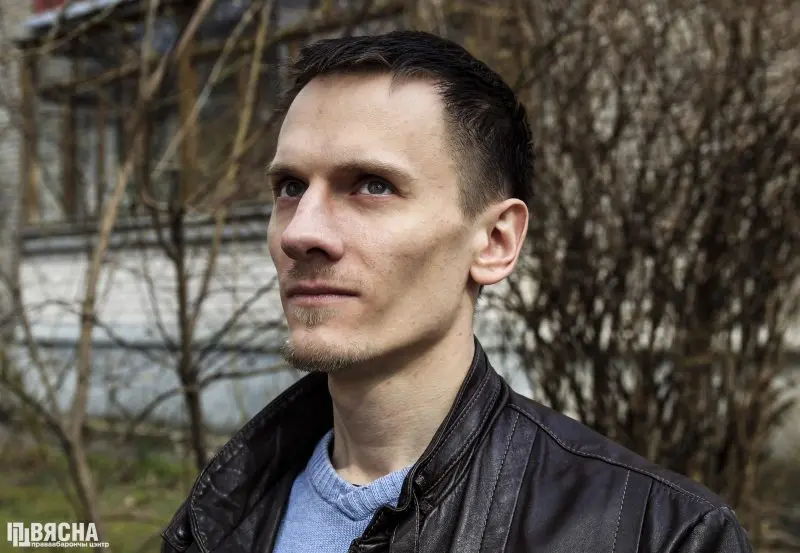
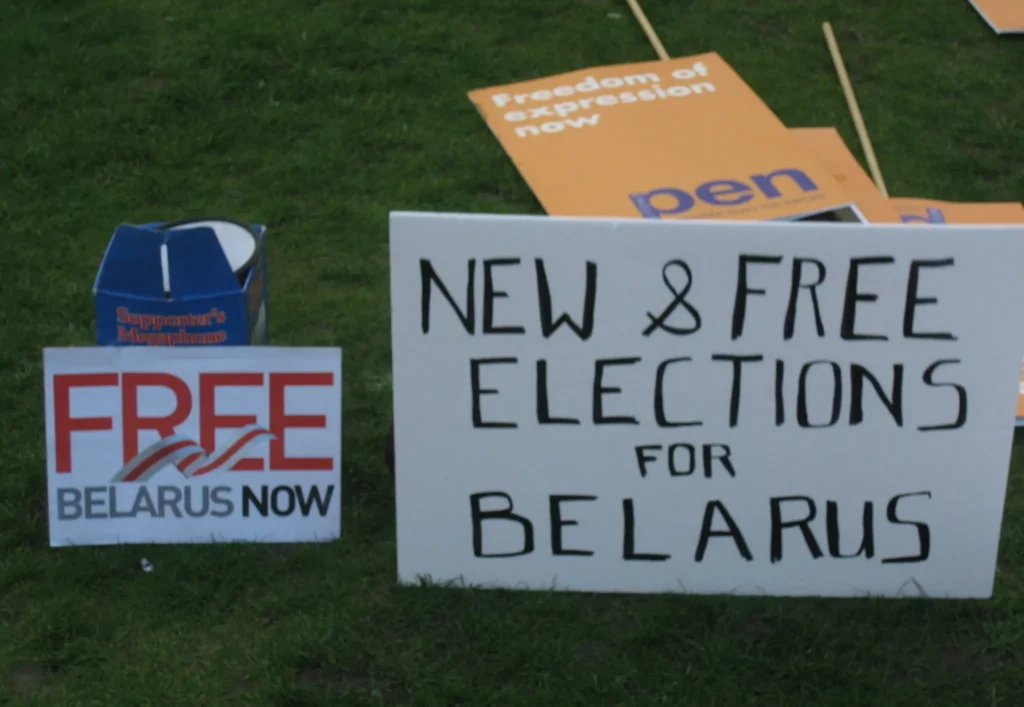
The number of individuals detained for their creative expression in 2020 rose in Egypt from 11 to 14 cases as the ongoing and persistent crackdown on freedom of thought and artistic expression under President Abdel Fattah El-Sisi continued unabated. The majority of Egyptian writers and intellectuals counted in the 2019 Freedom to Write Index remained behind bars, serving lengthy prison sentences, including researcher and freelance journalist Ismail Alexandrani, blogger and activist Alaa Abd El Fattah, and poet and songwriter Galal El-Behairy.
New cases of writers and intellectuals detained or imprisoned this year in Egypt include those targeted for producing online commentary or literary work critical of the government. Political analyst, writer, and well-known journalist Amer Abdel Moneim has written critically of President El-Sisi’s policies, among other international and current affairs, for the Egyptian Institute for Studies, a think tank and research center.140“Amer Abdel Moneim,” Egyptian Institute for Political and Strategic Studies, accessed March 24, 2021, en.eipss-eg.org/author/amer-abdel-moneim-en/ Abdel Moneim was arrested in late December 2020 and charged with spreading false news and participating in terrorist activities.141“Two more arrests in Egypt,” Reporters without Borders, December 23, 2020, rsf.org/en/news/two-more-arrests-egypt Longtime author, publisher, and El-Sisi critic Amin El-Mahdy was arrested in September 2020 in response to his online criticism of the president, including a Facebook post in which he described El-Sisi as “a murderer, traitor, coward, and thief.”142MEE correspondent, “Egyptian writer and Sisi critic Amin el-Mahdy dies days after release from jail,” Middle East Eye, October 12, 2020, middleeasteye.net/news/egypt-sisi-critic-amin-mahdy-dies; “Amine El-Mahdi: Sisi created death squads in Sinai to implement the deal of the century,” Middle East Monitor, May 14, 2020, middleeastmonitor.com/20200514-amine-el-mahdi-sisi-created-death-squads-in-sinai-to-implement-the-deal-of-the-century/ He faced 49 charges related to his publishing work dating back nearly two decades.143“Egyptian writer and Sisi critic Amin el-Mahdy dies days after release from jail.” Just three weeks after he was detained, however, El-Mahdy was abruptly released from prison and transferred to a hospital after he developed an unknown illness, despite having been healthy before his arrest. El-Mahdy died on October 11, 2020, at age 68, and his supporters have raised questions about the circumstances of his death.144“Egyptian writer and Sisi critic Amin el-Mahdy dies days after release from jail.”
Writers have also been targeted for raising their voices in support of other writers at risk. In June 2020, Alaa Abd El Fattah’s sister Sanaa Seif—a writer and film editor who has been previously arrested herself145“Egypt activists jailed for three years for ‘illegal protest’,” BBC News, October 24, 2014, bbc.com/news/world-middle-east-29778818—was attacked while waiting outside of Tora prison to receive a letter from her brother.146“Family says sister of prominent Egyptian activist arrested,” Associated Press, June 23, 2020 apnews.com/article/4f3c910544f1211ae14cd721a00c6a97 On her way to file a complaint the following day, she was abducted by plainclothes officers and detained on charges of “disseminating false news,” “inciting terrorist crimes,” and “misuse of social media.”147“Family says sister of prominent Egyptian activist arrested.”; “Egyptian activist Sanaa Seif detained outside prosecutor’s office,” Al Jazeera, June 23, 2020, aljazeera.com/news/2020/6/23/egyptian-activist-sanaa-seif-detained-outside-prosecutors-office After a trial, she was sentenced in March 2021 to 18 months in jail.148“Egyptian activist sentenced to 18 months for ‘fake news’,” Al Jazeera, March 17, 2021, aljazeera.com/news/2021/3/17/egyptian-activist-sentenced-to-18-months-for-fake-news Shimaa Samy, a freelance journalist and columnist, was arrested in May 2020 three weeks after she wrote an opinion piece in which she criticized the continued pretrial detention of political prisoners and highlighted Alaa Abd El Fattah’s case.149MEE correspondent, “Egyptian journalist Shimaa Samy appears in custody, days after disappearance,” Middle East Eye, May 31, 2020, middleeasteye.net/news/egypt-journalist-shimaa-samy-appears-prosecution-faces-formal-charges
No one wants to sit in prison. But if prison is inevitable for freedom fighters, if prison can serve a pre-determined purpose, then we should happily accept it.
Pham Doan Trang, “Just In Case I Am Imprisoned”
In Vietnam, the number of detained writers jumped from 8 in 2019 to 11 in 2020. During 2020, Vietnamese authorities ramped up their targeting of individuals associated with professional literary and writing organizations. This included multiple arrests of writers associated with the Independent Journalists Association of Vietnam (IJAVN), a civil society organization that advocates for press freedom consisting of writers, bloggers, and journalists. The IJAVN’s founding member and chairman Pham Chi Dung was detained in November 2019 and spent the entirety of 2020 behind bars,150An Hai, “Vietnam Arrests Prominent Blogger Pham Chi Dung,” Voice of America, November 22, 2019, voanews.com/east-asia-pacific/vietnam-arrests-prominent-blogger-pham-chi-dung; “US, EU Demand Release of Vietnamese RFA Blogger and Others Jailed For ‘Peaceful Expression’ of Views,” Radio Free Asia, January 6, 2021, rfa.org/english/news/vietnam/demand-01062021170023.html while several other core members of the IJAVN were detained or imprisoned during 2020, including three leading members of the association—Le Huu Minh Tuan, Pham Chi Thanh, and Nguyen Tuong Thuy—who were arrested and detained in May 2020. Pham Chi Thanh remains in pretrial detention as of this writing, while the other three have received prison sentences of over a decade each.151“Vietnamese Dissident Writer Arrested on Subversion Charge,” Radio Free Asia, May 21, 2020, rfa.org/english/news/vietnam/writer-05212020135521.html; Reuters Staff, “Vietnam jails journalists for ‘propaganda’ critical of state,” Reuters, January 5, 2021, reuters.com/article/us-vietnam-security-trial-idUSKBN29A0VI
In October 2020, authorities detained and arrested internationally recognized author and blogger Pham Doan Trang, hours after the conclusion of the 2020 U.S.-Vietnam Human Rights Dialogue.152“Arrest of Vietnamese Writer is Escalation in Attempts to Quash Independent Political Thought,” press release, October 10, 2020, pen.org/press-release/arrest-of-vietnamese-writer-is-escalation-in-attempts-to-quash-independent-political-thought/; RFA Vietnamese Service, “Rights Groups Deplore Arrest of Vietnam Writer and Activist Pham Doan Trang,” Voice of America, voanews.com/press-freedom/rights-groups-deplore-arrest-vietnam-writer-and-activist-pham-doan-trang A prolific author and leading member of independent Vietnamese-language publications, Trang is also the cofounder of the Liberal Publishing House, Vietnam’s only independent publishing house, from which she was forced to disassociate herself in July, after the Ministry of Public Security labeled her works “anti-state propaganda.”153Amnesty International et al., “Viet Nam, Move Beyond Repression”, PEN America, July 14, 2020, pen.org/viet-nam-move-beyond-repression/ As a prominent figure who has written extensively on voting rights, her arrest appears to be part of a broader crackdown on free expression ahead of the 13th National Congress of the Vietnamese Communist Party (VCP).154Chris Humphrey, “Vietnam arrests prominent journalist as state cracks down on free speech online,” The Guardian, October 7, 2020, theguardian.com/global-development/2020/oct/08/vietnam-arrests-prominent-journalist-as-state-cracks-down-on-free-speech-online
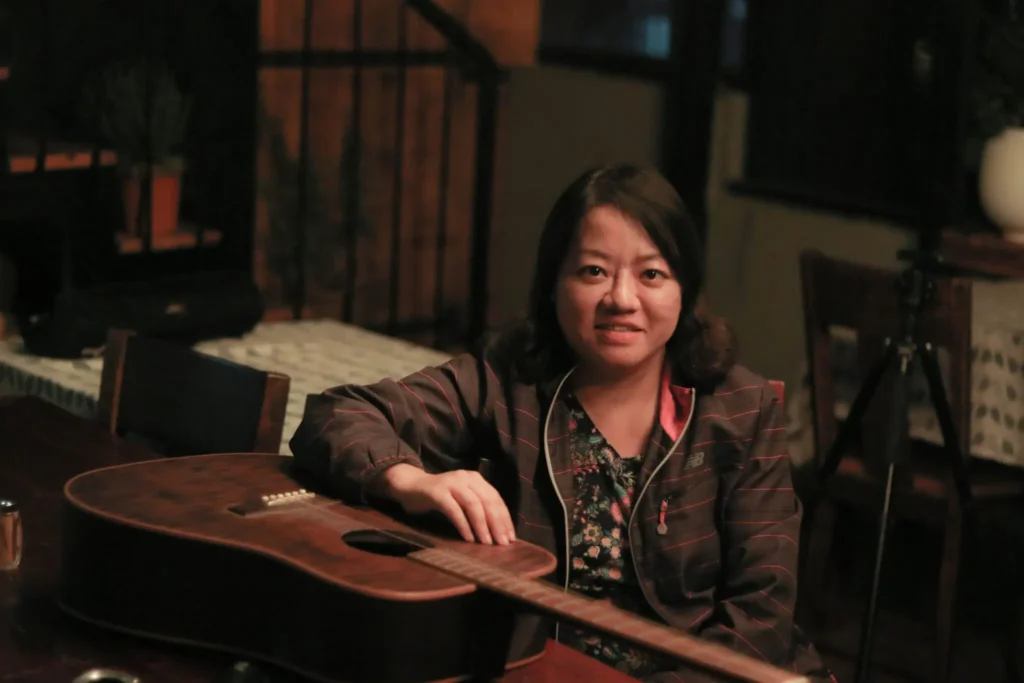
Pham Doan Trang
Vietnam
Status: Detained
Trang’s arrest for her pro-democracy writing appears as part of a broader crackdown on democratic voices in Vietnam.
Photo by Thinh Nguyen
All five of these Vietnamese writers and public intellectuals were charged under Article 117 of Vietnam’s Penal Code, which criminalizes “making, storing, disseminating documents and materials for an anti-State purpose.” Article 117, previously Article 88 of the country’s Penal Code, has long been a mainstay tool for political repression in Vietnam, used by authorities to punish dissidents for their critical speech with yearslong prison sentences.
India displayed a continued negative trajectory with regards to free expression, with an increase from five cases in the 2019 Index to nine writers jailed in 2020. This increase was due to the pretrial detention in 2020 of three additional writers, Hany Babu, Gautam Navlakha, and Anand Teltumbde. The charges against these three date back to the inter-caste violence that occurred in the village of Bhima Koregaon in 2018, resulting in the death of one person and injuries to five others. In the aftermath of the violence, the government has aggressively pursued charges against leftist writers and intellectuals, accusing them of inciting the violence and of links to banned groups. Others implicated in the case include the writers P. Varavara Rao, Arun Ferreira, Sudha Bharadwaj, and Vernon Gonsalves, who have been detained for more than two years.
The Bhima Koregaon arrests are a sobering representation of an increasing trend that PEN America previously explored in our 2019 Freedom to Write Index—the efforts of governments to restrict and even criminalize academic or literary narratives that diverge from their own preferred vision of history or national identity. Indian academics, writers, and intellectuals have been quick to decry the Bhima Koregaon arrests as a politically motivated attack against those who have long advocated on behalf of marginalized and minority groups in India and who have spoken out against Prime Minister Narendra Modi’s increasingly virulent Hindu nationalism.155CJP Team, “The Truth about the Elgaar Parishad,” Citizens for Justice and Peace, September 1, 2018, cjp.org.in/the-truth-about-the-elgaar-parishad/ For example, one Indian teacher’s organization, the Jamia Teachers’ Solidarity Organization, declared that the arrests formed part of a “systemic hounding of academics and activists,” alongside a “wholesale criminalization of ideas.”156Scroll Staff, “Bhima Koregaon: Arundhati Roy criticises Centre for arresting DU professor Hany Babu,” Scroll.in, July 29, 2020, scroll.in/latest/968919/bhima-koregaon-arundhati-roy-criticises-centre-for-arresting-du-professor-hany-babu More than 300 of Hany Babu’s current and former students at Delhi University, where Babu is an English professor, signed on to a public statement declaring the arrests “a direct attack on education, activists and the academic space at large.”157“‘A direct attack on education, activists and academic space’: Prof. Hany Babu’s students speak out against his arrest,” India Resists, July 31, 2020, indiaresists.com/a-direct-attack-on-education-activists-and-academic-space-prof-hany-babus-students-speak-out-against-arrest/ Scholars at Risk has also noted the deterioration in academic freedom in India, including violent attacks on student protesters and arrests of scholars both for their work on contentious issues, including challenging the caste system and promoting the rights of economically disadvantaged populations, and for alleged connections to the banned Communist Party of India (Maoist).158Scholars at Risk, “Free to Think 2020,” Scholars at Risk, November 18, 2020, scholarsatrisk.org/resources/free-to-think-2020/
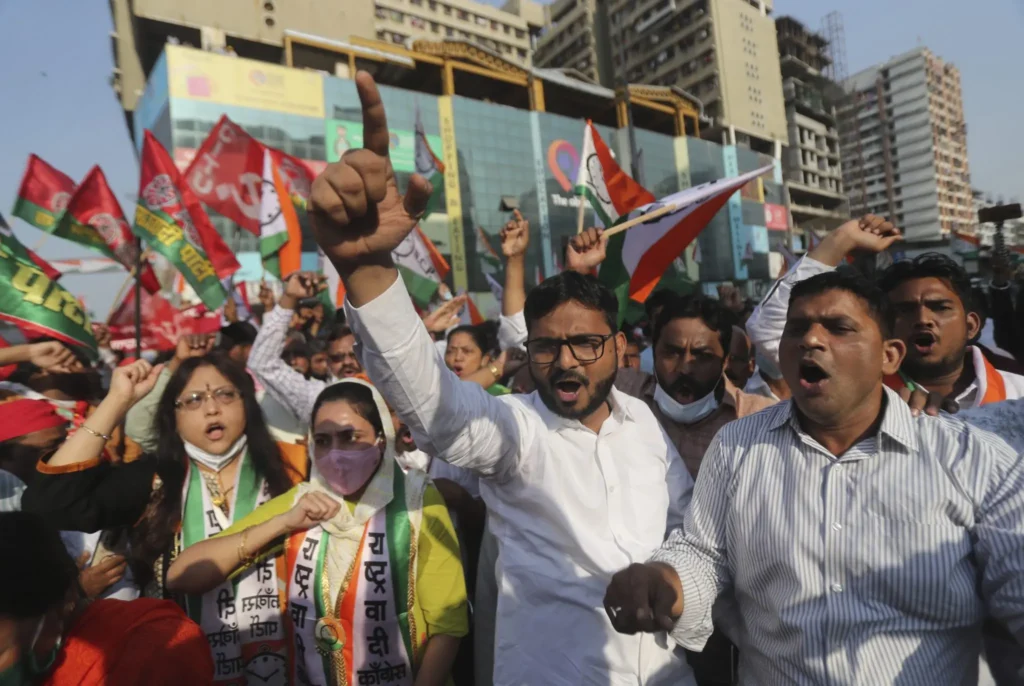
While India remains the most open political environment among the countries jailing the largest number of writers, the environment for free expression has continued to deteriorate in 2020 beyond cases of imprisonment or detention, with several dozen writers facing online harassment, physical threats, lawsuits, or other forms of intimidation. In Freedom House’s annual Freedom in the World report, India declined into the “Partly Free” category, due in part to “a multiyear pattern in which the Hindu nationalist government and its allies have . . . pursued a crackdown on expressions of dissent by the media, academics, civil society groups, and protesters.”159“India: Freedom in the World 2021,” Freedom House, accessed March 17, 2021, freedomhouse.org/country/india/freedom-world/2021 The Indian authorities also enforced as many as 83 internet shutdowns over the course of 2020, as a means to stifle protests and dissent.160Haripriya Suresh, “At 83 internet shutdowns in 2020, India holds dubious world record,” The News Minute, February 4, 2021, thenewsminute.com/article/83-internet-shutdowns-2020-india-holds-dubious-world-record-142778
Eritrea and Myanmar each held eight writers in prison in 2020. In Eritrea, the number remained stable; many of these writers have been detained for almost two decades, having initially been arrested as part of a sweeping crackdown on dissent in the country in the week after the attacks of September 11, 2001. In an extremely repressive political environment, information about these cases is limited, and explicit charges remain unknown. Dual Eritrean and Swedish citizen Dawit Isaak has been detained incommunicado and without trial since 2001.161Agency Reporter, “Swedish-Eritrean journalist alive after 18 years in Eritrean jail,” The Nation, July 6, 2020, thenationonlineng.net/swedish-eritrean-journalist-alive-after-18-years-in-eritrean-jail/ In October 2020, the European Parliament called for Isaak’s release in a resolution urging the release of prisoners of conscience held in Eritrea, including other writers and journalists detained in the September 2001 crackdown.162European Union Parliament, “Human rights breaches in Eritrea, Nicaragua and Saudi Arabia,” press release, October 8, 2020, europarl.europa.eu/news/en/press-room/20201002IPR88448/human-rights-breaches-in-eritrea-nicaragua-and-saudi-arabia
Although the environment for free expression in Myanmar remained restrictive in 2020, the number of jailed writers and creative artists declined from 10 in 2019 to 8 in 2020, the result of the freeing in May 2019 of Reuters reporters and writer/poets Wa Lone and Kyaw Soe Oo in a presidential amnesty. Yet an ongoing internet shutdown continued to affect parts of the country, and authorities continued to target writers and intellectuals for their speech and association; poet Saw Wai continues to face legal charges for reciting his work at an event and had to appear for regular court hearings throughout 2020.163Zaw Zaw Htwe, “Myanmar Court Seeks Arrest of Lawyer and Poet in Military’s Lawsuit,” Irrawaddy, January 23, 2020, irrawaddy.com/news/burma/myanmar-court-seeks-arrest-lawyer-poet-militarys-lawsuit.html Members of the Peacock Generation satirical poetry troupe, originally arrested in April 2019, and filmmaker Min Htin Ko Ko Gyi, who was first detained that same month, spent part or all of the year behind bars. While this Index only covers 2020, the February 1, 2021, military coup in Myanmar has dealt a brutal blow to the country’s hard-won, if still limited, freedoms. As this report goes to publication, a broad-based, countrywide civil disobedience movement involving thousands of protestors continues to challenge the military’s illegal takeover and fight for their country’s future. The impact of the coup—including the detention of prominent writers, poets, and cultural luminaries, the targeting of other writers and artists, and the broad restrictions on free expression and ability to access and share information and commentary, particularly online—will be documented in the 2021 Freedom to Write Index.
[My activism and writing] go hand in hand because the issues I take up with my body, as a concerned citizen, are the same issues that I weave into my narrative production.
Tsitsi Dangarembga, Zimbabwean writer and playwright
Writers and Intellectuals Take the Lead in Public Protests
Alongside the COVID-19 pandemic, 2020 was marked by protests that swept the globe, with millions taking to the streets to protest injustice, defend democracy, and call for change. In the U.S., the murder of George Floyd by Minneapolis police on May 25, 2020, sparked a sustained, nationwide series of demonstrations against police brutality and anti-Black racism, in what has been called the largest protest movement in American history.164Larry Buchanan, Quoctrung Bui, and Jugal K. Patel, “Black Lives Matter May Be the Largest Movement in U.S. History,” The New York Times, July 3, 2020, nytimes.com/interactive/2020/07/03/us/george-floyd-protests-crowd-size.html These protests were accompanied by distinct protest movements elsewhere, including mass protests against the stolen presidential election in Belarus, a wave of largely student-led protests calling for democratic reforms in Thailand, and dozens more.165Benjamin Press and Thomas Carothers, “Worldwide Protests in 2020: A Year in Review,” Carnegie Endowment for International Peace, December 21, 2020, carnegieendowment.org/2020/12/21/worldwide-protests-in-2020-year-in-review-pub-83445; Chonthicha Jangrew, “Thai student protesters in the time of COVID-19: New generation, new forms of resistance online,” Coconet, July 17, 2020, coconet.social/2020/thailand-student-online-activism-covid/
A few further examples help indicate the global breadth and scope of this year in protest: In India, farmers started nationwide protest actions in August 2020 against new agriculture deregulation.166Billy Perrigo, “India’s Farmers Are Leading One of the Largest Protests Yet Against Modi’s Government. Here’s What They’re Fighting For,” TIME, December 8, 2020, time.com/5918967/india-farmer-protests/ In Nigeria, youth-led protests to disband the Special Anti-Robbery Squad (SARS) were shut down by authorities, even as they went digital and trended online.167Chidozie Obasi, “The #EndSars movement: what you need to know,” Harper’s Bazaar, October 23, 2020, harpersbazaar.com/uk/culture/culture-news/a34459784/the-endsars-movement-what-you-need-to-know/ In Ethiopia, the assassination of Hachalu Hundessa, a beloved singer in the Oromo community known for his protest songs,168Awol K. Allo, “Haacaaluu Hundeessaa: A towering musician and an Oromo icon,” Al Jazeera, July 5, aljazeera.com/opinions/2020/7/5/haacaaluu-hundeessaa-a-towering-musician-and-an-oromo-icon spurred assembly in mourning across the country.169“Ethiopian singer Hachalu Hundessa shot dead in Addis Ababa,” Al Jazeera, June 30, 2020, aljazeera.com/news/2020/6/30/ethiopian-singer-hachalu-hundessa-shot-dead-in-addis-ababa In Zimbabwe, people assembled in protest of corruption and President Emmerson Mnangagwa’s leadership, existing issues exacerbated by the COVID-19 pandemic.170Jeffrey Moyo and Patrick Kingsley, “Zimbabwe Locks Down Capital, Thwarting Planned Protests,” The New York Times, July 31, 2020, nytimes.com/2020/07/31/world/africa/zimbabwe-coronavirus-protest.html
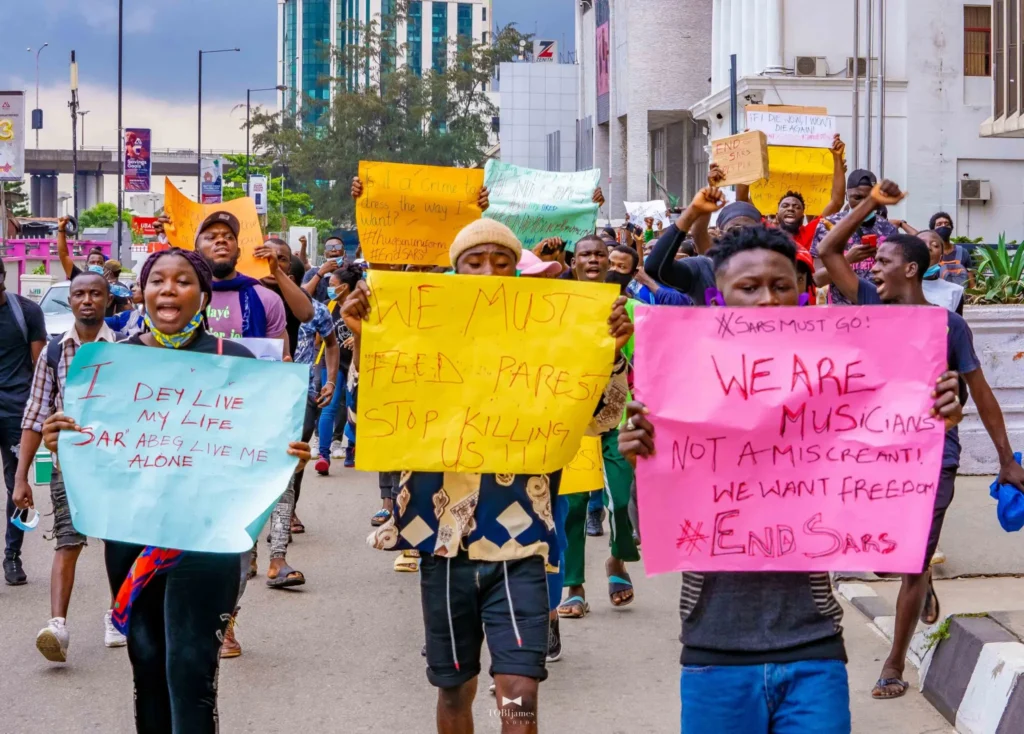
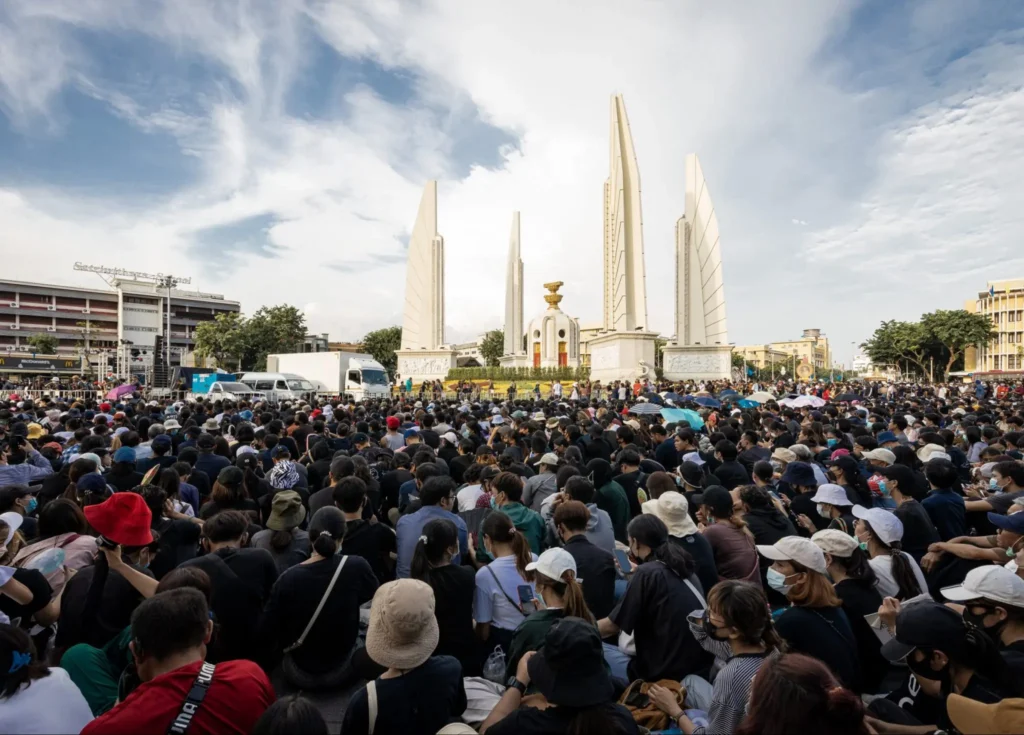
Writers and public intellectuals have participated in these protests across the globe, often for the same reasons as any other member of society. But as figures of national cultural significance, they also often play a unique role in inspiring movements and articulating the forces that drive them. In some cases, especially over the past year, artistic and cultural communities have played a distinctly influential role. Zimbabwean writer and playwright Tsitsi Dangarembga, who was briefly arrested and is facing charges for breaching coronavirus restrictions while protesting in July, described it best in a 2021 interview, when she noted that her activism and writing “go hand in hand because the issues that I take up with my body, as a concerned citizen, are the same issues that I weave into my narrative production.”171Barbara Boswell, “Tsitsi Dangarembga’s art and activism,” New Frame, March 1, 2021, newframe.com/tsitsi-dangarembgas-art-and-activism/
“This is How We Win”
victory
is comprised
of barely distinguishable
homeopathic gestures
this is how a hundred thousand
gather on marches in minsk
droplets of yards
streams of streets
into a human ocean
10.09.2020
By Dmitry Strotsev
Translated by Valzhyna Mort
Published by PEN/Opp, a publication of Swedish PEN
As a result, governments that respond to protests with repression may also crack down specifically on writers, artists, and intellectuals who lead, participate in, inspire, or simply support these protests, sometimes going out of their way to target these figures, recognizing the persuasive power that they wield. This year, we have seen this play out most dramatically in Belarus, as well as Cuba and Hong Kong.
In Belarus, writers, artists, theater professionals, and other cultural figures have been at the forefront of the widespread protests against the 26-year-rule of Alexander Lukashenka. Most notably, PEN Belarus President and Nobel Prize–winning writer Svetlana Alexievich has been a leading figure in the opposition movement, as a member of the opposition Coordinating Council.172“Svetlana Alexievich: Nobel laureate leaves Belarus for Germany,” Deutsche Welle, September 28, 2020, dw.com/en/svetlana-alexievich-nobel-laureate-leaves-belarus-for-germany/a-55079649 But writers, poets, and others have also lent their voices and creative work to the movement in less formal but still influential ways, through poetry readings, neighborhood concerts, and writing that has offered an essential narrative voice to the larger protest movement. Many of these individuals were already among the few who were brave enough to voice dissent in Lukashenka’s Belarus, and now their voices have taken on more significant weight. And while some writers and public intellectuals have been swept up at random in mass detentions at protests, others have been more deliberately targeted, including PEN Belarus’s own staff and members.173“With no right to the culture. Belarus 2020.” In addition to Alexievich, this has included PEN Belarus Project Manager Uladz Liankevich, and PEN Belarus Members Olga Shparaga and Dmitry Strotsev.
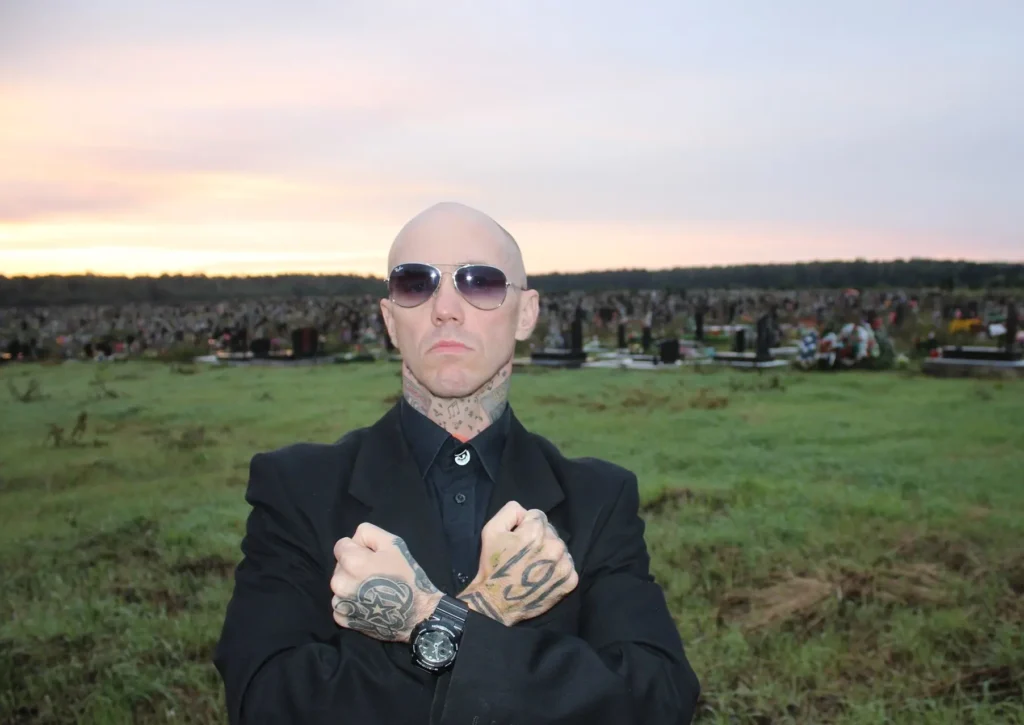
Ihar Bancer
Belarus
Status: On Trial
Lyricist Bancer faces over a year in a correctional facility for his vocal opposition to the fraudulent election of Alexander Lukashenka.
Photo courtesy of Ihar Bancer
Artists and writers who have helped lead the opposition protests, those who have merely participated, and even those who have seemed broadly sympathetic, have been arrested, beaten, imprisoned, kidnapped, tortured, and subject to unfair trials. The crackdown against them accounts for Belarus’s dramatic shift from holding no writers or intellectuals in prison in 2019 to appearing in the top five countries of the 2020 Index. Poet Dmitry Strotsev was seized off the street in October and detained for almost two weeks.174See “Poet and PEN Belarus member imprisoned for demonstrating,” PEN America, October 22, 2020, https://pen.org/press-release/poet-and-pen-belarus-member-imprisoned-for-demonstrating/ Musician and opposition leader Maria Kalesnikava was detained by masked men in September and forcibly driven to the Ukrainian border in an attempt to force her into exile; she thwarted this attempt by ripping up her passport and refusing to leave Belarus. Authorities, not content with their attempts to kidnap and forcibly exile her, followed up by charging her with national security offenses, and she currently faces the potential of up to 12 years in prison.175VOA News, “UN Urges Belarus to Release Opposition Figure Kolesnikova,” Voice of America, September 25, 2020, voanews.com/europe/un-urges-belarus-release-opposition-figure-kolesnikova Author and political analyst Mikola Dziadok was arrested on “public order” provisions in November, beaten, imprisoned, thrown into solitary confinement, and deprived of contact with the outside world.176Viasna, “Mikola Dziadok: A Tortured Political Prisoner in Belarus,” The Russian Reader, November 19, 2020, therussianreader.com/2020/11/21/mikola-dziadok-a-tortured-political-prisoner-in-belarus/ Journalist and author Ruslan Kulevich was detained at a protest in August by police who brutally beat him, breaking both his arms.177“Ruslan Kulevich, journalist at the Hrodna.life portal of Grodno,” Press Under Pressure, accessed March 25, 2020, en.underpressure.press-club.by/kulevich The list goes on—the 18 Belarusian cases that PEN America has included within the 2020 Index are marked by disregard for the rule of law, overt intimidation and violence, and a clear determination on behalf of authorities to quash this unprecedented challenge to Lukashenka’s rule. The harsh crackdown on these protests, and its impact on the writers and artists who have been affiliated with them, is solely responsible for Belarus’s status as one of the top jailers of writers in 2020.
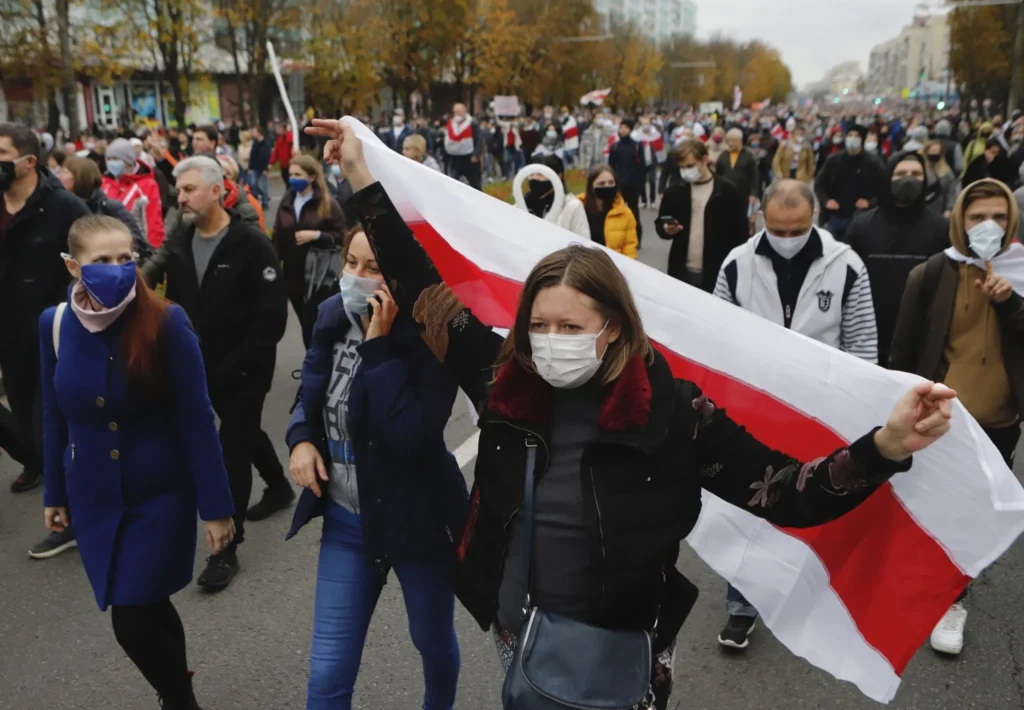
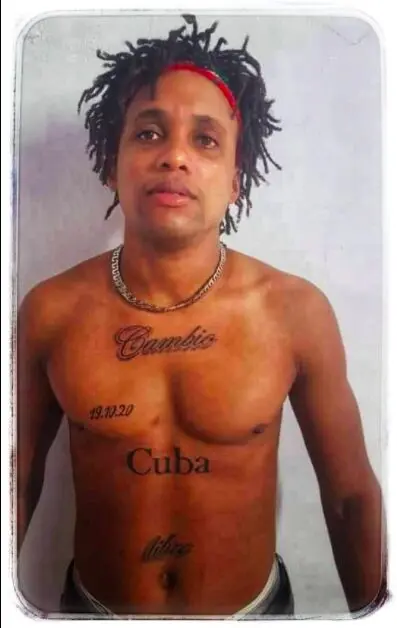
Denis Solís González
Cuba
Status: Imprisoned
Solís has used his lyricism and public concerts to advocate for free expression in Cuba, for which authorities have imprisoned him and other members of the San Isidro Movement.
Photo courtesy of Movimiento San Isidro Facebook Page
In Cuba, authorities have aggressively targeted the San Isidro Movement, a collective of artists whose work is both performance art and a form of protest. On November 9, members of the movement staged a protest outside Cuba’s Ministry of Culture in Havana against the arrest of rapper Denis Solís González—who has since been sentenced to eight months in jail for “contempt” after insulting a police officer who entered his home without a warrant. The government responded not only by immediately detaining several members of the Movement, but also by essentially putting it under siege, trapping over a dozen of the artists in the Movement’s headquarters for over a week, placing them under 24-hour surveillance, and refusing to allow them access to food.178Nora Gamez Torres, “Cuban police quell protest and detain young artists and academics on hunger strike,” Miami Herald, November 27, 2020, miamiherald.com/news/nation-world/world/americas/cuba/article247452965.html Police raided the building on November 26, and arrested more than a dozen people—including writer and journalist Carlos Manuel Álvarez, musician Maykel Castillo Pérez (El Osorbo), and performance artist Luis Manuel Otero Alcántara.
In Hong Kong, a global flash point in the struggle for freedom of expression, mass protests began in 2019, initially sparked by a proposed law that would have allowed residents of Hong Kong to be extradited to mainland China, which was viewed by pro-democracy groups as a threat to the autonomy and freedoms normally extended to the territory and was eventually withdrawn.179Holmes Chan, “‘Too little, too late’: Hong Kong democrats and protesters vow further action despite extradition bill withdrawal,” Hong Kong Free Press, September 4, 2019, hongkongfp.com/2019/09/04/little-late-hong-kong-democrats-protesters-vow-action-despite-extradition-bill-withdrawal/ But the movement evolved into broader protests against Hong Kong’s government and against increasing political and economic pressure from the mainland. They continued into 2020, but with the advent of the pandemic and the subsequent passage of the new National Security Law, they waned as the year went on.
Authorities, however, have continued to punish those who participated in these and even earlier pro-democracy protests in recent years, pursuing criminal charges that are months or years old and sending the loud public message that they would use the National Security Law as a tool to punish dissent with draconian criminal penalties. This campaign of political punishment has swept up writers, publishers, and intellectuals who have played a role in the movement. Only six weeks after the passage of the National Security Law, in August of 2020, Hong Kong police arrested publisher Jimmy Lai, one of the highest-profile supporters of the pro-democracy protests, and raided the offices of his newspaper Apple Daily, which had given extensive coverage to the protests and in which Lai wrote a weekly column that “cheered on the protesters.”180Andrew Higgins, “A Hong Kong ‘Troublemaker’ With a Clean Conscience,” The New York Times, nytimes.com/2019/08/23/world/asia/jimmy-lai-hong-kong-protests.html Lai’s two sons were also arrested, as well as several pro-democracy activists, making Lai’s arrest only part of a broader antidemocratic sweep from Hong Kong police’s newly formed national security unit.181Christy Leung, “National security law: Hong Kong media mogul Jimmy Lai’s two sons first to be released on bail, followed by Agnes Chow,” South China Morning Post, August 11, 2020, scmp.com/news/hong-kong/law-and-crime/article/3096968/hong-kong-media-mogul-jimmy-lais-youngest-son-first-be; “Jimmy Lai: Hong Kong media tycoon held amid sweep of arrests,” BBC, August 10, 2020, bbc.com/news/world-asia-china-53717843 Lai now faces vaguely defined charges of “collusion with a foreign enemy or external elements” under the National Security Law, which can carry a sentence of life imprisonment.
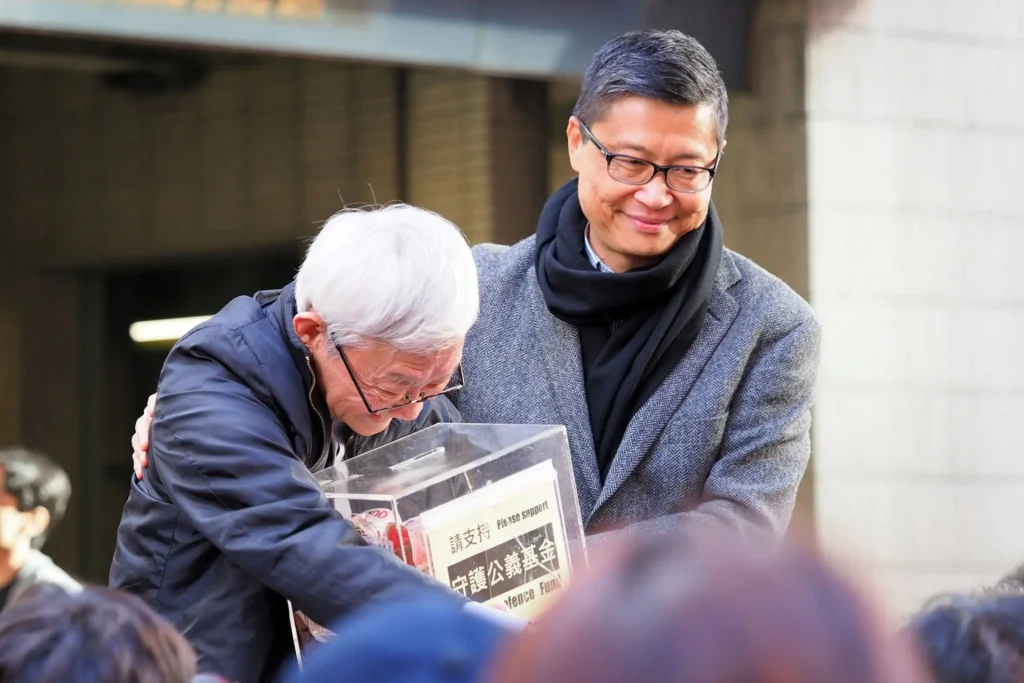
Academic Chan Kin-Man spent the first part of 2020 in prison for public nuisance charges stemming from his role as a leading figure in the 2014 “Occupy Central with Love and Peace” movement.182“Hong Kong ‘Umbrella’ protesters sentenced to jail terms,” BBC, April 24, 2019, bbc.com/news/world-asia-china-48033156 Chan, sentenced to 16 months in April 2019, was released early for “good behavior” in March 2020, and is appealing his conviction.183Jasmine Siu, “Benny Tai sent back to jail to await Hong Kong court’s ruling in Occupy Central appeal,” South China Morning Post, March 4, 2021, scmp.com/news/hong-kong/law-and-crime/article/3124100/benny-tai-sent-back-jail-await-hong-kong-courts-ruling Prominent pro-democracy figure and writer Joshua Wong has been repeatedly targeted with criminal charges for his participation in democracy protests. He—along with more than two dozen others, including several individuals included in PEN America’s 2019 Freedom to Write Index, such as Nathan Law and Alex Chow—was charged with “illegal assembly” in August, two months after participating in a candlelight vigil to mark the anniversary of the 1989 Tiananmen Square crackdown. Wong was arrested again in September and charged with participating in an unauthorized assembly and violating a ban on masks, this time in connection with an October 2019 rally. Wong and codefendants Agnes Chow and Ivan Lam pled guilty to the latter charges in November, receiving sentences ranging from 7 to 13 months’ imprisonment.184PEN America, “Hong Kong Pro-Democracy Activists Plead Guilty to Charge of ‘Unlawful Assembly,’” press release, November 24, 2020, pen.org/press-release/hong-kong-pro-democracy-activists-plead-guilty-unlawful-assembly/
In the aftermath of the National Security Law’s passage, Wong was one of the authors whose books began disappearing from public libraries, as librarians apparently feared the possibility that stocking books from pro-democracy authors would be treated as a criminal activity.185AFP, “Democracy books disappear from Hong Kong libraries, including title by activist Joshua Wong,” Hong Kong Free Press, July 4, 2020, hongkongfp.com/2020/07/04/democracy-books-disappear-from-hong-kong-libraries-including-title-by-activist-joshua-wong/ And while outside the time frame of the 2020 Freedom to Write Index, Wong was among a group of pro-democracy figures arrested under the National Security Law in January 2021, alongside sociology professor Benny Tai Yiu-ting (included in the 2019 Index) and 53 others, a massive crackdown that is clearly aimed at decapitating the pro-democracy movement in the city.186“Hong Kong: Police arrest over 50 pro-democracy activists in crackdown,” Deutsche Welle, January 6, 2021, dw.com/en/hong-kong-police-arrest-over-50-pro-democracy-activists-in-crackdown/a-56139138
In Thailand, demonstrations in early 2020 against the government of Prime Minister Prayut Chan-o-cha—who first took power in a 2014 military coup—expanded into demands for reform of the Thai monarchy. For some protesters, calls for reform have been inspired in part by the foundational writings of exiled public intellectuals critical of the country’s notorious lèse-majesté law that criminalizes speaking ill of or criticizing the monarchy, and who have been singled out by Prime Minister Prayut in his criticism of the protests.187Patpicha Tanakasempipat and Kay Johnson, “‘Illegal thoughts’: how some exiled critics of Thai king are fuelling a revolt,” Reuters, September 9, 2020, reuters.com/article/us-thailand-protests-exiles/illegal-thoughts-how-some-exiled-critics-of-thai-king-are-fuelling-a-revolt-idUSKBN2603HS In response, authorities have increasingly employed the lèse-majesté law alongside other criminal provisions to punish protesters, with decades-long convictions becoming increasingly common.188“Thailand revives law banning criticism of king in bid to curb protests,” BBC, November 25, 2020, bbc.com/news/world-asia-55062397 Poet, lawyer, and activist Arnon Nampa has taken a central role in questioning the undemocratic nature of the lèse-majesté law and the growing powers of the monarchy itself. After giving a speech at an August rally, Nampa was briefly arrested alongside activists and restricted from attending future protests. When he did, however, he was re-detained for four days, and was later charged with sedition and violating the lèse-majesté law for his participation in protests.189“Statement on the Bail Conditions for Arnon Nampa and Panupong Jadnok in Thailand,” South China Morning Post, September 17, 2020, cfj.org/wp-content/uploads/2020/09/Statement-on-the-Bail-Conditions-for-Arnon-Nampa-and-Panupong-Jadnok-in-Thailand.pdf; Reuters Staff, “Two Thai protest leaders arrested, rights group says,” Reuters, October 14, 2020, reuters.com/article/uk-thailand-protests-arrests/two-thai-protest-leaders-arrested-rights-group-says-idINKBN26Z38G; PEN International, “Thailand: End government crackdown and drop all charges against peaceful demonstrators,” press release, October 29, 2020, pen-international.org/news/thailand-government-crackdown-and-drop-all-charges-against-peaceful-demonstrators
Languages and Cultures Under Threat
Writers and public intellectuals, as “keepers and wielders of language,” are often targets of government efforts to silence minority populations on the basis of race and identity.190“Freedom to Write Index 2019,” PEN America, May 19, 2020, pen.org/report/freedom-to-write-index-2019/ Uyghur, Turkic, Mongolian, and Kurdish languages are at particular risk, with at least 48 writers and public intellectuals detained or imprisoned for their use of or efforts to guard and preserve these languages.191Counting 33 writers and public intellectuals in the Xinjiang Uyghur Autonomous Region, 6 writers and public intellectuals in the Tibet Autonomous Region, 7 members of Turkish music collective Grup Yorum, and 2 Kurdish culture activists Anisa Jafari-Mehr and Dariush Moradi in Iran. In China, Turkey, and Iran, it is common for writers and public intellectuals to be criminally prosecuted under harsh national security laws that equate the celebration of diverse ethnic identities with “membership in banned or terrorist groups,” “propaganda” against the state, “separatism,” and “splittism.”
During 2020, the Chinese Communist Party (CCP) steadily continued state repression of non-Mandarin or English languages in Tibet, Xinjiang, and the Inner Mongolia Autonomous Region. As covered above, Chinese government policy in Xinjiang has been recognized as an effort to erase the culture of Uyghurs and other ethnic minorities in order to reconstruct them as “patriotic” citizens.192“Chinese Persecution of the Uyghurs,” United States Holocaust Memorial Museum, accessed March 24, 2021, ushmm.org/genocide-prevention/countries/china/case-study/current-risks/chinese-persecution-of-the-uyghurs This policy goal lies behind the government’s decision to essentially outlaw the Uyghur language, largely banishing it from the public square and establishing the mere use of Uyghur language as a basis for detention.193PEN America, “Decision to Ban Uyghur Language in Xinjiang Schools an Attack on the Minority Group’s Linguistic and Cultural Rights,” press release, August 3, 2017, pen.org/press-release/decision-ban-uyghur-language-xinjiang-schools-attack-minority-groups-linguistic-cultural-rights/; Darren Byler, “The ‘patriotism’ of not speaking Uyghur,” Sup China, January 2, 2019, supchina.com/2019/01/02/the-patriotism-of-not-speaking-uyghur/ This attack on the Uyghur language goes hand-in-hand with the systemic crackdown on Uyghur intellectuals, writers, and others.

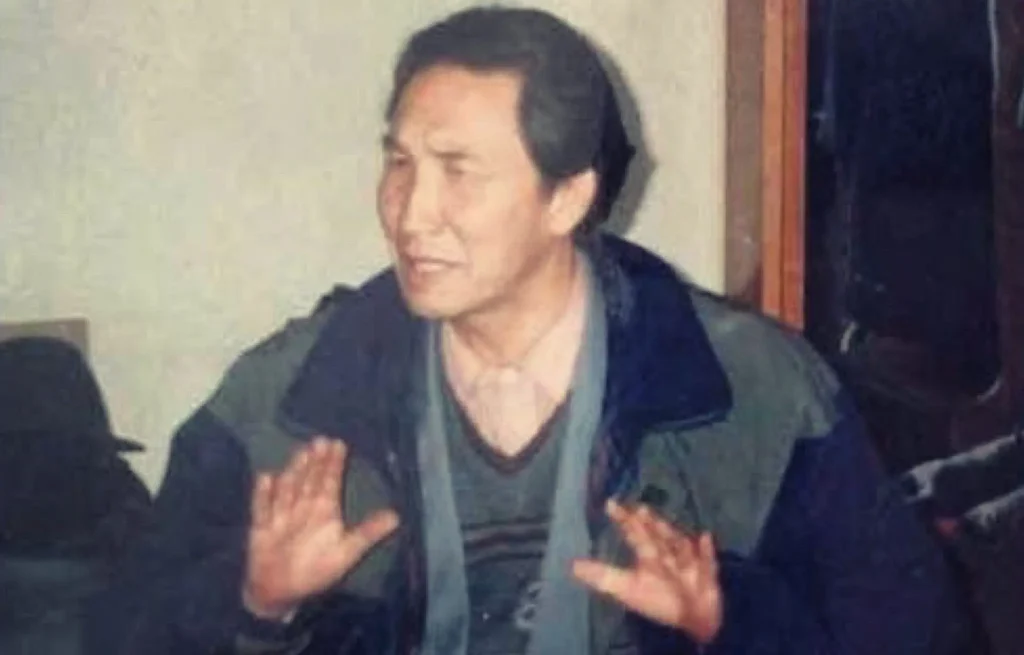
In Inner Mongolia, the CCP announced in August 2020 that it would roll out a series of changes to education policy there, prioritizing the teaching of Mandarin over Mongolian in elementary and middle schools around the region. The policy would utilize Chinese textbooks compiled and approved by the government—rather than textbooks formerly used in bilingual Mongolian schools—and introduce Chinese language earlier to students, diminishing Mongolian language instruction in traditionally bilingual schools.194Gegentuul Baioud, “Will education reform wipe out Mongolian language and culture?,” Language on the Move, August 30, 2020, languageonthemove.com/will-education-reform-wipe-out-mongolian-language-and-culture/; Amy Qin, “Curbs on Mongolian Language Teaching Prompt Large Protests in China,” The New York Times, August 31, 2020, nytimes.com/2020/08/31/world/asia/china-protest-mongolian-language-schools.html?referringSource=articleShare Unprecedented crowds of protesters decried the policy, prompting authorities to crack down in response, reportedly arresting thousands and shutting down access to Mongolian-language social media app Bainuu.195“China ‘Will End’ Mongolian-Language Education Starting This Semester: Reports,” Radio Free Asia, August 24, 2020, rfa.org/english/news/china/language-08242020101614.html Amid the crackdown, prominent ethnic Mongolian writers including poet O. Sechenbaatar, historian Lhamjab A. Borjigin, and former editor of the banned publication Voice of Southern Mongolia Hada have faced increased restrictions on their access to the internet and their ability to speak publicly.196“Nine Die, Thousands Arrested Amid Crackdown on Protesting Mongolians: Group,” Radio Free Asia, September 14, 2020, rfa.org/english/news/china/crackdown-09142020184034.html; China ‘Will End’ Mongolian-Language “Education Starting This Semester: Reports”; SMHRIC, “Activists face imprisonment and police stations in schools,” Southern Mongolian Human Rights Information Center, October 18, 2020, smhric.org/news_683.htm; “Thousands Held in Inner Mongolia as Crackdown on Language Protesters Continues,” Radio Free Asia, October 20, 2020, rfa.org/english/news/china/crackdown-10202020092816.html
In Tibet, language activists and those who openly advocate for free expression of Tibetan culture remain under serious threat. In 2020, several writers and public intellectuals remained imprisoned for their expression, including Tashi Wangchuk, Kunchok Tsephel Gopey Tsang, and Jo Lobsang Jamyang. Tashi was released from prison in January 2021, after completing a five-year sentence for “inciting separatism” related to his peaceful advocacy; he remains under a five-year sentence of “deprivation of political rights”—including the right to speak freely—and is presumed to be under continued state surveillance.197“PEN America Celebrates Release of Tibetan Language Advocate Tashi Wangchuk,” PEN America, press release, January 28, 2021, pen.org/press-release/pen-america-celebrates-release-of-tibetan-language-advocate-tashi-wangchuk/ During 2020, news of the imprisonment of multiple lyricists for their expression in support of Tibetan culture and identity came to light. Singer/songwriters Lhundrub Drakpa and Khado Tsetan were sentenced for their lyrics under national security laws, including alleged charges of separatism and state subversion.198Staff Reporter, “China imprisons two Tibetans for song praising His Holiness the Dalai Lama,” Central Tibetan Administration, July 21, 2020, tibet.net/china-imprisons-two-tibetans-for-song-praising-his-holiness-the-dalai-lama/; “Tibetan Singer Sentenced to Six Years in Prison in Driru: China Committing ‘Crimes against Humanity’ in Tibet,” Tibetan Centre for Human Rights and Democracy, October 30, 2020, tchrd.org/tibetan-singer-sentenced-to-six-years-in-prison-in-driru-china-committing-crimes-against-humanity-in-tibet/ Poet and essayist Gendun “Lhamko” Lhundrub was detained on December 2, 2020, roughly a month after publishing a poetry collection titled Khorwa and posting commentary on social media in support of Tibetans’ right to free expression.199“Tibetan Writer Arrested in Qinghai, Whereabouts Unknown,” Radio Free Asia, December 4, 2020, rfa.org/english/news/tibet/writer-12042020164144.html; Phayul Newsdesk, “Tibetan writer arrested, whereabouts remain unknown,” Phayul, December 7, 2020, phayul.com/2020/12/07/44897/
During 2020, authorities in Iran and Turkey continued to persecute writers and public intellectuals for their writing about Kurdish culture or use of Kurdish language. In Turkey, authorities in Istanbul and Şanlıurfa—a predominantly Kurdish locale—banned performances of the Italian play Bêrû by Teatra Jiyana Nû, Istanbul’s largest Kurdish-language ensemble, on spurious charges of spreading “terrorist propaganda.”200Ayla Jean Yackley, “Theater Ensemble Targeted in Turkey for Kurdish Performances; Accused of ‘Terrorist Propaganda,’” Hyperallergic, February 18, 2021, hyperallergic.com/623243/kurdish-theater-targeted-terrorism-propaganda/; MEE and agencies, “Ban on Kurdish-language play in Istanbul sparks condemnation,” Middle East Eye, October 14, 2020, middleeasteye.net/news/turkey-ban-kurdish-language-play-istanbul; BIA News Desk, “Investigation into banned Kurdish theater play,” Bianet, October 14, 2020, m.bianet.org/english/print/232729-investigation-into-banned-kurdish-theater-play While the theater ensemble members were not detained, the actors are reportedly under investigation.201Yackley, “Theater Ensemble Targeted in Turkey for Kurdish Performances; Accused of ‘Terrorist Propaganda.’” In Iran, Anisa Jafari-Mehr and Dariush Moradi, two writers for Kurdish literary and cultural publications, were detained in late November on suspicion of “propaganda against the regime” and “membership in groups opposed to the regime;” they were released on bail in early December.202“Kurdish Activists Released on Bail,” Kurdistan Human Rights Network, December 12, 2020, kurdistanhumanrights.org/en/kurdish-activists-released-on-bail/ These charges are similar to those brought against Kurdish language educator and culture advocate Zahra Mohammadi, who was detained for several months in 2019. While Mohammadi was not under detention in 2020, in February 2021, an appeals court upheld her conviction and five-year prison sentence for “forming a group against national security,” in response to her teaching of the Kurdish language; as of mid-April, Mohammadi had reportedly not yet been summoned to begin her sentence.
Conclusion
The freedom to write came under myriad forms of pressure in 2020. Long-standing threats against writers collided with new realities, including the COVID-19 pandemic and repressive responses to sweeping protest movements. Writers’ influential voices have played a key role in inspiring activists, analyzing and critiquing state responses to the pandemic, and imagining different post-pandemic realities and futures in which greater rights and protections are enjoyed by broader swathes of the populace. Seeing their power, authorities in democratic and authoritarian countries alike have constrained their individual freedom via legal charges and detention, trying to prevent their voices and ideas from reaching and influencing a wider audience. Meanwhile, writers and thinkers who attempt to preserve ethno-linguistic traditions, question social or cultural norms, or criticize government policy remain common targets for government officials treating peaceful expression as a threat.
By jailing a Xu Zhiyong, a Hany Babu, or a Maria Kalesnikava, governments are sending a signal that dissent will be punished, that the truth and facts will be suppressed, and that inspiring others to demand change will be considered a criminal offence. Nevertheless, the voices of writers and public intellectuals are essential ones for every society, and it remains imperative to push back against these incursions on the freedom to write and think.
2020 has been a year of unique difficulties, with a global pandemic that has powerfully and tangibly affected the lives of most people on the planet, especially through the enforced isolation that it has caused. During that isolation, the written word has been a powerful lifeline, as a source of vital information, and as an opportunity for imagination and escape from the hardships of this year. The fact that authorities across the world have used the pandemic as cover to enforce their own repressive agendas in ways that threaten the freedom to write—jailing critics, promulgating laws that grant them new censorious powers, and leaving writers to languish in unsafe prison conditions—may therefore feel like injustice heaped upon injustice.
But we should not lose sight of the fact that, where the COVID-19 pandemic has isolated many of us from each other throughout 2020 and now into 2021, we are still bound by our shared experiences, and our shared humanity. It is often our writers, artists, and intellectuals whose work serves to remind us of this fact—as the American writer Norman Rush once put it, “Literature is humanity talking to itself.” To demand the freedom of all those who are targeted for the peaceful articulation of their ideas and opinions is to insist that this conversation continue, and that it be held in higher esteem than the whims or prejudices of the powerful who insist on controlling it. This insistence on freedom of expression becomes more important, not less, in times of enforced isolation. As the world continues its slow emergence from the pandemic, we must continue to stand in solidarity with all those who face retribution for their decision to raise their voice in commentary or testimony—be they writers, intellectuals, or any others who are threatened.
Acknowledgments
PEN America is deeply grateful to the John Templeton Foundation for its generous support of the Freedom to Write Index and Writers at Risk Database. PEN America also extends its thanks to PEN International—both the Secretariat and the Writers in Prison Committee (WiPC)—for its collaboration on this project. The Freedom to Write Index report was written by PEN America staff members Karin Deutsch Karlekar, Summer Lopez, James Tager, and Veronica Tien, and Research Fellow Marta Lasota, with assistance on case research from Polina Sadovskaya, Julie Trébault, and Gabriel Fine. PEN America offers special thanks to Laura Charney, Sophia Craver, Hyun Ji (Tammy) Jung, Rachel Landau, Erin Harrington O’Brien, Cheryl Hege, Jeremy Slater, Nikitha Vincent, D. Zhang, and other interns and volunteers for their support with research, fact-checking, drafting, and editing.