Publishing is an elusive industry. Though all aspiring writers would love to walk into a nearby Barnes & Noble and see their debut novel lining its shelves, it’s not always apparent how they can make that dream a reality. How do they know when their manuscript is ready for external review? Where should they go to find an agent? And how can they ensure a successful working relationship with their editor?
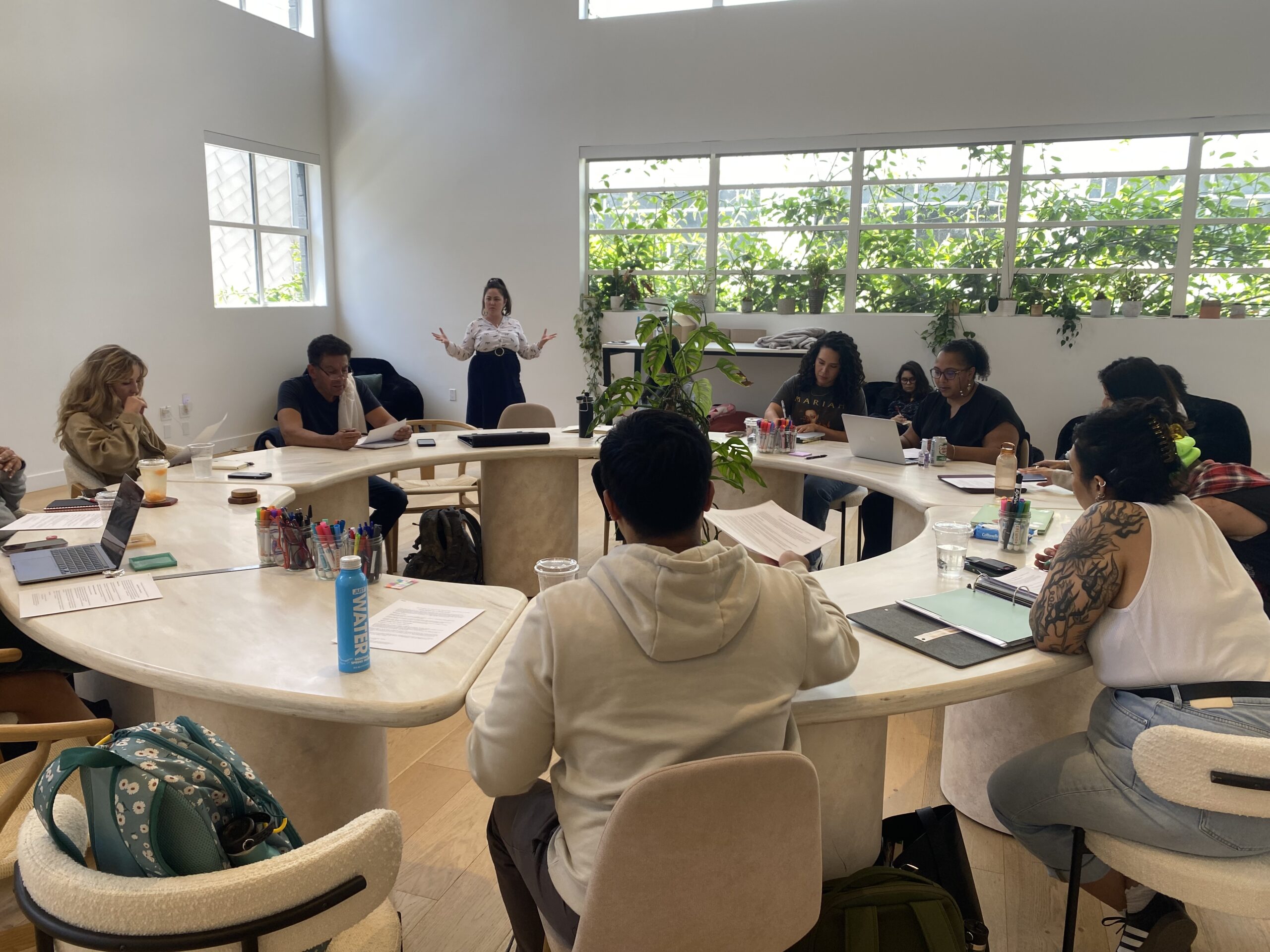
On September 8, 2025, PEN America and P&T Knitwear, a family-owned independent bookstore, joined forces to shine light on the industry’s complex processes. Over the course of the evening, almost 200 audience members received insider tips and tricks from six panelists: author and teacher Rob Cameron, vice president and agent at The Gernert Company Alia Hanna Habib, HarperCollins executive editor Rachel Kahan, New York Times Modern Love editor Miya Lee, vice president and publisher of Legacy Lit Krishan Trotman, and Penguin Random House editorial director Paul Whitlatch. Award-winning author Susan Shapiro moderated the discussion.
Here are five takeaways from the event:
Don’t jump the gun on querying agents.
Throughout the night, multiple panelists emphasized the amount of work writers should undertake before seeking out a literary agent.
“Everyone’s so eager to get an agent, and they see that as a major accomplishment, which it is, but also as a solution to their editorial problems,” Habib said. “That shouldn’t be the way you think of an agent.”
She recommended that, before they hunt down agents, writers complete multiple rounds of revisions and pass their work off to at least one trusted reader who will provide them with honest feedback — “so not your mom or your spouse,” she joked. Many agents won’t give a revised manuscript a chance if they rejected an early version of it, so it’s critical that writers put their best foot forward the first time around.
“You get that one shot,” she said. “Make it count.”
Later in the talk, Trotman reiterated a similar sentiment. “My advice is just spend time with your work,” she said. “Don’t race to the ‘find-an-agent’ track. Really get it ready for them. Really listen to yourself and make sure that by the time you send it to the agents — because you have to be competitive — that it’s really clear what you’re doing.”
Read, read, and read some more.
Kahan said that writers need to become adept at “positioning” their book, or learning to articulate how it will be situated in the marketplace. The simplest way to become better at “positioning” your work, she said, is to read.
“If you’re not a voracious reader, and you’re like, ‘Oh, well, I want to write a memoir about this,’ or ‘I want to write a novel about that’ — if you’re not reading memoirs and you’re not reading that kind of novel, what makes you think that you would be able to write a really good one and be able to get it out there in the world?”
With an understanding of the relevant literary landscape, writers can properly position their book for agents, who in turn can position the book for editors, who in turn can position it for their sales force. “Really know your category and what else is out there so that you can know what you’re bringing to the table,” she said.
Reading can also help writers identify potential agents. Habib recommended that writers check the acknowledgments page of recently published books that share similar sensibilities and would attract a similar audience to their own project. From there, writers can compile a list of agents and, in most cases, find their contact information via a quick Google search.
And when reaching out to agents, Habib said, demonstrate that you’ve done your homework. Show that you know the agent’s list, and explain that you’re writing to them because of it.
Beyond the practical benefits, Habib said the best writers are always voracious readers. “That’s how I know I’m working with someone really great: if they’re as curious about other writers as they are about their own work. No time is wasted that you spend reading.”
Hone your voice.
There are countless aspects of writing that can be taught, Cameron said, but the one that can’t be is voice. “It can only be found,” he said. “It can only be grown.”
He emphasized that writers seeking to cultivate their voices should avoid AI at all costs. “What AI does is it just kind of hones mediocrity,” he said. “You don’t want mediocrity. … You’re trying to figure out a way that you can put yourself on the page.”
Later, Whitlatch returned to the importance of voice, underscoring its significance in book proposals.
“There shouldn’t be anything in a book proposal that feels like it’s just appended because you read a manual somewhere that [said] it had to have this element,” he said. “Every piece should play a role. It should be trying to deliver a certain, consistent message to a prospective editor about who you are as a writer and what your voice is like.”
Learn to welcome edits.
After an agent reviews your work, they may ask you to change 50% of it, Cameron said. And when the revised work reaches an editor, they may tell you they love it — and then promptly ask you to change 50% of it again. But, Cameron said, “if you know what the story is that you’re trying to tell, that makes it relatively… I don’t want to say easy, but generative, because now you’re given a new assignment, a way to recreate what you’ve already done.”
Likewise, Kahan said that editors work in service of authors’ visions but that authors still need to remain open-minded about how to bring that vision to life. “The publishing and editing experience is fundamentally a very collaborative process, and if you’re not open to collaboration and not open to trusting people who do this for a living, then it’s going to be very hard and painful — and, also, your books are probably not going to do as well as they could,” she said.
Once, Kahan was discussing a manuscript she loved with its author. She talked about its strengths, and then she pointed out a few parts that she’d seek to improve, were she to acquire the project.
“And then after I had run out of things to say, she said, ‘You know, I spent 10 years writing that book, and I know every word in it, and I really don’t think I want to change a thing,’” Kahan said. “I thought, ‘Okay, then we are not meant to be.’”
Lee receives extremely personal Modern Love submissions at The New York Times, and though she’s mindful of that fact, it’s still her job to provide edits that ensure the stories are well structured, coherent, and engaging, she said. “If you’re fighting tooth and nail for every change, that can be kind of frustrating.”
Bolster your online presence.
Whitlatch said it’s a common misconception that editors are merely passive agents waiting for the next literary masterpiece to slide across their desk.
On one occasion, a post on X led Whitlatch to a satirical piece on CrimeReads that poked fun at the sheer number of people who end up murdered in quaint English villages. He tracked down the author and suggested that the piece be transformed into a book. The author took to the idea, and eventually the book became a national bestseller.
And though writing matters most, additional online content — such as other projects authors have worked on or even videos of themselves — can give editors insight into what authors are really like. “All of that kind of stuff can help us make a case to acquire something that we might fall in love with,” Whitlatch said.