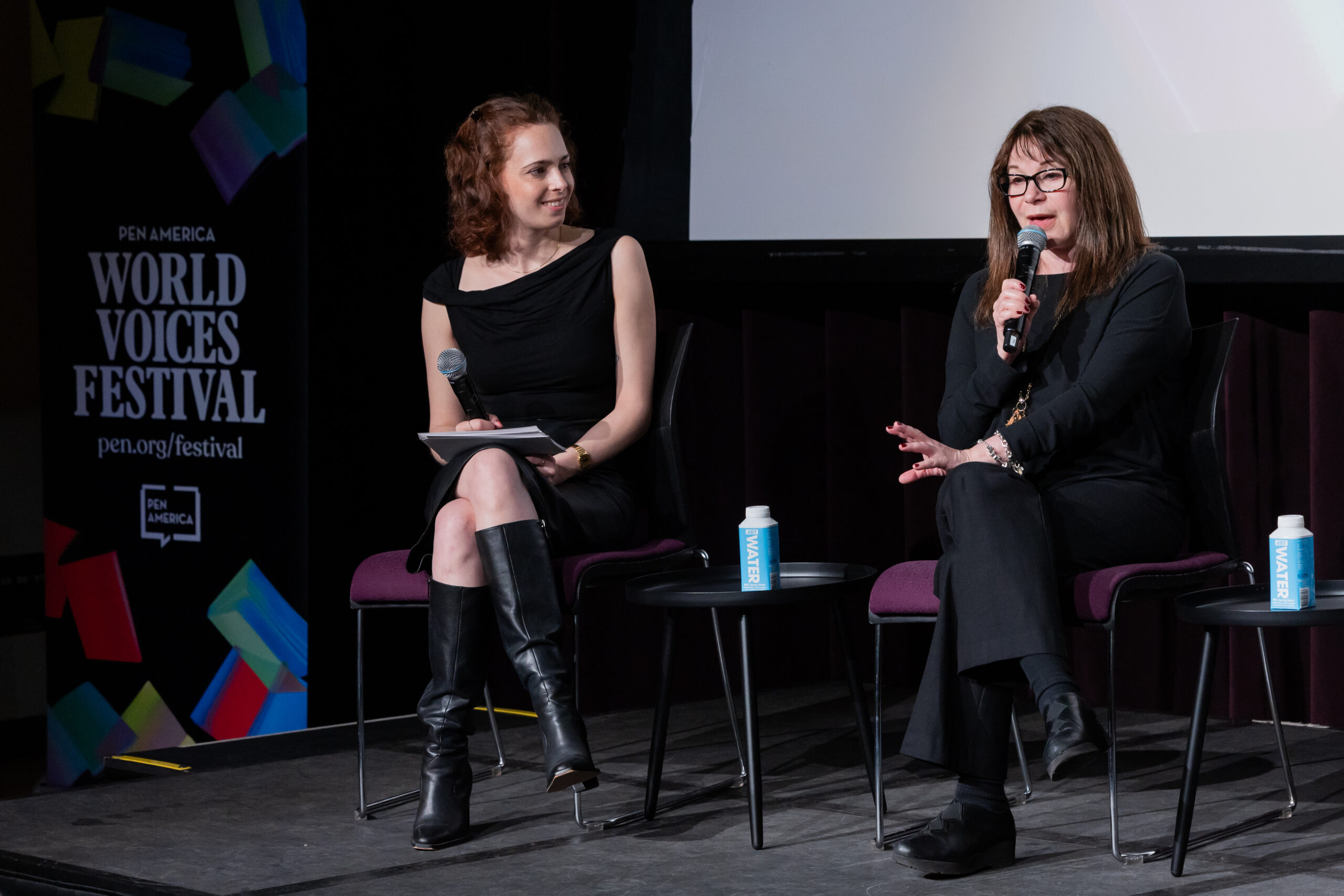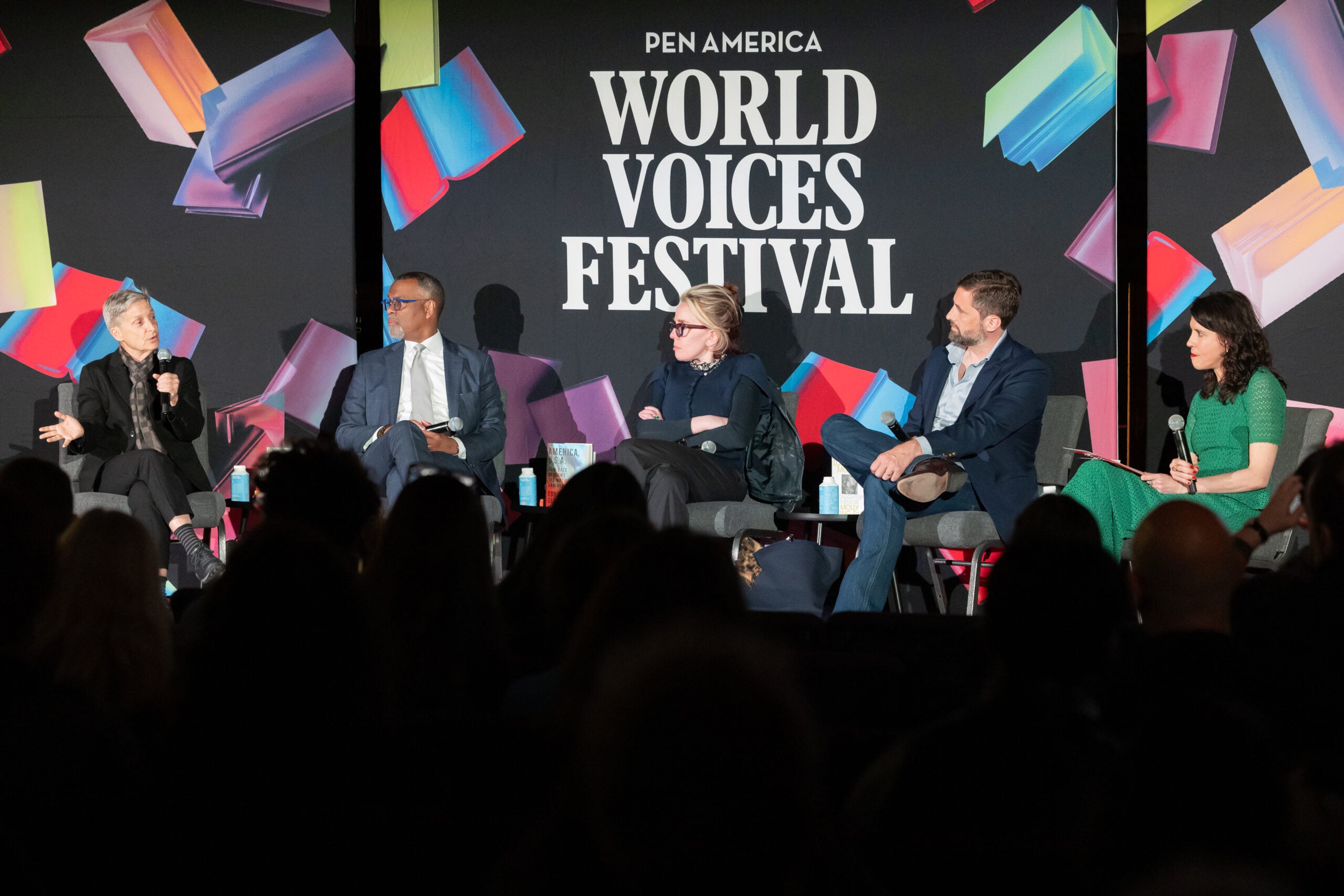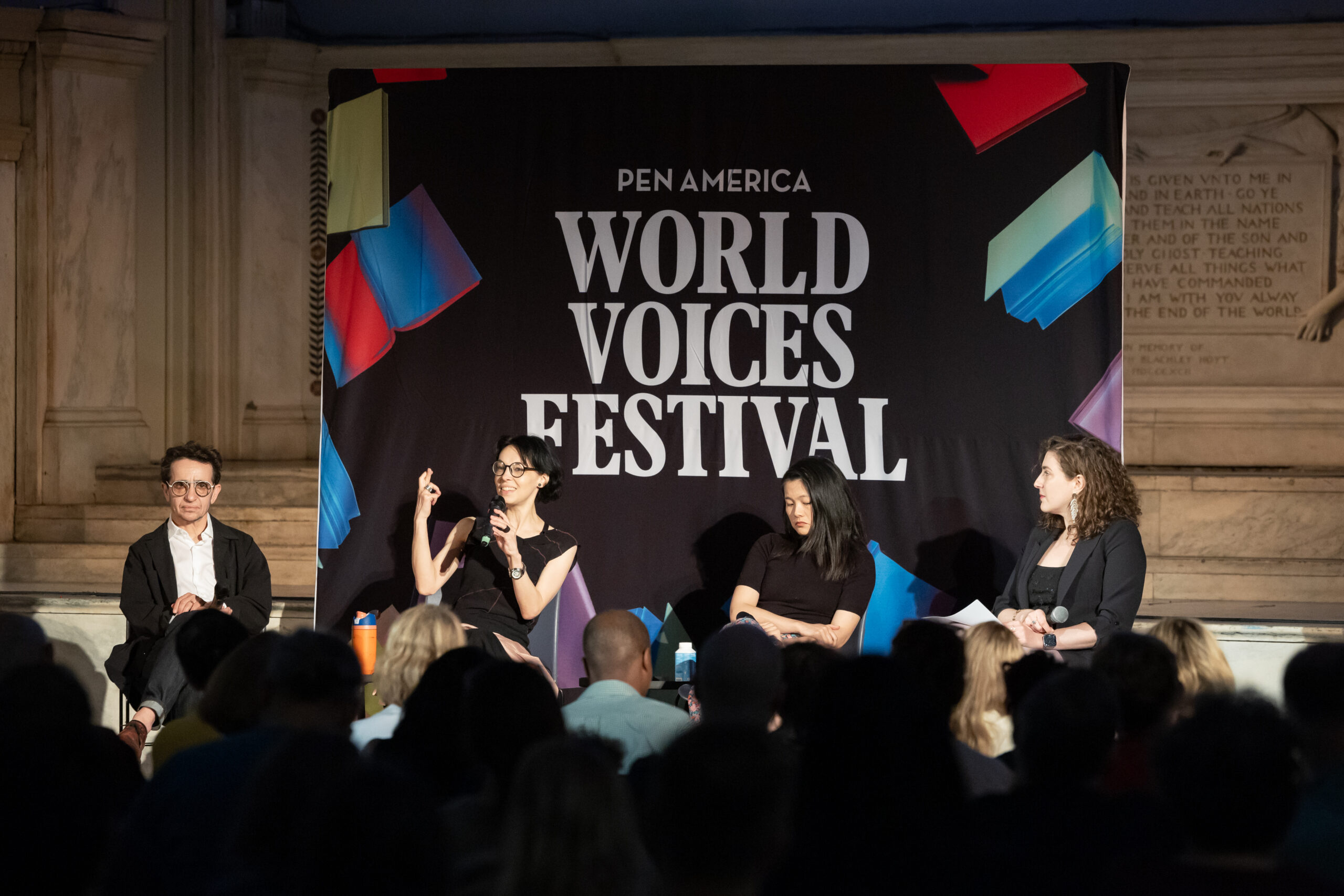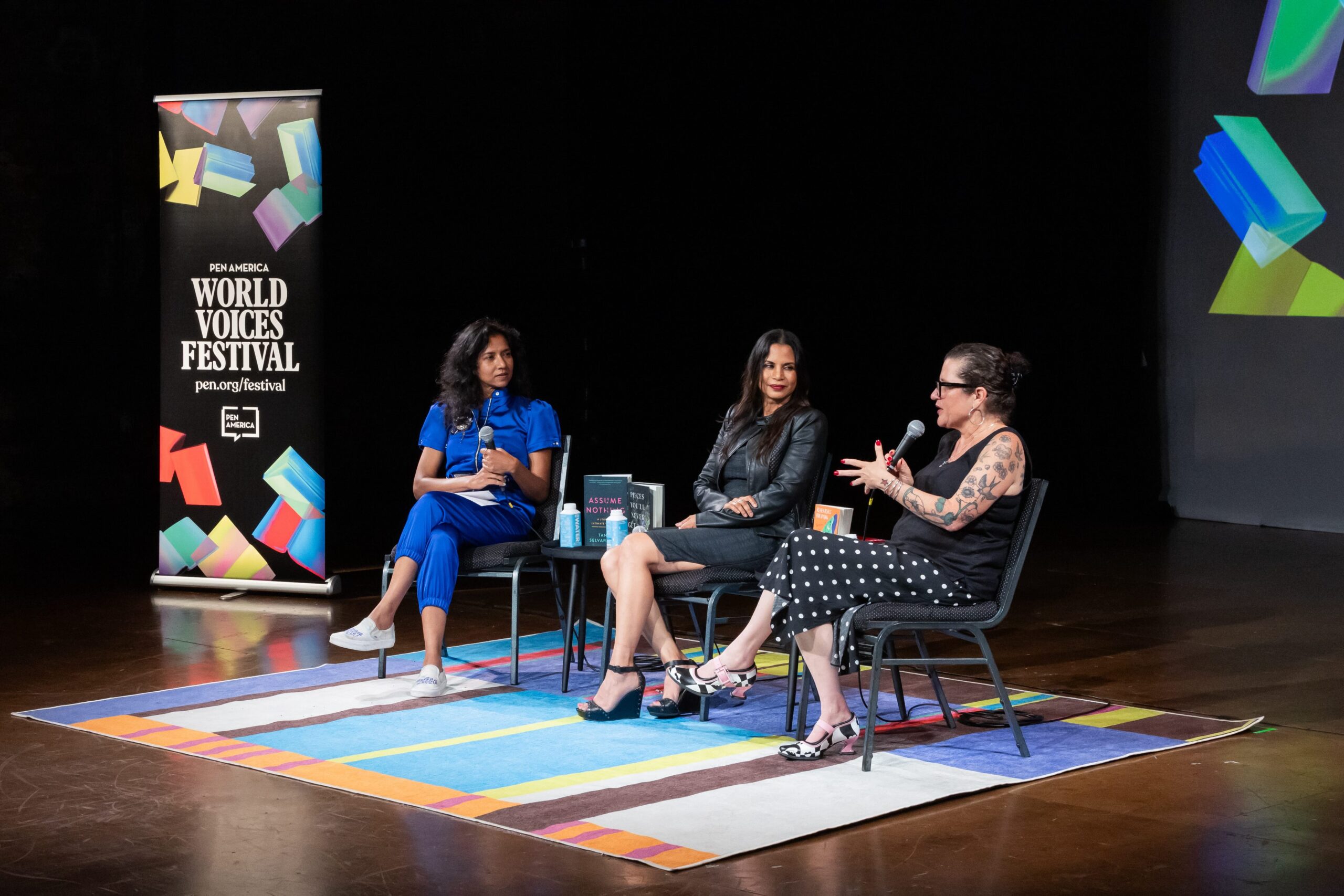

As readers and writers wandered through Washington Square Park during the 2026 World Voices Festival, purchasing books at the Indie Lit Fair, taking a peek at an art installation celebrating the freedom to read, and telling us about their reading preferences, many also gravitated toward our outdoor stage, where three acclaimed authors gathered for a rich conversation about conjuring up cities in novels.
Moderated by author and critic Hamilton Cain, the May 2 panel joined together Amanda Lee Koe, whose novel Sister Snake reimagines a Chinese folktale as a contemporary story about a pair of sisters in New York City and Singapore; Sam Sussman, whose Boy From the North Country follows a young adult called back to New York City after his mother is diagnosed with cancer; and Gary Shteyngart, whose novel Vera, or Faith explores a New York City several years in the future through the eyes of a 10-year-old girl.
During the panel, titled “Crafting the City,” the authors delved into how they learn about the settings of their novels, the capacity for cities to function as sites of political commentary, and New York City’s unique identity.
On Researching Cities for Their Novels
Cain opened the discussion by stating that he considers writing fiction about cities a kind of investigative journalism. “I’m very curious to hear you describe your own reporting process as you put your cities into your books,” he said.
Koe: “The way in which we interface with any given city is bound to carry certain biases, positive or negative. And I think that part of that investigative journalism is to be able to move through these streets with an eye to how you might be negatively or positively biased to a certain place, and then the way you conduct yourself through the city is part of the experiment of exploding those biases that you hold.”
Shteyngart: “I walk two or three hours a day wherever I am and take notes, I guess on my phone now. Just overhearing conversations is wonderful. People say the craziest things and do the craziest things. So I think that’s my recommendation to young writers, is just walk.”
On the Hardest Details to Nail
Cain inquired about the details of the cities that were the trickiest to get right. Koe described a scene in her book set at one of the most expensive hotels in Asia, which charges non-guests $50 just to see its pool – a price she wasn’t willing to pay.
Koe: “It makes sense that if there was a bar and this beautiful, infinity, 50-stories high swimming pool, the bar would connect to the pool, right? And so that’s how I wrote it. … I finally got to see it after my book was published, and I went up there, and it’s completely wrong. The bar does not connect to the pool. I think some things are more beautiful in fiction than otherwise.”
Sussman: “I was writing about New York 50 years ago. … For me, there was some humility in letting go and saying, ‘I’m not going to get every factual detail right about this time and place that I can never enter,’ but what I’m going to get right is the atmosphere. I’m going to get right the sort of playfulness and sense of carefree abandon.”
Shteyngart: “I never have any difficulty writing about New York or cities in general. I just did a piece about Uzbekistan, four cities in 10 days, and I think I got it. But nature is so hard for a New York boy to write about. I wrote a novel set upstate, and oh, these woodpeckers and all these goddamn animals. It’s too much. I can’t handle it. But cities are easy.”
On Depictions of Cities in a Perilous World
As fiction has shifted away from realism to genre and speculative work, cities are increasingly portrayed as fable-like sanctuaries in dangerous worlds, Cain said, citing Mohsin Hamid’s Exit West and Madeline Thien’s The Book of Records. He asked the panelists to reflect on cities as vehicles for political commentary.
Koe: “Part of what is beautiful about a city is that there is a lot outside of your control. I think that being okay with not being in control exposes you to a lot of stuff that you don’t want to be exposed to, but it makes you a more tolerant and more observant person for all that is to come, and that’s always a better place to be than being in your own echo chamber.”
Sussman: “We should resist the notion of the sort of city as a fortress against a more conservative, dangerous landscape beyond. Maybe that’s because I’m from that beyond. But I think there’s all sorts of great culture and ideas that you find outside of American cities. … I think we have to resist that sort of simplification.”
Shteyngart: “I’m working on a project now set in 1930s Berlin. And 1920s Berlin was the most progressive city in the world, easily, and it just took a couple of years and a few different things and it wasn’t. So there really are no walls around our cities either.”
On New York City
Cain told the panelists that he had recently gotten into an argument with a historian about whether New York City was an American or a global city. He asked Shteygnart who was right.
Shteyngart: “The whole idea of New York, and maybe it’s the immigrant to me, the whole idea of New York as a solely American city — well, what is an American city? When have our cities ever been anything but a place for others to come to? More than New York, I don’t think any other city has been a component of the entire universe that we inhabit.”
Sussman: “It’s worth acknowledging we have a mayor of the city who was born in Sub-Saharan Africa, right? And whether or not you agree with the specifics of his politics, he has such an expansive story of New York. When I listened to Zohran [Mamdani] speak through the campaign, I realized, ‘Oh my gosh, I haven’t had that type of food that he’s describing. I haven’t been to that neighborhood that he’s describing.’ He has such an expansive narrative of what the city is and can be, and I find that remarkable and inspiring.”
Want more?
Check out the panelists’ books:
- Sister Snake by Amanda Lee Koe
- Boy from the North Country by Sam Sussman
- Vera, or Faith by Gary Shteyngart