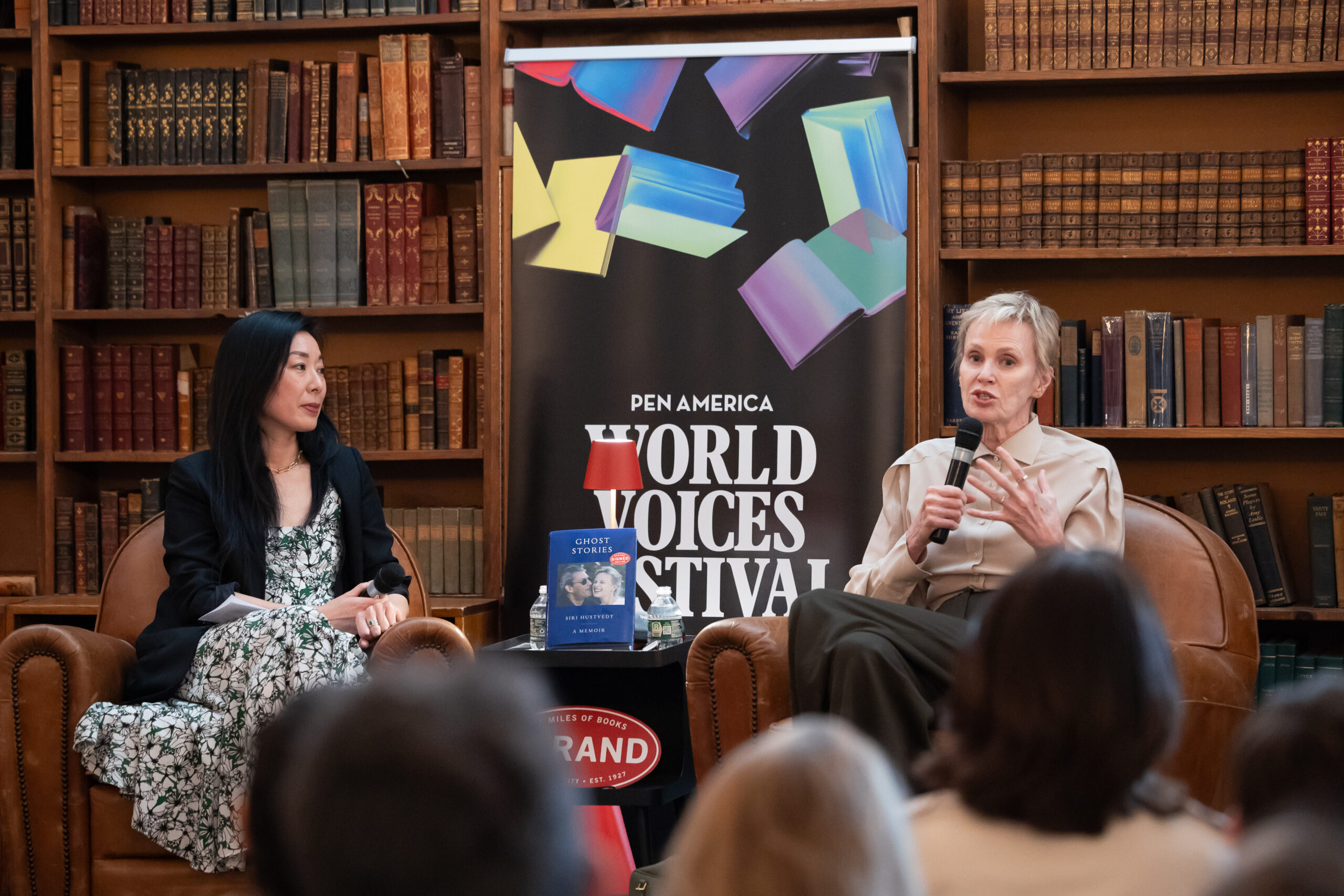
Following the death of her husband of 43 years, Paul Auster, Siri Hustvedt set aside the half-finished novel she had planned to return to after his cancer treatments.
“I was not in any shape to write anything except about this man who had died,” she said in reflecting on her new book, Ghost Stories: A Memoir of Love & Grief. “I know Paul thought that I was going to go back and finish this novel … and in a way, we were both stupid, because I should have known that that’s the only thing I could do, and he, if he had thought about it, might have known, too.”
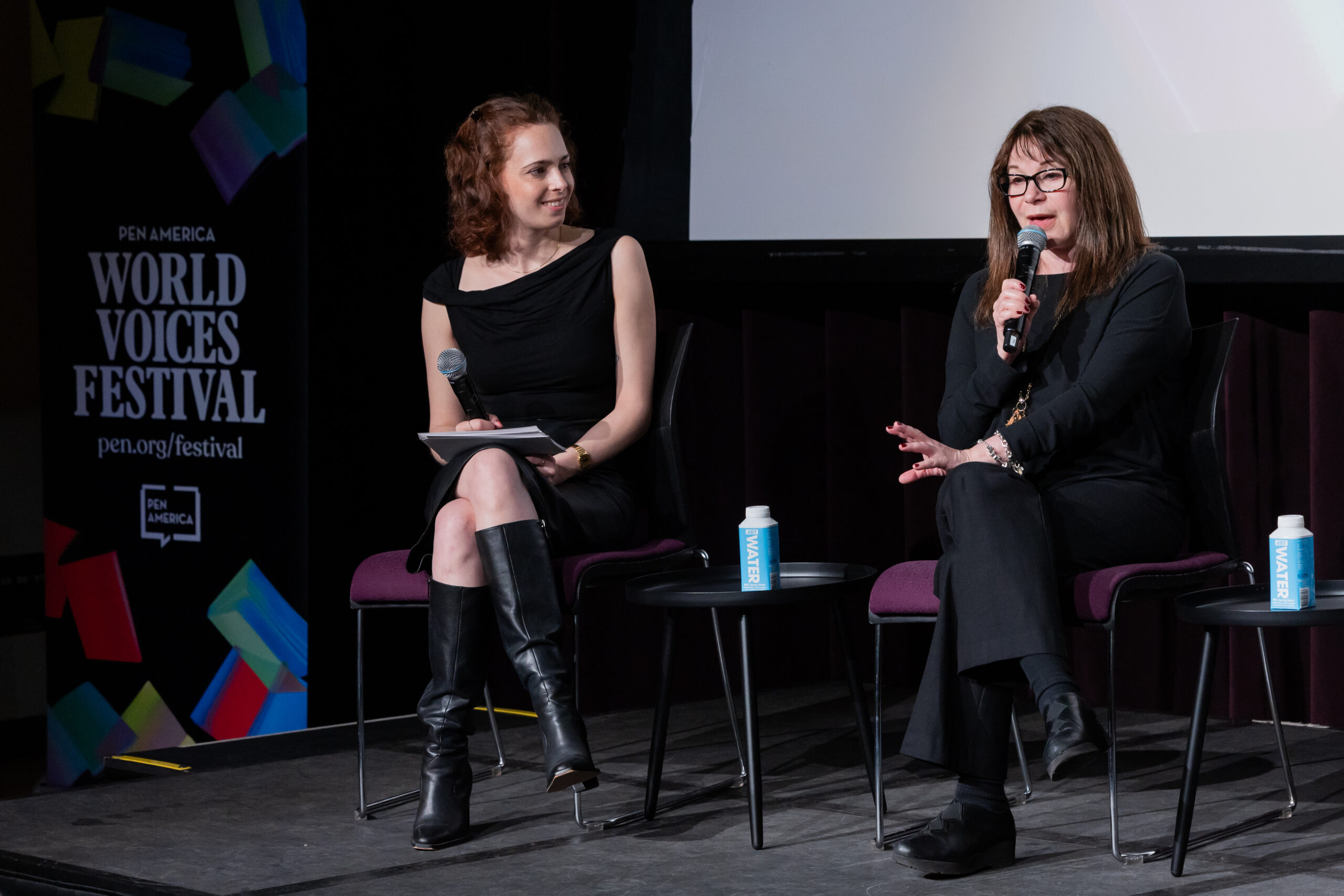
In conversation with Pulitzer Prize finalist Katie Kitamura (Audition) at the 2026 PEN World Voices Festival, Hustvedt described Ghost Stories as a resurrection. She explored a disruption to her sense of time, hallucinations of her husband’s cigar smoke, and the ghosts that haunted her on and off the page. “Grief is ordinary madness,” she said. “People go a little crazy.”
What follows are excerpts from their conversation on grief, joy, memory, and the therapeutic process of writing.
Katie Kitamura: You do walk through the world differently after you’ve read this book. But one thing that I felt very strongly is that it is a book that is about tremendous loss, but it is also a book about joy, and it’s a book that has these binaries.
Siri Hustvedt: I think this is true that for me, the story of writing the book that includes, well, the hardships of illness and cancer treatment that many people are familiar with, either because they’ve gone through it themselves, or watched a beloved person go through the treatments, that at the same time, when I was writing the book, I was remembering funny events so I could laugh while I was writing this memoir. I didn’t want it to be a hagiography. No, it’s not Saint Paul. The book was, for me, a resurrection. I wanted to bring something back of this person that I loved on the page. And I hope I did that. … At one point I say the ghost stories are also love stories, and they are, and that didn’t mean we didn’t have our arguments. I don’t often talk about books as therapeutic, but I did feel that writing this book, that the book was more cohesive than its author. So it was a good thing, kind of pulled me together a bit.
It is very much a book that is about writing and reading almost as much as it is about your marriage and your life together. … It’s not simple memoir. It complicates that timeline in many ways. So I wonder if you could speak about when you decided to write this book, and then when you came upon the form.
I started, I think it was only two weeks after Paul died, and I knew that this was the only thing I could write. I have a half-finished novel that I’m returning to now, but I was not in any shape to write anything except about this man who had died. And this is such a funny piece to say, but I felt the book almost as an organism, and I knew that it was going to have a timeline, sort of hovering in the back. There is a sort of diary aspect. You know that it’s May at the beginning, and you know that it’s March at the end when I finished the book, but in between there are all these memory fragments I unearthed, documents I hadn’t looked at in years, letters I wrote to Paul, notes he wrote to me that I could never have remembered verbatim. So that was also an act of discovery, and that was a kind of adventure. Before Paul died, the last thing he wrote was he wanted it to be a short book, he said, a book of 100 to 200 pages called “Letters to Miles.” Miles is our grandson, who’s now 2 years and 3 months going on 4 and so he couldn’t finish it. He finished 35 pages. And I had the idea that, because actually I do think about our marriage as a long dialog, that you would have the two voices mine, and then the letters to Miles, you would have the back and forth, a dialogical structure inside a timeline with documentary evidence from the past, and that that would be as memory is that you always remember the present, but you can remember any particular moment of one’s life. So, yes, it’s a complicated structure that I kind of felt it from the beginning, and then worked to realize that as I went.
If you’re a reader, and I assume everyone here is, you’ve spent a lot of time with ghosts. The dead speak to us.
It is a book that is also about hauntings. I wonder if you could speak a little bit about what encountering Paul’s voice in those letters to Miles, which are so moving, but also encountering your own voice.
I mean the past self, you know. I decided those documents were just going to be naked, and the punctuation of my letters is egregious. I was 26 and a graduate student, and I should have mastered the art of the comma long before that, but I didn’t, and I had to make the decision whether I was going to edit myself or not. And I decided, no, we’re going naked here. We’re just going with the flaws. …
Those letters, I hadn’t read them since I wrote them, and discovering them again was, in a way, part of the pleasure of the book, and some of the notes that Paul wrote to me that I remembered, of course, but I didn’t remember the exact prose, and so it’s strange to say, but the book, I think, allowed me the kind of distance that representation gives you. It’s not the embodied person, it’s the letters on the page, another kind of ghost. If you’re a reader, and I assume everyone here is, you’ve spent a lot of time with ghosts. The dead speak to us, and so again that wholly impossible resurrection urge was nevertheless part of it. Grief, you want the person back. That’s what grief is. After I finished the book, I thought grief is a kind of unrequited love. Not in the past, when you had it, but in the present. People try to be nice to widows and widowers and they say, Well, you have your memories. You do have your memories, but that’s part of the problem. What you want is the embodied man. You want the immediacy. Kierkegaard talks about this very well. You know memory is recollection, and you can never get the immediacy of that embodied reality back in recollection. So yes, you have your memories, but they’re not good enough.
I certainly would never expect you to ever formulate writing as being therapeutic in any way, but I do feel in this book … there’s something quite powerful about the almost mechanical act of writing and the way that it does sort time for you. You said there is disordered time and time out of joint, but then there is word after word after word after word writing.
Just to frame this, I actually am interested in writing as a therapeutic exercise for psychiatric patients and actually for everyone. And there is some research on this that’s quite interesting, that if you do 20 minutes of emotionally driven – it has to be emotionally driven – writing every day, it improves liver function, the immune system and mood. … So I am interested in the therapeutic act of writing, but in my own work, maybe I’m shying away from that, and maybe that’s a dumb thing. Writing has a cooling function, and I think that’s often where the therapy lies. … You put the I on the page, I feel, or went, or did, whatever I, and that alienation and proximity forces the writer to look from the outside at what’s happening, and I think this creates extra reflective self-consciousness, and that, especially if you’re feeling disintegrated, can have real therapeutic effects.
Because I’m such a wonk, after Paul died, I read a lot of bereavement literature that I hadn’t explored before, and quite a few brief memoirs. And one of the things I realized was that fractured time is something that happens to a lot of people. And if you think about it from, subjective, phenomenological point of view, philosophical point of view, we go through our lives and we have a sensual experience of the world, and the person you live with is profoundly part of that perceptual reality, and when that person vanishes, there is literally a hole in your perceptual world. And the story of grief in my case, but I think in many people’s cases, was an adaption to that hole, to what is no longer there. And that is why presences of one kind or another, hallucinatory experiences … it’s very common. I think it’s because our nervous systems are not just passive receivers of the world. We’re also active creators of it, and when something goes missing, the nervous system will bring that person back in some way or another.
we go through our lives and we have a sensual experience of the world, and the person you live with is profoundly part of that perceptual reality, and when that person vanishes, there is literally a hole in your perceptual world.
There’s a very moving almost visitation from Paul that you receive, and then there’s also the persistent smell of cigars in the house.
The day that we buried Paul in a small family ceremony in Greenwood Cemetery, on a beautiful day, actually, the sky got all blue. It was beautiful. And there was a little reception in the house. And at one point I went upstairs, I remember saying to myself, “the widow can do whatever the hell she wants.” And I went upstairs, it just lay down on our bed and I felt Paul on the stairs. I didn’t see anything, I didn’t smell anything, there was no touch. None of the senses were activated, but I knew it was Paul, and I felt his presence intensely, and was filled with joy. It was, I think, the closest I’ve come to a real ecstatic, mystical experience. …
And then in June, following his death, I started to smell cigar smoke. I was at my desk, I smelled cigar smoke, and I went to the window, lifted, you know, who’s out there smoking a cigar? No smoke. And then it started to come a lot and now it’s decreased. I actually had it just the other day, so it. Isn’t going away completely, but Paul had quit smoking these little cigars about nine years before he died, so there wasn’t a lot of smoke, but I think it was clearly identified with him and it’s those little cigars he used to smoke. That’s what I smell. It’s a hallucination that I like, and I hope it never goes away.
So much of living your life with Paul was very public in ways that were out of your control. I wonder how you made the choice to share these very intimate details in this book, and what that felt like.
I’m always writing to a kind of imaginary other, an imaginary reader, not specific people. And I never think about, oh my God, what are they going to say? That comes later. You get terrified, like, oh my God, what have I done? But the act of writing doesn’t include judgment, at least not for me, and I think that would interfere with the process. I knew this book really rested on intimacy. Don’t be frightened – there are no intimate descriptions of our sex life at all, none of it. But I do mention that we had a very strong physical sexual bond, erotic bond, that was really important, really even when he was ill, until the end, and the reason I did it was because I discovered that it’s almost never mentioned in these grief memoirs. Sex is gone, and that is interesting to me in this culture where people tell all kinds of things.
I think one of the great pleasures of the book is that it is, among many other things, a portrait of you and all those young poets in New York, before either of you were writing fiction. It’s an incredible portrait of a successful, happy marriage.
Yeah, we read each other’s work to each other from the very beginning and that was founded on, I think, the fact that we had mutual admiration for what the other was doing. I have thought about that because if I hadn’t so admired Paul’s poems – when we first met. He gave me all his little chapbooks – that it wouldn’t have worked. … I remember thinking, “Shit, this beautiful man so smart, but what if the poems are bad?” And fortunately, they were not, and it just kind of enhanced him for me. And I realized, also, with a lot of anxiety and nervousness, that when I showed him about 100 pages of a manuscript that I had put together, that I could see that he admired it, so we got over that hump.
The swiftest way, I think, to create unhappiness is to imagine that there’s some state of happiness that you reach and then you just stay there. It’s not like climbing Everest and just sitting down and now you’re happy. Life is an ongoing continuum of change. It’s never static.
It feels like the book resists a kind of temptation to make meaning, if I can say that. It seems that it doesn’t need meaning in that sense?
I wanted there to be a kind of openness and dynamic reality, because the only thing – and this, I did write down when Paul was in the middle of treatment, and it was a very low moment – the only thing in life we can be certain of is change. Whatever is now will not be like this forever. And I knew then that Paul could die, that it could be worse. But just the idea of change was a comfort in that moment. I’m an epistemological pluralist. I believe there are many ways to understand the world, many, many ways to know, and that all relations are dynamic. And the swiftest way, I think, to create unhappiness is to imagine that there’s some state of happiness that you reach and then you just stay there. It’s not like climbing Everest and just sitting down and now you’re happy. Life is an ongoing continuum of change. It’s never static. And I hope that the book embraces that idea, and I think between us, we did find a way to accommodate change over four decades of being together. Otherwise it wouldn’t have worked.