Wen-yi Lee | The PEN Ten Interview
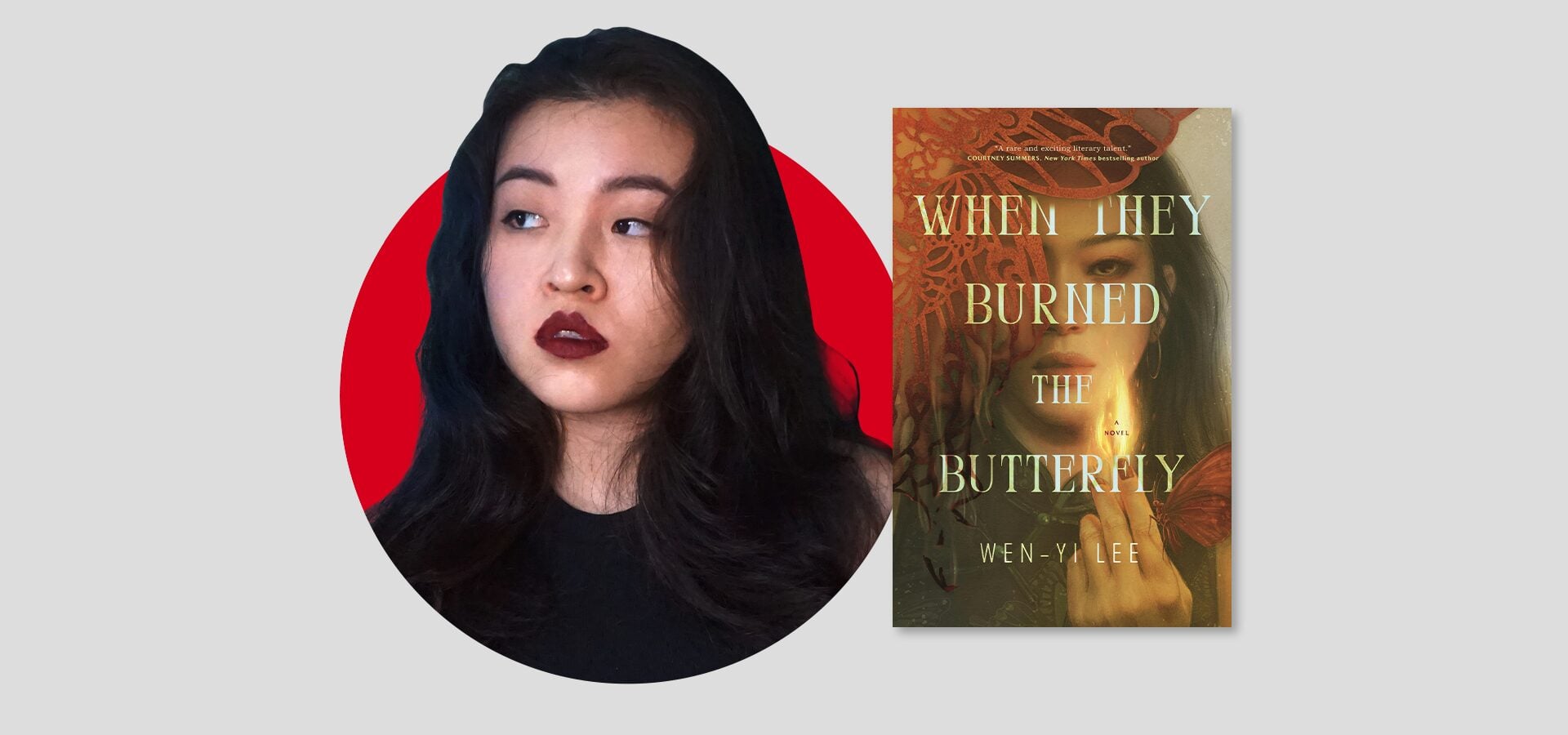
The new adult novel When They Burned the Butterfly by YA author Wen-yi Lee combines history with fantasy. Set in 1970s Singapore, readers are introduced to a changing city; neighborhoods are rebuilt, Western culture is promoted, and gangsters are the only ones using outlawed magic inherited from their ancestors. Adeline, a high school student, was always told by her mother to hide her ability to ignite fire from her fingertips. When her mother dies in fire that consumes their home, Adeline is introduced to the Red Butterflies–a woman-led, femme, and gender-inclusive gang who can all ignite fire just like her. (Tor, 2025)
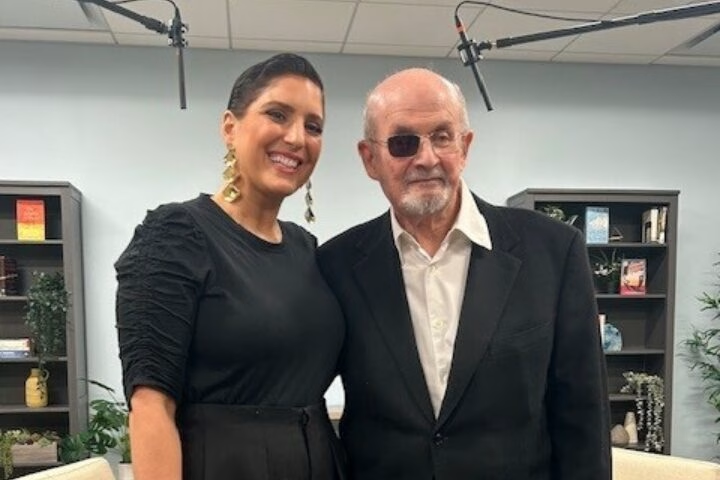
In conversation with PEN America’s World Voices Festival and Literary Programs Manager Sarah Dillard, for this week’s PEN Ten interview series, Lee highlights the parallels between sworn gang families and queer found families, the various groups of women from Singapore’s history she drew inspiration from, and how she portrayed feeling through poetics in her prose. (Bookshop; Barnes & Noble)
Your debut adult novel When They Burned the Butterfly is based on Red Butterfly, a real all-girl gang that operated in Singapore in the 1950s and 1960s. How did you combine research with your imagination or embodiment of their lived experiences?
I did go through our national newspaper archives and read a lot of articles written about them (and the time period largely). They’re surprisingly well-mentioned for such a small group, probably because of their novelty and subsequent mythology; the book’s final title actually came from one of these headlines back in the day, which ran ‘When callgirls hired the Butterfly’. There are details I borrowed that were iconic–the leader called Madam Butterfly having a red tattoo–or that I thought were interesting and complicated the feminist position, like how these girls were often going after other women, either as recruits or for example being hired by some rich wife to go after her husband’s mistress.
I read several books on historical groups of women in Singapore: the comfort women in World War II, the samsui women construction workers, a history of prostitution in the 19th and early 20th centuries. None of which Butterfly is directly about, but I wanted to be reaching forward as much as reaching back from the 2020s, and be able to trace a lineage of women’s evolving positions, including reflecting on the lives of women in my family.
I also read about Chinese secret societies broadly, about their history and evolution across Chinese migration to Singapore. There’s a great book that documents a collection of confiscated gang paraphernalia by William Sterling, who helped run the Chinese Protectorate that dealt with relations with the Chinese community–that gave texture to the actual objects and rituals used. I combined these secret society structures with inspirations from Chinese spirit medium, or tangki, rituals, which still exist today.
At the same time, I wanted to be writing a fantasy setting inspired by these societies, and not an ethnography or historical document, so I consciously left space for creative license. I find there’s a delicate balance between doing enough research and doing so much research I feel pressured to fit it all into the book, even when it doesn’t actually serve the story.
From the beginning, Adeline is a young woman at the margins and so are the women who become Red Butterflies. What inspired you to focus on a community of women who fight for their rights even if that means going against society?
When we think of Chinese gangs we think of these hypermasculine brotherhoods. When I learned about Red Butterfly, the image of an entirely female group existing within this space just sunk its claws into me–I wanted to know how they might variously reclaim, subvert, resist, appropriate, or be influenced by these masculine power structures. Especially when they’re already considered tainted women before they ever join the gang, because of the nature of their work; one of the epigraphs, about ‘infected, painted dolls behaving shamelessly in public’ and staining the country’s image, is from an open letter that someone wrote to the newspaper about the boom in prostitutes after World War II.
And actually, I don’t think the girls are fighting for their rights, necessarily, in the way that we would conceive of activism in its purest sense. They’re protecting themselves as individuals, and then their sworn sisters. Some of them are wary of putting themselves at more risk to defend anyone outside of that; that kind of solidarity might not even occur to them. I wanted to have that varying moral ambiguity as well. And we do see consequences to the girls choosing to try and learn what’s killing other girls. I think the idea of conceptualising your rights and fighting for them in that sense requires a level of social empowerment that maybe these girls don’t quite have yet. I was trying really hard to resist projecting contemporary values onto them.
But there’s also different intersections of marginalization, right? There’s women with more social or economic power who can exert that on women beneath them, there’s these girls with fire who have more power than those without, there’s lesbians and a trans woman who have different relationships to society and male structures than the other girls. And I think that gives them all slightly different priorities and vulnerabilities even in a broadly similar fight.
When Adeline arrives in a taxi to see her house burning, the cadence of your sentences changes. A rapid succession of short clauses is followed by a paragraph break that isolates a snapshot of the scene as if it’s scorched into memory. How did you decide which moments to capture distinctly? Is there a connection between the rhythm of your writing and the behavior of a fire?
This is such an interesting question! The whole time I was writing, I was definitely chasing the feel of a fire: passionate, all-consuming, unstoppable, but in moments also the source of life-giving light and warmth. I saw an interesting comment recently that the book feels like a duology, because there’s a fairly big shift in the status quo between halves. It’s intentional–I wanted the pace of change to feel breathless. I want the book to jerk you around as it picks up, never quite let you settle. The quiet intimate moments feel increasingly stolen from the breakneck series of unfortunate events. The narration also fragments as the events spiral out of Adeline’s control– breaks apart from her perspective, breaks tense.
I’m not a poet, but I’m very drawn to poetics and affect, and the reflection of feeling in the form of the prose. I think of prose as transcribed headspace. I really like playing with perspective and structure and rhythm and I adore fragmentation, as earlier evidenced. I try not to make it a crutch, but I’m very drawn to almost cinematic vignettes that capture everything about the scene in sensory flashes. Because I think that is how trauma often remains with us. Not as a coherent full image but in uneven pieces: some shards and some long, drawn-out, detailed moments that seem to never end and tumble into one another. A lot of my climactic scenes tend to break that way.
Worldbuilding is a huge part of fantasy writing but I think real settings need narrative worldbuilding, too, in choosing what details to focus on or diminish to create the atmosphere and stakes for the story. I’m always interested in the tensions between body and the environment, and the city as a body in itself.
Adeline describes her mother’s close friend and business partner Genevieve Hwang as someone with “too much duty and not enough power”. How does finding a balance between duty and power unfold within the other women characters throughout the novel such as Tian, Pek Mun, and Elaine?
Very close friend Genevieve. And I think the ambiguity in that relationship is very relevant to the question here, because there’s a lot of tension between loyalties to who gives you power and who gives you personhood; for women, and especially queer women in that time period, I think those can be two very different alignments. Choosing safety can mean giving up agency, and vice versa.
I was thinking about different kinds of power that women can attain. Having financial power or the protection of social class–like Genevieve and Elaine–can constrain you with the etiquette that these positions demand, especially from women, when this power and protection is often afforded by relationships with husbands or fathers. The Butterflies, on the other hand, are free from having to be proper ladies and they have a very real physical power that makes them a bigger threat than they otherwise would be in this hypermasculine environment. But at the same time, they’re very socially precarious. I specifically chose not to have them be an established, powerful mafia sort of family. I wanted that tension between their fire power and their social fragility to keep pulling at them, and forcing them to make difficult and different choices.
Your descriptions of the setting–city streets, changes to buildings and business over time, and the difference in atmosphere between night and day–make the scenes characters themselves. How did you conceive the place and why was it important to your writing?
I always want to make place a character in my writing. I need it as a reader, too. I think every story is inexorably shaped by where it happens–physically, in the way that the built and natural environments enable or constrain it, but also systemically. What are the underlying wider forces and contexts subconsciously driving the characters’ choices, etc? Worldbuilding is a huge part of fantasy writing but I think real settings need narrative worldbuilding, too, in choosing what details to focus on or diminish to create the atmosphere and stakes for the story. I’m always interested in the tensions between body and the environment, and the city as a body in itself.
It’s also particularly important for this book because a lot of the story is about finding places and losing places, figuratively or physically. The ‘70s in Singapore were a time of massive redevelopment of buildings, of housing, of the land itself. Adeline has moved homes twice before the book even begins and she’s lost that third one by Chapter 3. There’s a sense that they’re existentially under threat, not just from territorial and legal forces, but also the dismantling of the buildings they exist in. In that way, looking back at the city my parents would have been born into, which no longer exists in much recognizable form anymore, I was also doing that reconciliation for myself. Maybe I’m committing the sin of projecting my contemporary nostalgia onto these characters, but I think historical fiction is always inevitably an exercise of retrospection. There was a sense of prophecy while writing it, because I know where the city’s future ends up.
If anything I was overly indulgent with place. There are scenes that are set in places purely because I’d learned some interesting historical fact about them and wanted to engineer a way to get it on the page. I simply couldn’t kill the darling that was Pulau Saigon, for example–a little islet that used to sit in the middle of the Singapore River, but was filled in and became part of the mainland before I was born, and so seemed to appear magically to me in the process of research.
The origin history of the first Madam Butterfly and the reputation Red Butterflies hold assert that fire is most powerful. Why did you choose fire as the key element for this story?
There’s a fire in Singapore’s history that’s somewhat mythological in the way it’s incorporated into our national founding narrative: the Bukit Ho Swee fire, which in 1961 burned down several thousand homes in a squatter settlement. To this day the actual cause of the fire is unknown, but in the book, the fire is caused by a rogue Butterfly, which sets certain things in motion for 16 years down the line. It exemplifies their fire’s potential for devastation.
But it’s also a source for rebirth: the ashes of the Bukit Ho Swee fire gave rise to one of the burgeoning government’s most successful public housing projects and kickstarted that rapid development.
Symbolically, fire is transformation, fire is crucible, fire is passion, fire is consumption, fire is spirit, fire has a bright and raw potential that society often seems to fear in women, fire provokes a sense of fear that matched the anxieties and fragility and fervent hope I wanted to pull from the time period. And, you know, in the theme of challenging masculinities and femininities, fire is the masculine yang in yin-yang. The name Red Butterfly was a gift–it encapsulated all of that by itself.
So people will read what they want to read, and I see my job as just delivering the story as it wants to be. I find it fun when no one agrees on exactly where to put me. It means I’ve successfully encapsulated how multi-faceted the world is.
Kinship came up throughout the novel. Communities are connected not only by ancestral threads but due to circumstance, shared experiences, intimate relationships, and common beliefs. Can kinship ever be harmful or is it always beneficial to find communal support? How does When They Burned the Butterfly address this?
I kept running up against parallels between these sworn families of gangsters and queer found families–not that they’re the same thing, obviously, but these concepts of creating kinship outside of mainstream structures all slotted into one another when I was following a lesbian coming of age but also spaces like Bugis Street, which was a famous (now cleared out) spot where trans women found each other. Meanwhile, you have these secret societies that started out as migrant communities formed for survival in a foreign land, but have obviously evolved over the generations. I think it’s an interesting question of what happens when that initially very marginalized, very singular and noble motive diffuses as the Chinese community gained more belonging and power in Singapore. The Chinese became Singapore’s majority a good while back and the characters are all naturalized residents at this point; it’s not an immigrant narrative anymore. And obviously the country as a whole is figuring out what it means to be Singporean and belong to Singapore, as it’s now an independent nation. So changing questions of belonging really underlie the book.
It’s always beneficial to find communal support. Community is a key form of empowerment that disenfranchised people can attain. But obviously because we’re all human, it’s never going to be a perfect relationship. Hierarchies almost always emerge; goals rarely perfectly align; sometimes because the stakes are so existential, and the group so small, stepping out of line can have huge consequences, especially when ritual is involved. These tensions come up in Butterfly a few times and sometimes the characters leverage them against allies to their own benefit.
When They Burned the Butterfly is as much a fantasy novel as it is a mystery. Do you see genres as being distinct categories? How does your writing fit into these boxes?
I’d say genres are broadly more useful for readers and marketers than writers. They’re essentially shorthands for story conventions, right? Sometimes you can peg a book to just one category, by author’s design, but other times it’s reductive to read books through only one lens. Although a lot of cool work comes from knowingly playing with genre convention and exploring the lineages within which you can situate your work.
A lot of my writing is genre-blending. I write speculative fiction, but I tend to pull from a lot of different places within and outside that, the same way I read. I like traditional fantasy elements, I like gothic, I like horror, I like science, I like history, I like fabulism; those tend to seep in across all my work. In Butterfly I was also thinking about noir, like you said, and romance. My aesthetic map was as much Wong Kar Wai movies as Netflix’s Arcane as R.F. Kuang’s epic The Poppy War as Malinda Lo’s 1940s Chinatown lesbian club YA coming-of-age Last Night at the Telegraph Club.
It’s interesting at the end of it to see which elements different readers hone in on. I would call When They Burned the Butterfly historical fantasy with a couple of horror moments. But one trade review compared it to Monika Kim’s The Eyes Are The Best Part (about a Korean American college girl becoming a cannibalistic serial killer) and another compared it to the movie The Substance (the book’s plot involves some girls’ bodies being transformed by pills), so apparently they really zeroed in on the feminist horror. Meanwhile some bookstores have it tagged under romance, while other responses will not mention the romance at all. It’s all of that and not just any one of that. So people will read what they want to read, and I see my job as just delivering the story as it wants to be. I find it fun when no one agrees on exactly where to put me. It means I’ve successfully encapsulated how multi-faceted the world is.
The use of spoken English compared to native languages at work, school, and home throughout Adeline’s Singapore community is one example of a belief held then that Western culture meant a more advanced society economically. Where do you see language trending now? Is there an embrace for indigenous dialects or is there still a dominating discourse?
Singapore has a complicated relationship with language, to an extent that Butterfly, time-period wise, only skims the start of. In the book, there’s the advocacy of English as a uniting and utilitarian language for a multicultural and industrializing new nation. But in the years that followed shortly, Singapore actively flattened and consolidated languages even within ethnic communities: banning other Chinese dialects (which are migrant languages, not indigenous to Singapore, to be clear) in favor of Mandarin as the mother tongue of a singular Chinese community; folding various indigenous groups into one singular Malay umbrella.
Those efforts were, in short, extremely successful. I don’t speak my grandparents’ and my dad’s native language (Teochew). In general, non-English languages are on a decline. Our first prime minister infamously said that poetry is a luxury a developing nation can’t afford. But now we’ve gotten over the biggest hill of material development, and are realizing one actually needs to worry about intangibles like culture, some of which might already have been lost. That said, there is still functionally no recognition for or national efforts to preserve the heritage of the indigenous peoples, the Orang Asli.
That’s an abstract current I’m interested in exploring as a continuation of this first book–after making all the drastic choices you believed you needed to survive, what losses and costs do you have to grapple with, and could you ever regain any of it? It’s very much in that postcolonial setting of figuring out how to rebuild after relinquishing the previous regime.
I wanted fantasy that explores what happens after the empire’s overthrown; I wanted more marginalized women’s and queer women’s stories; I wanted more magic, grit, spirit, and a sense of living history in a city that’s often thought of as commercial and a little sterile.
Who is the intended audience you hope will find When They Burned the Butterfly in bookstores? Who did you write this book for?
This was such a ‘write what you want to see’ book. I wanted fantasy that explores what happens after the empire’s overthrown; I wanted more marginalized women’s and queer women’s stories; I wanted more magic, grit, spirit, and a sense of living history in a city that’s often thought of as commercial and a little sterile. So I guess I hope I’m writing towards people who want to see that, too.
Wen-yi Lee likes writing about girls with bite, feral nature, and ghosts. She is the author of YA horror The Dark We Know and has published fiction and essays in venues like Lightspeed, Uncanny, Strange Horizons, Reactor, and various anthologies. Her work has been supported by the National Centre of Writing in the UK and the National Arts Council of Singapore, where she is currently based. When They Burned The Butterfly is her adult debut.