Senaa Ahmad | The PEN Ten Interview
How would John Adams, Marilyn Monroe, and Nefertiti fare if they were all in attendance at the same dinner party? Could a romance ever blossom between Julius Caesar and Nellie Bly? What if Henry VIII’s attempts to rid himself of Anne Boleyn were unsuccessful because she kept returning from the grave?
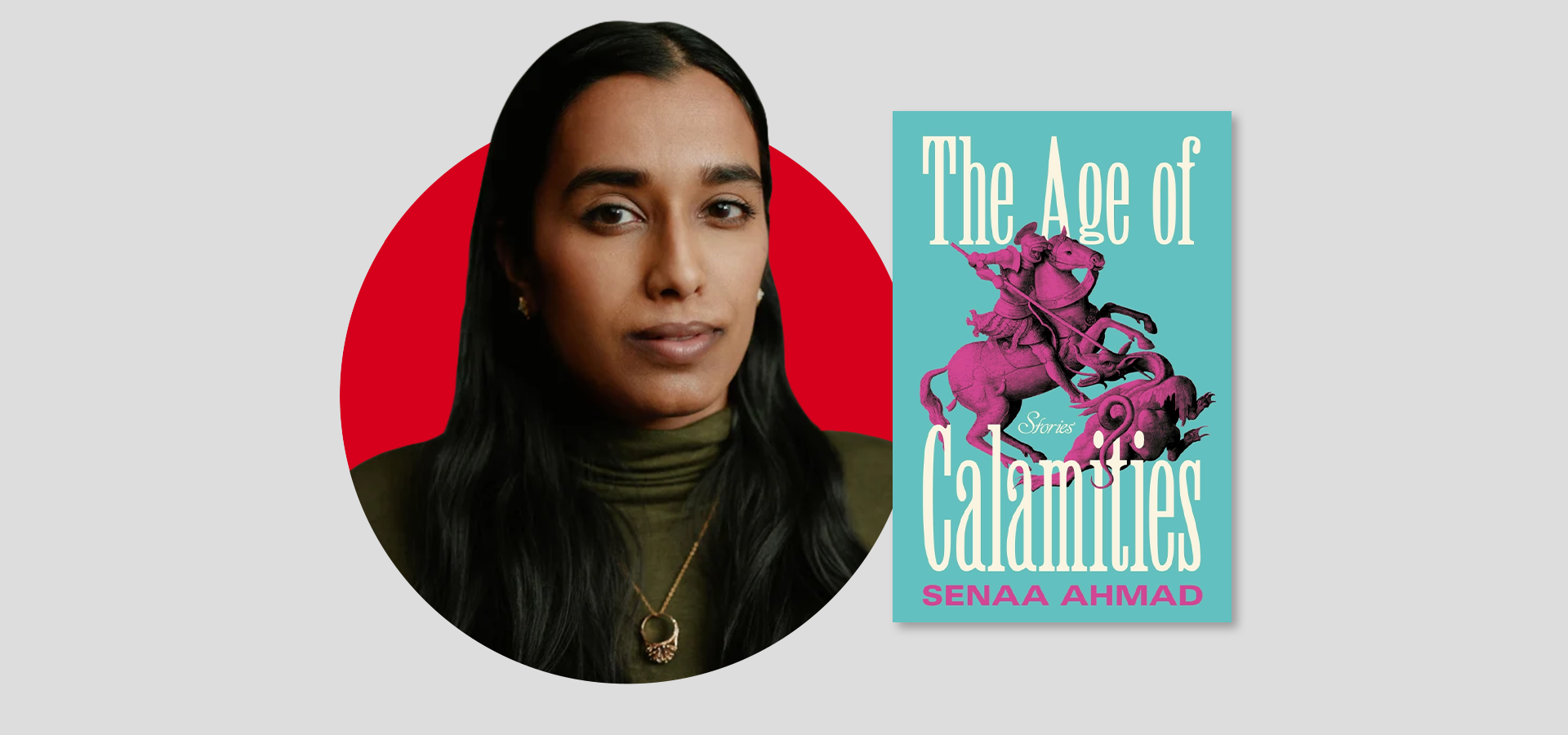
Senaa Ahmad’s The Age of Calamities (Macmillan Publishers, 2026) answers these questions and others in wildly brilliant and entertaining ways. In this week’s PEN Ten interview, Abhigna Mooraka, coordinator for membership and national engagement, speaks with Ahmad about the inspiration behind her debut collection. They also discuss Ahmad’s refusal to stick to one (or even two or three) genres, the intricate structure of a Choose Your Own Adventure-inspired story, and the people, dead or alive, she’d be first to invite to a dinner party of her own (Bookshop; Barnes & Noble).
This was such a wonderfully strange collection of short stories! What was the seed for The Age of Calamities? Did it start with a character, theme, or a fully-formed plot?
When I work on stories, I’m frequently looking for a binding agent between them, some overarching thematic architecture that brings them together. I find it irresistible to make sprawling plans for too many things in life. This collection started with the idea of plucking a historical figure out of their familiar context and putting them somewhere beguiling. At first, I thought it was a one-off concept. Eventually it dawned on me that this idea could yield an entire bucket of stories.
In 2018, I attended the six-week Clarion workshop in San Diego. One of the aims of the workshop was to write a short story draft every week, which is a laughably impractical pace for me. But I thought it could be a good opportunity to take this idea and sprint off with it in different directions, and it was.
You write decidedly historical characters and timelines in a looming present tense. Is there a reason behind that choice?
My default mode for writing short fiction is to write in the present tense, I think because of its thudding pulse of urgency. I like to hold my breath as I’m writing a story. That immediacy was hugely useful for the collection. It meant I could collapse the distance between the reader and the past, so that events were still undecided, still happening.
It was a delight to play with that sense of distant past in “The Wolves,” where the narrator has experienced events from almost a thousand years ago but is telling her story to an ostensibly modern child. The shifts from present to past tense helped to elongate and compress the passage of time.
There is a very interesting game of matchmaking happening in many of the stories in this collection. I could’ve never imagined Nellie Bly and Julius Caesar caught in a whirlwind, transatlantic romance. How did you decide which characters from history interact with each other?
I was searching for some kind of pleasant friction between characters. I love thinking about what people find annoying about each other, which sounds very petty, but I think it can be deeply illuminating about how a person makes their way through the world.
Often the kernel for the story would appear first, and then I’d work backward to determine which historical figure suited the situation. I knew I was looking at how they were perceived in the broader cultural imagination rather than the specifics of their lives. In the story with Nellie Bly and Julius Caesar, I wanted two people whose particular interests and eras would be incomprehensible to the other person.
I like to hold my breath as I’m writing a story.
I loved how time and timelines in this collection are often nonlinear. And how within each story, time functioned in even more distinct ways. How did you keep track of the years, months, days while you wrote?
I kept lots of long, chatty notes to myself, and I’d read those notes before starting the day’s work. I wanted the sequence of events to be legible to the reader, even if it felt dizzying, so that they’d have at least a hazy impression of how things were progressing. I took months or sometimes years before writing a new draft, which helped to approach stories with the distance of a reader. If I got lost on a read-through, I knew I needed to go back and clarify.
While all the stories in the collection are broadly historical and speculative, each story fits within a distinct subgenre. There is romance, mystery, horror, paranormal, and even Create Your Own Adventure! What was it like to write stories in so many genres, all while maintaining the cohesion of the collection?
Sameness in a short story collection can be very appealing, can’t it, because there’s a kind of meta-story told through the repetitions and tissue-like connections between each story. But it can also feel taxing if there’s too much of it. I was always conscious of exhausting the reader, knowing that the stories were already placing a lot of demands on them. I wanted to create different environments for each story, and genre is one of those environmental controls you can really have fun with.
When I started the collection, I wrote a little brief about what I was interested in. I wanted the stories to have a sense of fun, I wanted them to be structurally playful and occasionally metafictional. I wanted to use genre to amplify emotional or thematic elements. I think that jumble of notes helped to create some consistency for the collection.
Which story in the collection came to you the quickest, and which one was the most challenging?
Funnily enough, two of the stories that arrived fastest were also the most challenging. I wrote the first drafts of “Choose Your Own Apocalypse” and “Inside the House of the Historian” in 2018, and then it took me several years and multiple drafts to work out what I was doing with them, structurally and narratively. I wasn’t even sure they’d make it into the collection until the final year of working on the stories.
I wanted to create different environments for each story, and genre is one of those environmental controls you can really have fun with.
In “Choose Your Own Apocalypse,” the nuclear bomb is described as the “light that begins, and begins, and begins,” in the same way that story is structured to begin, and begin, and begin. How did you construct the intricate architecture of this story?
I wrote the first draft as a straightforwardly interactive story in the manner of Choose Your Own Adventure books, and I was immediately dissatisfied by the effect. I wanted the reader to feel mired in the past and present and future all at once, every possible outcome, for it to seem imminent and a little crushing, as it was for the narrator.
I experimented with different story structures over the years, without much success. Then a friend mentioned Cain’s Jawbone, and it pinged something for me. Cain’s Jawbone is, to my understanding, a murder mystery written with all the pages out of order, and the reader must reconstruct the order of the story to solve the mystery. It reminded me of how I’d read Choose Your Own Adventure books as a kid. I never followed the prompts, I was too impatient. Instead I read the books like any other novel, experiencing a collage effect of the overall story. That tumult of events was what I wanted the reader to experience, too.
In preparing to rewrite the story, I also re-read Sofia Samatar’s “Meet Me in Iram,” which is a beautifully impressionistic example of story-by-collage, and I thought about how she created footholds in this extended dream-state.
In “The Wolves,” there is an extraordinarily living, breathing quality to nature: the river “sucked in its breath,” and the characters follow its “ dark muscle” away from “the fortified town’s left lung.” In contrast, the narrator struggles to confront her own empathy, imagining a version of herself that is a “body with no occupant.” How did you think of dead-ness and alive-ness while writing your characters and their settings?
It’s occurred to me that several stories can be read through the lens of depression, either in the experiences of the characters or as a broader metaphor. In the case of “The Wolves” and “Our Lady of Resplendent Misfortune,” both of the central characters have, to some extent or another, lost their will to live. They also see the world around them as hostile to their continued existence.
Setting is a marvelous sensory playground, and its appearance in the stories is as indicative of the character and their particular frame of mind as anything else. I admit that I also gravitate towards representations of nature and the world as unknowable, ungovernable, a little enchanting, and a little frightening. Basically, the world as Jurassic Park.
“Inside the House of the Historian” feels like an elaborately-crafted answer to the question, Who would you invite to a dinner party, dead or alive? I want to ask you: Who would you invite to a dinner party, dead or alive?
What a terrifying question. Terrifying because the possibilities are limitless and I’m bound to wake up in the middle of the night three days later, wishing I’d answered it differently. If I was trying to cause chaos, I’d invite Harry Houdini from his séance-debunking era and some spiritualists to see how long it took for a fistfight to break out.
I wanted the reader to feel mired in the past and present and future all at once, every possible outcome, for it to seem imminent and a little crushing, as it was for the narrator.
Are there other speculative writers you drew inspiration from? Any books you would recommend?
It probably comes as no surprise that Angela Carter’s The Bloody Chamber was a touchstone for this collection. I also thought about the deft turns of Italo Calvino’s Cosmicomics, in particular the ending of the short story “The Dinosaurs.” I revisited Sofia Samatar’s Tender: Stories to consider the expectations it put upon its readers, and likewise Kelly Link’s short stories, especially Magic for Beginners. And Ted Chiang’s short fiction! It sometimes takes me one or two re-reads to pay attention to the mechanics of a story, and often the way I think about a story will shift on its head during the re-read.
Senaa Ahmad’s short fiction has appeared in The Paris Review, McSweeney’s, Best American Science Fiction and Fantasy, Best Canadian Stories, and elsewhere. She has received the generous support of the Canada Council for the Arts, the Ontario Arts Council, the Toronto Arts Council, the Speculative Literature Foundation, and the Carl Brandon Society’s Octavia Butler Scholarship. Her work was also the recipient of a Pushcart Prize and the Sunburst Award and a finalist for the National Magazine Award for Fiction. The Age of Calamities is her first book.