At one point while working on The Loneliness of Sonia and Sunny, critically acclaimed author Kiran Desai realized she had produced 5,000 pages of writing — and yet she hadn’t even figured out the novel’s major plot points.
Desai fleshed out the intricate themes of her book first and only later converted them into plot, a process that required her to toil away in the morning, afternoon, and evening for almost two decades. “I did think of myself as being like an ant or an earthworm or a bee,” she said. “It felt like a spiritual way of life, that I was not living in a way only so that I could write a certain way.”
In September, readers discovered just how much Desai’s industriousness paid off. Her ambitious novel, in the end just short of 700 pages, traces the love story of Sonia and Sunny, two aspiring writers who immigrate to the United States from India, while also following the lives of their extended families back home. Expansive yet intimate, The Loneliness of Sonia and Sunny was shortlisted for the Booker Prize and earned a spot on plenty of “best of” lists, including the New York Times’ top 10 books of 2025.
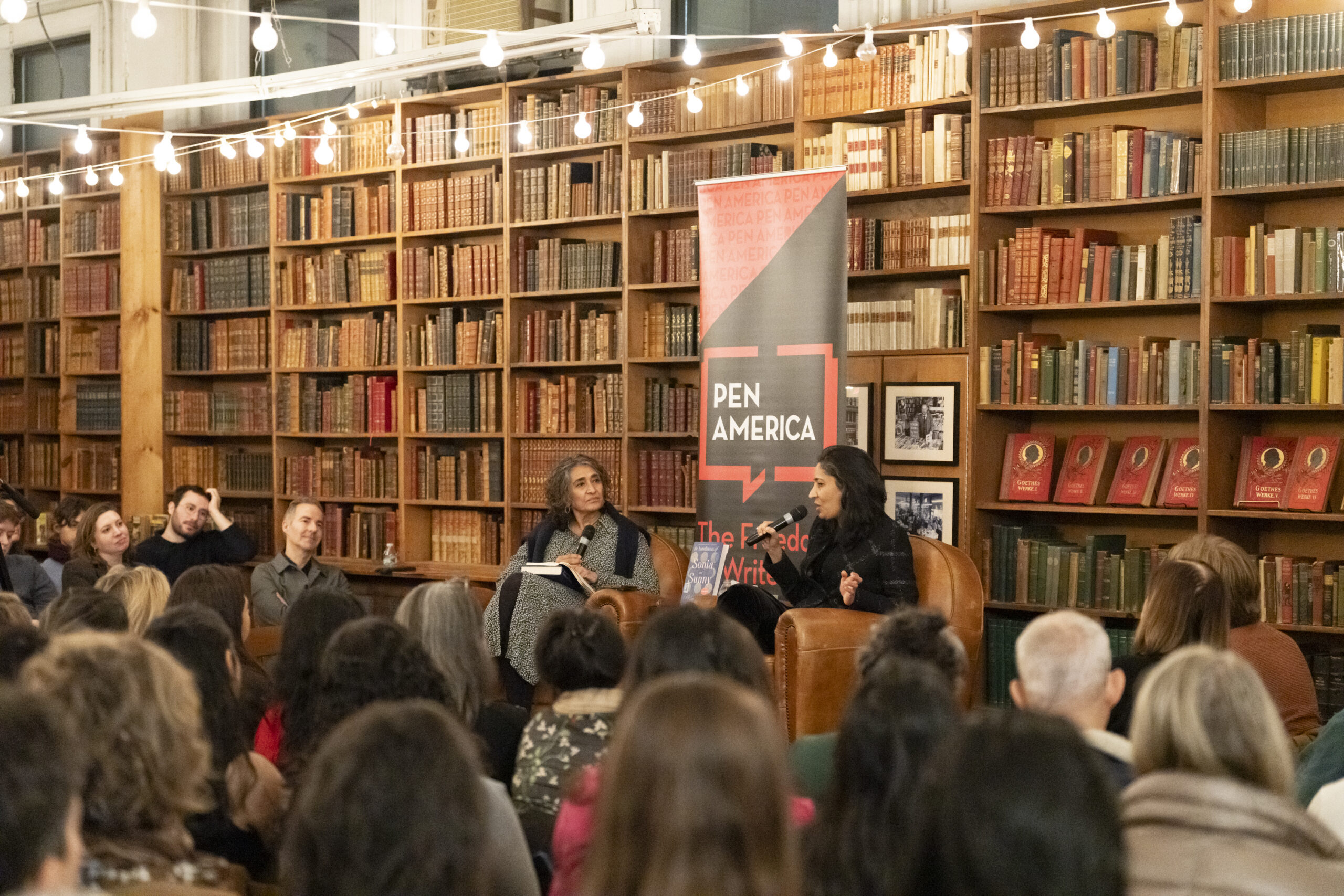
Razia Iqbal, a former BBC journalist and professor of international affairs at Princeton, joined Desai for a PEN Out Loud event at The Strand on December 5 to discuss the book, which Iqbal described as “everything that fiction should be.” “It is capacious, it’s generous, it’s funny,” she said. “It’s also about very serious things.”
“Those of you haven’t read it,” she added, “you’re in for a treat. I kind of envy you.”
Iqbal opened the conversation by asking Desai why she chose to set her novel at the turn of the century. Desai said she knew she wanted to write a story that spanned multiple generations, beginning with her grandparents’.
Growing up in India, Desai couldn’t make sense of her grandparents at all; it seemed like they were from “a kind of provincial circus.” Eventually, however, she came to understand the intricacies of the historical circumstances that shaped their lives, especially British colonialism and its legacy.
Iqbal noted that Desai’s two protagonists undertake a somewhat similar journey: Both have already left India for America at the outset of the novel but must turn back to learn about their familial history before its end.
Iqbal also inquired about Sonia’s relationship with her narcissistic boyfriend, Ilan, who sets limits on the subjects of her writing: no magic realism, no arranged marriages, no Oriental nonsense. Iqbal observed that Desai levels a critique of Ilan’s guidelines through The Loneliness of Sonia and Sunny, which explores all of the topics Ilan deems unworthy of literature.
“In a family like mine or Sonia’s or Sunny’s, there would be all of these stories,” Desai responded. “There would be arranged marriage stories, or semi-arranged. There would be divorced stories. … It would cover the whole spectrum, which is what I tried to do.”
She also said she doesn’t care for the label magic realism, noting that it’s employed almost exclusively to describe non-Western works. “It’s very weird to me that a novel from my part of the world, if it has a ghost, would be called magic realism, and if it’s in Henry James, it’s not,” she said, adding that neither Salman Rushdie nor Gabriel García Márquez applied the label to their writing.
Later in the evening, Desai and Iqbal touched on one of the novel’s most distinctive aspects: the attention it devotes to plenty of peripheral characters, including a spinster aunt, kebab cook, and even little stray dogs. Desai said she sometimes feels as though the heart of the novel lies in those characters, though she wasn’t certain why that was the case.
“Perhaps because… Sonia and Sunny are negotiating a world without a center,” she said. “If you’re negotiating a world without a center, the center could be anywhere, scattered between all of these different characters.”
And, of course, the two writers couldn’t skip over the novel’s titular topic. Iqbal prompted Desai to reflect on the theme of loneliness after reading aloud a short passage in which Sonia describes America’s culture of individualism.
“In India, you are never alone,” Desai said. “Your whole deliberate life is trying to run away from people. And then you come to the United States to study as I did, and you may go to Vermont to study as I did, and you are startlingly alone. Loneliness is an essential part of the conversation [about] migration, exile, translation.”
At the end of the talk, Iqbal asked Desai whether she felt lonely once again, having released into the world the novel that was hers alone for two decades.
“It was my companion all of these years,” Desai said. “Everywhere I went, my book came with me. It was very much a chosen loneliness. … It seemed to be the luckiest way to be a writer, to be able to be solitary in that way with your work.”
If you missed it, check out our PEN Ten interview with Kiran Desai, and purchase a copy online here.
Photo courtesy of Jasmina Tomic.