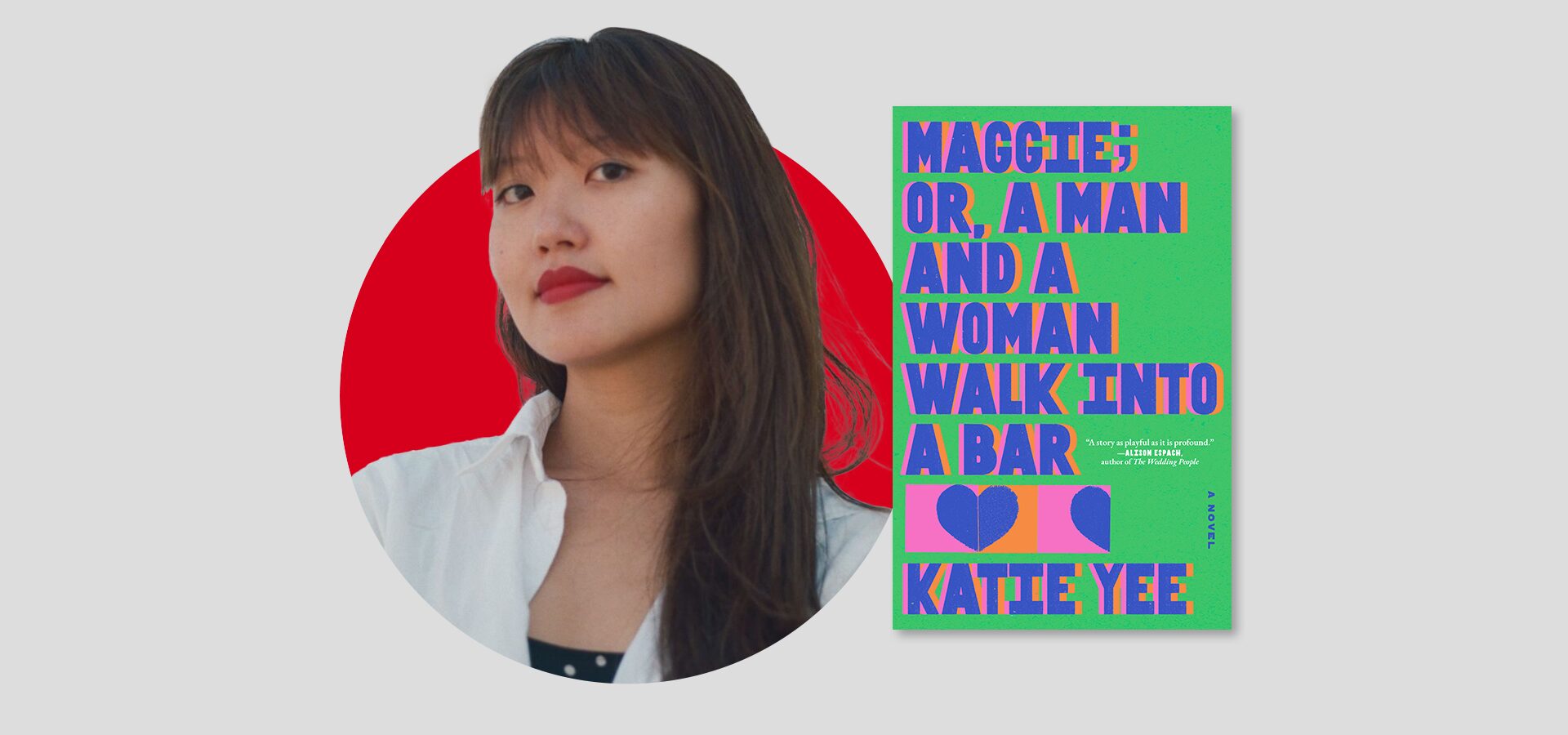
Katie Yee | The PEN Ten Interview
Maggie; Or, A Man And A Woman Walk Into A Bar is the debut novel by writer Katie Yee. Using the structure of a classic joke to outline sections of this at times tragic story, Yee follows a protagonist who learns about her husband’s affair and personal breast cancer diagnosis within the same time frame. Funny, corporeal, and filled with quippy phrases, Maggie is a fresh, new take on a typical narrative of heartbreak. (Summit Books, 2025)
In conversation with World Voices Festival and Literary Programs Manager Sarah Dillard, Katie Yee talks about the importance of a story’s starting point, advice for writing dark humor, and what techniques she used to portray free-falling through grief. (Bookshop; Barnes & Noble)
Congratulations on your debut novel! Where did Maggie; Or, A Man And Woman Walk Into A Bar start? How did you come to write this novel?
Thanks so much for your kind words! It’s so funny to be doing the PEN Ten because I used to be a Communications Intern at PEN many years ago, and one of my responsibilities was helping upload these interviews to the site; thanks for this full-circle moment.
At the start of Maggie, I was thinking about how strange it is to have a body—but how there are so many moments in life, especially in a women’s life, that might force you back into yours. Breast cancer, for one: getting screened for it, the subsequent treatment, waiting in rooms to find out something about yourself that is somehow both vital and unknowable to you. Breast cancer runs in my family, and it’s something I’d been trying to write about as a way to understand it better. Another example of something that puts you back into your body: having kids. The childbirth itself, of course, but also the physical work of raising them: carrying them when they’re tired, chasing them through the backyard, etc.
In our unnamed narrator, I felt I had created a character who was resilient and funny, and I wanted to see how much I could (lovingly) throw at her, to see what she could spin these circumstances into.
The opening scene of Maggie, where the protagonist realizes her kids don’t find her funny and she subsequently purchases a book of anti-jokes, sets the structure for the rest of the novel which includes opening lines that lay out each stage. What encouraged you to make this stylistic choice?
Whether or not something is a joke or a sentence, whether or not a story is a comedy or a tragedy, the greatest love story of all time or the tale of a torrid affair kind of depends on the starting point. Because our narrator becomes kind of obsessed with the stories we tell ourselves and the way we frame our own lives—specifically beginnings and endings—this felt like the right way to tease a bit of the humor that is so important to the story.
When the protagonist first learns of her husband Sam’s affair, she assumes the woman is white. Why did you decide to include this in the novel? How does a white mistress impact the plot compared to someone of color?
Regardless of race, any time some betrayal is made in a relationship in this way, I feel like it’s really common to try to pinpoint exactly what it was that went awry. You might comb through your own memories, to find the moment when the other person fell out of love. You might stalk the “the other woman” online, to try to understand what it was about her that was more appealing. For our narrator, the fact that Maggie was white was another thing in her list of doubts and fears, something she maybe always wondered Sam had been second-guessing about their relationship. It makes her feel like she was more of an experiment, and in the end, Sam chose to be with someone more like him—in terms of race, yes, but also class and upbringing.
I suppose this was also partially the catalyst for her wanting to infuse her children’s bedtime stories with Chinese mythology, to plant seeds of their shared culture in their lives.
In our unnamed narrator, I felt I had created a character who was resilient and funny, and I wanted to see how much I could (lovingly) throw at her, to see what she could spin these circumstances into.
Identity was one of the main themes I took away from the story which deals with racial, interpersonal, medical, maternal, and professional identities as well as others. During life-changing moments that impact these identities, the pacing of the narrative varies and time moves from in-scene to summaries and then pauses. Did you write any of these moments this way in initial drafts or did any take some revisions to decide when to speed up and when to slow down?
The way the book deals with time was my attempt to mimic the experience of free-falling through grief. When you experience something traumatic, your memories of these days might feel fractured and your relationship to time changes.
As a lifelong short story writer, I also tend to write brief. During the editing process, a lot of the notes I got from my brilliant agent and editor had to do with sitting in certain scenes or moments for a little longer.
The protagonist comes across differently depending on who she is with; Sam, Darlene, her kids, in-laws, doctors, and all other characters cause her to act in a way that reflects her relationship with them. This is not only shown through the plot but through sentence structure and amount of dialogue. What was the process of crafting these characters, who all revolve around the narrator, like? Did creating them conversely alter the progression of the narrator?
I think we all have to code-switch a little in life; that’s a survival tactic. The way you talk to your kids is naturally going to be different from how you talk to your partner, which will differ from the way you talk to your partner’s parents.
The kids were a joy to create; honestly, part of writing the children in this book was me imagining what the daily ins and outs of motherhood might look like. I wanted to give our narrator kids who were curious in big ways and rebellious/independent in small ones, individual people who she was fascinated by and genuinely wanted to get to know.
Our narrator is the most true version of herself when she’s with her best friend, Darlene. Darlene was the most fun character to write; I’ve put bits and pieces of all of my best friends into her, and it was a pleasure to spend time with them on the page this way.
You deal with a lot of heavy subjects in this novel – infidelity, cancer, racial inferiority complexes – all within 200 pages. How did you interrelate and thus compress these topics?
When it rains, it pours! I realize the blow-by-blow plot might seem a little unrealistic on-sight, but it’s been my experience that a lot of life happens this way. Everything happens all at once. In writing this story, I wanted to create circumstances that were totally out of our narrator’s control, and I wanted to lead with them so that the bulk of the story could be about how to pull yourself out of dark times (in this case: humor, a best friend, a big margarita).
The way the book deals with time was my attempt to mimic the experience of free-falling through grief. When you experience something traumatic, your memories of these days might feel fractured and your relationship to time changes.
Darlene, the protagonist’s best friend, was both a quiet sounding board and voice of reason throughout the novel. Do you have anyone in your writing life who takes on this type of role?
Darlene was really inspired by a whole bunch of my best friends, some of whom I’ve known since middle school! My first literary Darlene, though, would have to be my friend Emily; we met when we both worked at Grove Atlantic / Literary Hub. She said hi to me in the kitchen when I was new, and we became fast friends. When I told her, nervously, that I was ready to query agents, she already had a list in mind for me. She’s the kind of friend who intuits not only what you might want but what you might need; she has been such a great person to lean on throughout this whole process!
I’d also love to shout out my agent, Duvall Osteen, and my entire publishing team at Summit, especially Judy Clain (my editor) and Josie Kals (my publicist) for filling this role: they believed in the book from the beginning, and they have been here every step of the way.
How did you decide to structure the novel with demarcated sections that include vastly different amounts of text in each? Were there any authors who inspired you?
The structure was very much inspired by Jenny Offill’s Dept. of Speculation and Weike Wang’s Chemistry. I wanted to create a story where there were no chapters (no built-in breathers), where the story just keeps coming at you in waves big and small. I feel like this mirrors what it’s like when the rug has been pulled out from under you.
What advice do you have for writers trying to accomplish ‘dark humor’?
The devil is in the details, but so is the court jester. So much of what’s funny to me comes from observing things that are awkward (and very human!), even in bleak circumstances.
I wanted to create a story where there were no chapters (no built-in breathers), where the story just keeps coming at you in waves big and small. I feel like this mirrors what it’s like when the rug has been pulled out from under you.
If you had to categorize Maggie; Or, A Man And Woman Walk Into A Bar as being about race, health, love, or women, which would you choose? It may also be all of the above or something completely different!
It’s definitely about all of the above, but I would also add that it’s about the power of enduring friendships and the quiet bravery required to reclaim your own story.
Katie Yee is a writer from Brooklyn. She has received fellowships from the Center for Fiction, the Asian American Writers’ Workshop, and Kundiman. Her work has appeared in the Los Angeles Review of Books, No Tokens, The Believer, the Washington Square Review, Triangle House, Epiphany, and Literary Hub. By day, she works at the Brooklyn Museum. By night, she writes, usually under the watch of her judgmental rescue dog, Ollie.