Hu Anyan | The PEN Ten Interview
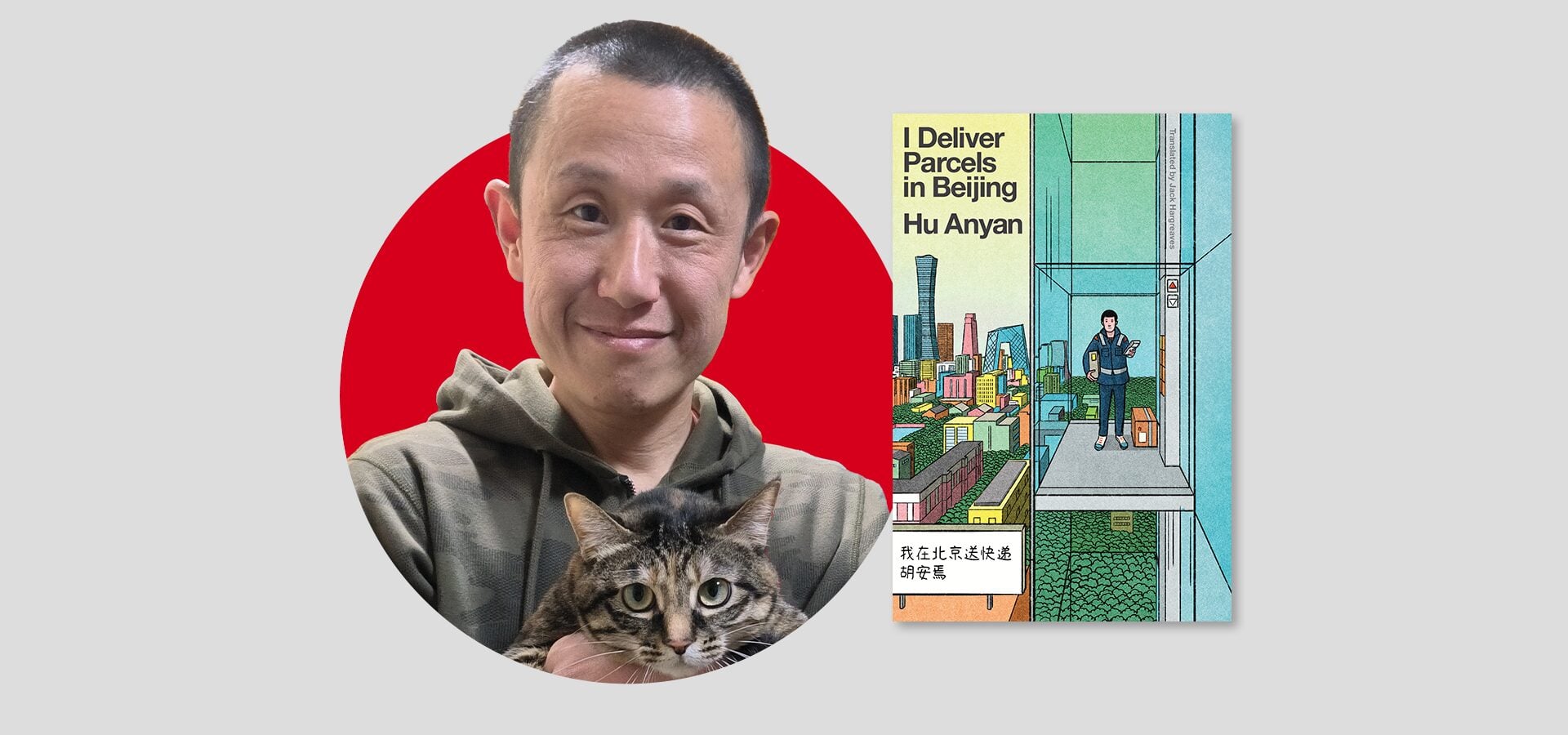
With wit and disarming candor, Hu Anyan’s I Deliver Parcels in Beijing, translated by Jack Hargreaves, offers an unflinching look at life inside China’s gig economy, as seen through the eyes of a worker who has done it all, from delivery driver to convenience store clerk to bicycle salesman. A bestseller in China and sold in more than 17 countries, the book captures the humor, exhaustion, and quiet resilience of a generation hustling to survive in the megacities of modern China. Equal parts memoir and social critique, the book gives voice to the invisible labor that fuels a globalized world. (Astra House, 2025)
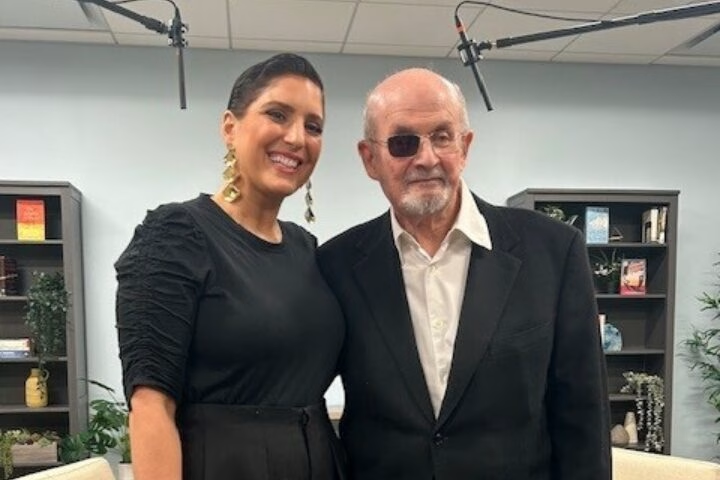
In conversation with PEN America’s media consultant Malka Margolies, Hu AnYan discusses his journey from worker to writer, the role of storytelling in reclaiming dignity, and what his experiences reveal about work and identity in the twenty-first century. (Bookshop; Barnes & Noble)
This interview was translated by Jack Hargreaves.
I Deliver Parcels in Beijing began as individual essays. When did you see a narrative thread between the stories and what was the process of turning them into one book?
Everything in the book is my lived experience. The narrative thread is my life trajectory. That said, there is a lot I never intended to share originally, because of how much of my private life that would reveal. I only wanted to put down some of the more memorable chapters. It was the book’s editor, Pu Zhao, who suggested tying everything together in one book. He first contacted me in 2021, when chapters one and three were already online, and chapter two had been published as a standalone “mook” by Duku. I’d always hoped to one day publish my work in print, of course, ever since I started writing, but I didn’t know how to go about it, I didn’t have a way in, so I didn’t dare to ever believe it would happen. You could say that, if it weren’t for Pu Zhao, this book would never exist. During our first conversations, the book was just the first three chapters and was presented more like an essay collection than a memoir of my 20 years of working. I added to each of the chapters, expanding on what was already there, but the book (at 90,000 Chinese characters) was still on the shorter side of what is conventional in Chinese publishing and what readers are used to. So, Pu Zhao suggested I write more. He didn’t force it, there were other solutions we considered, like adding illustrations between chapters. But I thought about it for a few months and decided I should make the most of this privileged opportunity, and I sat down to write what is now chapter four, which includes the rest of my work experiences. The biggest challenge with this was confronting and trying to understand who I was back then, in my youth: timid, childish, incompetent, over-the-top, irresponsible. Writing the chapter brought up a lot of feelings of hurt, shame and frustration, but it also came with its rewards. But that’s another conversation.
What compelled you to transform your private reflections on parcel deliveries into writing for a public audience? Was there a moment when you realized your experiences might resonate more broadly?
Anyone who posts writing online nowadays has to be conscious of the fact they’re doing so publicly. Writing that is purely private, like in diaries or notebooks, isn’t for others to read. So, I wouldn’t say there was a transformation, per se. I knew from the start which of my writing I would show to others, and which I would keep for myself. And it was by putting pieces online that I received any attention from readers in the first place and, on that basis, had editors become aware of my work and eventually offer me the opportunity to publish. So, if there was a particular moment I realized my experiences could resonate more broadly, it was when the conversation about my writing online started to pick up, in April 2020.
Have you ever edited one of your essays based on feedback from one of your online readers? Why or why not?
I don’t recall ever doing that yet, but I’m aware of certain criticisms of my work that were made online. Some of them identified genuine oversights of mine, some come from a place of misunderstanding, and others raise questions I’d never considered. I plan to take them all on board in future editions of the book. My editor did suggest some edits when we were first going through the manuscript together, like for the section about my time running a women’s clothing store in a mall from 2007 to 2009. My business partner had gotten in a fight with the owner of the store next door and been taken to the local bureau, and mall security came to speak to me. The guard said he saw arguments every day in the mall, mostly between women bosses, who he said seemed to like to argue, since it never took much for them to start. But once they had vented a little, whatever the issue, it was forgotten about. The men, meanwhile, wouldn’t go looking for fights, but once one broke out, the conflict would get out of hand and escalate until something bad ended it. At the time, I thought that there was something to that perspective, it chimed with what I’d seen myself, so I wrote it into the article as if it was my own. I must have done a bad job of explaining it, maybe it seemed a little abrupt, but my editor thought that discriminating between the sexes like that could be controversial, so I deleted the passage.
The biggest challenge with this was confronting and trying to understand who I was back then, in my youth: timid, childish, incompetent, over-the-top, irresponsible. Writing the chapter brought up a lot of feelings of hurt, shame and frustration, but it also came with its rewards. But that’s another conversation.
The book is very funny. Given the highs and lows of the work you describe, what led you to incorporate humor into your essays? Was there any concern during the translation process that humor wouldn’t translate given how humor can be culturally specific?
I wasn’t trying to write humorously, really. I think it’s just how I express myself when I feel comfortable. I like to joke, to tease my friends, to self-deprecate. But I’m fond of being asked this question. It’s one I’ve worried about in the past, and I’ve decided the people who ask it can see how important humor is to me. Unfortunately though, the rest of my answer is more pessimistic, because even in China a lot of readers didn’t get the book’s funny side. They seemed to struggle to understand why I would make light of such a serious subject matter. In their eyes the book should be serious, too, and heavy. But humor became a survival method I relied on through those long, hard years. It could alleviate my anxiety and help me avoid cracking under pressure and things taking an even more tragic turn, and it also taught me to be more frank and honest with myself and my situation. But no book is going to make sense to or connect with every reader, whether it’s in translation or not.
Your prose often mirrors the repetitive routines of delivery work. What stylistic choices did you make to show the monotony of these jobs?
That’s not something I did consciously, or even something I was aware of doing by accident. It never occurred to me how I might recreate the repetitive tedium of labor in my prose. My intention was to simply recount the experiences as concretely and accurately as possible, so they felt engaging and alive. The people and situations in my writing, I think, are already very interesting in and of themselves. At least, they left a deep impression on me. The highly repetitive, tedious content wasn’t something I really planned for.
How did it feel to see your story published in other languages and in countries with very different cultures? Was there anything about the international response that surprised you?
I was really pleased. My hope is the book moves readers because of the shared feelings it elicits on a human level, not because of common ideology or national identity. I’d love for it to become part of cross-cultural dialogue between people who live in different areas of the world and deal with different daily realities, for it to help us understand, respect, and care for each other. But other than a small number of comments and blurbs that publishers of the translated editions have sent me, for now I know very little of the international response to the book.
Humor became a survival method I relied on through those long, hard years. It could alleviate my anxiety and help me avoid cracking under pressure and things taking an even more tragic turn, and it also taught me to be more frank and honest with myself and my situation.
To what extent are the experiences of gig workers in China shaped by uniquely Chinese cultural, economic, or political circumstances and to what extent do you think they reflect global patterns of unstable labor?
To the first question, I can only answer, “to a large extent”. Anything more analytical is beyond my skillset. I’m a memoirist. I’m not an expert on sociological issues, and I don’t possess the ability to go deep into cultural, economic and political questions. But I find the second question harder still. I couldn’t even say if there are global patterns of unstable labor or what they might be.
Which writers did you draw inspiration from when writing I Deliver Parcels in Beijing and what about their writing inspired you?
Initially, when I was invited to write the book’s second chapter for a different publication, since this made me see the process as quite important, I looked for works I could use for reference. But I didn’t find any I thought were suitable, so I reverted to the approach I feel is the most natural and straightforward: remembering, reflecting and recording. That said, I wrote the various parts of the book between 2020 and 2021, more than 10 years after I first started writing, and in those 10 years I’ve loved many different authors, who have without a doubt influenced me: J.D. Salinger, Raymond Carver, Lydia Davis, David Foster Wallace, Anton Pavlovich Chechov, Franz Kafka, Robert Musil…
What do you hope readers take away after reading this book? If you could summarize your purpose for writing I Deliver Parcels in Beijing, what would it be?
I don’t suppose I hope anything of my readers, but I’m aware the only ones who will be moved by my writing are those who resonate with my experiences and feelings. Those who are similar in character to me, to some degree. I realized early on that literary works often aren’t trying to communicate anything to readers, but rather to prompt them to revisit and reconsider their own lived experience. I wasn’t aware of a purpose when I wrote the various parts of the book, anyway, so if I did, it must have been hidden in my subconscious, and wasn’t to do with my readers but myself: recording the ups and downs of my life was maybe my way of pushing back against the reality that had beaten me down and hurt me so many times; it showed me that my life wasn’t without its redeeming features, and proved that the setbacks and injuries I’d received were not entirely owed to my own inadequacies but were also the result of my awful reality. It’s sad to say, but underneath my fairly moderate writing style there is a deep-rooted hostility to real life.
I realized early on that literary works often aren’t trying to communicate anything to readers, but rather to prompt them to revisit and reconsider their own lived experience.
A recent study in the United States found fewer people are reading for leisure. How popular is reading for pleasure in China?
Obviously, I have only a partial, and inevitably biased, view on this. But I would say that in China there are many readers whose purpose for reading is clearly practical. They only read “useful” books. Literary works don’t have enough practical application for them to take note. Equally, there are a lot of readers who are only interested in specific genres, and they read exclusively for entertainment. If we don’t consider those two groups, or children, then there’s a very limited number of readers left, and I feel like there are fewer every year. People, especially young people, prefer scrolling short form content or playing video games.
Hu Anyan was born in Guangzhou, China, in 1979. After graduating from secondary school he joined the workforce, moving around between places and odd jobs to make a living: hotel waiter, convenience store clerk, courier, night shift worker and many more. In 2009 he began to post some writing online, and became a full-time writer after an essay went viral during a COVID lockdown.
Jack Hargreaves is a translator from East Yorkshire who is currently based in London. His literary work has appeared on Words Without Borders, LitHub, adda, Arts of the Working Class, Samovar, The Southern Review, and elsewhere. Published full-length works include Winter Pasture by Li Juan (with Yan Yan) as well as Shen Dacheng’s short story “Novelist in the Attic” and Wen Zhen’s “Date at the Art Gallery” for Comma Press’ The Book of Shanghai and The Book of Beijing, respectively. He was ALTA’s 2021 Emerging Translator Mentee for Literature from Singapore, volunteers as a member of the Paper Republic management team, and is currently on a three-year virtual residency for young artists in Nanjing, in association with the city’s UNESCO City of Literature program.
Read this interview in Chinese >>
《我在北京送快递》始于几篇独立的随笔散文。你何时发现这些故事之间存在叙事脉络?将它们整合成一本书的过程是怎样的?
这些故事都是我的真实经历,我的人生轨迹就是天然的脉络。不过在最初,我并没有想要分享自己大段的、连贯的人生,因为那意味着袒露许多隐私,我只想把一些记忆深刻的片段写下来。是后来这本书的编辑普照,发现了我的故事可以整合成一本独立的书。2021年他刚联系上我的时候,这本书中的第一和第三章已发布在网上,第二章则收录在一本MOOK《读库》里。当然,作为一名多年的写作者,我也渴望出版一本自己的著作,可是我没有任何方法或门路,甚至不敢奢望这件事能实现,所以我没有为此作过尝试或争取。可以说,如果不是普照找到我,这本书就不会诞生。在我们一开始的商量中,这本书只有现在前三章的内容,书的形式类似于文集,而不是我20年完整工作经历的回忆录。为此我对前三章的原始版本进行了扩写,可是扩写后的篇幅(约9万字)在中国的出版惯例和读者认知中仍然字数偏少。因此,普照建议我增补一些内容。但他没有强迫我,他同时也在权衡其他解决方案,比如为文章配上插图等。我犹豫了几个月后,决定珍惜这个难得的机会,写下了现在书中的第四章,把我20年间的全部工作经历补全。其难点在于面对和理解年轻时那个懦弱、幼稚、无能、偏激、不负责任的自己。写作这部分激起了我的难过、羞耻和懊恼等感受,同时也有丰富的收获,这些是另一个话题了。
- 是什么促使你将送快递的私人随想转化为面向公众的写作?是否曾有过某个瞬间,让你意识到这些经历可能引发更广泛的共鸣?
在今天这个互联网时代,写作者把文章发在网上,不可能意识不到这是一种公开的写作。而纯粹私人的写作,比如日记,或素材笔记等,是不会给别人看的。所以我会说,我没有问题里的那种“转化”,从一开始我就清楚自己写下的哪些东西要给别人看,同时哪些东西只留给自己。事实上,我是因为在网上发布文章,意外地受到大量网友的关注,继而才进入编辑的视野,并得到出版的机会。因此,假如说有某个瞬间,让我意识到自己的经历可以引发更广泛的共鸣,那就是2020年4月我最初在网上受到关注的时候。
- 你是否曾根据网络读者的反馈修改过文章?修改或并未修改的原因是什么?
我印象中好像暂时还没有这样的情况。但是肯定,在网友对我的批评里,有些是出于我的疏忽,有些是网友对我的误解,还有些提出了我原本没有意识到的问题。对于这些批评,将来在这本书再版时,我会作出调整或予以回应。我的编辑倒是给我提过几处修改意见,比如2007年到2009年,我在一个商场里经营女装店,我的合伙人和邻店的店主打架,两人双双被拉去了派出所。这时报警的商场保安来和我说,商场里每天都发生大大小小的纷争,一般来说,女店主喜欢吵架,一点小摩擦就能吵起来,但吵完就发泄完了,不会有什么后续。而男店主不会动不动就吵架,可一旦矛盾爆发了,冲突很可能不断升级,最终酿成恶劣的后果。我觉得他的分析有道理,和我观察到的情况也吻合,就是把这当作自己的看法写进了文章里。可能因为我表达得太简略和武断,没有像现在这样展开来前因后果说清楚,我的编辑认为我以性别来区分人的行为特征,很容易引起部分读者的反感和争议。于是我听从了编辑的建议,删除了文章中的这个观点。
- 本书充满幽默感。考虑到书中描述的工作是起伏跌宕的,你为何选择在文章中融入幽默元素?是否担心书中的幽默在翻译过程中难以跨越文化鸿沟?
我没有刻意在文章中融入幽默元素,事实上,这就是我的本性和底色,当我在放松的情况下,和亲密的朋友在一起时,我自然的谈吐风格就是这样。我喜欢开玩笑,喜欢和朋友互相调侃,也喜欢自嘲。这个问题深得我心,我确实担心过这个问题,提问者似乎能察觉到我对幽默的重视。可是我的答案比较悲观,哪怕是在中国,很多读者也体会不到我的幽默。他们似乎难以理解我会在这种题材里开玩笑,或许在他们眼里这本书应该更严肃和沉重。可是幽默恰恰是我在漫长和窘迫的岁月里自然形成的一种精神生存策略,它可以缓解我的焦虑,让我不至于在压力中轻易崩断,造成更极端和悲剧的结果,并且帮助我更坦然和诚实地面对自己,以及面对自己的处境和经历。不过我想,任何书都无法被所有读者理解和体会,无论是否经过翻译或跨文化传播。
- 你的行文常如实勾勒出快递工作不断重复的例行程序。你通过哪些风格手法展现了这类工作的单调乏味?
我没有这方面的方法论或方法意识,在写这本书的时候我并没有想过“用什么方法能展现这类工作的单调乏味”这样的问题。我的本意是尽量把这些经历写得具体、准确、生动和有趣。我自己觉得,我写下来的事和人,都是很有意思的,或者说给我留下深刻印象的。而工作中那些真正高度重复和乏味的内容,我并没有特别着墨。
- 看到自己的故事被译成其他语言,在文化背景迥异的国家出版,你有何感受?国际反响中是否有令你意外或惊讶之处?
我非常非常开心,希望这本书能触动读者作为人而不是观念或国别身份的那部分共同的感受和愿求,希望它成为一种让生活在世界不同地方、面对不同人生处境的人们互相理解和尊重、关心和体谅的文化交流的组成部分。除了少部分外语版出版方的评语和推荐辞,我暂时还没有听到任何关于这本书的国际反响。
- 中国零工劳动者的经历在多大程度上受中国独特的文化、经济或政治环境的形塑?你认为这些经历在多大程度上反映了全球不稳定劳动力的普遍模式?
对于第一个问题,我只能回答很大程度,更详细的分析超出了我的能力。我是一个回忆录作者,但不是研究社会问题的专家学者,我不具备深入文化、经济和政治问题的能力。第二个问题对我来说更困难,事实上我对“全球不稳定劳动力”的状况一无所知。
- 创作《我在北京送快递》时,哪些作家对你产生了启发?他们的哪些写作特质令你深受触动?
这本书中的第二章,因为最初是受邀而写,我相对比较重视,在写作前曾尝试寻找借鉴的作品,可是我没有找到合适的,最后仍然是采用对我来说最自然也最简单的方法:一边回忆,一边反思,一边记录。不过,这本书的各章节分别写于2020年和2021年,这时距离我写作的起点,其实已过去了十多年。在那十多年里,我喜欢过很多作家,我的写作肯定有受过他们的影响:J.D.Salinger、Raymond Carver、Lydia Davis、David Foster Wallace、Anton Pavlovich Chekhov、Franz Kafka、Robert Musil ……
- 你希望读者读过这本书后有怎样的收获?若要概括创作《我在北京送快递》的核心意图,你会如何表述?
我没有这方面的预期,不过我知道,我只能打动那些对我的经历和感受有共鸣的读者。一定程度上,他们都是和我有某些相似特质的人。此外,我很早就明白到,文学作品往往不是要向读者传达些什么,而是触动读者对自身经验的重新发现和理解。当年写下《我在北京送快递》的各章时,我并没有意识到自己有一个“核心意图”,或应该有一个“核心意图”。今天面对这个问题,我发现假如说真的有那样一个意图,那么它可能藏在我的潜意识里,并不针对读者,只针对我自己:通过记录自己的生平和经历,反击曾反复打击和伤害过我的现实——证明自己的人生并非一无是处,也证明自己曾受过的挫折和创伤,不完全是因为自己不够好,同时也因为现实很糟糕。很抱歉的是,在我看似温和的笔触下,其实包藏着对现实的刻骨敌意。
- 美国近期研究显示为乐趣而阅读的人数正在减少。在中国,为乐趣而读书的风气如何?
我的观察并不全面,难免有所偏颇。我觉得在中国,有相当多读者带着明确的实用性目的在阅读,他们只看“有用”的书,文学作品因为缺乏实用性而不在他们的视野范围内。还有很多读者则只选择形式雷同、内容单调的纯消遣读物。在刨除了这两类读者及幼儿读者后,剩下来读者数量似乎很有限。总的来说,我感觉读书的人一年比一年少。更多的人,尤其是年轻人,沉迷于刷短视频或打游戏。