Fátima Vélez | The PEN Ten Interview
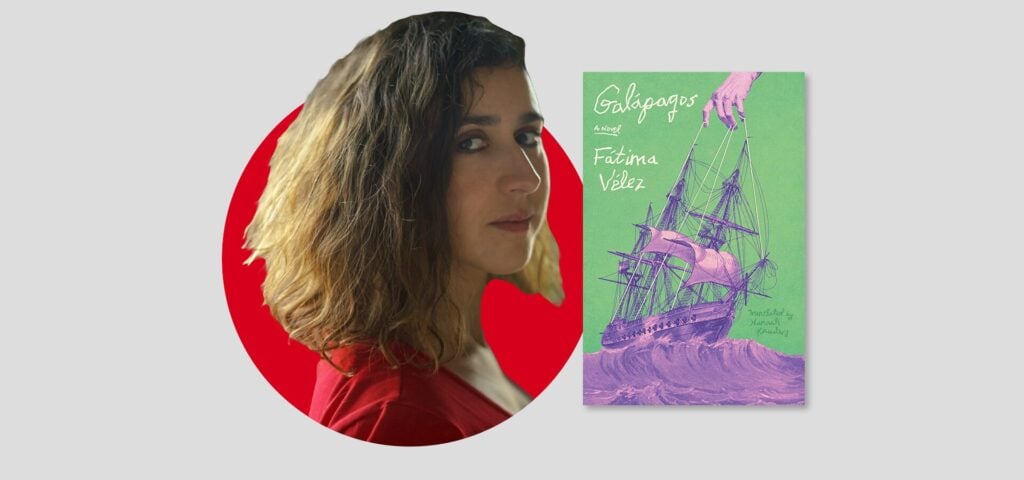
Written by Fátima Vélez and translated by Hannah Kauders, Galápagos (Astra, 2025) is the haunting and hypnotic tale of a group of artists voyaging through the Galápagos Island as their bodies succumb to AIDS. Following a painter, Lorenzo, across Colombia, Paris, and the islands, the novel plays with surreality and magic to explore the vulnerability of our bodies and the evolving nature of friendship under unthinkable loss.
In conversation with Campus Free Speech Program Manager Aileen Favilla, Vélez shares insights into the personal and literary figures who inspired Galápagos, a comma’s capacity to function like a wave in the ocean, and how her “untranslatable” Spanish novel came to be translated into English (Bookshop; Barnes & Noble).
Lorenzo, the protagonist, is a painter who prefers watching Jeanne Moreau films to painting. What do you think about the ways artists approach or avoid their art practices? Is it ever possible to find a balance between the two?
I believe that creation exceeds the moment of making. It happens continuously, because artists remain open channels of attention, always searching for form. Yet that form must eventually materialize, and for writers, this often means sitting down for years to shape it.
I am fascinated by procrastination in the arts because it is usually understood as avoiding what one does not want to do. Artists, however, are often imagined and depicted as devoted to their discipline. Yet in my own experience as a writer, and in the stories I have heard from other artists, especially women of my generation, I have encountered a persistent avoidance not of what we dislike, but of what we are supposed to love most: our craft. Why is it that so many women writers would rather write an email, a report, or even an academic paper than sit down to write literature?
I believe that writing, especially the act of sitting down to write, is painful because it forces the body into discipline. Lorenzo embodies, in many ways, the fantasy of creating while living: creating the way the mind produces dreams, the way an infected wound produces pus, or the way the heart pumps blood: in motion, in the present progressive, without subjecting the body to the extreme discipline of sitting for eight hours a day over many years in order to produce a novel or a painting.
Painters, perhaps, have more room to work through the body and through space. Writers, by contrast, have no choice but to sit down and write. At times, writing feels like a dry terrain for the body, and I wanted to place that discomfort within Lorenzo’s character. I also wondered what a painter who is avoiding painting, love, and death might feel and think, how does his mind speak?
With Lorenzo, I wanted to explore the act of avoiding what one loves, without an obvious reason. At the same time, Lorenzo is avoiding what is happening to his own body. He lives in a constant state of avoidance, so deep that it becomes a meditation on avoidance itself.
Galápagos is called a “contemporary plague novel.” Beyond simply being about a disease, what do you think distinguishes a “plague novel”?
I think the term “plague novel” is quite literal. A plague does not affect individuals alone; it involves groups, entire communities. During the COVID pandemic, we experienced in our own bodies how a plague can tear apart the social fabric. The term remains close to us, recent in our lifetime. One aspect that strikes me most in these moments is how abruptly temporality is disrupted. I am drawn to this idea of disruption: when does it begin, and where?
In Lorenzo’s case, it begins with a nail, a falling nail. He follows it, and from that moment on, the disruption does not stop. That is how the novel opens: with the first sign of a disturbance that only ends with death. One day, you notice a small bump on your chest, and it continues. When this bodily disruption is no longer an isolated event but repeats itself across multiple bodies, it becomes a plague.
I grew up around my father’s friends, a community of young artists who were intensely alive and who later began to die, one by one, from one mysterious and disintegrating illnesses. I came to know death through AIDS, a devastating way to die, one that also profoundly disrupts sexuality, which for me is one of the most powerful forces in existence, and perhaps the most violated.
At the same time, a “plague novel” is often one in which people tell stories to one another while disruption unfolds, perhaps as a way to distract the mind, to avoid what is happening, returning to the theme of avoidance, or perhaps as a way to impose meaning and structure on a world saturated with death. Galápagos has been described as a contemporary plague novel because it intentionally enters into dialogue with Boccaccio’s Decameron. I was deeply inspired by it. I am drawn to the lack of moral judgment in those stories, and to their sexual drive, especially at a moment when death surrounds everything.
The story does not shy away from the strange, disturbing, and grotesque ways our bodies can change and betray us. Which bodily experience you wrote about in this book has stuck with you the most?
The image I like the most came to me in a powerful moment of inspiration. I vividly saw the skin of sacrificed loved ones protecting the skin of those who are not even alive. It was raw, visceral, clear gore in my mind. That vision led me back to the figure of the martyr: those who were flayed for defending their beliefs, who sacrificed themselves for Christianity, without knowing that neither the words nor the practices of Jesus, himself a sacrificial figure, would ultimately be followed. I am deeply drawn to the idea of sacrifice, though for me, it serves no purpose. It is a belief that leads to extermination. Through this image, I wanted to explore what it means to sacrifice loved ones (or to be sacrificed by them) and to question the necessity of such suffering, its lack of meaning, its genocidal excess.
I came to know death through AIDS, a devastating way to die, one that also profoundly disrupts sexuality, which for me is one of the most powerful forces in existence, and perhaps the most violated.
This novel is written almost entirely in run-on sentences, connected by commas for dozens of pages. Short, complete sentences are rare. I found the reading experience hypnotic, dreamlike, and disorienting. How did you develop the voice for this novel?
The novel’s voice comes from a transcription of a documentary I watched fifteen years ago: Nuestra película by Colombian filmmaker Luis Ospina. The film is a portrait of Colombian painter Lorenzo Jaramillo. What struck me was the contrast between his image, he was clearly dying in front of the camera, and the softness of his voice and the clarity of his words. It seemed almost impossible that this person was dying, and yet there was no doubt. AIDS is never mentioned in the documentary, but given the year and the symptoms, it can be inferred.
Watching the film reactivated memories of my father’s friends who died of AIDS. I felt an impulse to transcribe everything Lorenzo was saying. While transcribing, I allowed his voice to pass through me. Once the transcription was finished, I began to work with it as material, shaping Lorenzo’s voice as one might shape a sculpture. I wanted to give it another form by working with the texture of his voice, its accent, frequency, and vibration. For me, punctuation is a tool for shaping the texture of a voice. I am no longer concerned with punctuation rules in literary writing; I use them to produce effects in characters and verses.
It was through this process that I began to use commas more deliberately. Later, during the editing process with my editor and fellow writer, Pedro Lemus, he noticed the persistent repetition of the commas in the text. I realized that the commas could serve a purpose: They were not only markers of character, but also worked like waves. I was drawn to the idea of creating waves through punctuation, to open the field of imagination, which I understand as unlimited, as the commas and the sea suggest.
As a poet, I am attentive to the smallest elements of language. I am drawn to working with the voices of people around me, friends, lovers, those I listen to. I am interested in how people speak and how they think, in what it means to inhabit someone else’s mind, in how a mind speaks.
Something unexpected happened during the transcription process. One day, my father interrupted me and asked what I was working on. When I told him I was transcribing Lorenzo Jaramillo’s voice from Nuestra película, he said he had known Lorenzo. They had once traveled together through the Galápagos Islands. Then he added, very matter-of-factly: “Everyone who went on that trip died of AIDS except me.” That image stayed with me.
Friendship in this novel is complicated. Characters turn from lovers to friends to lovers. They abandon and disappoint and sacrifice for one another. What influenced the way you write about the shifting nature of friendship in this novel?
I believe that those who did not grow up in an affectively toxic environment can consider themselves fortunate. I also feel fortunate because, although I was raised by people who had themselves been harmed and abused, I live in a time and context that allow me to choose a loving and caring community: people who are conscious, people with whom I feel safe and with whom I enjoy sharing my life. This community also gives me the strength to care about others beyond my family and close friends.
Friendship, however, as you note, has a shifting nature. Friendships change, and so do the contexts that shape them: class, gender, shared histories, and circumstances all affect how relationships evolve. I observe these dynamics among artists, especially writers, as well as among those in positions of power. I take notes. I transcribe. I am drawn to the subjectivities of the wealthy, of the narcissistic artist, of the suicidal, because they allow me to think through forms of experience different from mine, while still resonating in my body. I am also curious about how people behave together in moments of disintegration.
In Galápagos, I was interested in crafting the subjectivity of artists stripped of social or political consciousness, driven primarily by ego, drifting in the Galápagos Island, the site where Darwin formulated The Origin of Species, and where social Darwinism becomes a delirious drift.
The second half of the novel follows the group of friends on a surreal voyage to the Galápagos Islands at the end of their lives. If you were going on a voyage somewhere at the end of your life, where would you go? Who would be with you?
I like to think, as one of the characters in my book says, that death is a space where everything is possible, that the secret, the solution to the mystery, is that whatever drives your desire will give shape to your death. I like to think of death as a journey toward mystery. I would visit a black hole, another galaxy, a volcano, and then arrive at a place surrounded by water and mountains, where I could grow rosemary and tangerines and co-habitate with many humans and non-humans without any forms of violence.
As a poet, I am attentive to the smallest elements of language. I am drawn to working with the voices of people around me, friends, lovers, those I listen to.
When you were writing this novel, how did you decide the rules of the world you were writing about? What pieces of the world as we know it were important to keep and which did you allow to evolve beyond reality?
I created this world using fragments of transcriptions from different contexts, along with readings, images, stories, and ideas of places I have never visited. While writing, I set aside realism and chose to work with a mixture of reference and invention. I researched the Galápagos Islands and Paris, two places I have never visited, yet which serve as settings for the novel, but since I was not aiming for fidelity, I allowed myself to work with fragments, impressions, and stories others had shared with me about those places.
I wrote the novel while I was part of the MFA in Creative Writing in Spanish at NYU, a space that significantly shaped my writing. I was fortunate to share that environment with writers from many regions of the Spanish-speaking world. That experience expanded my vocabulary and led me to reflect on Spanish as a colonial language, but also as a space through which people from different territories can share their histories and stories.
During the MFA, I was surrounded by writers deeply invested in experimenting with language as a way of building worlds. In that context, I became increasingly experimental myself, thinking of the novel as a theatrical setting, shaped through concrete references, transformed through craft and imagination, while still retaining names and certain resonances to the “originals.”
I felt satisfied with this process until one day, when one of my professors, the Chilean writer Diamela Eltit, whose workshops felt ritualistic, asked me about the purpose of these formal experimentations while reading an early draft of Galápagos. Her question stayed with me. I understood it as an invitation to think about the relationship between formal experimentation and politics. That connection remains important in my work.
Because I am also a Spanish teacher, I have developed a close relationship with complex grammatical forms, such as the subjunctive, which can be understood as the mode of possibility and uncertainty.
Galápagos was translated into English by Hannah Kauders. What was the translation process like for you?
When Hannah contacted me in 2022 to say she wanted to translate Galápagos for Astra, it felt unreal. It felt unreal because I had always thought Galápagos was untranslatable, and also because, at that moment, I didn’t even know I had an agent in Spain. Hannah learned about my work through them, and she not only translated the book—she also found it a publisher in the United States. I am deeply grateful for the care and rigor she brings to her work.
Over the course of the process, we became friends. We had long conversations not only about specific words, but about love, family relationships, and life more broadly. Hannah speaks fluent Spanish, shaped by Mexican, Colombian, and Spanish influences. I feel fortunate to have experienced this level of intimacy with my translator; it is not something that happens often.
Hannah has told me many times how challenging the translation process was. The novel is written in verse and relies heavily on formal experimentation and slang, which required her to make bold and risky decisions. Through this process, I learned a great deal about translation. To give a novel another life, another dimension, is an act of generosity and attention, of careful craft, and above all, an act of faith.
During a book presentation at Café con Verso in Brooklyn, someone from the audience asked Hannah how she translated esdrújulas—words whose stress falls on the antepenultimate syllable. In English, that rhythm is rare. In Spanish, I love how it sounds. Words like Galápagos, Fátima, sábado, miércoles, and esdrújula itself all carry that stress. Even when these words lose their esdrújula form in translation, they gain a new rhythm in Hannah’s English. Even now, more than three years later, I still find it hard to believe that the book is out and entering the realm of English-language readers.
Who do you consider the literary ancestors of this novel? Which writers (or other artists) were you writing alongside?
Alongside Decameron, I consider One Thousand and One Nights, The Odyssey, various fairy tales, especially those collected by the Brothers Grimm, and Russian and Japanese folk tales to be literary ancestors of this novel. My writing is also nourished by mythology, ranging from Egyptian and Greek traditions to the Old and New Testaments of the Catholic Bible, as well as mythologies from Mesoamerican and South American territories.
At the same time, while I was writing Galápagos, I read extensively women writers from different regions, particularly from Latin America. I had not had the opportunity to read many of them during my studies in Colombia, as their work was not yet widely circulating at the time. During the writing process, I read Rosario Castellanos, Elena Garro, Silvina Ocampo, Alba Lucía Ángel, Marvel Moreno, Lina Meruane, Gabriela Wiener, Marta Dillon, Diamela Eltit, Vanessa Londoño, Fernanda Trías, among many, many others.
Through this process, I learned a great deal about translation. To give a novel another life, another dimension, is an act of generosity and attention, of careful craft, and above all, an act of faith.
What is the last thing you read that made you see the world in a different way? (Anything from a book to a billboard to a cereal box.)
I recently read an extraordinary novel by the Uruguayan writer Fernanda Trías, El monte de las furias, which, through the voice of myth, mystery, and wonder, and through the networks that sustain life, unfolds a language that moves beyond the human.
I was also struck by a line by Robert Bresson from Notes on the Cinematographer, which I revisited while watching Nuestra película for this interview: “I dreamed that my film was being made gradually before my eyes, like a painter’s canvas, eternally fresh.” That sentence has stayed with me. For many years the film was not available online, until recently.
FÁTIMA VÉLEZ is a writer, professor, cultural producer, and Ph.D. candidate in Hispano-American Literature and Cultures at the Graduate Center, CUNY. Galápagos is her first novel.
HANNAH KAUDERS is a writer, translator, and musician from Boston. She holds a BA in Spanish and Latin American cultures from Barnard College and an MFA in fiction from Columbia University, where she taught undergraduate writing. Her writing and translations have appeared in Fiction International and Exchanges: Journal of Literary Translation. She was a finalist for the 2020 Iowa Review Award in Fiction.