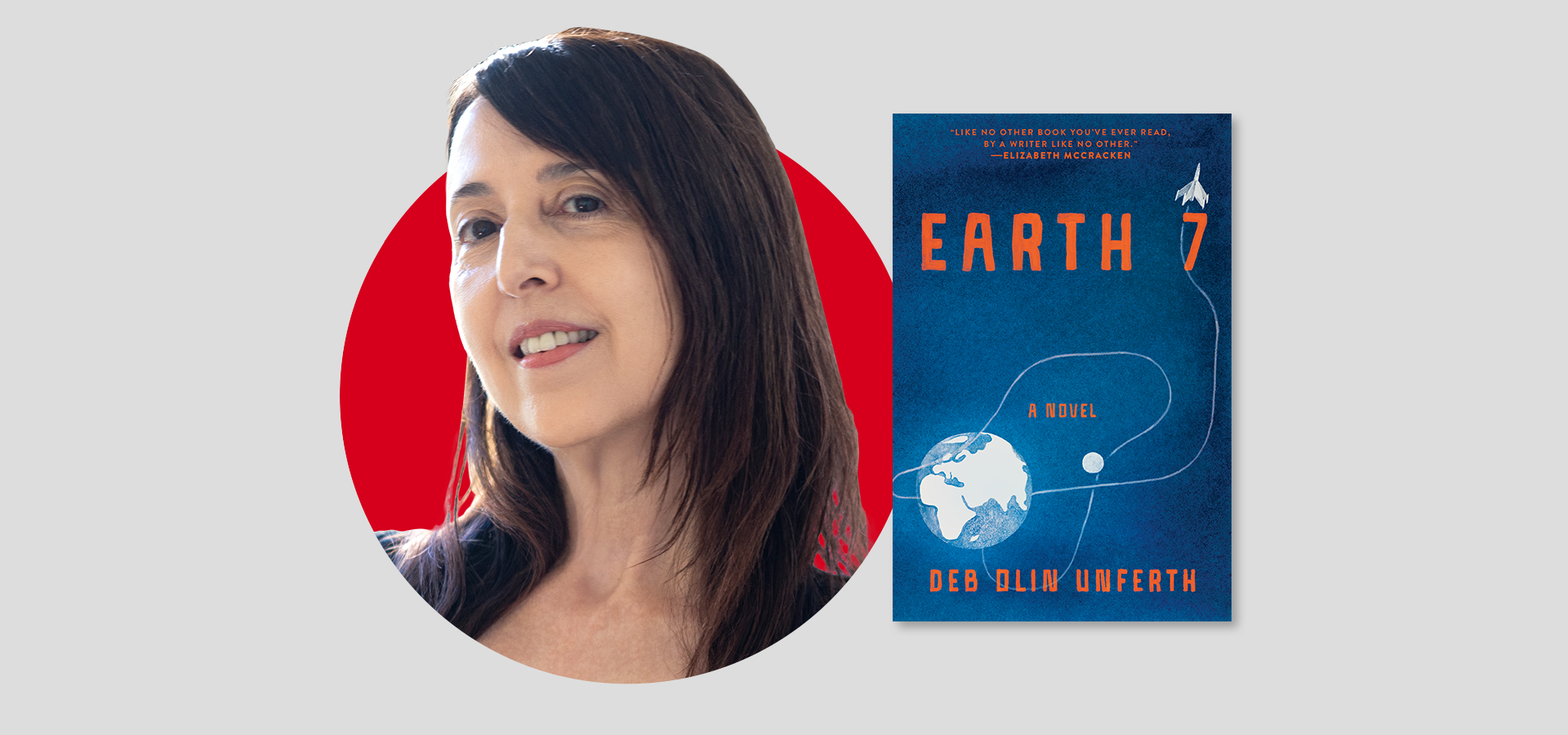
Deb Olin Unferth | The PEN Ten Interview
Deb Olin Unferth’s Earth 7 (Graywolf Press, 2026) is a love story that takes place at the end of the world. As Earth grows irreversibly inhospitable, two women — or rather, one woman and one possible robot — meet at a beach of artificial sand and fall for one another. Poetic and haunting, the novel grieves the diversity of life on our beloved planet and imagines what might happen once it’s no longer around.
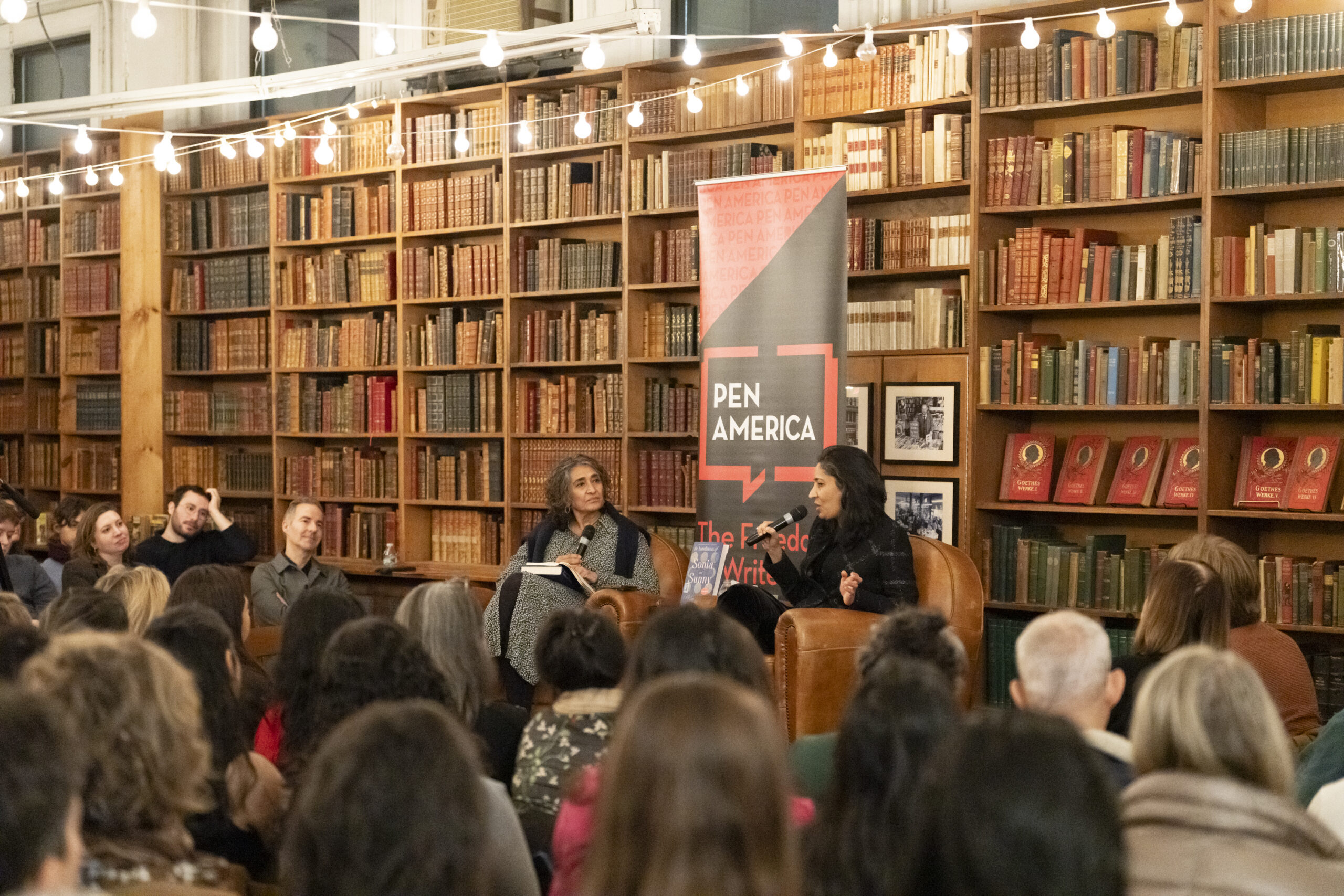
In conversation with Malcolm Tariq, program director for the Prison and Justice Writing Program, Unferth speaks about traveling to deserts and glaciers for inspiration, discovering her favorite science fiction novels, and upending cliches about humans, robots, and love (Bookshop; Barnes & Noble).
Thank you for speaking with me about your novel, Earth 7. Compared to its length, the story is quite expansive. Initially, I thought I would ask what inspired you to write this story, but your style of writing (which I would describe as a flower slowly blossoming) leads me to ask this differently: how did this story come to you, and why did you feel compelled to write it?
Malcolm, it is so fun to be in touch with you. Thanks for these great questions. The story first began to come to me when I noticed how many articles I was reading about the various technological band-aids researchers are coming up with to try to keep civilization going in the face of climate change. I was reading about carbon-capture machines and solar arrays and seed banks and artificial-reef-building robots and canons that would shoot sulfur into the air to refract the sunlight. And I began thinking about how strange things are going to get, going forward. I wanted to imagine the future that is swiftly becoming our present.
This novel takes place across a few environments: the Earth, the ocean, outer space. I’m curious how much of your writing about these environments relates to our access and experience with them. What research, if any, went into the writing of this novel? As a writer of science fiction, how do you negotiate between fact and fiction, if at all?
This is my first book that is fully science fiction (or speculative fiction? I never understood the difference). I researched the hell out of it, literally for years. Everything I write is heavily researched, even if the research doesn’t appear on the page. In this case, I read books about DNA and electromagnetic waves. I read five books about sand. I read about extreme climates, too, the great deserts of the world, including the Arctic. I read a lot of science fiction too. I’d always liked it but I hadn’t read that much of it, I realized, and I wanted to be in conversation with that genre. I also visited extreme climates. I visited the Sahara and stayed in a tent. I went to Svalbard to see the glaciers and icebergs and talk to researchers about the effects of global warming. Almost none of that research is in the book, but it helped me imagine the story.
I began thinking about how strange things are going to get, going forward. I wanted to imagine the future that is swiftly becoming our present.
There were a number of moments throughout this story that involve migration or journeys across and through these environments. I enjoyed these moments because they registered possibility or change. Was this aspect of the novel inspired by moments in history?
It’s interesting that you say that. One of my earliest experiences of art that had a deep effect on me was Jacob Lawrence’s series of paintings The Great Migration. I happened to see the entire series at the Art Institute of Chicago when I was a young girl. Each panel has a few words of description and a strong image, and I recall walking slowly around the room like reading a book, and by the end I was changed. I hadn’t known that part of history and I never looked at the world the same way again.
So, yes, as I read about climate and the changing Earth and about the geology of our planet, I realized I was reading a story of migrations. Migration and journeys are our past—and our future. Humans and all animals, and also all of life and all of not-life—we are, everything is, on the move. I wanted that to be all over the book and I wanted to end with thoughts about it. I have spent my life thinking about it, the emotional wreckage of it, the inevitability of it.
One of the most compelling parts of this novel—and one of the most unexpected—is how much the concept of healing appears throughout the novel. It’s the leading theme drawing me back for a second read. There is the human experience of healing, but it also seems like there is the environmental aspect of healing. At the same time, there is consistent loss—loss of family, home, and love. What space does science fiction give us for interrogating, exploring, and feeling our way through loss?
That is so beautiful. Healing. I like it, yeah. The characters are trying to heal from childhood injuries that were mostly caused by global forces—the destruction of the planet. And, yes, my motivation for writing the book was that I am mourning for all that is being lost on our planet. The great sixth extinction, the end of the era we have all been a part of, which includes the lush diversity of our planet. It is an extinction which will likely end with our own extinction. The question is: how does one heal in the face of realizations that are unfathomably terrible? I think I am healing by allowing myself to feel the grief, to mourn, and by celebrating the thing we are losing. And by imagining what it will be like when it is gone: that’s where science fiction comes in.
Admittingly, I have not read a science fiction novel in a long time. Once I settled myself into the world of the story, I was engrossed in the events and the relationships between these characters. I almost felt transported to my middle school years, when I first discovered the work of authors like Ray Bradbury in school. As an adult now, it felt liberating to get lost in the world of this book while still thinking critically about contemporary life. As a reader and writer, what draws you to science fiction, and has that reason shifted over time?
Well, I’ve never been much of a science fiction reader either! This is my only book that is fully sci-fi, or speculative. My other books have some surreal or supernatural or futuristic elements here and there, but mostly they are rooted in our contemporary world. In preparation to write the book, I immersed myself in sci-fi. It turns out I like the ones that have a sense of humor, like Hitchhiker’s Guide to the Galaxy, which I read as a kid, or Kelly Link’s Get in Trouble. I also loved reading Octavia Butler and Ursula Le Guin.
Migration and journeys are our past—and our future. Humans and all animals, and also all of life and all of not-life—we are, everything is, on the move. I wanted that to be all over the book and I wanted to end with thoughts about it. I have spent my life thinking about it, the emotional wreckage of it, the inevitability of it.
I appreciate how you blurred the lines between the state of being human and/or robot. I think it’s interesting that in public discourse, the conversation is about robots replacing humans. In your novel, that’s not necessarily the case. Was your writing of “the body” in this novel intended as a point of critique for us to think about AI? In thinking about the latter chapters, how does consciousness play a role in our relationship with technology?
I’ve read plenty of books and movies that have at their centers the questions: Can a robot love? Is love or friendship with a robot real? Do robots have feelings? I liked the idea of upending those cliches and having a character who everyone thinks is a robot but it turns out that she isn’t. It turns out that the protagonist is falling in love with an actual human, not a robot at all. And the human who isn’t a robot is an older woman who is trying to figure out how to be old. I guess I didn’t want to write about AI so much as write about aging.
How do you go about imagining different worlds and placing structures to those realities for plot? Is there a certain process for this, or does it vary according to the story you’re writing?
It varies. This book grew out of research. The more I researched, the more I could see the world. The more I could see the world, the more I was able to play with the world I was making. So it was embedded in research, but the facts felt like a launching pad into play and invention and creativity. I like to keep it loose, not assign a specific process or structure. I like to use intuition and my senses and imagination to let the story grow.
We at PEN America’s Prison and Justice Writing Program are familiar with your work as founder and director of Pen City Writers, a program providing creative writing and arts workshops to people incarcerated in South Texas. You have also taught at the university level for several years. What are some of the most valuable lessons you have learned from the writers in the classes and workshops you lead?
I’m so glad you asked about this, Malcolm. The PEN America Prison and Justice Writing Program is so badass. I’m old enough to remember the ’80s, when there were hundreds of college prison programs all over the country, through Pell grants. And I remember clearly when a crime bill in the 90s took away Pell grants and the number of prisons that offered college behind bars dropped to almost zero. And now that Pell grants are back, I’m watching the college programs slowly come back. The thing I always think of is that, through all that, PEN America never stopped its prison creative writing contests and mentoring program, which was such a lifeline through those dark years. PEN America wasn’t interested in what was in fashion. They had a mission and didn’t waver. I think they also had a writing instruction booklet that they sent out. I remember it. Now I’ve been running a small creative writing program at a prison in South Texas since 2015. Nearly all the students submit to the PEN contests and several of them have won prizes and had mentors and been published in PEN anthologies. Extremely important work. I wish more people understood PEN’s history and the important role it played and plays. It is the only program like it that I know of.
Sorry, I didn’t quite answer your question, but it needed to be said.
I’ll never leave Earth. I’ll be the last person standing by the rocket waving goodbye from my own pile of sand.
What advice do you have for writers who want to attempt crafting science fiction?
Read as much science fiction as you can. Find your people. Figure out what your questions are and go at them obliquely.
Your family is joining the caravan of humans leaving Earth. Aside from your luggage and living essentials, what are five key things you are taking with you?
I’ll never leave Earth. I’ll be the last person standing by the rocket waving goodbye from my own pile of sand.