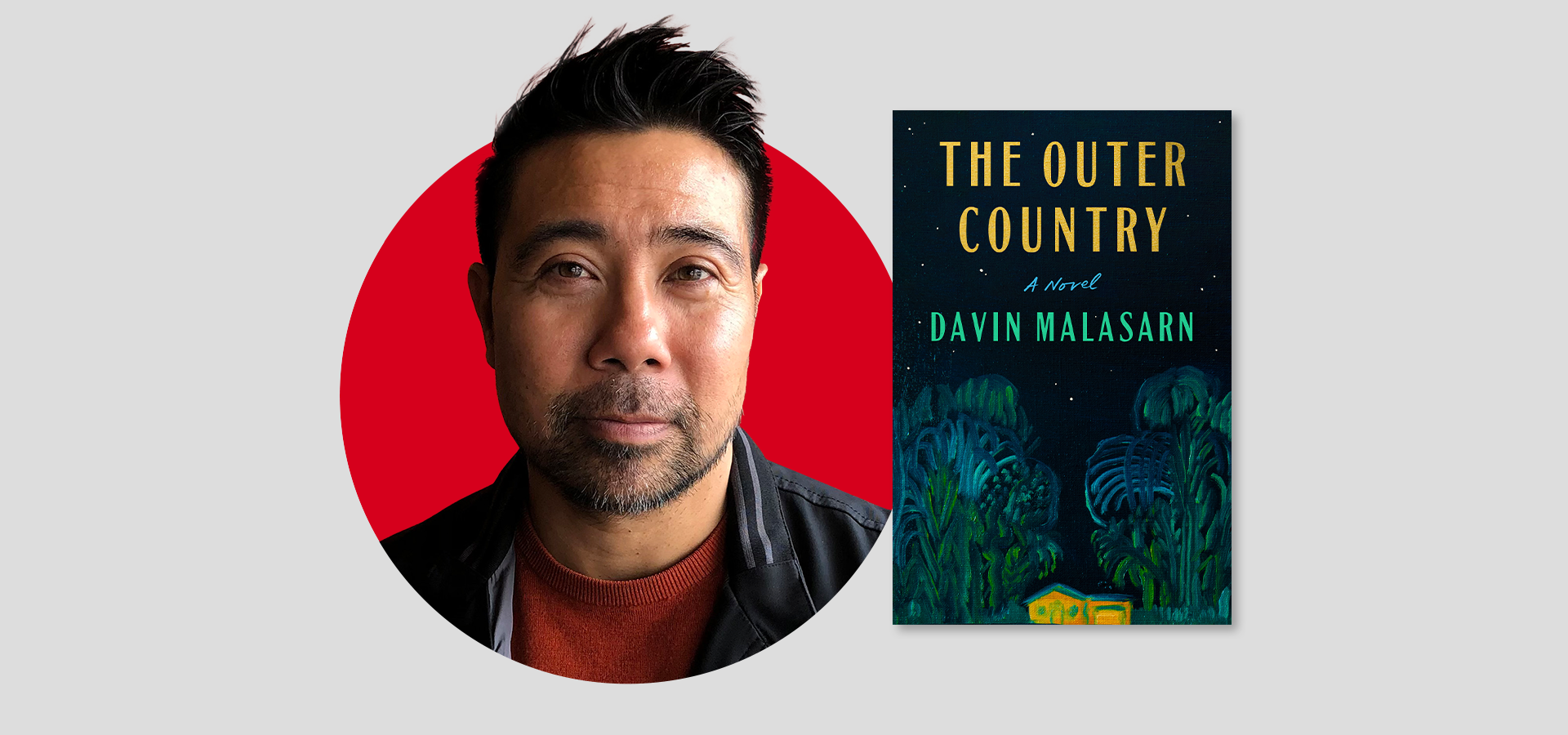
Davin Malasarn | The PEN Ten Interview
After years apart, two sisters, Manda and Siripon, are reunited by Siripon’s entry into motherhood. It seems like her son, Ben, will grow up with two loving mother figures in his life — but things swiftly change as he becomes more effeminate. His identity overwhelms Manda with fear, and she colludes with Ben’s father to arrange a Buddhist exorcism of the spirit she thinks has possessed her newphew. Rather than bringing peace and happiness for the family, however, the ceremony results in a decade of sickness and devastation.
In conversation with Sabrina Adams, senior manager for literary programs, Davin Malasarn discusses The Outer Country (Penguin Random House, 2026), the complicated family dynamics within it, and the parts of the book that he drew from his own life (Bookshop; Barnes & Noble).
I loved this book! I was really taken by Ben’s journey as he grows up and gains independence and self-actualization. What led you to write this book, and what (if any) elements of your own life did you bring to the story?
Thank you so much! The first pages of The Outer Country were written during my first year at the Bennington Writing Seminars. Deadlines always help spark creativity! I wrote a short story about an aunt, Manda, who suspects her nephew, Ben, is gay. She finds a monk who claims he can exorcise a feminine spirit from Ben’s body. The ceremony takes place, and after it’s over, Ben gets a mysterious illness.
The story was told from Manda’s point of view and took place over a few days. But during workshop, people had questions. They wanted to know more, not only about Ben’s illness, but also about the family dynamics. My mentor, Justin Torres, told me the story needed to be expanded into a full-length book to answer these questions.
I drew from my own experiences when writing the initial scenes, but I had to excavate memories that were once repressed. So, I won’t ever be able to say definitively what’s true and what’s not. But elements of this book certainly feel true.
Were there any aspects of this book that you found challenging to write?
I’ll start by acknowledging that writing is almost always challenging for me. I enjoy it, but it’s rarely easy. The challenge is part of the fun.
With this book, the structure was certainly tricky. The novel is told through multiple perspectives and in nonchronological order, so I went through several rounds of remodeling before all the pieces fit together.
Writing from the points of view of some of the characters was also difficult. In particular, the father, Kamron, required a lot of reflection before I could see him clearly.
Who is your ideal audience for this book?
My central focus for the book is family. And I’ve heard positive things from readers who were invested in the mother-son relationship or the father-son relationship. I’ve also heard from readers who had an alternative mother figure and connected with that element of the story. So, I certainly had in mind people who grew up in complex households.
I think we also read to commune with people who share our identity, and I’ve received some nice compliments from the Asian-American and the queer communities. I certainly had them in mind as well.
I had to excavate memories that were once repressed. So, I won’t ever be able to say definitively what’s true and what’s not. But elements of this book certainly feel true.
This book shows the American immigrant experience through multiple eyes: mother, father, and aunt. Despite living in the same house, they all have vastly different experiences. What did you want to show about the immigrant experience through these varied perspectives?
The American Dream was a very real promise for Southeast Asians in the 1970s. Thousands of people from Thailand came to this country and made a better living. The money they earned helped them establish families in the states and help their relatives back home. In that sense, these immigrants traveled along parallel journeys.
But as a child growing up, I wasn’t interested in any of that. The jobs, bills, and relatives receded into the background. The stories I felt most powerfully took place within the walls of my house. I saw drama arise from different personalities and desires.
I wanted these two sides of the story to play off each other, the generalized immigrant experience clashing or harmonizing with the drama of individuality.
The idea of surrogate mothers is a recurring theme throughout this story. What did you want to say about these surrogate moms and their impact on Ben?
My approach was to show the different ways each woman viewed motherhood depending on their idea of what it means to truly love someone. The nature of love—particularly in relation to sacrifice—was an idea I kept coming back to. Both women, Siripon and Manda, sacrifice for Ben, but that sacrifice takes two very different forms. That’s what interested me. And I didn’t want to decide for readers which approach was “correct” or “best.” Rather, I wanted to present them both in a way that was true to the characters.
Fatherhood has an interesting place in this story. As much as Ben has mother figures seemingly crawling out of the woodwork, he has only one true father figure in his life, and Kamron is hardly father of the year. What was your goal in writing this very flawed dad?
Kamron is a flawed character among other flawed characters. His flaws run deep, though. And, because he is so subsumed by them, he rarely takes the opportunity to defend himself, even when he’s telling his own story. He almost can’t see himself as a protagonist, which for me emphasized the tragedy of his situation. But his love for his wife and son are there, and I tried to reveal those moments as well.
I wanted these two sides of the story to play off each other, the generalized immigrant experience clashing or harmonizing with the drama of individuality.
Birth order is a very interesting dynamic in this book, along with its relation to (often gendered) parental expectations. What guided your approach to the parent-sibling dynamics?
My mother often told me about an older brother who died as a baby. In her account, the boy was so good-natured, so well-behaved, so loved, and so favored. I always wondered how someone who was alive for only a few months could be a favorite for so long afterward, and I always came to the same conclusion. He was perfect because he was a memory. He was a perfect memory.
Meanwhile, my mother’s youngest sister was always described as the least favorite. She let her parents move in with her in their old age, and she cooked and cleaned for them until they died. But she never won them over.
That dynamic was so intriguing and troubling to me, and I saw how it shaped my mother’s view on parenting—how important it was for her to love my brother and me equally. I wanted to capture that idea of favoritism and its generational curse.
Siripon (Ben’s mother) was indisputably my favorite character. She’s kind, driven, and selfless, seemingly putting everyone’s needs before her own. Despite this, her work is often taken for granted by the people she loves most. As you developed this character, what was your intuition with the suffering she endured?
As I alluded to earlier, one advantage that came with writing from multiple perspectives is that I was able to reveal characters through their own view of themselves and through other characters’ views of them. Siripon saw herself as always working hard and suffering. And that was often true. She voluntarily took on so much for herself, and others let her. But the other characters recognized that she sometimes took service to the extreme. At times she took the suffering on as a way of winning favor or being better than other people. She needed to find a middle ground for herself.
The family’s Buddhist faith is a pillar of their world, and it’s shown in a variety of ways, like the funerals in Thailand, the shrine they keep in their Los Angeles home, and a secretive ceremony performed on Ben when he’s a boy. What guided your treatment of Buddhism in this story?
I went into this story thinking there would be a clear line between believers and non-believers. Instead, it was a matter of degree. The minor character Aunt Seamstress is a deeply religious person, but the family thinks of her almost as a fanatic. Manda and Kamron, the characters who allow a Buddhist ceremony to shape Ben’s life, question their faith. And they blame that questioning for at least some of the problems they must confront. They wonder if being more committed to their religion would have helped to manifest its many offerings. Then, Siripon is cosmopolitan when it comes to her religious views. She practices Buddhism, but she doesn’t object to her son exploring other faiths. I realized I needed to embrace the blurriness of this family’s religion. They were religious, but they weren’t fanatics. They believed in science, and they believed in reincarnation. Their views didn’t conform to strict boundaries.
One advantage that came with writing from multiple perspectives is that I was able to reveal characters through their own view of themselves and through other characters’ views of them.
Ben is on the receiving end of an attempted “exorcism” intended to “fix” him and prevent his homosexual tendencies. While this obviously doesn’t work and causes Ben severe physical and mental anguish as he grows up, I found your handling of the topic particularly nuanced. You showed great care by giving humanity to the family members who put Ben through that ordeal, without justifying it. I’m curious about your process on that. How did you strike that balance?
When I was growing up, a trans woman owned my family’s preferred Thai restaurant. I saw my parents and aunt interact with her on several occasions, and I never sensed any rudeness or discrimination from them. So, when my family objected to my own coming out, the question became why queerness was so much more of a problem at home. It wasn’t sufficient to blame general homophobia.
I kept this in mind when I created the adult characters in the book. On one hand, they did place different values on men and women, masculinity and femininity, straight and queer as a result of their culture and upbringing. But they each also drew from different life experiences to arrive at their decisions, and that added a layer of complication. Manda steered Ben’s upbringing from the perspective of them being immigrants and underdogs, and anything that put him at a greater disadvantage worried her. Siripon witnessed the ravages of the AIDS epidemic and didn’t want to lose Ben to that disease, which almost always led to death in those early years. I tried to capture that multi-layered picture.