Brad Meltzer | The PEN Ten Interview
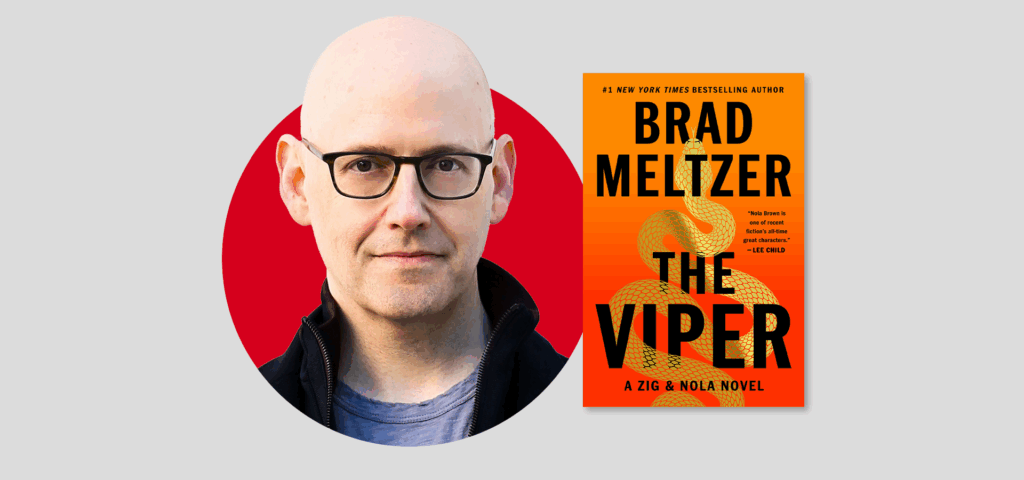
Brad Meltzer writes illuminating stories that explore history, power, and the choices people make under intense pressure. A prolific genre-hopping author, his work spans bestselling thrillers, children’s books, comics, and nonfiction. His latest thriller, The Viper, builds suspense through vivid characters, sharp pacing, and carefully timed reveals (HarperCollins, 2026). The novel continues the Zig & Nola series, following a U.S. Army mortuary specialist and a former Army combat artist as they uncover a dangerous conspiracy tied to buried secrets and present-day threats.
In this PEN Ten interview, Brad Meltzer talks with Florida director William Johnson about how he uses time shifts to build suspense, what comics taught him about storytelling, and how his writing process has changed over time (Bookshop; Barnes & Noble).
As a reader, I am obsessed, in a good way, with your use of time shifts to heighten narrative suspense. The Viper often builds tension by moving the reader backward and forward through time just as the stakes peak. How do you think about structuring those temporal shifts on the page? Do you rely on instinct while drafting, or do you refine them later as part of the editorial process?
It’s definitely a bit of sorcery, voodoo, and gut instinct. I put them where I feel like I need them as I go. But in the end, I do take a peek and count pages, just to make sure they’re relatively spaced out evenly.
In this novel, you sometimes let the reader know a character’s fate before revealing how it unfolds. How does giving us the what before the how reshape suspense, particularly in terms of pacing and reader attention?
It’s the old Hitchcock quote: “There is no terror in the bang, only in the anticipation of it.” The moment I tell you someone is about to be in pain, all we do is let it invade our brain and haunt us.
In the novel, the investigation unfolds through multiple strands: Zig’s work as a forensics expert with the dead, Nola Brown’s buried family connections, and the gradual exposure of the victims’ pasts. Do you have a personal method for keeping control of a multi-threaded plot like this?
When I was younger, I kept it all in my head. In my middle age, I write it down. As I was writing The Viper, I wrote a whole section of the plot, then misplaced it. So a few weeks later, I replotted it. Then I found the original notes I had written. Nothing had changed, for the most part. So at least I was consistent.
Mary Higgins Clark once said that writing four-minute radio scripts taught her to write cleanly and succinctly, because every chapter in a suspense novel had to advance the story. Your novels move with a similar sense of economy while still leaving room for rich character detail. How do you balance forward momentum with character development, and is that something you learned over time or something that came instinctively?
I honestly think it came from reading comic books growing up. Every comic is a short chapter and ends on a cliffhanger. That trained me to see a novel the same way: short chapter and cliffhanger, short chapter and cliffhanger. It’s what I prefer as a reader and a writer.
You need to have adventure, but, at its core, it needs to add something to the character and say something about our time on this planet.
You grew up reading comics and later went on to write them. What did reading and writing comics teach you about shaping a narrative?
See above. It was my Mr. Miyagi. It had me sanding the floor and painting the fence, training me in ways I never understood until it was time to fight Johnny.
Were there any specific comic books or books in general that helped shape the kinds of stories you wanted to tell?
Watchmen by Alan Moore is still my favorite book of all time. Batman: Year One. There were so many. They were all part of what I still love today: you need to have adventure, but, at its core, it needs to add something to the character and say something about our time on this planet.
You write across genres, from children’s books to comics to thrillers. Does your process change depending on the genre, or do you rely on a core approach that carries across all of them?
Same approach always: tell a good story. It’s my true mantra. The genre doesn’t matter. A good story is a good story.
Forget twists and plots. The best stories are the ones that tell you something about yourself that you didn’t even know was there.
You have been writing and publishing for decades. What has shifted the most in how you approach the work itself?
I think I’m just more honest now. More honest with my reader, but also more honest with myself. I don’t have all the answers, but I can see my blind spots better, along with my fears and pain. I used to hide those things, especially from myself.
Much of your work draws on history. How do you think about free expression at a time when access to history itself is increasingly debated or restricted?
Clearly, free expression is as vital as ever. But in my mind, history is like your old, wise grandmother. She never forgets. So yes, there are lots of things to worry about these days. Plenty. But history sees it. And she’s writing it all down.
When a reader closes one of your books, what do you hope lingers longer: the twists, the moral questions, or the emotional residue of the characters?
The emotion you feel about yourself. Forget twists and plots. The best stories are the ones that tell you something about yourself that you didn’t even know was there. It’s the ultimate magic trick. Abracadabra.
Brad Meltzer is the Emmy-nominated, #1 New York Times bestselling author of The Lightning Rod and twelve other bestselling thrillers. He also writes nonfiction books like The JFK Conspiracy, and the Ordinary People Change the World kids book series. Brad is also the host of Brad Meltzer’s Decoded on the History Channel and is responsible for helping find the missing 9/11 flag with his show, Brad Meltzer’s Lost History.