Aja Gabel | The PEN Ten Interview
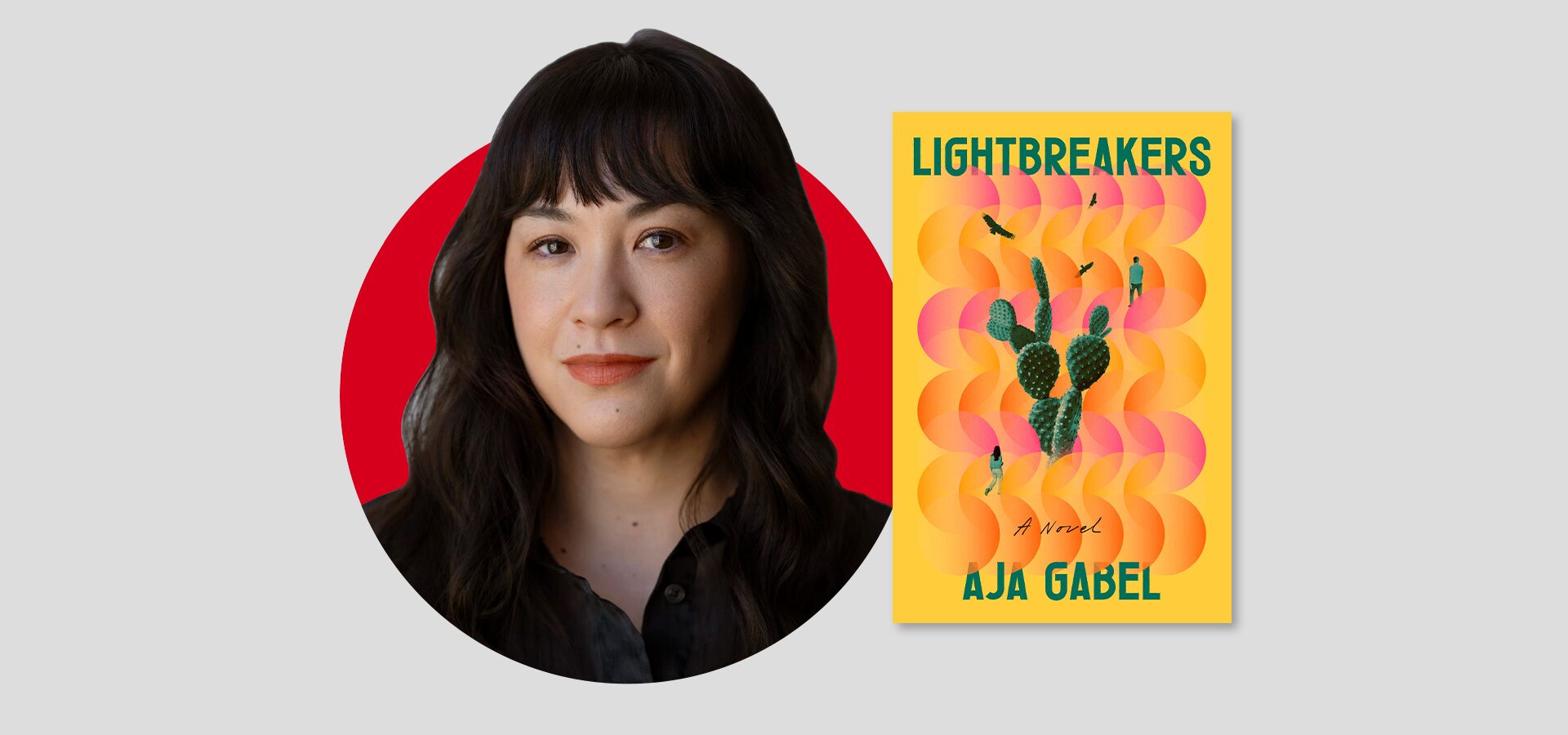
A profound and intimate look at marriage, Aja Gabel’s stunning new novel, Lightbreakers (Riverhead, 2025), is epic in its ambitions —tackling questions of time, grief, and memory. Husband and wife, Noah, a quantum physicist, and Maya, an artist, are both haunted by loss; Noah by the death of his daughter, Serena, from his first marriage to his ex-wife Eileen, and Maya, by the stalling of her artistic career. When they move to Marfa, Texas, after Noah gets invited to work with the Janus Project, a secret laboratory attempting to make time travel a reality, they both end up embarking on journeys into their pasts.
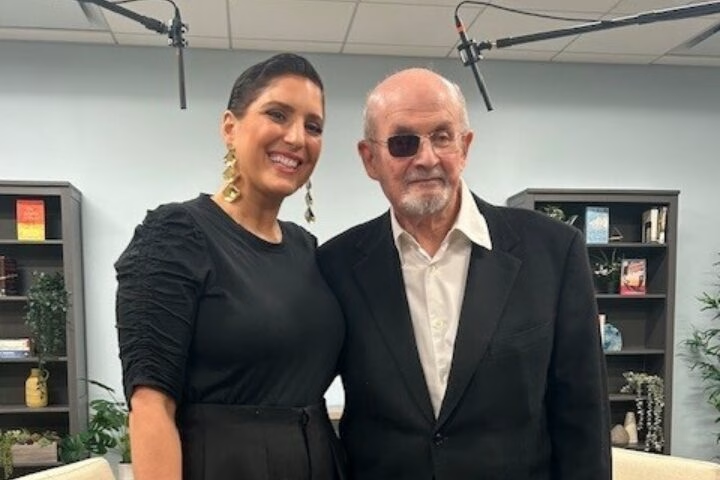
In conversation with PEN America’s Director of Literary Programs & the World Voices Festival, Sabir Sultan, for this week’s PEN Ten, Gabel discusses coming to terms with grief, the uses of contemporary art in the novel, and writing literary fiction that utilizes sci-fi elements. (Bookshop, Barnes & Noble).
Lightbreakers is your second novel. Your first novel, The Ensemble, was published seven years ago. How have you evolved as a novelist in that time? Have your interests as a writer changed or deepened?
In the last seven years since The Ensemble, I got married, had two children, and began a screenwriting career. I often have to remind myself of that when I think that seven years seems like a long time. And I’m also sure that all that stretching —into a relationship, into motherhood, into a new kind of creativity— influenced me as a novelist. I became deeply interested in marriage, because I never thought I’d conform to the institution and yet here I was, and I do think of Lightbreakers as a novel about marriage. I also became more confident with the machinations of plot, as I explored writing scripts, which often need to be described in a sentence or less to attract creative partners. And I became less shy about what I might have previously referred to as guilty pleasures, like sci-fi stories, love stories, and sad stories.
Grief and the way it intersects with time is in many ways the central exploration of the novel. Noah and Eileen are both haunted by the loss of their young child Serena. Noah’s grief is present in his marriage to Maya, influencing how they think about starting a family. The death of Serena creates an inflection point for Noah, where he is endlessly drawn to return to that defining moment. What do you see as the relationship between grief and time? How did you want to explore it on the page?
My oldest brother died very suddenly when I was in college, and I could tell you everything about the moment I found out—what the room smelled like, what was on the counters, the exact weather. I was with my father a year and a half later when he took his last breath, and I could also give you those excruciating details. It was as though time was warped by my grief, slowing to allow me to take in everything. In my writing in the twenty years since all this happened, I have often returned to those details, without knowing why exactly. Once I started to work on this book, I understood. Death is binary and final, and when the losses happened, I felt the dichotomy acutely in my body. From here, I thought, my life is different. But that other life, the one where they didn’t die, those went on, just out of reach to me. The desire to hold onto that moment of death and somehow change it felt so strong that I thought it might drive someone mad were that opportunity actually possible, which is where Noah’s journey originated. His understanding of time is warped by his grief, and here is an opportunity to warp time to solve his grief.
Maya too is shaped by loss of a different nature. When we meet Maya at the novel’s start, her career as a painter has stalled, and she is working in development at a museum. Throughout the novel, we see Maya try to reconnect with her art and her ambition. She takes her own journey into the past, traveling to Japan where she grew up, and reconnecting with her ex-lover Ren, an artist whose career took off. In what ways does Maya’s journey in the novel parallel Noah’s?
This idea of visiting lives we could have lived is not novel, but I think it is powerfully universal. Whereas Noah’s past life is marked by death, Maya’s is marked by a different kind of loss. Ren is part of the time where she was an artist-in-the-making, a time when she dreamed big because she didn’t know any better. She decides to revisit that possible self as she is starting to realize her relationship with Noah might be tainting her idea of herself as an artist. Both Noah and Maya must find a way to release possible past selves to embrace possible new selves.
The desire to hold onto that moment of death and somehow change it felt so strong that I thought it might drive someone mad were that opportunity actually possible, which is where Noah’s journey originated. His understanding of time is warped by his grief, and here is an opportunity to warp time to solve his grief.
In Lightbreakers, we’re given glimpses into various marriages and relationships; Maya and Noah’s; Noah & Eileen’s; Maya and Ren’s. Through the characters’ divergent voices, the reader is shown the different narratives they project onto their roles in relationships and their individual understandings of shared pivotal moments. What do these discrepancies reveal about the nature of relationships and the knowability of the characters to each other?
One of the driving questions at the heart of this book for me, in my own notes, was how can we truly love someone if there’s a part of ourselves that the other can never know, and if there’s a part of the other that we can never know? How can we get around the loneliness of our unknowability? Why do we try, anyway? The answer, I think, is that love is in the trying.
One of my favorite aspects of Lightbreakers is the deft weaving of contemporary art into the novel. We encounter works such as Yayoi Kusama’s Infinity Mirror Rooms and Donald Judd’s Marfa cubes. Both works that bring in questions of scale, space, and time, organically speak to the novel’s themes. How did you approach curating the art you feature in the novel?
Both of those pieces of art are immersive, kinds of art that require you to move through them, to exist inside of their boundaries. That felt important in making writing about the art more accessible, that my characters could physically experience them. Both Kusama and Judd are immersive, even if their styles are radically different in that Kusama is a maximalist and Judd is a minimalist. But both offer really clear ways of reframing the world and interacting with it, and I personally think it’s impossible to experience those particular pieces and come out unchanged. I cut a scene where Maya and Noah walk through a Dan Flavin exhibition, but he’s also one of my favorites, in the way that his pieces have a physical effect. And Robert Iwrin’s dawn to dusk plays a major role in the book, even though I haven’t been there, because the very idea of that installation makes my heart skip a beat. I hope to visit soon.
When Noah first meets Maya, he wanders into a talk she is giving on the fictional photographer Yuko Matsuda’s self-portrait, Weight. Maya is moved by and drawn to the work, but her interpretation of it changes over the course of the novel. How did you come to create Weight, and what do you see as Maya’s relation to it?
When I first wrote about Maya’s interest in this made-up self-portrait, I didn’t think it would come back around in the book. But once I began to sketch out what the self-portrait actually looked like, it became clear to me that every character ought to have a take on it. Because part of the point Maya is always trying to make to Noah is that there is freedom and joy in interpreting art, as long as you’re honest with yourself. But what Maya learns about her own relationship to the piece is that it’s not static, and that possibly her relationship to everything doesn’t have to be static. Even the art itself changes. Through drafts, Weight got more complex and dynamic, and I worried about that, because it’s tricky to have a pivotal element of a book be art that you cannot see. But then I thought, well, you can’t see quantum entanglement, either.
One of the driving questions at the heart of this book for me, in my own notes, was how can we truly love someone if there’s a part of ourselves that the other can never know, and if there’s a part of the other that we can never know?
I love the way you use metaphor, allegory, symbolism, and allusion throughout the book, like naming the laboratory after the Roman God Janus, whose two faces look forward and backwards. Or, the pronghorn Maya sees beating itself to death against one of Judd’s cubes, which later becomes a source of creative inspiration for her. The pronghorn caught in it’s suicidal repetition seemed to mirror Noah too. How do you use these rhetorical devices to enhance the atmosphere of the novel?
The goal of a good novel is to realize the book’s themes in the world, and rhetorical devices are crucial to accomplishing that. But I think it’s best not to think too hard about rhetorical devices the first time around. For me, that kind of assessment is meant for later revisions, to discover your own tics and repetitions. Early in drafting, it’s best if I try to tap into what Gardner called fiction’s “vivid and continuous dream” mode, meaning that I try not to question what comes up. Because if you infuse a rhetorical device with too much meaning too early, you risk it feeling manipulative. You want the heart of the rhetorical device to come from inside the story first, not an outside idea graphed onto the story.
Though the novel deals with time travel and uses elements of science fiction, it is classified as literary fiction. What do you see as the delineation between the two in Lightbreakers?
The main difference to me has to do with expectations. I think traditional sci-fi audiences expect fast-paced plot and a larger scope, and traditional literary fiction audiences expect deeper character and thematic development. But I don’t actually think one genre precludes using markers of the other, and I’m more interested in writers that straddle both, like Ted Chiang, Octavia Butler, and Charles Yu. I do feel like Lightbreakers leans more toward more involved character development, but I also hope there’s something for sci-fi fans in here, too.
In addition to being a novelist, you are also a screenwriter, having worked on the HBO Max original miniseries The Staircase starring Colin Firth, Toni Colette and Michael Stuhlbarg, Sunny featuring Rashida Jones and the forthcoming Five Star Weekend, starring Jennifer Garner. How is writing for the screen different from writing for the page? Has your work in one influenced your work in the other?
In novels, I’m working out my ideas through drafts, and in a TV writing room, I’m working out ideas through talking. That was a huge adjustment for me, but honestly it’s such a relief to hash out plot and character problems in a vibrant conversation every day instead of alone at my desk. It helped me learn to let go of darlings and be less precious with my ideas. That said, you’re always working things out in scripts, too. I’ve noticed screenwriting got me more comfortable with tackling bigger plots and propulsive elements in novel-writing, and I hope my primary interest in character and theme has made me valuable in a TV writers’ room.
I think traditional sci-fi audiences expect fast-paced plot and a larger scope, and traditional literary fiction audiences expect deeper character and thematic development. But I don’t actually think one genre precludes using markers of the other, and I’m more interested in writers that straddle both.
Now that your novel is out in the world and you have more time to read, what books are you reading?
I just read Lily King’s Heart the Lover, which left me in a puddle for several days. I thought Sonya Walger’s Lion was remarkable. I’m eager to start Hiromi Kawakami’s The Third Love.
Aja Gabel is the author of the novel The Ensemble. Her prose can be found in The Cut, the Los Angeles Times, Oprah Daily, and elsewhere. Her short story “Little Fish” was adapted into a feature film, and she has written extensively for television. She lives in Los Angeles.