
2025 Emerging Voices Fellows | The PEN Ten Interview
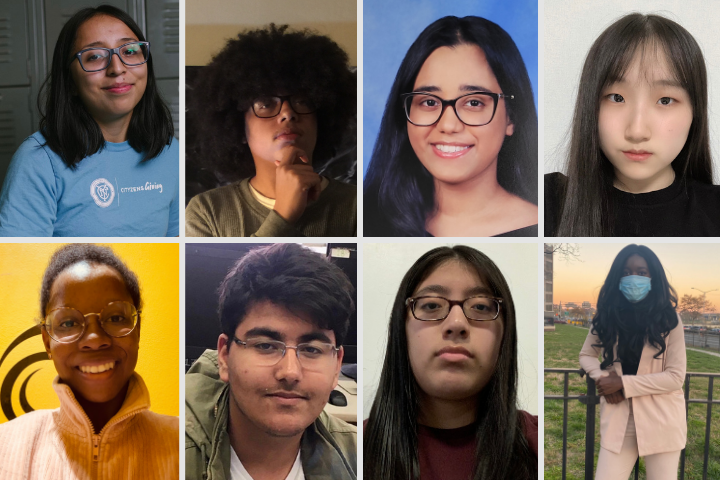
The PEN Ten is PEN America’s weekly interview series. This week, PEN America’s 2025 Emerging Voices Fellows, hailing from nine states across the country, provide insight into their creative processes, how they’ve developed as artists and writers, and what inspires their literary practice. PEN America’s Emerging Voices Fellowship provides a five-month immersive mentorship program for early-career writers from communities that are traditionally underrepresented in the publishing world. The fellowship nurtures creative community, provides professional development training, and demystifies the path to publication—with the ultimate goal of diversifying the publishing and media industries.
Join the fellows for their final reading on Oct. 22 >>
How does your writing navigate truth? What is the relationship between truth and fiction?
Pegah Ouji: I see fiction as a pathway to truth, through discrete, subversive alleys and thorny yet dazzling backroads. Fiction is Persuis’ Aegis through which I aim to slay the Medusas of my own self-delusion and ignorance. The best pieces of writing, even those widely imagined, reveal assertions about reality that shake my taken-for-granted assumptions. Then I’m left, once again, with the task of reconstructing my understanding of the world and my place in it. I’ve come to love this process of destruction and re-creation.
In my own writing, I aim to capture honestly and imaginatively, the story of Iranian people. My goal is to pursue a more expansive notion of reality. Growing up my grandmother put me to sleep with Iranian fairy tales but each night, she’d alter some details– the ending, who were the heroes, or the villains. This has fueled my love for what-could-have-beens and what-ifs. What if Iranians weren’t characterized by oppression? What if Iranians became custodians of their own beauty? What if progress and preservation of tradition could go hand in hand?
What was an early experience where you learned that language had power?
Danielle Emerson: When I was younger, my grandmother used to keep the radio on in the morning. I’d walk over from my aunt’s trailer to get ready and shower, and the moment I opened the screen door, I’d be greeted with Diné Bizaad from our local radio station, KNDN. My grandparents were already working in the fields by then, but I could feel their presence in the language, land, and smell of roasted coffee. Diné Bizaad is a language of comfort and beauty. The moment I walked into my grandparent’s hogan and heard Diné Bizaad on the radio, greeted by warmth from the cast iron fireplace, shins nuzzled by rez dogs, I knew I was home. I knew I was safe. That is the power of language.
What is your relationship to place and story? Are there specific places you keep going back to in your writing?
Emily Ramirez: My relationship to place begins with language. In my stories, I use Dominican slang and words with meanings in Caribbean Spanish that resist translation. I trust my readers to step into the rhythms of the language I grew up with. Place then is not only geography, but also this intimacy with my language. My stories visit the campos of DR, but also the factories that rooted my family in the US, family apartments across NYC, and imagined places where reality meets the magical.
I’m drawn to building worlds that hold these histories and memories together. A character’s connection to place shapes their desires and their sense of belonging. Their inner world remains tied to the geographies they’ve inherited. They never abandon these details. I hope that when this is communicated, the places my characters travel to become as real as any place my reader has been to themselves. That my work crosses over geographical borders to tell the human stories that connect us all.
If you could claim any writers from the past as part of your own literary genealogy, who would your ancestors be?
Elisabeth Vasquez Hein: Since I began writing creative nonfiction only a few years ago, most of my recent literary genealogy are contemporary writers of memoir – all of whom are women of color, particularly those who write on themes of mixed race identity, immigration, and diaspora. But if I think back to my youth, when my love of literature was stoked, the writers who come to mind are writers of poetry and fiction. Eugene Gloria and Li-Young Lee inspired me to consider my own experience as an Asian American navigating a cultural and geographical in-between. Isabel Allende, Leslie Marmon Silko, and Luis Alberto Urrea enticed me into worlds of family legacy, multigenerational consciousness, and historical contexts. I loved devouring any works by Tom Spanbauer and Richard Brautigan, who wove fascinating stories full of metaphor and the western landscape. Lastly, I’ll mention the book The Little Prince by Antoine de St-Exupéry, which opened me to another way of imagining and making sense of the world.
What do you read (or not read) when you’re writing?
Solomon Tesfaye: I mostly read short fiction and poetry while drafting. I try to read with intention—usually works related to a craft question I’m wrestling with in my novel. For example, Jhumpa Lahiri and Alice Munro help me think about restraint, emotional layering, and the quiet weight of dialogue. When I’m stuck structurally, I revisit Italo Calvino to remind myself that form can be playful, expansive, and still precise. I read to solve problems—but also to remember what’s possible.
Coming from an oral tradition and having learned English as a third language, I lean also on other mediums like photography and digital media (i.e., New Yorker’s Fiction podcast) for inspiration to push through when momentum fades.
What’s something about your writing habits that has changed over time?
Leila Farjami: Over time, my writing has grown in both frequency and depth. I’ve become more committed to the craft, not only by writing consistently but by reading poetry daily. I am more willing now to practice vulnerability in my poems, to confront difficult emotions, states of being, and personal and collective traumas. I also prioritize my early morning reservoir of energy for writing at least a few lines and do not worry if a poem is complete or chiseled the way I would want it to be.
My work seeks to give voice to the unexpressed, to cross the thresholds my matrilineal ancestors were forbidden to step beyond, to name their fire and my own as a threat to patriarchy. What anchors me now is a deepened dedication: writing as a sanctuary I’ve rebuilt after years of inner struggle, especially around creating in my adopted language rather than my maternal one.
What is a moment of frustration that you’ve encountered in the writing process, and how did you overcome it?
Trini Bui: One of my greatest moments of frustration was uncertainty in how to communicate the integral parts of my Vietnamese heritage and the sentimental parts of it. What was the truth of my heritage and what was just my understanding of it? I felt that, if I adhered to the “truth,” I might be misconstruing my experience; if I adhered to my “understanding,” I might be misrepresenting Vietnamese customs.
Speaking with others from diverse backgrounds and seeing the ways they grappled with their own identities and understandings of how they fit into the world helped me overcome this internal struggle. Our lives are an interpolation of our cultures and heritages. As we grow, our understanding and performances of who we are grows with us–as our cultures shape us, we shape our cultures in return. Through community and mentorship, I overcame this tension of what I believed my writing needed to do, and let the writing speak for itself.
What does your creative process look like? How do you maintain momentum and remain inspired?
Ava Pauline: My creative process looks like remaining present and persistent. Our culture glorifies writers living in solitude and auspicious strikes of inspiration, but I find writing to be far more mundane and hard-earned.
My creativity is not separate from what I see, feel, or experience every day; telling the truth about the moment I live in requires active engagement with the world around me. I always return to Octavia Butler’s practical advice that habit, which she calls “persistence in practice,” sustains creative discipline. I write down snippets of dialogue I overhear on the train, record the details of people’s outfits at the club, and allow stories, or bits of what will one day become stories, to hijack my daydreams.
Grounding myself in loving relationships is how I remain inspired: venerating ancestors, reading, gathering with trustworthy people, and spending time under the sky. These practices strengthen my faith in the unknown—a mystical realm where all stories wait to be told.
What do fellowships, workshops, and programs such as the Emerging Voices Fellowship mean to emerging writers? How, if at all, do they help with viewing oneself as a writer?
Varun Shetty: For writers like me who are not in the academic writing environment, fellowships and workshops provide an important way to grow skills, learn, and network. They break down the barriers for those not in the academic writing space. These environments are often incredibly supportive. A few years ago, when I wasn’t sure if I could call myself a writer if I wasn’t writing full-time, my instructors and my cohort reminded me that I was a better writer because of my work in medicine. It allowed me to embrace all aspects of myself and fold that into my writing, bringing more dimensions to my work.
What is your favorite aspect of the Emerging Voices program?
TC Mann, Emerging Voices Coordinator: My favorite aspect of the Emerging Voices program is the moment when each fellow realizes that they are not only writers, but good writers whose stories deserve to be heard. Watching that shift from doubt to confidence is incredibly powerful. The program creates a space where diverse voices are uplifted and celebrated, which feels especially urgent in today’s climate, when literature and education are under constant attack. These stories matter, and Emerging Voices ensures they are shared at a time when we need them most.
During our final reading, which is the culmination of the program and an opportunity for fellows to showcase all of their hard work, you really see the life and laughter they bring to their characters. They manage to make these stories so full, and it is incredibly inspiring to witness the transformation that happens in just five months. Whether it’s an essay, poetry, or an excerpt from a novel in progress, every year, I am tremendously proud of every single fellow who comes through our program.