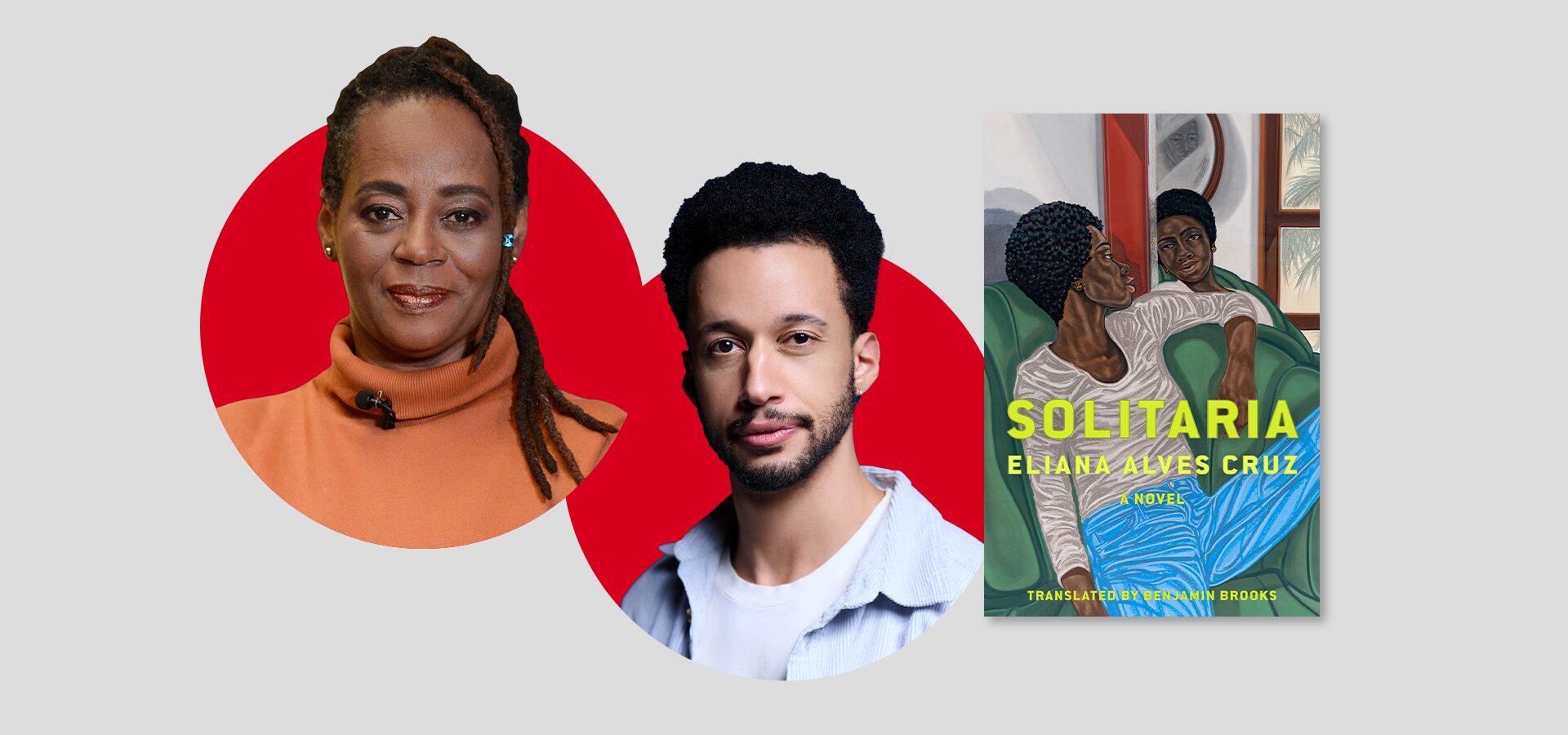
Eliana Alves Cruz | The PEN Ten Interview
Translated by Benjamin Brooks
In Solitaria (Astra House, 2025), Eliana Alves Cruz dives into the interlocking dynamics of race and class in modern-day Brazil. The novel follows Mabel and her mother, Eunice, who works as a live-in maid in an apartment building in an unnamed city, contrasting their perspectives to shine light on the forces that shape their relationship, as well as their interactions with the other residents of the Golden Plate, the allegorically named high-rise. Skillfully translated by Benjamin Brooks, Solitaria explores the legacy of slavery in Brazil as well as the capacity for traditional wisdom to heal hurt felt across generations.
In this interview, translated by Brooks, Cruz tells Amy Reid, Freedom to Learn Interim Program Director at PEN America, about the complexity of Mabel and Eunice’s mother-daughter relationship and the necessity of puncturing the myth of Brazil’s racial democracy. She also reveals the thinking behind many of Solitaria’s notable features, discussing her decisions to leave the city in which the novel takes place unnamed and to retain certain Portuguese words in the English text. (Bookshop; Barnes & Noble)
1. Can you provide a little context for the title of your novel —– which is the same as the title in Portuguese, minus the accent: Solitária. It’s a powerful title, at once literal and paradoxical, given that the novel focuses on how a mother and daughter negotiate shared spaces and experiences.
The title Solitaria has an obvious connotation with solitude, but it also refers to the cruelest space in a prison (solitary confinement). The space where incarcerated people are cut off from any interaction in these dehumanizing conditions. In Brazil, it can also be used to refer to an infestation, a parasite. This kind of isolation is like a tapeworm, something that sucks the energy from your body. I thought it was relevant here, this thing that Brazilians in the more affluent or middle classes aren’t familiar with if they’ve never had domestic workers drained of their life force in this role of the “servant.”
Solítária é um título que remete obviamente a solidão, mas também ao espaço mais cruel de uma prisão. Aquele onde os encarcerados são isolados do convívio em condições sub-humanas. No Brasil também é como chamam a uma verminose, um parasita. Um sinônimo de Tênia que suga as forças do corpo. Achei pertinente, pois a classe média e as classes mais abastadas brasileiras não vivem se não tiverem trabalhadores domésticos que tem suas forças sugadas nesta função.
2. Eunice and Mabel, your mother and daughter protagonists, share not only a constricted living space but many parallel experiences, although they respond quite differently to their circumstances. How would you describe the connection between them, and their connection to Eunice’s mother, Vó Codinha?
I wanted to bring in the three generations with their differences and conflicts, while showing that there are values, lessons, a kind of wisdom that unites these women. Mabel is young, she dares to dream, she doesn’t let herself be limited and to some extent, she resents her mother for being in this subjugated position where she gives more attention to her employers’ daughter than her own. Mabel wants to escape a destiny that already seems sealed by those from her same background. However, at the end she understands the paths her mother and grandmother took in order for her, Mabel, to manage to break the generational cycle.
Eu quis trazer as três gerações com suas diferenças e conflitos, mas mostrando que há valores, ensinamentos e uma sabedoria que as une. Mabel é uma jovem que ousa sonhar, não se deixa limitar e em alguma medida se ressente da mãe estar nesta condição subalterna e precisar dar mais atenção à filha do patrão que a ela. Mabel quer escapar de um destino que parece selado para pessoas de sua mesma origem. No entanto, finalmente ela entende os caminhos percorridos para que ela conseguisse quebrar um ciclo.
3. Your novel gives a rich description of the lives that play out in the Golden Plate, a luxury apartment building, but you don’t situate the story in a specific city. Why did you make that choice?
I chose not to name the city because these are issues that permeate every part of Brazilian society. This story could take place in any city in the country, as it deals with the overwhelmingly strong remnants of the country’s 380 year history of enslaved labor.
Escolhi não determinar o lugar porque esta é uma questão que perpassa toda a sociedade brasileira. Essa história poderia acontecer em qualquer cidade do país, pois se trata de um resquício fortíssimo do país que teve 380 anos de trabalho escravizado.
I chose not to name the city because these are issues that permeate every part of Brazilian society. This story could take place in any city in the country.
4. One thing that I really appreciate about your novel is the clarity of your writing—it’s spare, but turns lyrical when you reference the natural world, and you have very different registers for your different narrators. How would you characterize the voices of Mabel and Eunice?
I like to really work these narrative voices. All of my books have unusual narrators. In Solitaria, Eunice is a woman who reflects on the years spent on the periphery of a family. Mabel is a woman who reflects on the years she grew up on her mother’s periphery, already at the periphery of this other family! Eunice’s voice is more resigned, Mabel’s is more pragmatic and righteous.
Gosto de trabalhar bem as vozes narrativas. Todos os meus livros possuem narradores pouco usuais. Em Solitária, Eunice é uma mulher que faz uma reflexão sobre os anos que passou sendo a periferia de uma família. Mabel é uma mulher que faz uma reflexão sobre os anos que cresceu sendo a periferia da mãe que é a periferia daquela família! Eunice tem uma voz resignada, Mabel uma voz pragmática e indignada.
5. Your doubling of characters creates a sort of house of mirrors – with contrasting pairs of mothers and daughters and, for both Eunice and Mabel, romantic partners. I initially saw this as underscoring social differences (the stark contrasts between Eunice and Mabel, and Lúcia and Camila, for example), but perhaps you were also trying to explore each character’s agency. What was the intent behind this set up?
I wanted to show that the same existential questions change our perspective based on where we come from and where we are. Motherhood for Lúcia is something totally different than it is for Eunice, for example. The same goes for the mother daughter relationships and the question of how we remember things.
Quis mostrar que as mesmas questões existenciais mudam de perspectiva a partir do lugar de onde viemos e estamos. A maternidade para a Lúcia é algo completamente diferente do que é para a Eunice, por exemplo. A mesma coisa com as relações entre mães e filhas e as questões das memórias afetivas.
Solitaria is a really lovely work of “decolonial” translation, that is to say, a translation that respects the linguistic differences and varied meanings that make up a story written in a language other than English. It’s an invitation to the reader who’s not fluent in Portuguese to immerse themselves a bit in the sounds and what they mean.
6. By setting your novel in an apartment building, you are able to introduce side plots that amplify the social commentary of the novel, the story of Dadá, for example, and her abuse by the super, Imaculada Beira Alta. Why did you choose to include that story and can you provide a gloss for the super’s name?
My aim was to create a microcosm of Brazil in The Golden Plate. There are a number of worlds within those universes. The character of Dadá is a very literal manifestation of cases analogous to slavery that still persist in Brazil. Even today, there are numbers of people working as slaves, not just in rural areas, but in cities as well. The name Imaculada Beira Alta sounds aristocratic, like someone with Portuguese origins, the colonizers of Brazil.
Pretendi criar um microcosmo de Brasil no edifício Golden Plate. Há vários mundos dentro daqueles universos. A personagem Dadá é uma atualização literal de casos análogos à escravidão que ainda persistem no Brasil. Ainda hoje muitas pessoas trabalham escravizadas não apenas no campo, mas nas cidades. O nome Imaculada Beira Alta é um nome que soa aristrocrático, algúem com origens portuguesas, que foi o país que colonizou o Brasil.
7. Linked to Dadá’s story is the image of the criado-mudo, literally the mute servant, a term that refers both to a bedside table and the mistreatment of enslaved people. It’s also one of the untranslatable words in the novel, like saudades. I’m wondering how closely you worked with the translator, Benjamin Brooks, and about the choices made about which words to leave in Portuguese — including names for family members, foods, and saudades?
Solitaria is a really lovely work of “decolonial” translation, that is to say, a translation that respects the linguistic differences and varied meanings that make up a story written in a language other than English. It’s an invitation to the reader who’s not fluent in Portuguese to immerse themselves a bit in the sounds and what they mean. It’s an invitation towards a broadening of these worlds, and not an attempt to confine the reality of this book into English. The dialogue with Benjamin Brooks was intense and beautiful. His time living in Brazil and his sensibilities as a black man meant he could understand the subjective concerns of the book. Our origins trace back to the same diaspora.
Acho Solítaria um belíssimo trabalho de tradução “decolonial”, ou seja, uma tradução que respeita as diferenças linguísticas e de significados que compõem uma história escrita em língua não inglesa. É um convite ao leitor e à leitora que não dominam o português para que mergulhe na sonoridade e em outros significados. É um convite à ampliação de mundos e não a tentativa de encaixar uma realidade em outra. O diálogo com Bem Brooks foi intenso e bonito, sua vivência no Brasil e sensibilidade como homem negro, que também entende as questões subjetivas do livro, pois nossas origens são uma mesma diáspora.
8. A scene near the end, where Eunice and Mabel cross paths one final time with Sérgio, is quite poignant. Recent census data from Brazil emphasizes the overlapping and mounting crises of poverty and inadequate housing, noting that about 25% of Rio de Janeiro’s population lives in favelas (a figure that rises even higher in cities like Belém, Salvadór da Bahia, and Manaus). What does Sérgio’s plot line — his abuse, but also his green thumb, and his eventual departure from the city — contribute to the broader story?
The character Sergio represents a reality across families, not only in Brazil: the black man who sinks into alcoholism to anesthetize the pain of his frustrations and tears the family apart. I wanted to see this man beyond his obvious role as an abuser, to see the human being who is sensitive, who has a hand for something that is extremely delicate, but who sees himself confined inside these impossibilities of realizing his dreams. Sergio, in his fullness, represents a terrible side-effect of racism.
O Sérgio é um a realidade dos lares não apenas no Brasil. O homem negro que mergulha no álcool para anestesiar as dores de suas frustrações e dilacera uma família inteira. Desejei ver este homem para além do óbvio do abusador, o ser humano que é sensível, tem um talento extremamente delicado, mas que se vê enclausurado nas impossibilidades de realização de seus sonhos. O Sérgio é todo ele uma sequela terrível do racismo.
I want people to understand that Brazil is a complex, gigantic place, with deep historical wounds… but also it’s a country capable of seeing the science and wisdom passed down from very old traditions in black and indigenous populations.
9. The marketing for your book highlights race — your identity as an Afro-Brazilian writer and Mabel and Eunice as Black women — but your novel really hones in on class and social disparities. What do you want American readers to understand about race and class in Brazil?
I want Brazil to be engaged with beyond the stereotypes of sun, of beaches, gorgeous landscapes, joy, samba and beautiful people. Brazil is all of this, essentially, but there’s a darker current that persists alongside it all, mainly caused by this mythic aura of a “racial democracy,” one that is incapable of seeing the brutal inequalities across race and class. I want people to understand that Brazil is a complex, gigantic place, with deep historical wounds… but also it’s a country capable of seeing the science and wisdom passed down from very old traditions in black and indigenous populations. The relationship between Codinha, Eunice and Mabel symbolizes this beautiful facet of Brazil in which many intersecting layers of ceremonial healing happen at once, curing multiple forms of hurt simultaneously.
Quero que o Brasil seja encarado para além do estereótipo de lugar solar, com praias, paisagens lindas, alegria, samba e pessoas simpáticas. Ele é isso em essência também, mas tem um lado sombrio que persiste justamente porque esta aura mítica de lugar da democracia racial não deixa ver as desigualdades brutais de raça e classe. Quero que entendam que o Brasil é um lugar complexo, amplo, com marcas profundas…mas também é um país capaz de enxergar ciência e sabedoria em aprendizados muito antigos trazidos e construídos pela população negra e indígena. A aliança entre Codinha, Eunice e Mabel simboliza este lado bonito e que em muitas camadas curam tantas feridas.
10. The conclusion of the novel ties together several plot threads, but also strikes a very different tone. You set it in the trauma of the Covid pandemic, but also pass the narration on to the physical spaces Mabel and Eunice inhabit. Why did you choose to juxtapose community and isolation in this way and conclude your very intimate novel with omniscient narrators?
The omniscient narrators in the third part are really the voices of intimacy in the novel. The rooms witness what no one else sees. Only the walls of a room see the tears, the exhaustion, the pain… everything that is concealed in public. There’s that saying, “if walls could talk,” then one day they might decide to tell. I understood that it’s only by immersing ourselves in what’s unsaid, what we don’t admit, what’s unseen or unvalued by this society, that we are capable of explaining it, and — who knows? — healing it.
Os narradores oniscientes da terceira parte são, na verdade, vozes da intimidade. Os cômodos testemunham o que ninguém mais vê. Apenas as paredes de um quarto vêem o choro, o sonho, a dor… aquilo que não é admitido em público. Há um ditado que diz que paredes tem ouvidos e quem escuta um dia pode decidir contar. Entendi que apenas mergulhando no que não é dito, admitido, revelado e valorizado por esta sociedade é capaz de explicá-la e — quem sabe? — cicatrizá-la.
The omniscient narrators in the third part are really the voices of intimacy in the novel. The rooms witness what no one else sees. Only the walls of a room see the tears, the exhaustion, the pain… everything that is concealed in public.
Born in Rio de Janeiro, Eliana Alves Cruz is a writer and journalist. Her debut novel, Água de Barrela, won the Oliveira Silveira award, from Fundação Palmares, in 2015. She is also the author of O crime do cais do Valongo (2018), Nada digo de ti, que em ti não Veja (2020), and A vestida: contos (2022), which won the Jabuti Award for Best Short Story. She is also the host of Trilha das Letras, TV Brasil’s author interview program. Solitaria is her most recent novel.
Benjamin Brooks is a writer, an editor, and a translator of Brazilian literature. He is a Fulbright Scholar and a 2024 Periplus Fellow. He lives in Brooklyn, New York.