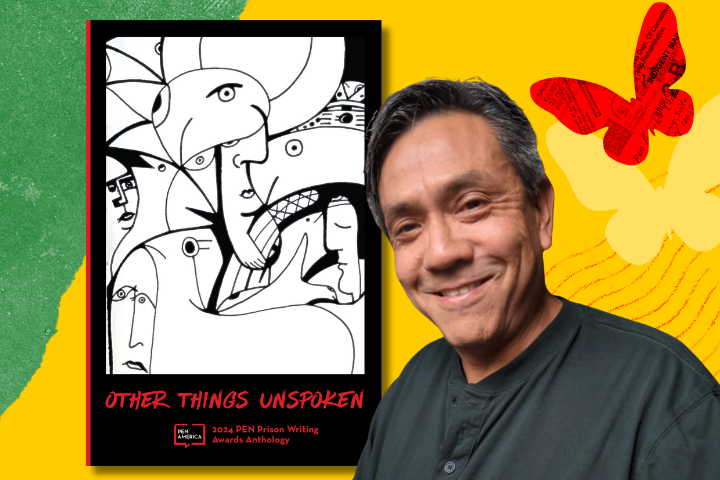
PEN America’s Prison and Justice Writing Program is pleased to announce the publication of Other Things Unspoken: 2024 PEN Prison Writing Awards Anthology. The seventh volume in the series, the book features an introduction by PEN Prison Writing Award winner frank kensaku saragosa.
An Introduction to the 2024 PEN Prison Writing Awards Anthology
I began by writing my dreams.
I can’t describe the journeys that the writers in this volume have taken to be honored by the PEN America Prison Writing Awards and to be included in this anthology. Some of them were professional writers before their involvement in the criminal justice system, and others came to writing after serving many years of their sentence. For some, this is the first time they’ve submitted their work anywhere. Others have won PEN awards in previous years, and still others have had their work published widely. Some will live the rest of their lives in prison, while others, like me, are fortunate enough to be serving comparatively short sentences. But what we all have in common is that we wrote in prison, and we have, somehow, found our way to the PEN America Prison and Justice Writing Program (PJW) and the PEN Prison Writing Awards. I can’t tell you about their journeys, but I can tell you about mine.
At the time I was arrested, I’d been living unhoused in downtown San Diego for something like four years. In a previous life, I was a professor of American literature, and at one point, I’d even begun an MFA in creative writing (which I never completed). But I was in my 50’s when I became homeless, and I’d long since given up any literary aspirations, any hope that I might ever write or be published. I didn’t think anybody anywhere would want to read anything from me.
After a few months in custody, I began to have dreams about the streets, dreams so vivid they woke me up, dreams that felt like memories of events that unfolded in strange, disturbing, and poignant ways. In fact, most of these dreams were memories I didn’t think of as memories, of people and events and places and feelings I didn’t realize I’d stored.
Life on the streets has its own kind of intensity: I was high on crystal meth every day, and often in some kind of delusion or psychosis. I didn’t sleep for days at a stretch. I lived in constant crisis. I was living solely in the present, focusing only on what I needed at that moment and what I had to do to get it. I did not pause for a moment to draw a line from my prior life to my life on the street, to imagine where my life might lead or how it would end. Those first weeks in federal detention were the first real break I’d had from that life in years.
These dreams were so vivid that I started writing them down, memories of friends, memories of people who died, memories of drug use and criminality and love and betrayal that were the stuff of my life on the streets. So, I began writing all of them, a kind of dream journal that was also a log of my unhoused life.
When friends on the outside heard I was writing again, some of them sent me information about places where I might want to submit my work. They didn’t realize that aspects of submitting one’s work like formatting guidelines, submission fees, and online portals, were insurmountable barriers to many of us behind bars. And for me, at least, it was hard to have confidence that my work might be accepted for publication.
One friend sent me information about the PEN Prison Writing Awards, and I became very excited. I thought maybe here I might find readers interested in my work. Still, actually submitting my work to this contest was hard. The only work I had at that point was my dream journal, fragments of dreams and memories I’d scribbled into notebooks, and I had to figure out how to turn that into something II could submit.
In the submission guidelines my friend sent me, I didn’t see a deadline. But I knew I was going to appear in court for sentencing on a specific date, and that I would probably be transferred to a different facility the same day. I made that date my deadline, and I spent the next couple of months revising and writing feverishly.
This was in the first year of the COVID pandemic, we were given limited access to computers in the pretrial detention facility where I was housed. The moment the cell doors were opened in the morning, I jumped on one before anyone else was awake enough to want to use it, and then stalked the computers the rest of the day for any opportunity to get back on. The only way to print a document was to ask the prison librarian to print it for us, and printing was only allowed for legal documents pertaining to our cases. There was no proviso for submitting to a writing contest. I had no choice but to submit a request for my work to be printed and hope for the best, fully expecting to be denied. A couple of days later, the librarian came to my cell and delivered the printed documents– a cover letter and two pieces I wanted to submit, printed, collated and stapled, ready to mail in a manila envelope, and then wished me good luck. I hope maybe she’s reading this, and knows how grateful I am.
Writing for publication was prohibited at that detention facility, so I worried that my work wouldn’t make it past the mailroom. When I submitted my work, when I handed that manila envelope to the correctional officer to mail, I gave him the only printed copy I had of my work. It felt like I was casting my work into the ocean, hoping that someday somewhere someone might read it.
Obviously, my work did make its way into the hands of the PEN Prison and Justice Writing Program, and that the people who read it thought it had some worth. But it is striking to realize how much my success depended on good luck and good will. I remember how precarious this opportunity felt at the time, and it’s sobering to think how easily my efforts could have been frustrated, and how if just a couple of things happened differently, that I wouldn’t have been able to submit my work to this contest. I wonder how many writers didn’t have my luck and couldn’t submit to this contest. I wonder how much work never makes it beyond prison walls.
Virginia Woolf famously argued that a writer needs an annual income of at least 500 pounds (about $ 50,000 today) and a room of one’s own in order to write. I happened to have a single cell during this time, and I didn’t need to worry about paying rent or any bills, so I had a little bit of the privacy and time Woolf imagined was necessary. But there are other material conditions necessary to write, and many of them are not often or easily available in US prisons: access to books and libraries and research materials, the tools we need to type and print our work, places to find community with other creative people, ways to find publishing opportunities, and the ability to be in good communication with others. It feels nearly miraculous that hundreds of incarcerated writers submitted work to this contest, and that, as a result, this anthology exists.
Submitting to the PEN Prison Writing Awards motivated me to write. The contest excited me, and in that burst of effort it took for me to get my work ready to submit, I discovered I loved writing and revising and shaping my work. I continued writing for the rest of my time in prison, and I have this contest to thank for starting me down that road.
The truth is, as much as I hoped my work might win an award, I didn’t think it would. Really, on some level, I submitted my work because I wanted someone to read it. It felt good to imagine that my work might circulate in the world in ways I couldn’t.
I know many prison writers. I met some of them in prison, and others I met after I got released. I know people who filled volumes of notebooks with rap lyrics and poetry and novels and screenplays, I know people who write love poems, or songs about the streets, people who critique the carceral state and people whose minds take them into the realms of fantasy and science fiction. While some of those people who wrote in prison have found some success as published writers, others are still struggling to find the time or the resources to continue writing at all. But all of us who’ve written behind bars know what it’s like to hope for chances to share our work, hoping to find the people who want to read what we’ve written.
Prohibitions against publication are not uncommon in American prisons. Inmates in the custody of the US Bureau of Prisons are informed that we may not communicate with journalists. When I think about how hard it was for me to submit my work, I find it astonishing that some of the authors being honored in this anthology have been published in magazines like The Atlantic or Slate or in a host of literary journals, and that others are editors of publications within their own facilities. I am astonished and delighted to see the growth of a literary community among incarcerated people.
When I was released from federal prison into a federal reentry facility (aka a federal halfway house), I was a homeless drug addict and convicted felon who used to be a college professor but now had no place to live and nothing to show for myself. About a week later, I learned that I was also a winner of the PEN Prison Writing Award in Fiction and in Nonfiction Essay. And for the first time, I felt like a writer with a story to tell. Winning this award practically at the moment when I was reentering society changed the course of my life.
There are demands that are very specific to those of us who are newly released. In my case, that included reporting to my Probation Officer regularly, frequent random drug tests, completing a court-ordered drug treatment program, and finding stable housing and employment. Since I was unhoused for years, I had no family to call on, or savings to use. Dealing with all of this could easily have consumed all my time, and my writing would have taken a back seat. Who knows what would have happened to all the notebooks I had that were filled with all the stuff I’d written in prison.
Because of the publication and promotion of the 2022 PEN Prison Writing Awards anthology, I was featured in the San Diego Union Tribune and interviewed on KPBS, the local NPR affiliate. I was invited to join circles of system-involved and system-impacted artists, and I was approached by people interested in publishing other things I’d done. These awards gave me opportunities I could not have made for myself. And as I began submitting my work and applying for fellowships and residencies, I’m sure they gave people a reason to take a second look at what I’ve done. I’m excited for the writers who are honored here and for the attention and opportunities that will likely follow. But for me, the best thing that happened from winning this award was realizing that there are people who think my work is worth reading. That, more than anything, helped me to focus on creating a writing life after my release.
Today, 26 months since my release from federal custody, here are some of the things that have happened. I was named a 2023 LAMBDA Literary Foundation Emerging Voices Fellow and a 2023 Anaphora Arts Fellow. A friend I met through one of the circles of system-involved artists in San Diego, documentary filmmaker Jason Ritchie, and I co-founded the San Diego Unhoused Collective. Together, we won a 2023-2024 Columbia University Assembling Voices Fellowship to develop an immersive, documentary theatrical project devised from interviews with currently and formerly unhoused people in San Diego.
It’s worth remembering that PEN America was among the first arts-focused institutions to recognize, support, and shine a spotlight on incarcerated writers. And now, in the midst of a small explosion of prison arts programming in writing, visual arts, music, and acting, there are also amazing opportunities for system-involved artists to get fellowships, residencies, and grants when we are released. We all have opportunities to continue the creative work we began in prison.
I don’t dream about homelessness so often anymore. I have other dreams today, new hopes and aspirations that drive my waking hours. I have these dreams because of the efforts of artistic and activist communities invested in giving system-involved writers an opportunity to share our stories and what we create from our experiences.
Of course, I’m talking about you—the people who bothered to buy this book, the people interested in supporting the work of incarcerated writers, the people in the world who want to read and celebrate this work, this collection, and these writers. There are many reasons why this book landed in your hands, but whatever your reason is, maybe you might discover that you are the reader these writers are hoping, by some miracle, to find.