Texas Tech students sounded the death knell for academic freedom on their campus Thursday with a “funeral” to protest censorship during the system’s Board of Regents meeting.
The protest included a slow, solemn “final journey” on the Lubbock campus, as a horse drawn carriage carrying an urn, books, photographs and other markers of academic life led the funeral procession.
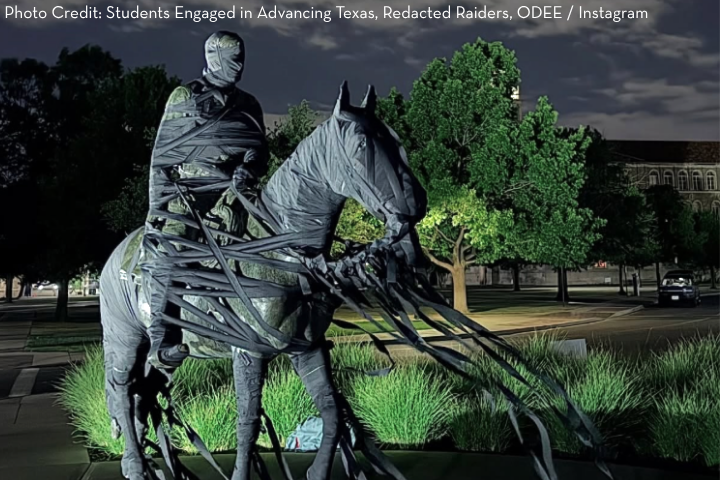
On Wednesday night prior to the protest, Odee Friðriksson, an Icelandic artist and PhD student at Texas Tech, used a statue known as the Texas Tech rider –which is often decorated by students ahead of athletic events – to visualize the mourning. The horse and rider were draped in black. “Censorship is happening at Texas Tech University at an unprecedented scale,” he wrote in a caption to the photo he posted on social media. “Teachers are being restricted in what they can teach, and students starting next fall face restrictions on what they can research and produce,” he wrote.
A second art installation featured a video of David Bowie’s “Life on Mars” projected onto the school’s seal. “Of the hundreds of examples, things reportedly NOT ALLOWED by Texas Tech University include Elsa from Frozen, Romeo and Juliet, Moby-Dick… and David Bowie,” Friðriksson wrote.
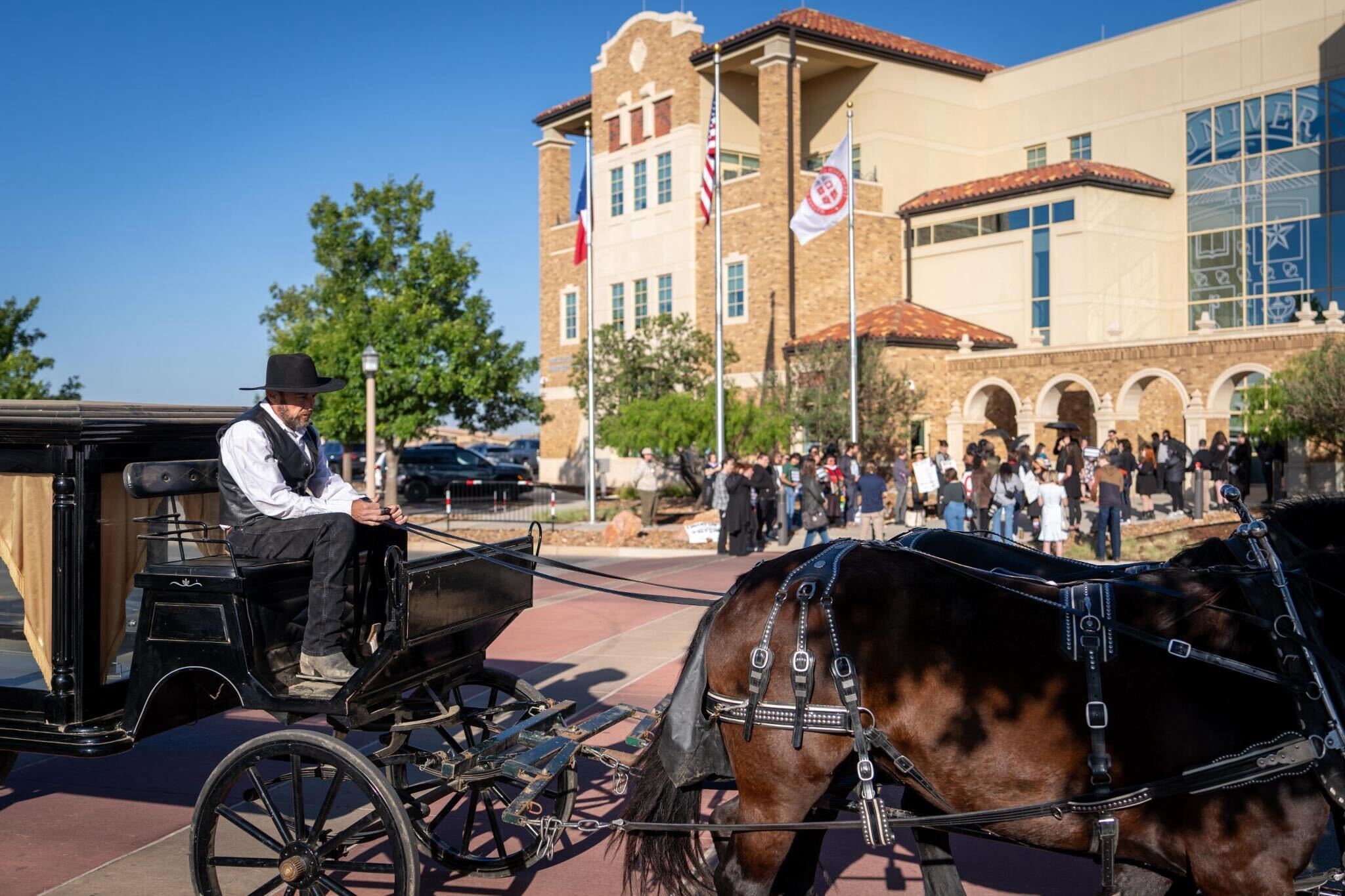
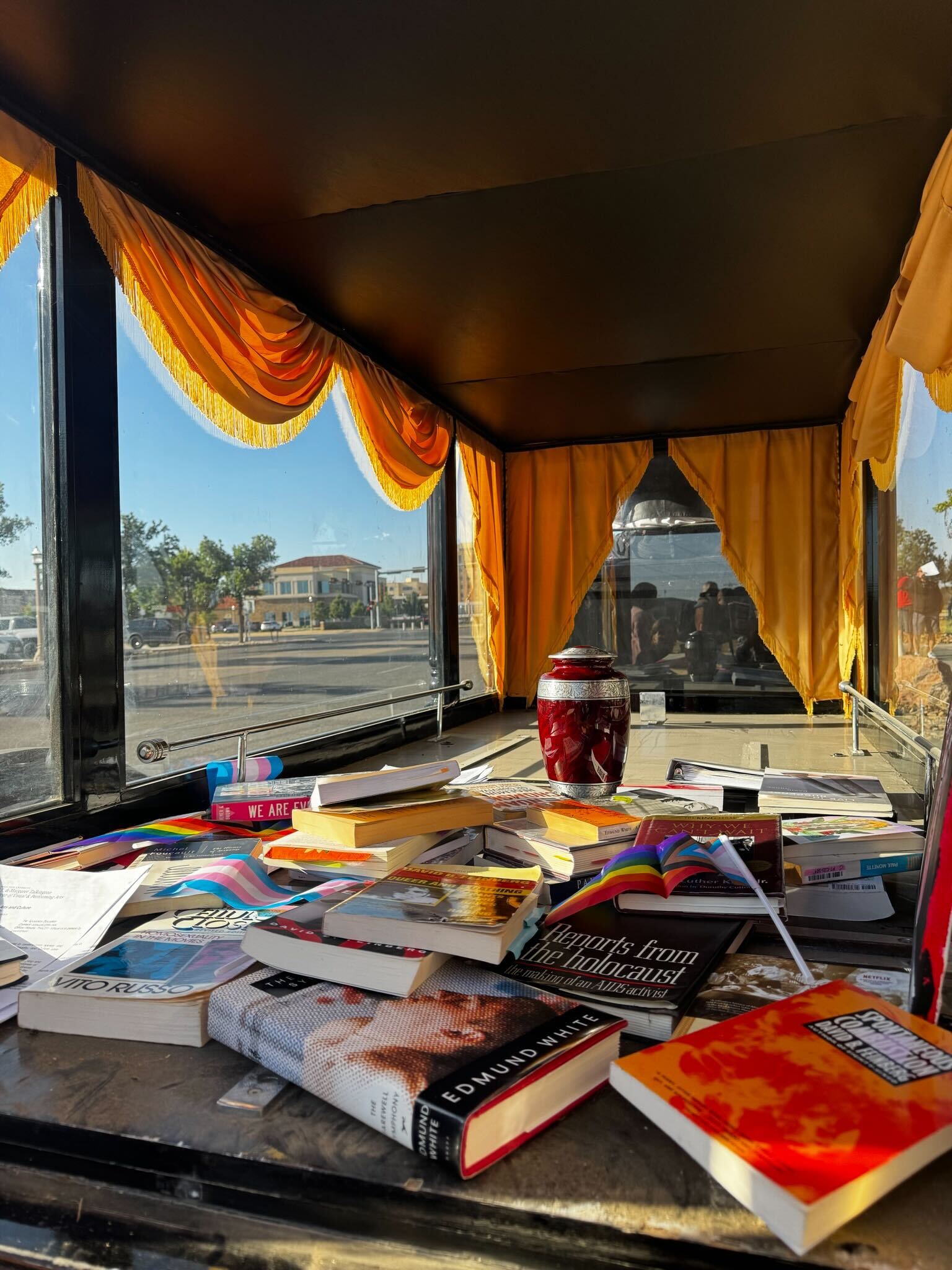
James Snoddy, a pre-law student and founder of co-sponsor Raiders Against Censorship, asked students to bring objects “representing the blessed memory of academic freedom,” to place in the carriage during a morning “wake.” Students, some dressed in black and wearing veils and hats, others wearing graduation gowns and caps, placed books no longer allowed to be used in classes and other objects into the carriage. One touching moment was when a student placed a small rainbow flag inside.
“This is not symbolic exaggeration,” Snoddy said in a statement. “This is a serious response to a year of decisions that threaten the integrity of our universities.”
“We’re like patient zero and this is the worst kind of pandemic. We’re losing our academic freedom and the gain of knowledge at a university,” Snoody said at the wake Thursday morning.
Due to the policies adopted in the past year, “a lot of professors professed that their curriculum and stories cannot be shared in their classes anymore,” Snoddy said in a video posted on Instagram during the march through campus, adding, “It’s such a beautiful and powerful message, because we can no longer share what we want and learn what we want.”
The policies enacted by Texas authorities, saw certain disciplines attacked and course materials at Texas Tech and the state’s six other public university systems combed through for concepts and ideas deemed unacceptable by politicians. At the start of this academic year, officials scrutinized the syllabi and course descriptions of thousands of classes offered at dozens of schools, searching for hints that professors planned to discuss any aspect of race or gender identity.
In the wake of these decisions, courses were canceled, programs eliminated, syllabi altered, readings scrapped, and beloved professors are choosing to leave their institutions, and in some cases, the state.
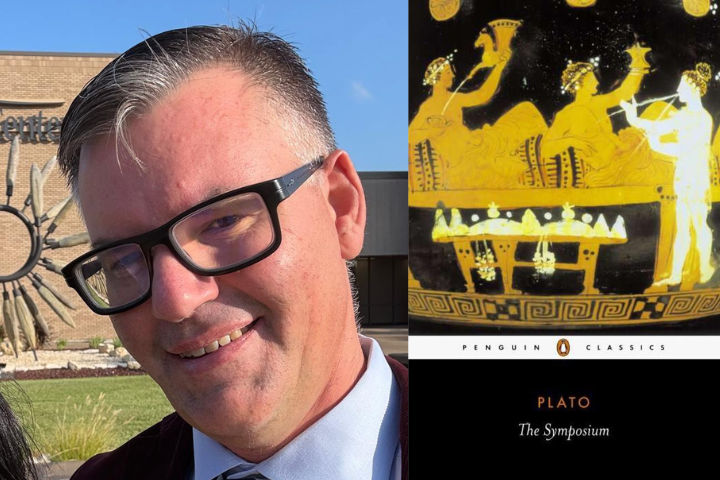
Perhaps most symbolic was the mandated removal of certain works by Plato from an introductory philosophy class at Texas A&M University.
Some of the students marching on Thursday carried signs that said, “RIP reading Plato on love.”
Texas Tech Chancellor-elect Brandon Creighton – a longtime politician appointed by Gov. Greg Abbott despite having no academic experience – recently announced plans to close all gender and sexuality programs across the system and even to ban graduate students from research in the field. While in the Texas Senate, it was Creighton who wrote Senate Bill 37, which mandated the curriculum reviews, stripped faculty senates of authority and more.
Organizers of Thursday’s funeral said the result of these efforts to scour the university for thoughts and topics deemed unacceptable has led to the “death by a thousand cuts” of academic freedom and higher education in Texas. Students bear the weight of these cuts, as their options to learn, discuss, and explore new ideas are reduced.
But it’s not only students who are limited. Honors college student Aaron Texidor addressed the Board of Regents during its meeting with a message about the fear he senses on campus among professors.
“I’ve learned from the greatest professors here, who know me by name,” Texidor said. “And when you get that connection with someone, you start to hear their story. Yet the story that I’ve been hearing, specifically in the Psychology and Education departments, has been a story of fear. These teachers, people who have dedicated their lives to the pursuit of knowledge, are afraid to share it.”
“They’re worried that through Senate Bill 37 their classes, their jobs and their livelihood will be at risk simply for speaking on peer reviewed scientific fact,” Texidor continued.
Cameron Samuels, a student at the University of Texas at Austin and executive director of Students Engaged in Advancing Texas (SEAT), which co-sponsored the event, told PEN America that protest came after “years of policy changes that have replaced curiosity with constraint.”
The crowd that marched through Texas Tech included more than 100 students, community members and alumni. Samuels said the alumni participation was an important element, because one of the arguments against changing curriculum to fit political viewpoints is that weakening academic standards are reducing the value of degrees issued by schools known for censoring academic discussion.
“Initially they were saying this is about degrees, that’s what students care about, high paying jobs,” Samuels said, recounting some of the arguments Texas politicians used to support ever-increasing restrictions on what may be taught at the state’s schools. But by limiting what Texas students can study and discuss the degrees earned at these schools are becoming tarnished.
“Conservatives are saying they want degrees that are meaningful,” Samuels continued. “That’s what they’re saying, but by censoring our universities, that is cheapening our degrees. Employers are going to want universities that have a high academic standard, not ones that limit what we learn. There’s going to be a stain on the reputation of Texas Tech.”
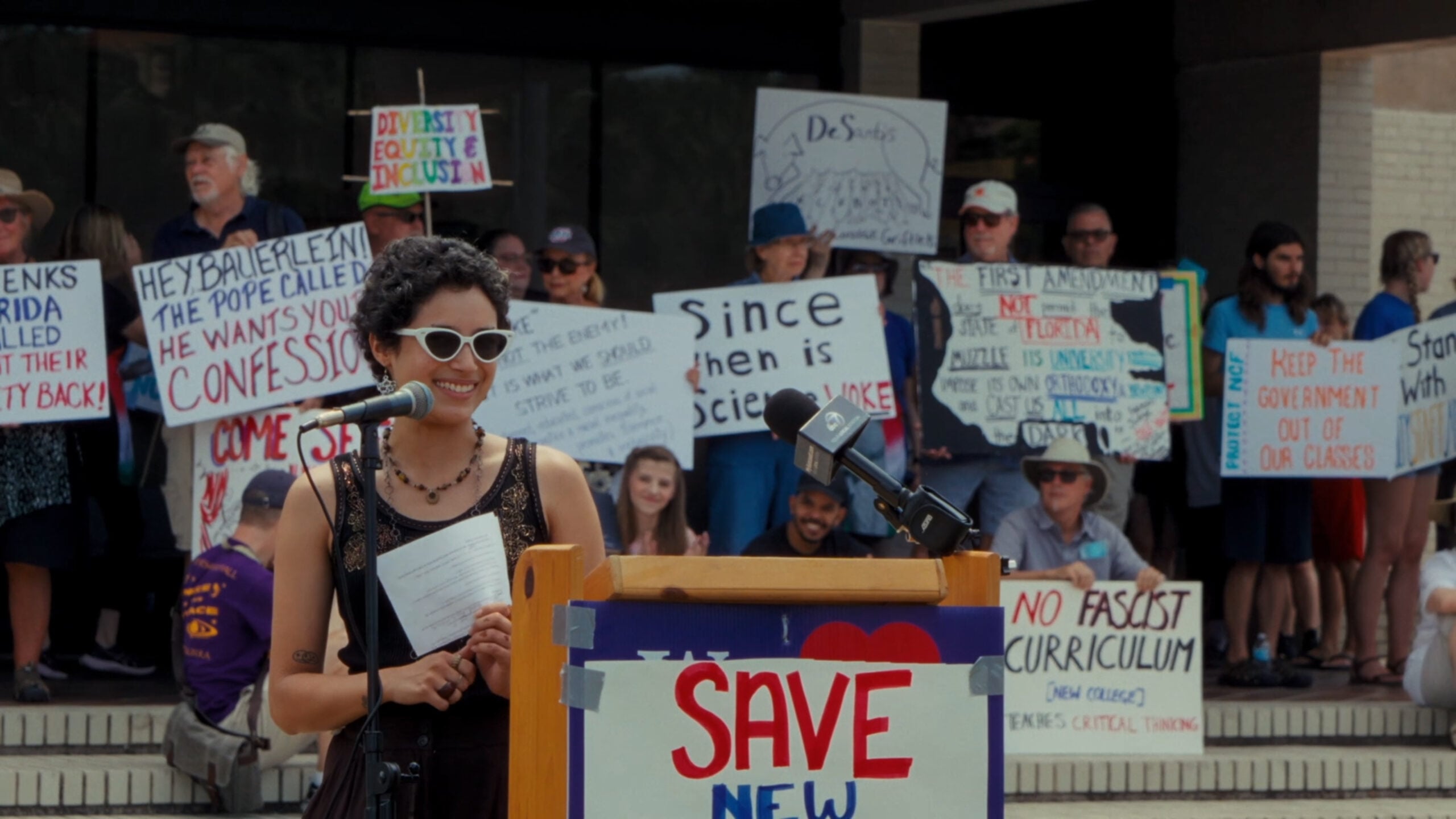
“I think that’s exactly what the majority of people in Texas and around the country are worried about,” Samuels said, noting that one of the signs carried on Thursday read, “First, They Came for My School,” a reference to the poem by German pastor Martin Niemöller condemning complicity during the Nazis’ rise to power.
It’s also a nod to a recent documentary, First They Came for My College, about the conservative takeover of the New College of Florida, where Gov. Ron DeSantis appointed a new board that led to gut wrenching changes at the state-sponsored liberal arts college. The film, which was featured at the South By Southwest festival in Austin, posits that what New College was only the beginning of the effort to regulate higher education to meet conservative ideology.
“What’s happening here in Texas is similar. I think that’s really important that we have this solidarity,” Samuels said. “It’s not raising an alarm, it’s something we know to be true, they’re coming for other universities next and now they’re here for my university.”