Rachel Eliza Griffiths | The PEN Ten
On Rachel Eliza Griffiths’ wedding day, her closest friend, the poet Kamilah Aisha Moon, died suddenly. Almost a year later, as Griffiths worked through her grief, an attack nearly killed her husband, the novelist Salman Rushdie.
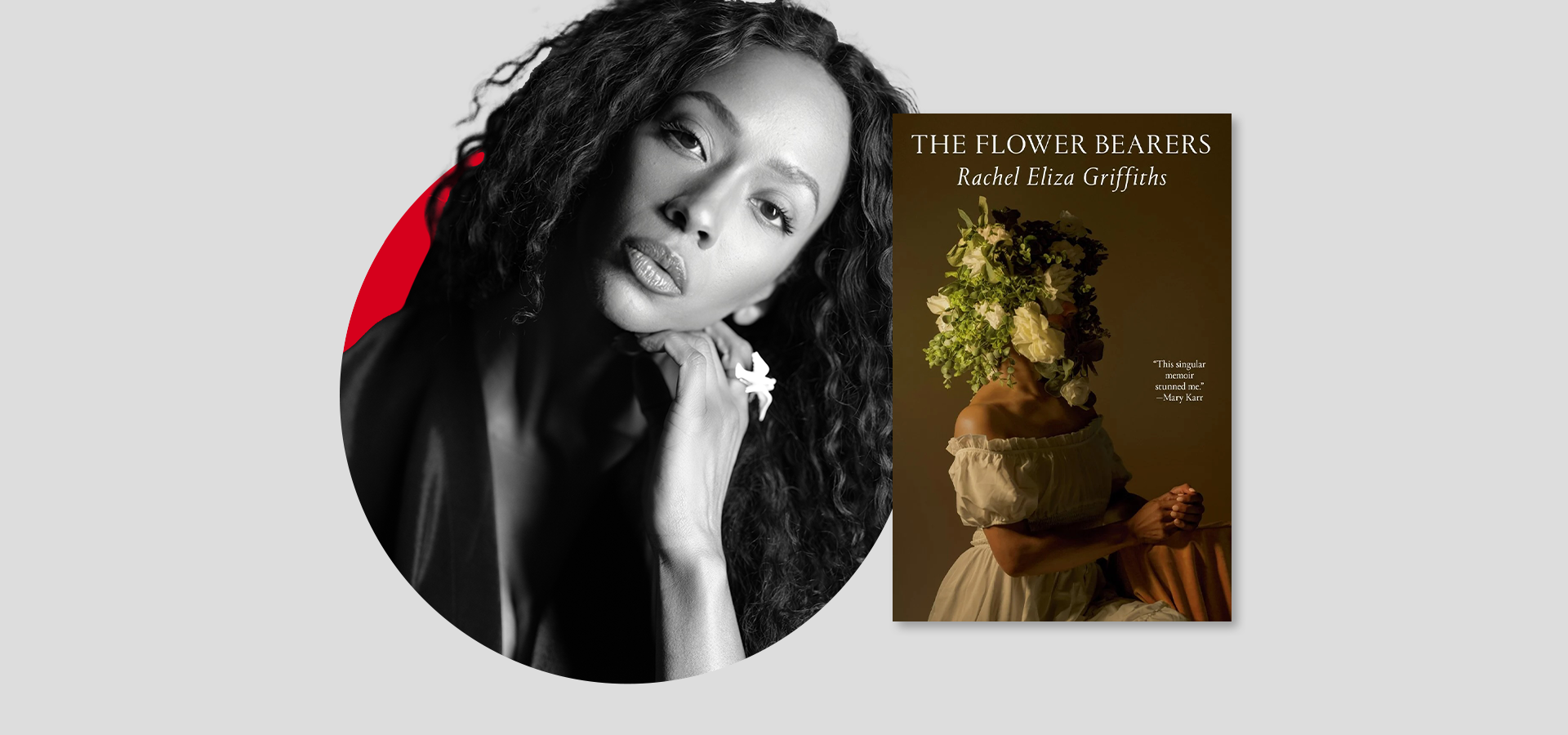
In her memoir The Flower Bearers (Penguin Random House, 2026), Griffiths explores her deep relationships with Moon and Rushdie as well as the process of rebuilding a self in the face of trauma and loss (Bookshop; Barnes & Noble). In conversation with Malcolm Tariq, Director of the Prison and Justice Writing Program, Griffiths discusses her initial unwillingness to write a memoir, the vulnerability required to be any kind of artist, and why she approaches her grief with wonder and curiosity.
How did you begin writing this book? When did you know you would write a memoir or that you were writing one?
I was very unwilling to write The Flower Bearers. I tried to write poetry and fiction but nothing was working. It took me some time to accept that I needed to write a memoir. It was the best medium for me to comprehend what had happened to the narrative(s) of my former life. Memoir was like a voice that listened and replied in ways that terrified me. Because it was unfamiliar, because I’d never written memoir formally, it was exactly the kind of risk that offered me the space and perspective I needed.
This memoir is about yourself as well as two important people in your life. Were there any parts of the book that you initially did not plan to include?
I moved intuitively through different moments and events that I felt would be necessary to fully realize the woman––myself––who continues to witness the relationships of love and trauma that have changed me. When I found myself inside of experiences that disturbed me, I couldn’t omit those moments. I was also aware that I was still “editing” but not in the way I might work as a poet or a novelist. I couldn’t put everything in the book but I also know I’ve held nothing back.
In a previous interview when I asked about turning from poetry to fiction, you replied: “My writing practice is about writing and this means any and everything.” But did you ever imagine you would write a memoir? Did the process of writing The Flower Bearersteach you anything about yourself as an artist or reinforce anything that was already there?
I learned more about myself as an artist and it also reinforced what was already there. The evolution astonished me. Spending time with old journals and writing was both embarrassing and empowering. I held space with younger, messy versions of myself. I apologized to them, placed them inside of contexts, and I praised my inner child for not giving up on me. I also tried not to judge and to self-censure myself with brutal self-criticism, which was a former habit of mine. The trauma I’ve experienced isn’t about learning my lessons so that I could be a strong woman. The loss of my dear friend and the near murder of my husband were both events beyond my control. My early, past struggles actually helped me survive.
Memoir was like a voice that listened and replied in ways that terrified me.
This is a vulnerable book where you discuss some personal details about your life and weave together your friendship with another poet. What does vulnerability mean to you as an artist? Is there any advice you’d offer writers at the beginning stages of their creative practice or publishing career about being vulnerable in their work?
I don’t know what vulnerability means yet. I don’t think I can make a flat statement about vulnerability except to express how intimate it feels to share with another reader.
Growing up, I wasn’t raised to be vulnerable or recognize vulnerability in others. Back in the day, being vulnerable meant being unsafe, weak, sentimental. There was no place or permission for vulnerability.
But I actually don’t believe I was attached to any reductive way of thinking about or defining vulnerability because I knew I was an artist. I felt guilty all the time, as I was secretly vulnerable––whenever I picked up my pen or pencil. Vulnerability created me and its dissonance brought me both shame and joy. If I might advise about anything it would be about tending to one’s intuition and mental health in a world filled with violence.
In presenting these special relationships and pivotal moments in your personal and professional life, you mention a number of people. Some you name and others you don’t. Some relationships you explore over several pages and others in much shorter sections. How did you decide what to include and what not to include?
This is the kind of the book, because of who I am, that names people who were generous as authors, artists, friends, etc. to me at earlier points during my journey. Naming moments when someone was kind to me is a way to express my gratitude, my admiration, to thank them for seeing a future version of myself that I might become when I lacked any imagination of a future. This isn’t the kind of book where I’m licking wounds or binding my story to people who caused me great harm. For me, that’s neither creative nor constructive. The source of this book is bound to love. There is a gorgeous, personal kaleidoscope of generosity and harm working simultaneously in The Flower Bearers. I praise all of it.
Unfortunately, I never met Kamilah Aisha Moon, but I learned about her in graduate school when a friend recommended her book. Reading The Flower Bearers a decade later, I understand why my friend made that suggestion—she wasn’t just sharing a book with me. She was sharing the light of a generous, caring person who was also a phenomenal poet. Your book is testimony of that, and by the end, you name her as a literary ancestor. Was a goal of yours when you started writing this book to place her in a genealogy and lineage of Black women writers?
Kamilah Aisha Moon was already a living ancestor to me while she was here in this world. We never took our sisterhood for granted because it was and remains so special. It was definitely one intention of mine to place Kamilah Aisha in a lineage of Black women writers when I began the memoir because it was part of the journey of our sisterhood and also of the book’s journey too, which came fully into view when I visited the archives of Lucille Clifton, Alice Walker, Toni Cade Bambara, and Audre Lorde.
Kamilah Aisha Moon’s presence is deeply missed and rightly celebrated. Her extraordinary writing and grace remain here. And I want to celebrate that in the same breath that I also cherish dancing with her to our favorite Stevie Wonder songs. She was completely real. One aspect of publishing The Flower Bearers that I love is hearing that people are (re)reading Kamilah Aisha Moon.
This isn’t the kind of book where I’m licking wounds or binding my story to people who caused me great harm. For me, that’s neither creative nor constructive. The source of this book is bound to love.
I was struck by how you write about mental health and your candidness in detailing your own experiences with hospitalization and triggers. In my reading, I could see how you wrote that alongside your connection to the work of Black women writers such as Toni Morrison, Lucille Clifton, and Toni Cade Bambara. Was it challenging for you to write this? What is your litany for survival?
There is more for me to write about this subject, but I knew that I couldn’t write The Flower Bearers and exclude sharing and examining my own mental health. If I didn’t write about these things, then it would mean that I was still ashamed of myself. I’m not.
I hope my honesty about this subject will help someone who is hiding, afraid, or anxious that they will be ostracized and punished because of it. For years, I was paralyzed by my fear.
When I think about Black women writers, there are also examples, visible and unspoken, whose writings and relationships with mental health issues helped show me I wasn’t alone and I wasn’t “crazy.” I remember reading Ntozake Shange’s For Colored Girls Who Have Considered Suicide and later learning that Shange herself tried to commit suicide a number of times. I remember meeting Shange and being so glad she was alive. I’ll never forget the sound of her laughter. It made me want to live in a way that I might laugh like that one day.
As much as this book is about finding life through the people you know, grief is written throughout. I’m also thinking about your collection of poems, Seeing the Body, which was inspired by your mother’s death. Like love, grief constantly changes us. In writing this book, is there anything that grief revealed to you?
I offer my grief wonder and curiosity so that I can keep it close to wherever I locate joy. For me, grief isn’t static or monolithic so I try to appreciate what I can about its evolution. I listen closely. I don’t try to force myself to be happy and positive when I’m upset or angry. I can be in deep grief and laugh with my entire body. I’ve worked hard to gather some mental and somatic tools to judge when I’m able to tend to my grief on my own or need to reach out to professionals for support. There are certain kinds of grief and trauma I carry that will stay with me my entire life. Like love, grief isn’t perfect, but both experiences are essential stories of my humanity.
Reading this book, I felt a sense of gratitude for having the experience of reading so much of your work over the years, from the poetry to your recent prose. How do you feel about your work and your career at this moment?
The notion of a career feels very external right now. During these past years, I was at a point where I wasn’t sure if I could actually create anything again. I couldn’t confront past versions of myself or the new self I was forced to become because of complicated grief and complex trauma. I was fighting to survive; I didn’t have energy to curate a career. I can’t really create anything now that’s interesting to me if I think that way. I’m not being negative about the idea of a career either because it’s very hard to live as a writer. We are all working so hard. As I continue to heal and to accept difficult aspects of my current life, I try to focus on the quality of my life in the present moment. I center the wonder and vulnerability I feel when I make anything at all. I tend to what didn’t die in me.
Like love, grief isn’t perfect, but both experiences are essential stories of my humanity.
You write about meeting a poet from whom you were seeking mentorship and receiving a disappointing response. We have worked together remotely a couple times over the past few years, and I remember how thoughtful you always were in your responses. If you were the prospective mentor in that situation, what advice would you offer a young, Black woman who is trying to navigate the literary landscape and publishing industry today?
Your question immediately made me think of Toni Morrison’s comment: “Just remember that your real job is that if you are free, you need to free somebody else.” There are issues that a young, Black woman faces today that I might not necessarily grasp but there are also all the timeless tools that continue to work: discipline, imagination, risk, pride, grace, rest, community, health (mental and physical), friendships, self-compassion, and reading, reading, reading. And too, as Miss Lucille Clifton often signed her books––“Joy!”