

The PEN Translation Prize is an annual award for book-length prose translations from any language into English. Awarded annually since 1963, the award confers a $3,000 prize to the translator of the winning book.
All winners, finalists, and longlisted books are eligible to receive PEN America’s official emblems. If you are a publisher interested in obtaining a PEN America award emblem for use on a book cover, please write to [email protected].
For more information about PEN America’s Literary Awards, please visit our FAQ.
Submissions for the 2027 Literary Awards are now open! The deadline for submissions is August 1.
2026 Winner
For a book-length translation of prose from any language into English.
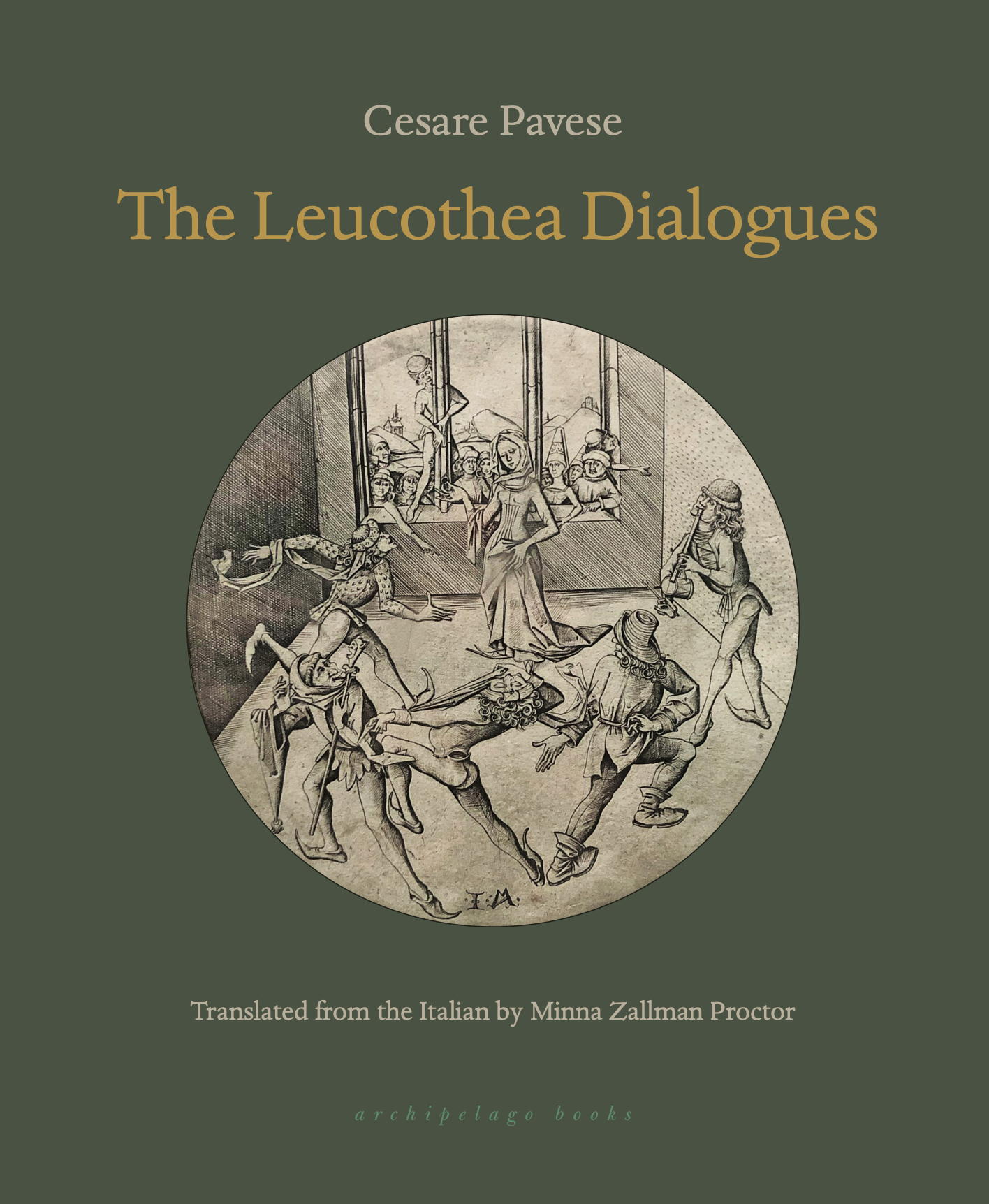
Winner: Minna Zallman Proctor for The Leucothea Dialogues by Cesare Pavese (Archipelago Books), translated from Italian
Judges: Jenny Bhatt, Ronald Meyer, Damion Searls
From the judges’ citation: “Minna Zallman Proctor’s vigorous retranslation from Italian of Cesare Pavese’s singular yet multiplicitous The Leucothea Dialogues stands out from a superb shortlist as a brilliant meditation on, as well as in, translation. Pavese’s moving book neither retells Greek myths nor simply gives a new spin on the old stories: it draws on those myths, as though drawing water from an inexhaustible well, in the service of personal, even private concerns. Made up almost entirely of dialogues between figures from Greek mythology, sometimes quite peripheral figures, the book is neither a novel nor a play nor an externalization of Pavese’s inner voices—neither quite fiction nor quite nonfiction (mythology, history, memoir), but partaking of them all. He uses myth the way writers use the world as a whole: as material to be transformed into a unique vision. Proctor’s translation, from its more approachable title to its consistently fresh and contemporary tone and rhythm, makes the book come alive for readers today. Her introduction is especially remarkable for soaring beyond the usual necessary context about author and book into its own mythological register, letting the voice of Arachne speak for her about Pavese’s relationship to myth, his book, and his future translator. Arachne, describing herself as a translator figure, tells us that Proctor, instead of reusing the literal translation Dialogues with Leucò, “calls the book The Leucothea Dialogues. [Shrugs.] I guess that sort of makes sense…. That said… when you start changing things like that, someone might complain that you’re challenging the real author…. I’ve ‘heard’ that comparing yourself to gods can make them mad.” Arachne certainly has “heard” that—she has lived it, insofar as she’s lived at all; those scare quotes run deep. Meanwhile, Proctor has heard Pavese, too, and stepped up to the challenge of his book, doing something of her own with her Italian original no less than Pavese did with his Greek material.”
Previous Winners
(Formerly known as the PEN/Book-of-the-Month Club Translation Prize, this award was renamed in 2008.)
2025 Brian Robert Moore for Verdigris by Michele Mari (And Other Stories), translated from Italian
2023 Tiffany Tsao for People from Bloomington by Budi Darma (Penguin Classics), translated from Indonesian
2022 Mariana Oliver for Migratory Birds by Julia Sanches (Transit Books), translated from Spanish
2021 Emma Ramadan for A Country for Dying: A Novel by Abdellah Taïa (Seven Stories Press), translated from French
2020 Allison Markin Powell for The Ten Loves of Nishino by Hiromi Kawakami (Europa Editions), translated from Japanese
2019 Martin Aitken for Love by Hanne Ørstavik (Archipelago Books), translated from Norwegian
2018 Len Rix for Katalin Street by Magda Szabo (NYRB Classics), translated from Hungarian
2017 Tess Lewis for Angel of Oblivion by Maja Haderlap (Archipelago Books), translated from German
2016 Katrina Dodson for The Complete Stories by Clarice Lispector (New Directions), translated from Portuguese
2015 Denise Newman for Baboon by Naja Marie Aidt (Two Lines Press), translated from Danish
2014 Joanne Turnbull and Nikolai Formozov for Autobiography of a Corpse by Sigizmund Krzhizhanovsky (New York Review Books), translated from Russian
2013 Donald O. White for The Island of Second Sight by Albert Vigoleis (Overlook Press), translated from German
2012 Bill Johnston for Stone upon Stone by Wieslaw Mysliwski (Archipelago Books), translated from Polish
2011 Ibrahim Muhawi for Journal of an Ordinary Grief by Mahmoud Darwish (Archipelago Books), translated from Arabic
2010 Michael Henry Heim for Wonder by Hugo Claus (Archipelago), translated from Dutch
2009 Natasha Wimmer for 2666 by Roberto Bolaño (FSG), translated from Spanish
2008 Margaret Jull Costa for The Maias by Jose Maria Eca de Queiros (New Directions), translated from Portuguese
2007 Sandra Smith for Suite Française by Irène Némirovsky (Knopf), translated from French
2006 Philip Gabriel for Kafka on the Shore by Haruki Murakami (Knopf), translated from Japanese
2005 Tim Wilkinson for Fatelessness by Imre Kertesz (Vintage), translated from Hungarian
2004 Margaret Sayers Peden for Sepharad by Antonio Muñoz Molina (Mariner), translated from Spanish
2003 R.W. Flint for The Moon and the Bonfires by Cesare Pavese (New York Review of Books), translated from Italian
2002 Richard Pevear and Larissa Volokhonsky for Anna Karenina by Leo Tolstoy (Viking), translated from Russian
2001 Tiina Nunnally for Kristin Lavransdatter III: The Cross by Sigrid Undset (Penguin), translated from Norwegian
2000 Richard Sieburth for Selected Writings by Gerard De Nerval (Penguin), translated from French
1999 Michael Hofmann for The Tale of the 1002nd Night by Joseph Roth (St. Martin’s), translated from German
1998 Peter Constantine for Six Early Stories by Thomas Mann (Sun & Moon), translated from German
1997 Arnold Pomerans for The Letters of Vincent Van Gogh (Viking), translated from Dutch
1996 Stanislaw Baranczak and Clare Cavanagh for View With a Grain of Sand by Wislawa Szymborska (Harcourt), translated from Polish
1995 Burton Watson for Selected Poems of Su Tung–p’o (Copper Canyon), translated from Chinese
1994 Bill Zavatsky and Zack Rogow for Earthlight by André Breton (Sun & Moon), translated from French
1993 Thomas Hoisington for The Adventures of Mr. Nicholas Wisdom by Ignacy Krasicki (Northwestern University Press), translated from Polish
1992 David Rosenberg for The Poet’s Bible (Hyperion), translated from Hebrew
1991 Richard Pevear and Larissa Volokhonsky, The Brothers Karamazov by Fyodor Dostoevsky (North Point Press), translated from Russian
1990 William Weaver for Foucault’s Pendulum by Umberto Eco (Harcourt Brace Jovanovich), translated from Italian
1989 Matthew Ward for The Stranger by Albert Camus (Random House), translated from French
1988 Madeline Levine and Francine Prose, A Scrap of Time by Ida Fink (Pantheon), translated from Polish
1987 John E. Woods for Perfume: The Story of a Murderer by Patrick Suskind (Knopf), translated from German
1986 Barbara Bray for The Lover by Marguerite Duras (Pantheon), translated from French
1985 Helen R. Lane for The War at the End of the World by Mario Vargas Llosa (Farrar, Straus & Giroux), translated from Spanish
1984 William Weaver for The Name of the Rose by Umberto Eco (Harcourt Brace Jovanovich), translated from Italian
1983 Richard Wilbur for Four Comedies: The Misanthrope, Tartuffe, The Learned Ladies, The School for Wives by Molière Jean Baptiste Poquelin De Moliere (Harcourt Brace Jovanovich), translated from French
1982 Hiroaki Sato and Burton Watson for From the Country of Eight Islands: An Anthology of Japanese Poetry (Anchor Press/University of Washington Press), translated from Japanese
1981 John E. Woods for Evening Edged in Gold by Arno Schmidt (Harcourt Brace Jovanovich), translated from German
1980 Charles Simic for Homage to the Lame Wolf by Vasko Popa (Oberlin College/Field Translation Series), translated from Serbian
1979 Charles Wright for The Storm and other poems by Eugenio Montale (Oberlin College/Field Translation Series), translated from Italian
1978 Adrienne Foulke for One Way or Another by Leonardo Sciascia (Harper & Row), translated from Italian
1977 Gregory Rabassa for Autumn of the Patriarch by Gabriel Garcia Marquez (Harper & Row), translated from Spanish
1976 Richard Howard for A Short History of Decay by E. M. Cioran (Viking Press), translated from French
1975 Helen R. Lane for Count Julian by Juan Goytisolo (Viking Press/Richard Seaver Books), translated from Spanish
1974 Hardie St. Martin and Leonard Mades for The Obscene Bird of Night by Jose Donoso (Knopf), translated from Spanish
1973 J. P. McCullough for The Poems of Sextus Propertius by Propertius (University of California Press), translated from Latin
1972 Richard Winston and Clara Winston for Letters of Thomas Mann by Thomas Mann (Knopf), translated from German
1971 Max Hayward for Hope Against Hope by Nadezhda Mandelstam (Atheneum), translated from Russian
1970 Sidney Alexander for The History of Italy by Francesco Guicciardini (Macmillan), translated from Italian
1969 W. S. Merwin for Selected Translations 1948-1968 (Atheneum), translated from various languages
1968 Vladimir Markov and Merrill Sparks for Modern Russian Poetry (Bobbs–Merrill), translated from Russian
1967 Harriet de Onis for Sagarana by J. Guimaraes Rosa (Knopf), translated from Portuguese
1966 Geoffrey Skelton and Adrian Mitchell for MaratSade by Peter Weiss (Atheneum), translated from German
1965 Joseph Barnes for The Story of a Life by Konstantin Paustovsky (Pantheon), translated from Russian
1964 Ralph Manheim for The Tin Drum by Gunter Grass (Pantheon), translated from German
1963 Archibald Colquhoun for The Viceroys by Federico de Roberto (Harcourt Brace), translated from Italian
Eligibility
- Eligible titles must be original book-length literary prose translations published between January 1 and December 31 of the current calendar year by a U.S. trade publisher.
- Eligible books may have up to two translators but are limited to one original author.
- Eligible books must be originally written and published in a language other than English.
- Translators and authors may be of any nationality. U.S. residency or citizenship is not required.
- Only titles of a literary character are eligible.
- Books submitted for this award may not be submitted for any additional PEN America Literary Awards, with the exception of the PEN Open Book Award. Please note that the PEN/Faulkner and PEN/Hemingway Awards are not considered PEN America Literary Awards.
NOT Eligible:
- Poetry, trade, technical, or academic writing and anthologies with more than one original author.
- Reprints or retranslations, unless the work can be said to provide a significant revision of the original translation.
- Books with more than two translators.
- Translations in progress are not accepted; to submit a work in progress, please see the PEN/Heim Translation Fund Grants.
Submission Guidelines
- All submitted books must be published by a trade or academic publisher between January 1 and December 31 of the current year. Self-published books are ineligible for the PEN America Literary Awards.
- Books with more than one original author are ineligible for the PEN America Literary Awards.
- PEN America will only accept submissions from publishers or literary agents. Authors may not submit their own books.
- Please be sure to select the award you are submitting to on the submission form.
- Submitting a book for multiple awards is allowed only in the case of the PEN Open Book Award. Please complete a separate submission for this award if applicable.
- Please submit verified email addresses on the submission form. Your order cannot be processed without an email address. Multiple addresses are essential so that we can get in touch directly if an author or translator is selected as a longlister, finalist, or winner.
- Upload a PDF file of the galley or final manuscript to the book submission form. Book award submissions will be read as PDF files. Please upload the file saved as BOOKTITLE_AUTHORNAME. For the judges’ ease of reading, please upload a book file WITHOUT watermarks. Each book file will remain confidential and is accessible only to the Literary Awards team and the awards judges. Please note that if a book is longlisted, PEN America may request physical copies for the judging panel.
- Upload a high-resolution image of the book cover. This will be used if the book is a longlister, finalist, or winner.
- Each submission is $85. Submission fees are not refundable. Please note that all payments must be made via the submission form.
- Submission fees may be waived for publishers whose annual net sales are less than $2 million. You may request an exemption here; a letter on company letterhead stating that the press’s annual net sales are less than $2 million is required. Do not submit your title before requesting your fee exemption, as the Literary Awards Team will provide you with an alternative submission method.
- Once a submitted book is received and reviewed for eligibility by PEN America, it will be passed along to the judges. Please add [email protected] to your address book, as it will be the main point of contact from PEN America.