Pardeep Toor | The PEN Ten
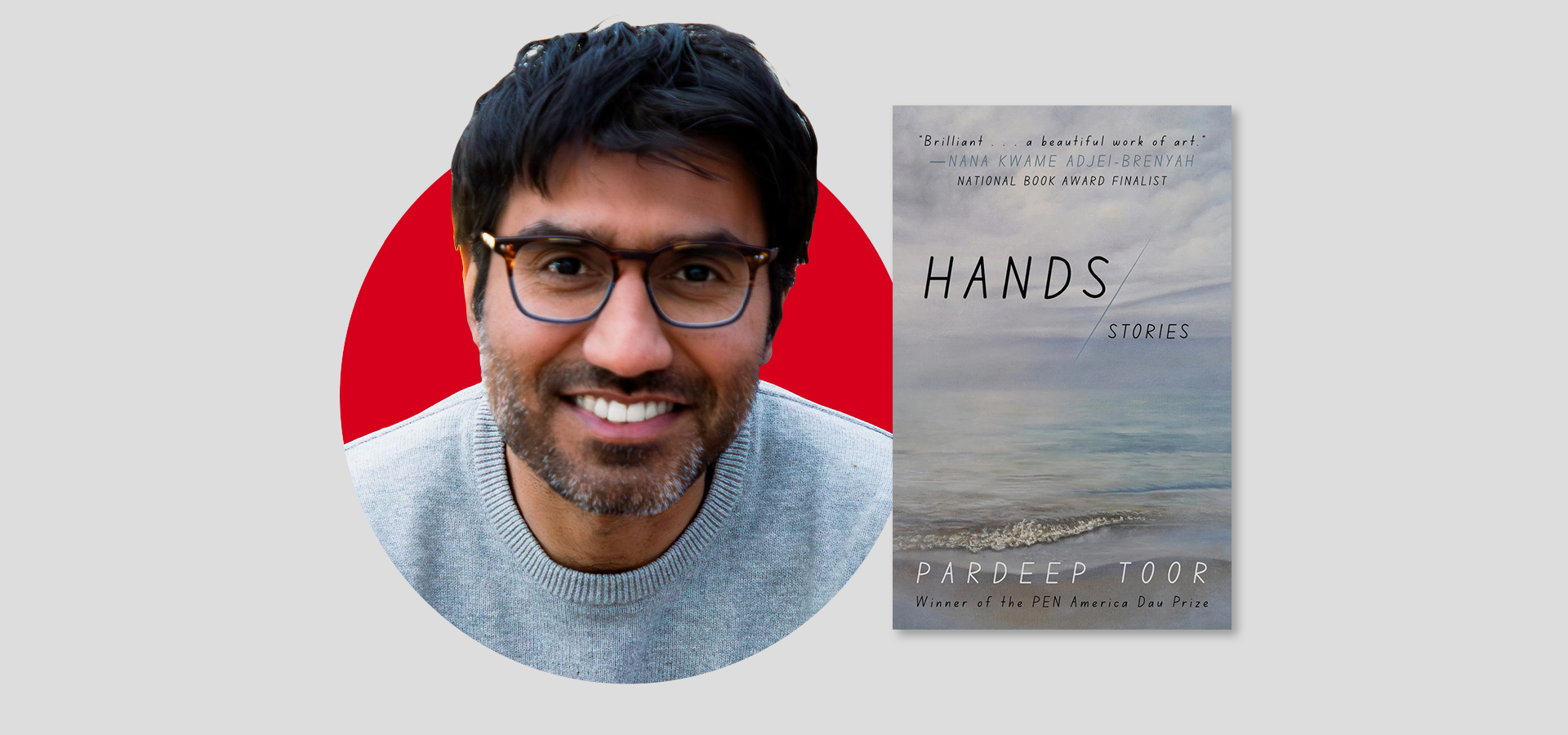
Pardeep Toor’s debut short story collection Hands (Cornerstone Press, 2026) looks unflinchingly at the life and labor of immigrants in the United States today. Following protagonist Hans from high school into adulthood, the stories provide glimpses into his efforts to navigate his relationship to work, love, selfhood, and cultural identity.
In this week’s PEN Ten interview with Literary Awards Consultant Sarah Whitacre, Toor speaks about winning the PEN/Robert J. Dau Short Story Prize for Emerging Writers for the first story he wrote for the collection, creating flawed characters, and the role of literature in the current political landscape (Bookshop; Barnes & Noble).
Congratulations on your debut short story collection! As a former winner of the PEN/Robert J. Dau Short Story Prize for Emerging Writers, how did winning the PEN/Dau prize for “Taxi” in 2021 influence your writing and your approach to this collection?
The PEN/Dau prize was a critical moment in my writing career. My writing style is a little bit different and odd. I can be very literal and short at the sentence level. That’s just how I write. But doubt is a part of writing and I’d often doubt whether my style was resonating or if the stories were having the desired impact on readers. The PEN/Dau prize helped eliminate some of that doubt (it’s impossible to ever be totally free from it!). The prize gave me the conviction to double down on my style and the rugged and seedy stories that I’m trying to tell.
I’m interested in your choice to create an interconnected story collection that centers around one character. What went into your decision to pursue this form rather than, for example, a collection of more disparate stories with unique main characters?
The main character, Hans, is the one who dictated this decision. “Taxi” was the first story I wrote in the collection, and I felt like that story left a lot unsaid about Hans’s immigrant journey. So, from “Taxi,” I wrote stories in both directions, the past and future. Then it was a matter of momentum around Hans. He became more and more alive as the collection grew and it felt wrong to cut him off or pivot to a different character or world. I guess I’d say the decision to interconnect the collection was made collaboratively between Hans and myself. He provided the intrigue and I wrote to his character.
These stories take place in Michigan, fluctuating between urban and rural settings. Why did you choose to center this collection in the Midwest, and how did you use the varying settings to shape the atmosphere of these stories?
I previously lived in mid-Michigan (Lansing and Flint) for many years so I’m intimately familiar with post-industrial midwest towns portrayed in the collection. There’s a deep history in these towns and I wanted that history to be a character in the stories. The environment in the collection is as oppressive as Hans’s circumstances because he doesn’t belong in either the rural or urban setting. Being an immigrant has a social and environmental component and it was important for me to place Hans among difficult people and uncomfortable physical spaces to fully highlight how lost he is at times in this new American world.
The environment in the collection is as oppressive as Hans’s circumstances because he doesn’t belong in either the rural or urban setting.
Hans is a character with rough edges and vices who occasionally mistreats the people around him. These traits might make him a little harder to love at times, but still, the reader feels a connection to his struggle to succeed and survive. How did you go about forming his character and making it so that the reader can still identify with him, despite his flaws?
“A little harder to love at times” is such a polite way to call him an “asshole!” I’m glad you still felt a connection to him and his struggle. Hans is not the hero of his own story. He’s incredibly flawed and is a master of self-sabotage. His poor decisions follow his own ill logic. Yet, I don’t think he’s a bad guy but I also don’t think he’s a good guy. He’s somewhere in the middle like most of us. I didn’t set out to write a protagonist or antagonist. I only wanted Hans to feel real and I hope I’ve gotten close to that goal. I think readers can relate to Hans’s vulnerability and obvious mistakes. It’s easier for readers to see these things in others than themselves. I think any connection that folks feel to Hans is a reflection of the reader’s own sensitivities and flaws.
The first few stories take place during Hans’s adolescence and young adulthood, immediately propelling the reader into stories of teenage masculinity and the volatile feelings of youth. Why did you choose to examine that moment in life?
All characters have an origin story and I wanted Hans to have his own. I started in high school because of the universality of that experience. Everyone knows what it feels like to be an outsider in high school and all the complicated emotions that come with that period in life. Hans deals with issues of masculinity, sexuality, and his brownness during this period because that’s usually when folks first become aware of their bodies in this way. Hans’s experience is slightly different because he’s an immigrant but still mostly universal. I wanted to use high school as a moment for the reader to experience same-ness and affinity with Hans despite all the differences that lie ahead later in the collection.
I noticed that many of the women in these stories play important—though fleeting—roles, whether that is Sarah giving Hans a brief moment of hope at the lake, or Neelam encouraging him to pursue real estate. What made you want to use women as catalysts for change and opportunities for self-reflection in Hans’s life?
That’s a really interesting observation. I hadn’t thought of women as the catalysts for change throughout the collection. The women in Hans’s life are supportive and curious about his pursuits. However, despite their support and affection, Hans is unable to get out of his own way and accept a better path for himself. Despite the good people in his life, Hans is unable to free himself from the bad. The women are strong, demanding, and clear with him but Hans is his own worst enemy.
I don’t think he’s a bad guy but I also don’t think he’s a good guy. He’s somewhere in the middle like most of us. I didn’t set out to write a protagonist or antagonist. I only wanted Hans to feel real and I hope I’ve gotten close to that goal.
These stories span across several years, tackling different eras of Hans’s life. What influenced the structure of this collection? Was it always your intent to order the stories chronologically?
I didn’t write these stories in chronological order. They developed in all directions at different times. But the chronology made sense once I was able to take a step back and look at the collection as a single body of work. Ultimately, it shows Hans’s struggle over time, from youth to middle age. An elder Hans story is missing from this collection but that’s assuming he makes it to old age. Who knows what happens to him after the last page of this collection. Your guess is as good as mine!
Hans is in a seemingly endless—and at times fruitless—pursuit of work. He cycles between driving a taxi, pursuing real estate, and delivering pizzas. There are times he strives for a different path, and times where he is resigned to stay where he is. What did you want to convey with this examination of immigrant labor in America?
It’s never been harder to make it in America as it is now. My parents came to North America without a college education and simultaneously held multiple jobs in factories, pizzerias, and convenience stores to carve out a mediocre living. It’s always been hard but it also feels like it’s getting harder. I don’t think you can tell the story of immigration without talking about the difficulty of labor and the desperate pursuit to first make ends meet and then hopefully build something better for yourself. The jobs that Hans holds mean something because there’s nothing he won’t do to try to make a living. But that’s still not enough. I hope this collection shows that the immigration journey is not linear. Upward mobility is not guaranteed. Sometimes, despite hard work, the journey flatlines and folks are stuck like Hans. The correlation between labor and success has been invalidated in America and it’s not because of the lack of effort from laborers, immigrant or otherwise. What do you do when you’re willing to work anywhere for any pay and it’s still not enough? That’s the question Hans is grappling with in this collection. And I imagine it’s the same question many immigrants in America are asking themselves as well.
A recurring theme concerns the immigrant experience and feeling ostracized or discriminated against in America. What made you want to center on immigration, and what do you hope readers will take away from this collection?
I want this collection to add nuance to the reader’s understanding of the immigrant experience, especially when things don’t work out. This collection shows an immigrant experience gone wrong despite the character’s best intentions and efforts. It’s never been more crucial to tell these stories than it is now, given the political rhetoric and propaganda being spread about immigrants in the United States. This collection isn’t a response to federal narratives but instead attempts to present a fuller, more nuanced story. Literature’s role is to illustrate the totality of an experience, to present all sides through stories. I hope my collection provides a unique perspective of a blue-collar immigrant experience where failure might be more likely than success.
This collection shows an immigrant experience gone wrong despite the character’s best intentions and efforts. It’s never been more crucial to tell these stories than it is now, given the political rhetoric and propaganda being spread about immigrants in the United States.
If you had to pick one story in Hands that best represents the overarching themes and emotional landscape of the collection as a whole, what would it be and why?
This is really hard. It’s like asking me which one of my kids I love the most! I shouldn’t answer this but I will. I think the final story in the collection, “The Astrologer,” is the most complete and ambitious thing I’ve written to date. Sometimes I don’t even recognize the story as my own because I don’t feel I could replicate the nuance and subtext throughout the story. I don’t think I could write that story again, no matter how hard I tried. I’m not sure if readers will feel the same way. But picking one is so arbitrary. And if my kids are reading this interview when they grow up, I want both of them to know that I love them equally!