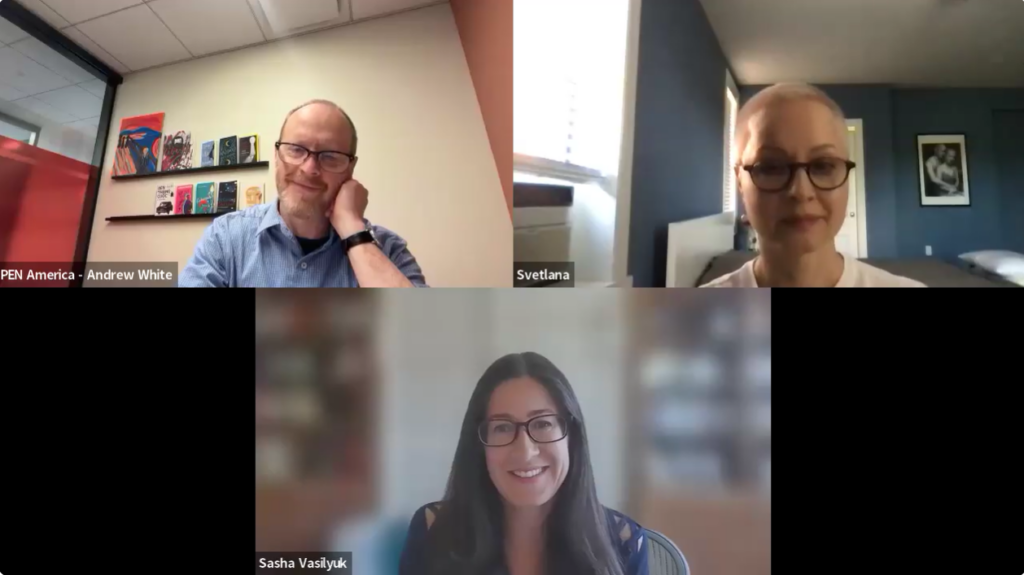
Russian writer Svetlana Satchkova recognizes that there are undeniable similarities between the political climate in her home country and the United States: escalating attacks on public institutions, growing polarization, and the treatment of political opponents as enemies of the state, to name a few. But from her perspective, there are also essential differences that Americans may overlook.
“When people ask me, ‘What should Americans do?’ my answer is simple: Vote. Talk to people, including members of your own family. Go to protests. Speak up. Because these are the rights that Russians have lost,” she said. “It actually pains me sometimes when people who come from democratic countries ask, ‘Why don’t Russians just go out into the streets and overthrow Putin?’ because they just assume that the political reality that they know also exists in Russia, but it doesn’t.”
For a member-exclusive event, PEN America brought together Satchkova and Sasha Vasilyuk, who grew up in Russia and Ukraine before she emigrated to the U.S. Together, they discussed ways their novels depict life under authoritarian regimes and their perspectives on the erosion of democracy in the United States. Satchkova’s most recent novel, The Undead, follows a young filmmaker in present-day Moscow whose low-budget horror movie draws the ire of state censors, while Vasilyuk’s debut, Your Presence Is Mandatory, tells the story of a Jewish Soviet soldier who returns from World War II with a secret he’ll keep for the rest of his life. Andy White, program director of membership, moderated the discussion, titled “Between Rocks and Hard Places: Writing Characters Under Authoritarianism.” Here’s what the two writers shared.
On the Titles of Their Novels
Satchkova said that The Undead can be interpreted in three ways: It references the zombie film that the novel’s protagonist, Maya, creates, but it also describes the leaders who have come to power under Putin’s regime as well as the citizens who slowly become deaf and blind to the crimes committed in their name.
“I remember how shortly before I left Moscow, I actually tried to explain my decision to friends, and what I said was, ‘I can’t stay anymore, because the city has been seized by ghouls,’” Satchkova said. “And then the title came to me almost immediately.”
Vasilyuk said that she came up with the title of her book, Your Presence Is Mandatory, while keeping in mind her intended audience: Americans without firsthand experience of what authoritarianism feels like. The command, she hoped, would “right from the start instill the sense of fear and obligation” in her readers.
On Life Under Authoritarianism
Picking up on a common theme across the two titles, White asked if it was more challenging to be fully present in daily life in an authoritarian state. Both authors agreed it was.
Growing up in the Soviet Union, Satchkova’s parents would tell her, “The harder you laugh now, the harder you cry later.” The phrase likely grew popular during Stalin’s reign, she said, when her family learned to hide signs of prosperity and happiness, which could increase the risk that their neighbors or colleagues would report them for fabricated crimes. Keeping one’s hopes and expectations low also became a way to protect against emotional loss.
“I internalized it to the point where my own happiness made me suspicious, because it always affected some sort of retribution,” Satchkova said. “The idea behind it was to make you live in a dull, lukewarm state that perfectly matched [my parents’] colorless Soviet existence.”
Vasilyuk’s novel begins when a widow discovers a letter that her late husband, Yefim, wrote to the KGB in which he revealed what really happened to him during WWII. The husband’s character is based on Vasilyuk’s grandfather, who, like so many others, never confessed to the trauma they endured, she said. “For me, that question of presence is like, ‘Are you even able to be you when you are hiding essential parts of yourself?’”
On Their Characters’ Political Awakenings
Before Satchkova left Russia, she would talk to others who seemed to live in an impenetrable bubble, convinced that there was no reason to fear or be wary of the government. Eventually, once they or someone they loved were hurt, the bubble would pop — and that’s the journey that Maya undergoes, Satchkova explained.
Vasilyuk said that she loved Russia as a kid but slowly grew disillusioned with it, an arc that’s represented in her novel by Yefim, who takes pride in his Russian identity only as a young man. “I did know how he would end up toward the end. … I knew that this would be somebody who was not going to believe in the beautiful communist project that the Soviet Union is,” she said.
On the Political Climate of the United States
Turning away from their novels, White asked Satchkova and Vasilyuk to touch on the ways that the United States has — and hasn’t — begun to resemble Russia.
“There’s a rulebook that authoritarian leaders read — you know, Authoritarianism 101 rules — and they just go check, check, check, so it does often feel like the current president is borrowing ideas that have been tested and have done well in the Russian market,” Vasilyuk said. Her husband, who is American, believes that the only difference between the two countries is the way they discuss or dress up their policies.
But Vasilyuk thinks he’s wrong: Authoritarianism requires a combination of widespread apathy and fear to thrive, and Americans aren’t apathetic or afraid, in her opinion. “I don’t think the U.S. is there yet,” she said.
“It’s completely different,” Satchkova said. “I’m very optimistic about the future here in the States.”