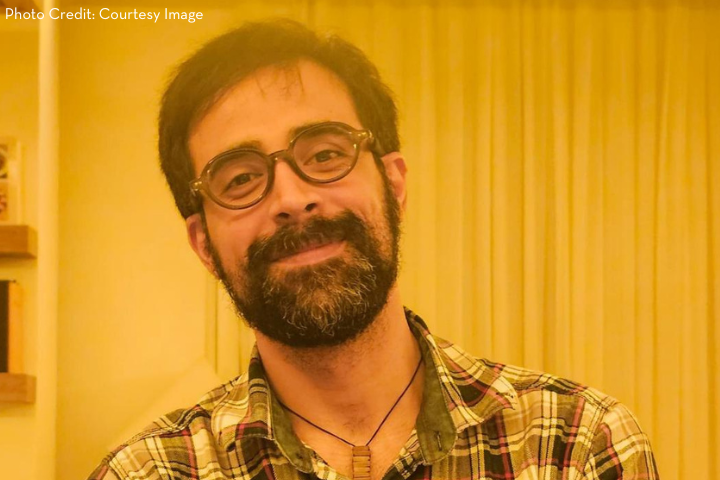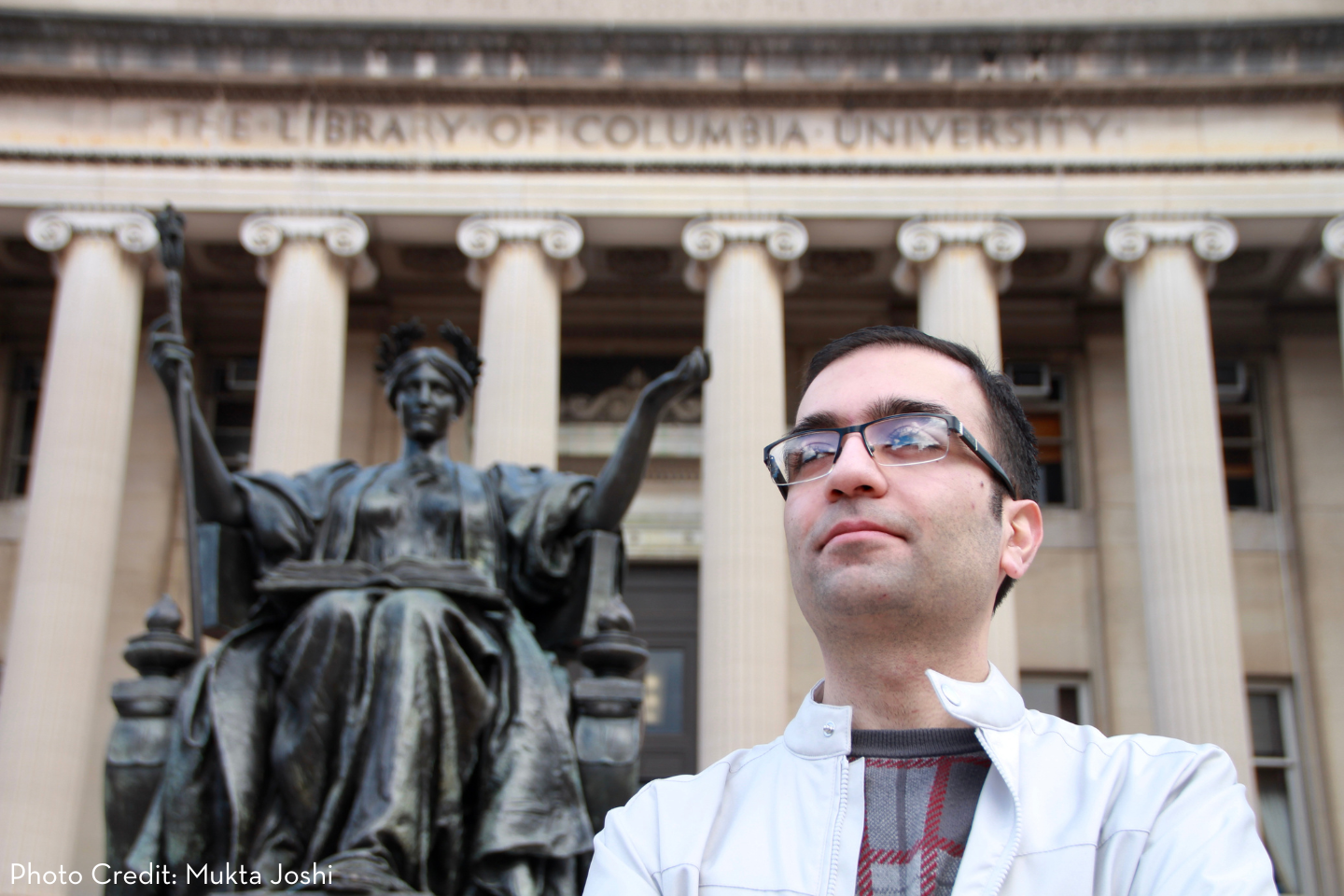
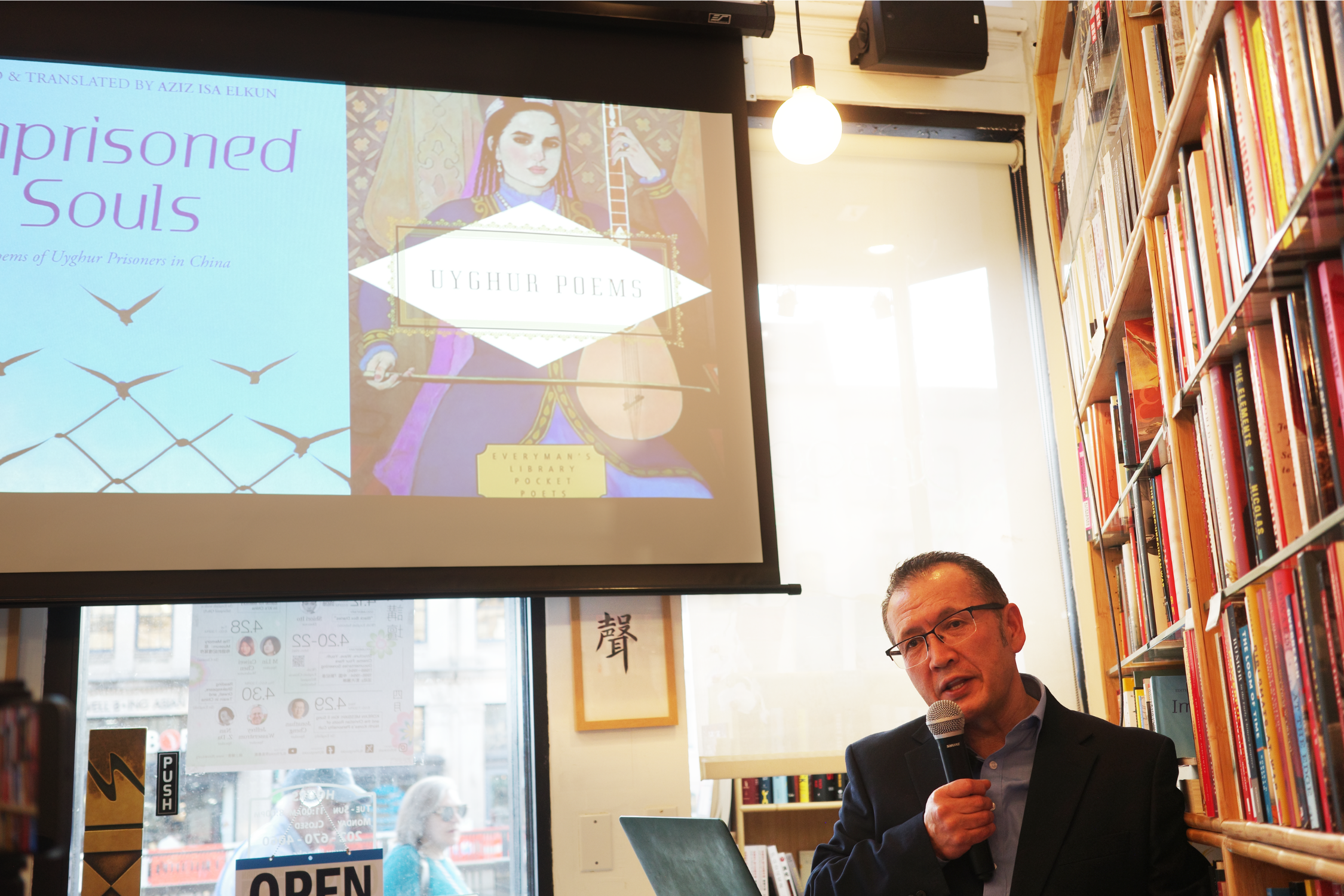
Now that Aziz Isa Elkun’s second poetry anthology, Imprisoned Souls, is out in the world after eight years of work, he’s already planning for what’s next: supporting the next generation of Uyghur poets, many of whom have been forced from their homeland due to repression, and are taking to the written word.
“This is a kind of poetry that expresses a sense of loss, creates loss,” said Elkun, talking about one of the young poets he particularly admires, and how these voices are preserving Uyghur culture.
Elkun was speaking at an event hosted by JF Salon on March 31 in Washington, D.C. Elkun, who is the president of Uyghur PEN Centre and a member of both English PEN and PEN America, discussed his new anthology, his other work, and the role and direction of Uyghur poetry. His first collection, Uyghur Poetry (published 2023), was the first English-language Uyghur poetry anthology and covered classic, modern, and contemporary Uyghur poetry spanning 2,000 years.
While he was working on Uyghur Poetry, the Uyghur poet and scholar began working on Imprisoned Souls. “I felt an urgent responsibility to bring [imprisoned Uyghurs’] voices to the world. Many were punished simply for writing. I knew their work must not be lost in silence,” said Elkun. Among the writers featured include imprisoned Uyghur poets Gulnisa Imin, Perhat Tursun, and Qurban Mamut.
The process to source and translate the poems was painstaking – and emotional. “I began searching in 2017. I collected poems from books, magazines, online sources like Web Archive, piecing together fragmented stories under conditions of severe information suppression,” said Elkun to attendees. He spoke about the limits of translation – including the impossibility of translating some poems – and the intentional, but tough choices, that had to be made. He and his wife, a fellow translator, discussed one poem’s translation for over a month.
“Uyghur poetry [continues to] reflects the social and political struggle of its people, expressing a deep longing for freedom, dignity, and a better future,” said Elkun, emphasising that it had done this for thousands of years.
The place where I was born
Has turned into a heap of ghostly relics
It only exists among the non-existence
Aziz Isa Elkun
From “Roses”, originally published in the Index on Censorship’s winter 2021 edition
Elkun, who has been exiled since 2001, finds power in poetry himself. “I did not write poetry for comfort, I wrote it to express anger at injustice,” Elkun said to PEN America. His poem, “Roses,” which closes the anthology Uyghur Poetry, weaves together the injustices Uyghurs have faced, especially in increasing intensity since 2016, and illustrates why poetry, with its long history in Uyghur culture, is a tool for resistance today.
At the Salon, his speech seemed to reflect the lines of this poignant piece of work.
The first rose I planted three years ago
To mark my father’s destroyed grave
“Not even the dead ones are spared,” said Elkun about the persecution of the Uyghurs. In Spring 2019, while looking at his family’s graveyard on Google Earth, he discovered it had been destroyed in the name of “modernization.” This meant his father, who died in November 2017, remained in his grave for only 623 days – less than two years.
This pretext of “modernization” has been used to refashion the Xinjiang Uyghur Autonomous Region in service of state narratives, destroy heritage, and disconnect Uyghurs from their homeland. Hundreds of Uyghur village names with historic, religious, or cultural significance have been changed to “names reflecting Chinese Communist Party ideology.” Mosques have been destroyed and damaged.
This erasure extends to the digital space. The Uyghur internet has been deleted, and the Uyghurs who built it up have been persecuted. Two apps – one language app called Talkmate and a video platform called Bilibili – removed the ability to learn and comment in Uyghur.
The second rose I planted
On Mother’s Day last year
Following increased intimidation on his parents, and later, increased restrictions on digital communication between those inside and outside of China, Elkun was unable to speak with his mother for seven years. He was only able to confirm she was alive from a random call in April 2024.
His story is not unique. As Uyghur spaces online and offline are remade by the Chinese Communist Party, Chinese authorities have disconnected Uyghur communities and families. Others have lost contact entirely and do not know whether their loved ones are alive.Travel restrictions, including passport confiscation and visa denials, for Uyghurs both inside and outside China prevent families from being together. The risks of digital communication are severe – those in China who try to contact relatives abroad risk detention.
“If I don’t tell you this, we will be in trouble, but if I do tell you, I know you’ll be very sad, but I have to tell you. Please can you stop calling us for a while? Over the last few weeks, whenever you call us, within an hour two or three policemen come to our home. They first ask about the content of our conversation on the phone, then they say I must stop speaking to you. Now they’re saying I shouldn’t answer your phone calls.”
Aziz Isa Elkun’s mom
From “An unanswered telephone call” in PEN/Opp, published by Swedish PEN
In its report on the use of family separation as a form of transnational repression, the Uyghur Human Rights Project laid out the real human costs: long-term grief, isolation, trauma, and self-censorship.
The third rose I planted for the unknown Uyghurs
Who survive inside the camps
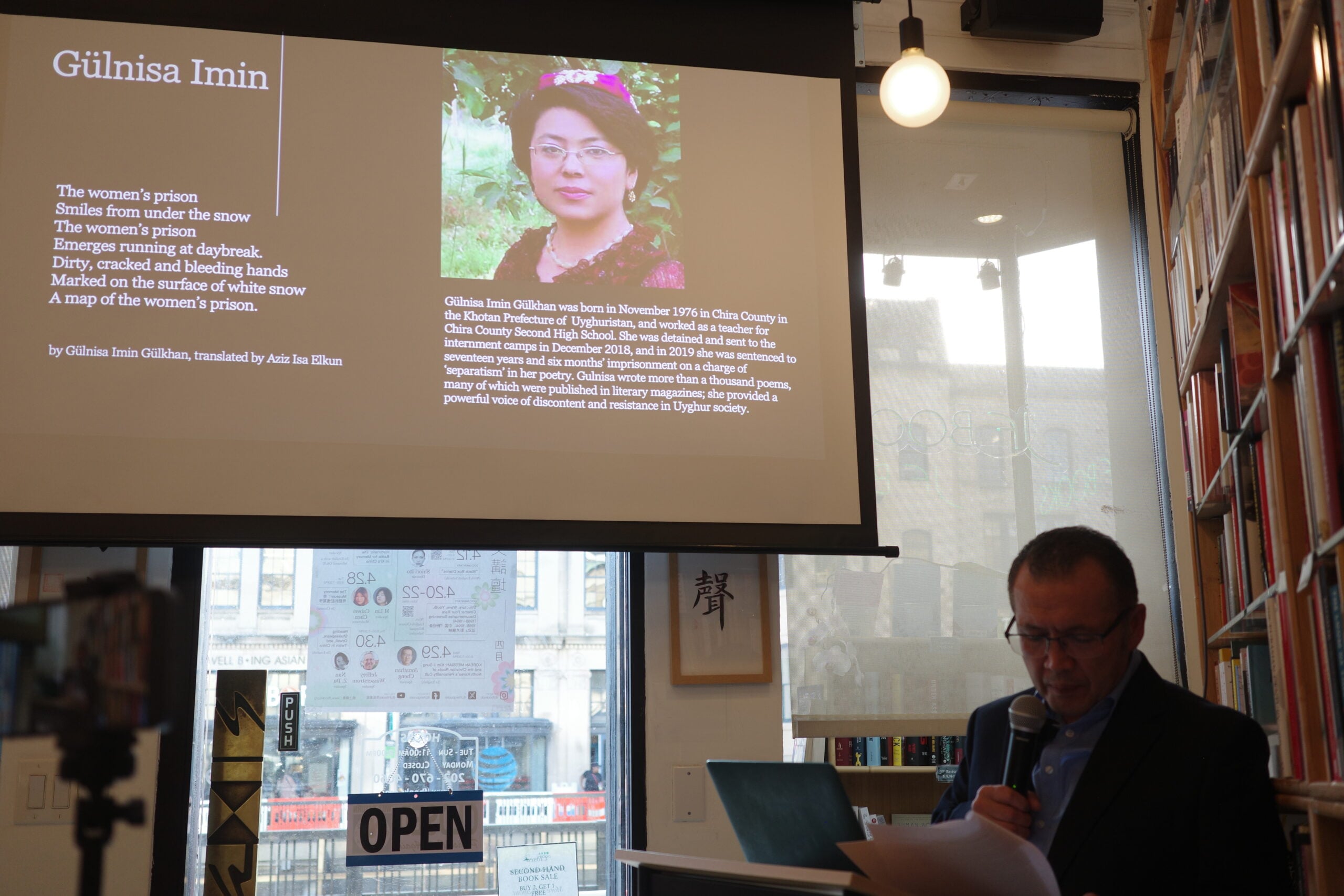
One of the hallmarks of the Chinese government’s repression against Uyghurs is the mass detention of Uyghurs across re-education camps, pretrial detention centers, and prisons. Simple expressions of culture like posting verses from the Quran or teaching the Uyghur language are grounds for internment.
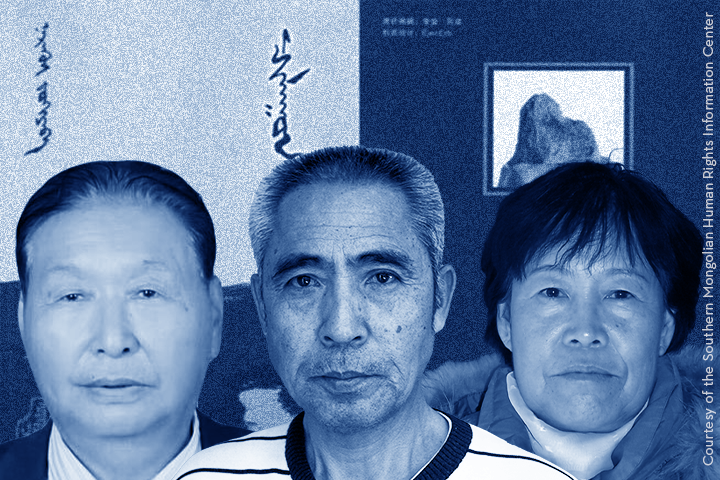
PEN America’s Freedom to Write Index found that, of the 118 writers imprisoned in China in 2024, just under half were ethnic minorities, including over 40 Uyghurs. During the literary salon, Elkun mentioned just a few of the many cases: Gulnisa Imin, Uyghur literature teacher and poet, reportedly sentenced to 17.5 years in prison; Perhat Tursun, Uyghur poet and novelist who wrote The Backstreets, reportedly sentenced to 16 years in prison;and Qurban Mamut, Uyghur poet and journalist, reportedly sentenced to 15 years in prison.
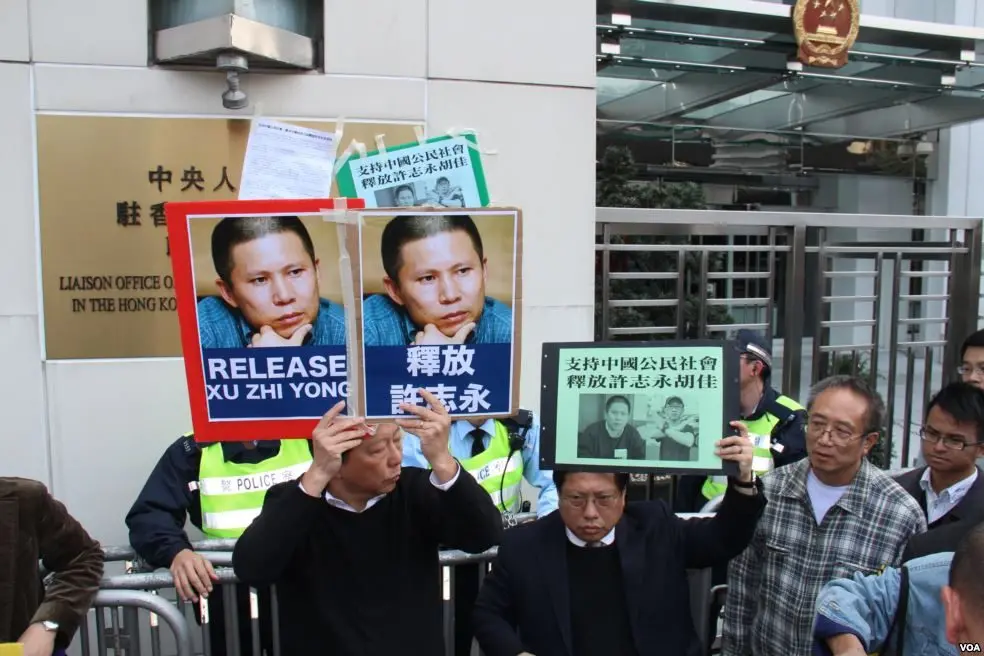
Other imprisoned Uyghur writers include Yalqun Rozi, a Uyghur writer, literary critic, and historical researcher; and Rahile Dawut, a Uyghur scholar whose research focuses on Uyghur folklore and Islamic sacred sites across Xinjiang. Rozi was sentenced to 15 years in prison and Dawut, life. Ilham Tohti, a Uyghur economist, blogger, 2014 PEN/Barbey Freedom to Write Honoree, and member of the Uyghur PEN Center, was detained in 2013, sentenced to life in prison in 2014, and has been held incommunicado since 2017.
The fates of these writers are largely unknown, including to their loved ones.
My roses are blossoming with hope
Singing a song of freedom
All of these strategies by the Chinese government – cultural erasure and destruction, community disconnection, and persecution of writers – are especially sinister in the face of a concerted global campaign to mask deep repression with shallow, state-sanctioned expressions of culture. Chinese AI chatbots deny violations of Uyghur rights when asked about concentration camps, calling them “education and vocational training centers.”
A new law on ethnic minorities, passed in March 2026, cements the government’s longstanding policy of forced cultural assimilation, including marginalizing minority languages and the human right for people to learn and use their mother tongue, under a pretense of “ethnic unity.”
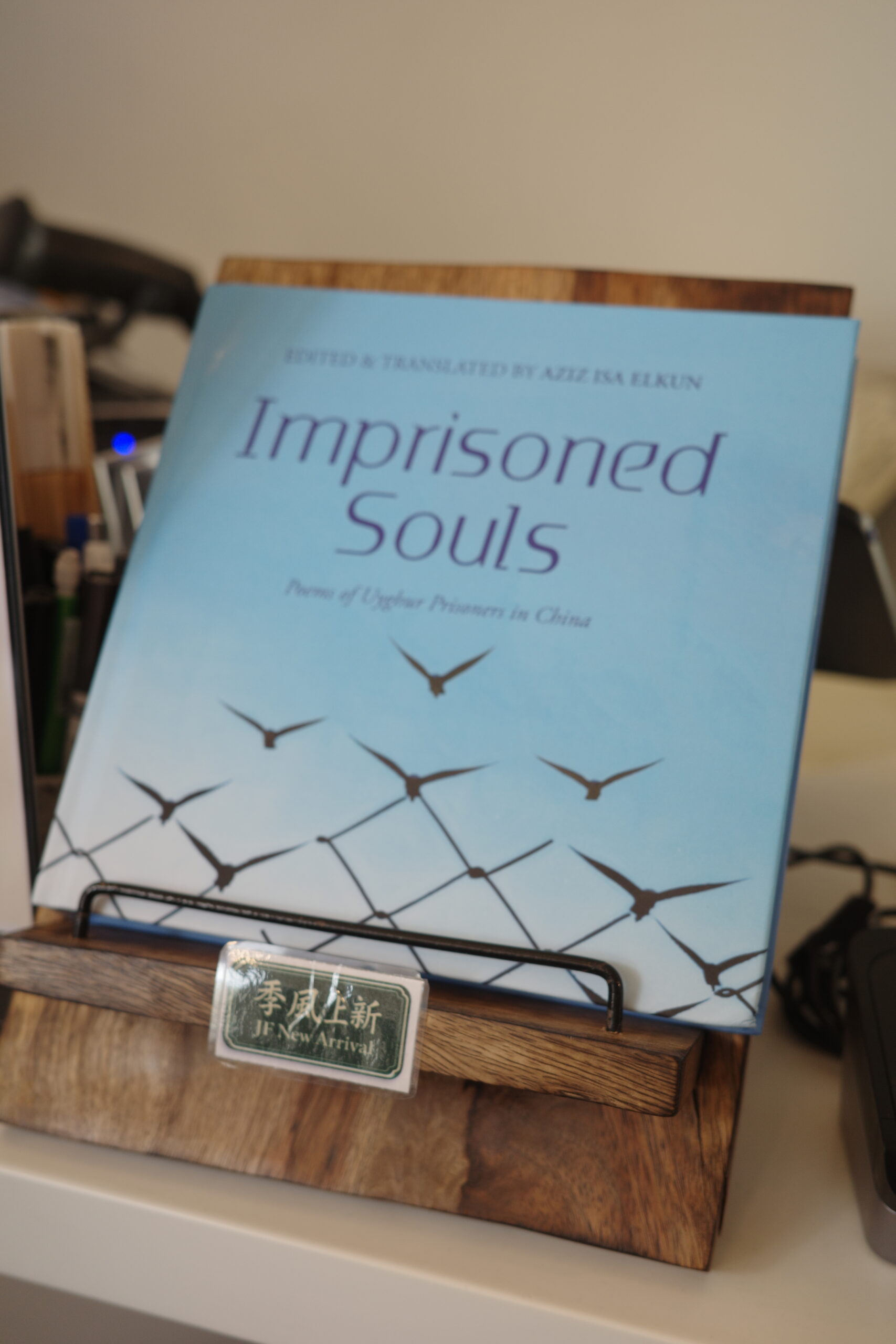
Uyghurs’ own stories and testimony make clear the reality though, and underscore why poetry matters. “Their poetry has played a vital role in preserving Uyghur language and literature, while also giving voice to resistance against oppression. It’s more than an expression of identity, it’s an act of defiance, one that safeguards memory, affirms culture, and carries hope forward for the future generation,” said Elkun.
Speaking to PEN America, Elkun linked the “freedom to write” with “freedom of [the] soul.” And in the face of the Chinese government’s campaign of repression and erasure against Uyghurs, including those exiled and in the diaspora, organizations like the Uyghur PEN Centre are all the more essential.
Their work to support the Uyghur writers community, provide a platform for a new generation, including refugee and young writers, and campaign for imprisoned writers helps maintain a collective sense of identity and ensures that Uyghurs continue to tell stories on their own terms in their own mother tongue.
English-language readers are lucky to have these new collections, but the work is far from over. Elkun pledged to keep “writing until everyone’s free” – and we will continue fighting too.
How You Can Take Action
- Buy, read, and amplify work by Uyghur writers, and request copies for your local library. Some work to begin with includes:
- Uyghur Poetry and Imprisoned Souls, translated by Aziz Isa Elun, which features work by Gulnisa Imin, Perhat Tursun, and Qurban Mamut.
- We Uyghurs Have No Say: An Imprisoned Writer Speaks by Ilham Tohti
- The Backstreets by Perhat Tursun, translated by Darren Byler and Anonymous
- Follow and support Uyghur PEN Centre’s work on their site, X, and Instagram