Readers of Dr. Ibram X. Kendi’s work have rarely been neutral about it. In the wake of the murder of George Floyd and Black Lives Matter protests that followed, sales of Kendi’s How to Be an Antiracist soared; the book reached No. 1 on the New York Times bestseller list and stayed there for 45 weeks. Kendi was lauded for sparking a racial reckoning in the United States, and Time magazine named him one of the most influential people in the world.
But as conservatives began pushing back against the BLM movement, Kendi quickly became one of their primary targets. According to PEN America’s documentation, his books were banned at least 50 times in public schools throughout the country.
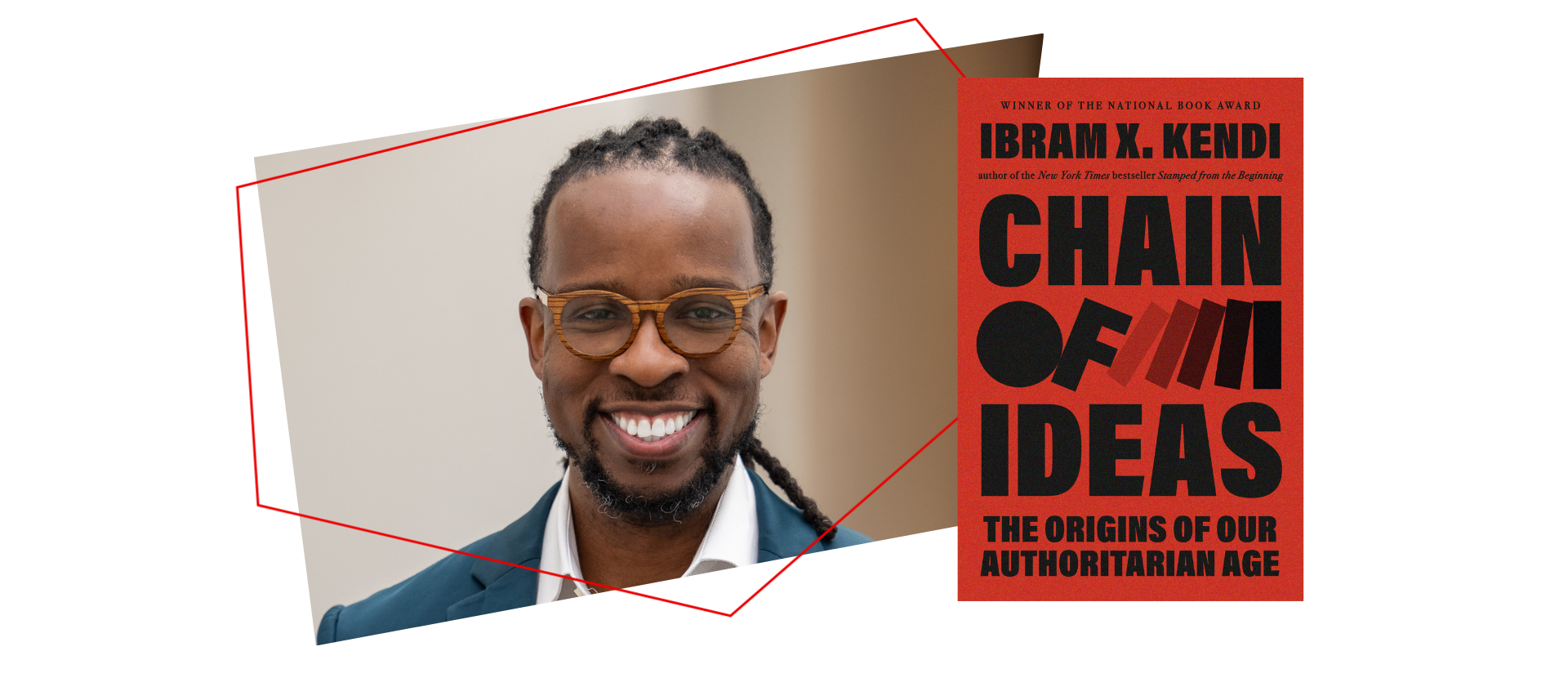
Kendi’s new book, Chain of Ideas: The Origins of Our Authoritarian Age (One World, 2026), examines what he claims is the central ideological driver of modern authoritarian politics worldwide: “great replacement theory.” Kendi argues that authoritarian regimes perpetuate the myth that marginalized groups steal the lives and liberties of privileged groups. Enraged they’re losing out, relatively advantaged people then flock to authoritarians for protection.
Kendi notes that the identities of “replacers” and “replacees” can be divided along any number of lines, such as gender, sexuality, or religion, but in Chain of Ideas, he’s primarily interested in tracking the spread of great replacement theory as a racist phenomenon. In his account, since the early 2000s, it’s grown into the most dominant political theory of our time.
PEN America sat down with Kendi to discuss how writing the book shifted his attitude toward the criticism he’s endured and the erosion of democracy across the globe. “I’m the most pessimistic when I don’t understand the playbook that’s being used against me or that’s being used against humanity,” he said. “And so after writing Chain of Ideas, after writing literally the authoritarian playbook that’s being used, I’ve become much more optimistic, because now we can formulate a counter-response.”
PEN America will host conversations with Kendi online on March 21 and in Florida on March 29.
In the prologue, you write that you didn’t find the subject of this book; it found you. Tell me about how great replacement theorists came after you and your work, and how you realized that their attacks were actually worthy of scholarly analysis.
When I set out to write this book, I actually did not know that Renaud Camus, who wrote the book called The Great Replacement, naming this theory, a theory that actually had been around for quite some time — I didn’t know that he wrote in his book that the major antagonist of the great replacement was antiracism. He wrote that in his book in 2011 and again in a new book called You Will Not Replace Us! in 2018, [the title of] which was actually taken after the chant in Charlottesville, Virginia, in 2017. I didn’t necessarily know that replacement theorists were powering a political movement to ostracize and take down and undermine those of us who were interested in antiracist work. I learned that through researching and writing Chain of Ideas.
Your book is split into 10 chapters, each of which describes one of the interlocking tenants of great replacement theory by examining its manifestation in a new country. How did you decide which countries to include as case studies, and why did you decide to integrate analysis of the United States throughout all of them?
First, I think Americans typically are not aware of how much of the playbook that the Trump administration is using had been written and refined and tested in other countries around the world. I think it can be easy for Americans to think that this all comes out of our own history, and certainly much of it does, but I thought it was important for Americans in particular to see the global sweep of great replacement theory and how that’s impacted American politics. And then I also wanted to provide a nice variety of different demographic settings. I wanted to provide a variety of different types of politicians who have been espousing great replacement theory in different regions of the world.
You’ve drawn the title of your book from a quote by the French Enlightenment thinker Joseph Michel Antonie Servan, who stated that “A fool despot can constrain slaves with iron chains; but a true politician binds them much more strongly by a chain of their own ideas.” What patterns do you see in how those in power have attempted to control our understanding of the United States, especially as it pertains to race?
Well, think about it: If a politician can get a person to believe that their life is under threat at the hands of Muslims, immigrants, or Black people, then that same politician can say, ‘You need a protector. You need a savior.’ And then that politician can present themselves as a protector and savior, and then they can do away with that person’s freedoms and rights in the name of protecting them. And that’s precisely what’s been happening, and that’s how great replacement theory has been used to literally constrain the very people who believe it.
I think it can be easy for Americans to think that this all comes out of our own history, and certainly much of it does, but I thought it was important for Americans in particular to see the global sweep of great replacement theory and how that’s impacted American politics.
As an author whose work has been banned many times over, how do you think book bans contribute to forming that “chain of ideas” in America?
I mentioned Renaud Camus, in one of his books, directly challenges the legitimacy of science, particularly scientific data that proves that the great replacement is not happening. He also specifically challenges higher education for all. And I mentioned those two in the context of book banning because I think book banning is part of a larger project to really prevent people from learning and understanding and being educated about the world that they live in, which can then make them more susceptible to domination.
In your case, it isn’t just book bans; you’ve become a personal target for conservative activists. In its attack on the Smithsonian, the White House even labeled you a “hardcore woke activist.” How has that affected you personally?
I understand, as a historian and as an educator, that if you’re living in a political moment where there are powerful forces who do not want people to know their own history or to understand what happened to them, then one of the ways in which you can ensure that ability to dominate people is to delegitimize and undermine and attack and engage in character assassinations of those historians and educators who are trying to clarify things for people. So I’ve learned to really just not take it personally and understand it’s part of a larger effort to bring in an authoritarian or to maintain an authoritarian age.
And that is a realization you came to by writing this book?
To be perfectly frank, I think I had inklings of it before I wrote this book, but it was certainly through writing Chain of Ideas that I fully understood why these bad faith attacks were coming for me and many others. For me, any book that I write, first and foremost, has to educate me, has to clarify for me what’s happening in society. So certainly Chain of Ideas did that for me personally.
Was writing the book therapeutic for you in that sense?
Writing is always therapeutic for me. I need razor focus in order to write, in order to research. Everything else that’s happening in the world or even in my life is out of focus, and so I’m really able to focus on the writing. As I focus in on the writing, and I come out of that writing space, I also come back into the world, or even into my life with more clarity, which is also therapeutic.
After writing Chain of Ideas, after writing literally the authoritarian playbook that’s being used, I’ve become much more optimistic, because now we can formulate a counter-response. Now we can formulate precisely how we should and can resist.
Your thesis — that what you deem “a renovated Nazism” has emerged as the most dominant political theory today — has some terrifying implications for our future, but you say one source of hope remains: “Only a universal recognition of the unbreakable chain of humanity can liberate us from the breakable chain of ideas.” How do you think we go about achieving that recognition of our shared humanity and disavowing grievance politics?
That was one of the reasons why I wanted people to have an understanding of what great replacement theory is, so that they can protect themselves from internalizing that conspiracy theory. … And once you begin to understand how those links in the chain of ideas are false, like great replacement theory is more broadly, it is going to fall into place that there is actually a chain of humanity, that we’re all connected, that we’re not political enemies, that there’s enough for all of us, and that we could and should build a democracy.
How optimistic are you that any of these global regimes might actually be overtaken by people who realize what they could instead gain from democracy? What might make you more optimistic about that possibility?
I’m the most pessimistic when I don’t understand the playbook that’s being used against me or that’s being used against humanity. And so after writing Chain of Ideas, after writing literally the authoritarian playbook that’s being used, I’ve become much more optimistic, because now we can formulate a counter-response. Now we can formulate precisely how we should and can resist. They have been actively trying to conceal their playbook, specifically their use of great replacement theory, but they’re not going to be able to conceal it anymore with the publication of Chain of Ideas.
Join us for online discussions with Dr. Ibram X. Kendi online on March 21 and in Florida on March 29.