
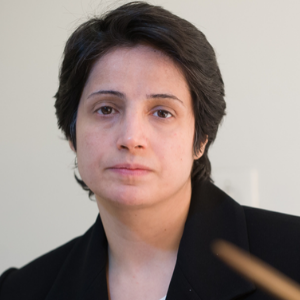
About Nasrin
Nasrin Sotoudeh a prominent human rights lawyer, writer, and activist, was abruptly re-detained on October 29, 2023, after being arrested and brutally beaten by authorities after attending the funeral of slain Iranian teenager Armita Geravand without a hijab. She was reportedly transferred to Qarchak Prison following her arrest. Sotoudeh had been conditionally released from serving a decades-long prison term on a medical furlough since mid-2021, though had been disbarred and therefore banned from continuing her legal work.
PEN America’s Advocacy
October 29 and November 2, 2023: PEN America condemns Sotoudeh’s arrest at the funeral of Armita Geravand and expresses alarm about her health and safety after new details emerge regarding the injuries she sustained during the assault and arrest.
February 14, 2023: PEN America strongly condemns the summons issued by the Iranian authorities to Reza Khandan, Nasrin Sotoudeh’s husband, to report to jail and serve a 2019 prison sentence. In a powerful statement, PEN denounces this effort to intimidate Sotoudeh and called for the immediate review of this decision.
May 27, 2021: PEN America—in collaboration with Robert F. Kennedy Human Rights, Amnesty International USA, and the makers of the documentary film Nasrin—present “#FreeNasrinandLoujain: Virtual Reading of Women Writers at Risk around the World,” featuring writing by Nasrin Sotoudeh and five other women writer-activists. Their works are read by emerging women’s rights activists.
February 23, 2021: PEN America publishes a letter to the Secretary-General of the United Nations on behalf of Nasrin Sotoudeh, who remains imprisoned. In her letter, Sotoudeh protests the unjust executions of religious and ethnic minority members in Iran and asks the United Nations and the international community to take action against this system.
December 21, 2020: PEN America co-hosts a virtual event with Ms. Magazine to mark the theatrical release of the documentary film NASRIN. Introduced by Karin Deutsch Karlekar of PEN America and moderated by New York Times columnist Nicholas Kristof, the event focused on Iranian women’s movements and Nasrin Sotoudeh’s activism, as discussed by panelists human rights advocate Kerry Kennedy, Iranian artist and activist Parastou Forouhar, and NASRIN filmmakers Jeff Kaufman and Marcia Ross. Statements of solidarity from writer Margaret Atwood and Ms. Sotoudeh’s husband Reza Khandan rounded out the program.
December 2, 2020: PEN America releases a joint open letter with the Raoul Wallenberg Centre for Human Rights, the International Bar Association’s Human Rights Institute, and the Center for Human Rights in Iran to Iranian Supreme Leader Ayatollah Khamenei to quash the unjust conviction and sentence against Sotoudeh, as well as the pending sentence against her husband, Reza Khandan.
September 2020: PEN America calls for the release of Nasrin Sotoudeh in a widely-circulated public petition after she began her hunger strike on August 11 to protest Iranian prison conditions amidst the COVID-19 pandemic.
March 11, 2019: PEN releases a statement as she is sentenced to a combined 38 years in prison and 148 lashes. In the statement, PEN calls on the Iranian government to uphold the due process rights of human rights activists, to clarify the exact terms of this horrific verdict, and to immediately and unconditionally exonerate and release Nasrin Sotoudeh.
March 6, 2019: Upon the news alleging that Sotoudeh is sentenced to 34 years in prison and 148 lashes based on unspecified charges, PEN America releases a statement, describing Sotoudeh’s alleged conviction as a “grave miscarriage of justice.”
June 18, 2018: PEN America calls for the immediate and unconditional release of the Iranian human rights lawyer, as she was arrested and detained on June 13 at her home in Tehran, where she was informed she would be serving a five-year sentence after being convicted in absentia.
October 20, 2014: PEN expresses concern over the news that Sotoudeh is once again barred from practicing law for three years, insisting that she be returned her legally granted license to practice law.
April 18, 2014: PEN America revisits Nasrin Sotoudeh’s case as part of its ‘Freedom to Write Retrospective.’ In a blog post, PEN explains the instances in which she was arrested or targeted by the Iranian government, at the same time drawing attention to her human rights work.
March 7, 2014: PEN America expresses support for women at risk who bravely fight for free expression, including Nasrin Sotoudeh, at the eve of International Women’s Day.
September 18, 2013: PEN America welcomes the release of Nasrin Sotoudeh. She had been serving a six-year sentence in Tehran’s notorious Evin Prison on anti-state charges for comments she gave the media in defense of her clients.
January 22, 2013: PEN America calls for the release of Sotoudeh upon her return to Even Prison after a three day furlough. PEN America welcomed her temporary release on January 17, 2013 when she was temporarily released.
October 25, 2012: PEN America joins PEN International expressing concern for the health of the writer, journalist and lawyer Sotoudeh and calls for her immediate and unconditional release.
April 30, 2011: PEN America honors Sotoudeh with the 2011 PEN/Barbara Goldsmith Freedom to Write Award.
Case Background
Nasrin Sotoudeh is well-known for taking on high-profile political cases. She began her activism in 1991 as the only female writer for the nationalist-religious publication Daricheh Goftegoo; one of her first projects was to prepare a series of interviews, reports, and articles on Iranian women to mark International Women’s Day, all of which her editor refused to run. After completing her Master’s Degree in International Law at Shahid Beheshti University, Sotoudeh passed the bar exam in 1995 but was not permitted to practice law for another eight years. She concentrated on journalism instead, writing for several reformist newspapers, including Jame’e.
She has also boldly defended prisoners sentenced to death for crimes committed while they were under 18. Sotoudeh has recently worked as a defense attorney for women charged with violating Iran’s compulsory veiling law. During an outbreak of protests in December 2017 and January 2018, a number of women participating in the Girls of Revolution Street Protest were arrested for removing their headscarves in public to demonstrate against the mandatory dress code. Article 638 of Iran’s penal code mandates that women who appear in public places or roads without wearing the hijab will be sentenced to prison time, corporal punishment, or fines.
In addition to defending women who were arrested for protesting Iran’s compulsory hijab law, Sotoudeh is also known for her criticism of the judiciary’s decision to force detainees facing politically motivated charges to choose their counsel from a list of lawyers approved by the judiciary. She criticized the new amendment, indicating that it ‘not only undermines due process rights, it also undermines lawyers’ independence.’
Sotoudeh was re-arrested in June 2018, shortly after her legal support and advocacy for women who were facing charges for peacefully protesting Iran’s compulsory hijab law, including criticism of Iranian judicial procedures limiting defendants’ access to a lawyer in security-related cases. The charges against her were initially unclear, though later revealed to be for “propaganda against the state and assembly and collusion to act against national security.” In March 2019, Sotoudeh was convicted of several national security-related offenses in absentia, totaling a sentence of 33 years in prison and 148 lashes. Her husband clarified later that in accordance with Iranian law, Sotoudeh will only serve the longest sentence for one of the convictions against her, which is 10 years. Sotoudeh has been granted medical furlough multiple times since she entered prison, most recently in July 2021, and has remained at home since then, as her 46-day hunger strike—which ended on September 24, 2020 due to her severely deteriorating condition–is still impacting her health.
Sotoudeh was briefly arrested in 2024 while at a funeral for slain teenager Armita Geravand. She was severely beaten and was detained for two weeks. Her husband, Reza Khandan, was arrested in December 2023 and began a prison sentence in December 2024.
Sotoudeh is the winner of the 2011 PEN/Barbara Goldsmith Freedom to Write Award and a co-winner of the European Parliament’s 2012 Sakharov Prize, as well as more recently the 2023 Brown Democracy Medal and the Train Foundation’s 2023 Civil Courage Prize. She was also shortlisted for the 2024 Aurora Prize.
Case Updates
May 28, 2025: Sotoudeh reports that her son was summoned to court.
January 29, 2025: Sotoudeh’s son is beaten by prison guards while visiting his father in prison.
December 18. 2024: Sotoudeh’s husband begins a prison sentence of three years and six months from 2019.
December 13, 2024: Sotoudeh’s husband is arrested.
November 15, 2023: Sotoudeh is released on bail.
November 13, 2023: Sotoudeh is transferred to Evin prison. It is revealed that she has not received medical treatment yet and is in poor health.
November 7, 2023: Sotoudeh’s request for bail is rejected.
November 6, 2023: Sotoudeh’s medical furlough has been suspended and she is on hunger strike.
October 31, 2023: Sotoudeh’s husband speaks to her and reveals new details about the violent conditions of her arrest. She was severely beaten at the funeral and was denied the standard legal process as she refused to wear a hijab to the proceedings. She ends her hunger strike.
October 30, 2023: Sotoudeh is reportedly refusing food and medication.
October 29, 2023: Sotoudeh is arrested after attending the funeral of Armita Geravand without a hijab. She was taken to the police station Tehran’s Abdul Azim neighborhood and then transferred to Gharchak Prison.
March 15, 2023: It is announced that Sotoudeh will receive the Brown Democracy Medal from the McCourtney Institute for Democracy.
February 21, 2023: The International Bar Association makes a statement condemning Reza Khandan’s summoning.
February 14, 2023: Sotoudeh’s husband, Reza Khandan, is summoned to prison after Sotoudeh gives an interview to CNN.
October 6, 2022: Sotoudeh’s daughter is prevented from leaving Iran at the airport.
November 3, 2021: Radio Farda releases exclusive documents on prisoner mistreatment in Evin Prison which confirm earlier reports that authorities had attempted to prevent Sotoudeh from meeting her family by setting conditions such as wearing a chador, the full-length covering that leaves only the hands, face, and feet exposed.
October 17, 2021: An Iranian lawyer tweets a detailed account of human rights abuses against Soutoudeh’s lawyer, Payam Derafshan.
September 15, 2021: Sotoudeh is named one of Time Magazine’s Top 100 Influential People of 2021
August 10, 2021: A group of Democratic senators introduced a resolution Tuesday condemning four Middle Eastern states for the unjust imprisonment of women. Sotoudeh was among the following women the lawmakers demanded to be released.
July 22, 2021: Sotoudeh is released from prison for a five-day medical leave.
June 21, 2021: UN human rights experts condemn the ongoing imprisonment of Sotoudeh and demand her immediate release.
March 17, 2021: Nasrin was released from prison on a two-week leave to celebrate the Iranian New Year (Nowruz). Unfortunately we have learned that at the end of the permit she had to return to prison again. Iran’s most outspoken political prisoners are being moved to new jails far from their families as part of a campaign of harassment against the regime’s most-effective critics, a human rights group has said.
February 23, 2021: PEN America releases a letter on behalf of Nasrin from Qarchak prison protesting the practice of unjust execution of individuals from minority communities
February 5, 2021: Human rights lawyer Brian Stevenson of the EJI voices his support for the release of Nasrin Sotoudeh in a video for NASRIN film and Ms. Magazine.
January 20, 2021: Nasrin returns to Qarchak prison after undergoing an angiography. Her family’s bank accounts are simultaneously frozen.
January 8, 2021: Iran approves 3-day release for jailed lawyer Nasrin Sotoudeh
December 2, 2020: Sotoudeh sent back to jail despite the doctor’s recommendation that she needed to visit a health clinic and continue her recovery this week.
November 7, 2020: Sotoudeh temporarily released on furlough.
October 26, 2020: Sotoudeh’s daughter defends herself in court against retaliatory charges that she assaulted an officer.
October 20, 2020: Judiciary officials in Iran transfer Nasrin Sotoudeh to Qarchak prison, described as “Iran’s most dangerous for women,” instead of the hospital, where officers at Evin prison claimed they were taking her. Nasrin Sotoudeh’s husband discloses in a tweet that specialists had recommended she undergo a heart examination and angiography.
October 1, 2020: The Right to Livelihood Foundation honors Nasrin Sotoudeh with the Right to Livelihood Award. Sotoudeh is honored “for her fearless activism, at great personal risk, to promote political freedoms and human rights in Iran.”
September 25, 2020: Sotoudeh ends her hunger strike due to her severely deteriorating health. Sotoudeh went 46 days without food, 5 of which she spent in the cardiac care unit of Taleghani hospital, to protest the continued detention of political prisoners in Iran during the COVID-19 pandemic. Sotoudeh’s husband, Reza Khandan, relays her announcement via Twitter the following day.
September 23, 2020: Authorities return Sotoudeh to Evin prison without further medical care, after several days in the cardiac care unit in Taleghani hospital. Interviewed by AFP, husband Reza Khandan expresses concern for her lack of medical care in prison, saying, “Because of her heart problems, I expected them to at least refer her to the prison clinic, especially after 44 days on hunger strike.”
September 2020: Worldwide campaign around Nasrin’s hunger strike pushes forward conversation about Iranian political prisoners and the need to release them. Jailed Iran human rights lawyer hospitalised after hunger strike.
August 20, 2020: Sotoudeh is taken to Evin Prison clinic in critical condition related to her hunger strike. She is now also protesting her daughter’s arrest.
August 17, 2020: State security forces arrest Sotoudeh’s 20-year-old daughter and take her to Evin Security Court on charges that she had assaulted a female officer during prior visitation at Evin Prison. Sotoudeh’s husband, Reza Khandan, believes the arrest is another intimidation tactic in a series used against Sotoudeh’s family in retaliation for her public advocacy. Sotoudeh’s daughter is subsequently released on bail.
August 11, 2020: Nasrin begins a hunger strike in protest of the unjust living conditions in Tehran’s Evin Prison, where COVID-19 has spread, in continued detention of prisoners eligible for release. In a letter written by Sotoudeh, she calls for rightful legal recourse to appeal imprisonments and the release of political prisoners.
July 27, 2020: Iran’s judiciary has blocked the bank account of Nasrin Sotoudeh, according to her husband. The bank account has been blocked since May 2020.