
Speakers and Events on Campus
Campuses must foster a culture where speech and other expressive activities including protest, dialogue, and debate are seen as the best tools for confronting hateful ideas and disinformation.
Guiding Principle
Campuses, both public and private, should keep their forums—classrooms, events, publications, and other platforms—accessible to a wide variety of academic and popular opinions. At the same time, they must foster a culture where speech and other expressive activities including protest, dialogue, and debate, rather than silencing in its many forms, are seen as the best tools for confronting hateful ideas and disinformation.
In 2024, a record 174 campus speakers and events faced disruption or cancellation attempts, up from 154 in 2023, 81 in 2022, and 56 in 2021.
“Campus Deplatforming Database,” Foundation for Individual Rights and Expression (FIRE), accessed November 2025
Overview
Creating a healthy learning environment where knowledge and ideas are shared includes engaging with a wide array of opinions and beliefs, through invited speakers and campus-wide events.
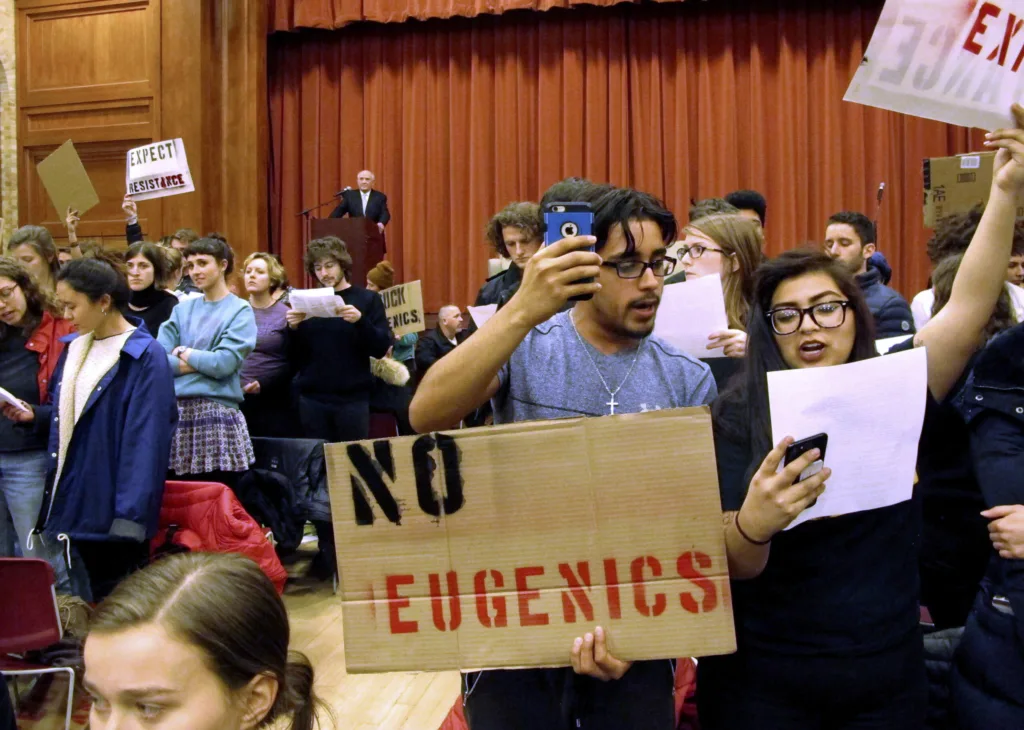
Most campuses are decentralized, with student groups, academic departments, classroom teachers, and others free to invite whom they wish to campus without having to obtain prior administrative approval. This approach helps generate exposure to the widest breadth of ideas and aligns with the principles of academic freedom. When a speaking invitation sparks protests, those who object should have an opportunity to make themselves heard. However, in exercising their own voices, protesters should not be permitted to shut down, shout down, or obstruct speech, or prevent others from seeing or hearing the speaker.
What does the law say about speakers and events on private and public campuses and universities?
Only 8% of college students say they would try to stop or disrupt a campus speaker with opposing views, while 92% would either take no action, attend, boycott, or take other non-disruptive action.
“College Student Views on Free Expression and Campus Speech 2024,” Knight Foundation and Ipsos, July 2024
Our Approach
- Once extended to a speaker, an invitation should not be rescinded, except in the rarest of circumstances.
- Except in the most extreme cases, concerns over threats of violence or the potential outbreak of violence should not be grounds for withdrawing an invitation or canceling a controversial speech or event.
- The likelihood that a campus event will be met with protests should not be considered a reason to suspend it.
- Security costs should not be grounds for withdrawing a speaking invitation. Such costs are unavoidably linked to the anticipated reaction to the content of speech and are thus viewpoint specific.
- When a speaker is invited to campus whose speech or views are contradictory to certain values of the institution, university leaders may choose to make this clear, while also restating that the institution’s commitment to free expression and open discourse means such speech must still be permitted to proceed.
Title of recent blog post about this topic that we want to highlight
Lorem ipsum dolor sit amet, consectetur adipiscing elit, sed do eiusmod tempor incididunt ut labore et dolore magna aliqua. Ut enim ad minim veniam, quis nostrud exercitation ullamco laboris nisi ut aliquip ex ea commodo consequat.
The Campus Free Speech Guide Blog
To read case studies about free speech on campus and learn more about PEN America’s approach to these issues, check out the Campus Free Speech Guide blog.
Acknowledgements
PEN America is grateful to the thousands of students, faculty, and administrators who have engaged with us over many years, and especially to those who offered detailed and substantive feedback on earlier versions of this site.
The Campus Free Speech Guide was made possible by the generous support of our funders.
Disclaimer: Nothing on this website constitutes, nor should be construed, as legal advice on any matter. All content on the website is for informational purposes only. PEN America is not liable for any errors or omissions in the information and is not liable for any injuries or damages related to the display of the information on this website.