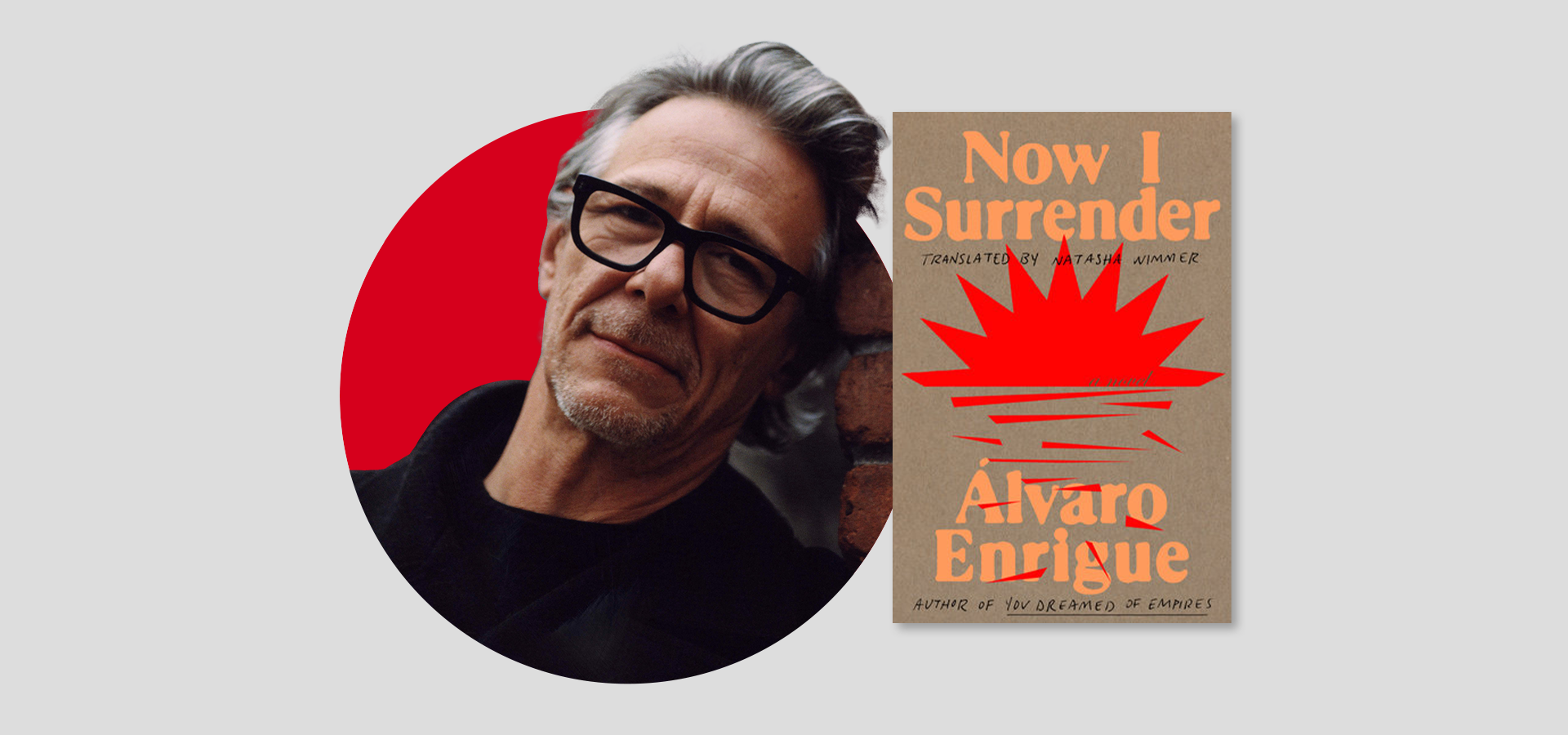
Álvaro Enrigue | The PEN Ten Interview
Fluidly alternating between past and present, and subtly interweaving history and myth, Álvaro Enrigue’s Now I Surrender (Riverhead Books, 2026) reimagines the wars over the borderlands between Mexico and the United States. Imaginative, impassioned, and expansive, the novel forces us to reconsider what we think we know about the West and how it was “won.”
In this interview, Enrigue, who joined PEN America at the World Voices Festival for a panel on the American West, dives deep into his novel. In conversation with Erik Gross, senior manager of foundation relations and grants, Enrigue speaks about his efforts to make his fiction beautiful, the history (and future) of Chiricahua Apaches, and his refusal to imagine potential readers as he writes (Bookshop; Barnes & Noble).
You start your novel with a provocative line: “Writing is a defiant gesture.” Given our work and mission at PEN America, it immediately grabbed my attention. Can you tell me more about what you meant by this?
I was really thinking about Saint John’s Gospel, not my personal politics. About logos and fiat lux, and all of that. There is something timidly rebellious in raising a world made only of words. Now it sounds a bit exaggerated to me, as so many things I have written and then have to live with, but I suppose that the great literature that formed us — and Saint John was a formidable writer — ends up mixing in all we do, including our moments of insolence.
Your novel shifts back and forth between the past and the present day. From a technical standpoint, did writing like this feel natural to you?
There is nothing as difficult as writing fiction. That’s precisely why it is the best job in the world: it is crazy demanding. And there is nothing natural about writing a novel. It took us hundreds of millennia, as a species, to develop that technology, which is still a wonderful machine to understand human interior life. In Cervantes we believe. I think that everybody can tell a story and I am not particularly talented — my stories are always too long, people at the table get distracted — but what makes a writer is the ability to find the right form to tell one, and if you are a novelist, length passes for a virtue. Some novels are born like Palas-Athenea, ready to fight, but you don’t have an idea of how many years of trial and error it took me to find the way to tell this one.
Your novel investigates many of the complexities and inconsistencies regarding how we think about identity: national identity, racial identity, cultural identity, and the way they’re often at odds. What were you trying to contribute to the contemporary discourse around identity?
I am not a philosopher, and I am not a political scientist. I’m mainly a reader, during some periods a writer. I teach literature and language — not theory or writing — and I am not trying to contribute anything to any contemporary academic discourse when I write a novel. Not only that: I think that if I tried, I would be writing dead books. I tell fables that I find meaningful, many times without knowing why. Then the critics say that is postmodern or decolonial, and I tell my children: “You see, this very respectable professor thinks that I am decolonial and postmodern.” And I write fiction using language as a machine of producing beauty — if I can. Writing is always political, of course, we write with our capital of political rage, of course, but that comes from a different place, is a different discussion. I don’t want to change the polis when I write a novel; I just want the book to be beautiful and moving.
There is nothing as difficult as writing fiction. That’s precisely why it is the best job in the world: it is crazy demanding. And there is nothing natural about writing a novel. It took us hundreds of millennia, as a species, to develop that technology, which is still a wonderful machine to understand human interior life.
Tangential to Now I Surrender: I watched a wonderful YouTube video of you (posted by Riverhead Books) talking about soccer and your “Number 9 Theory.” As an avid soccer fan and employee at a literary non-profit, I can’t resist asking: What can the literary community learn from soccer?
It’s all about form and beauty, right? That magnificent moment that every now and then happens in the pitch can make the rest of the day worth living, the rest of my life if it’s the World Cup and truth manifested in a guy with the green jersey and the eagle in the chest — I detest nationalism, but during the World Cup, or Copa América, I become a 9-year-old again and national feelings are childish. That eternal second in which perfection just happens has something sacred for me. It is not, but it feels like it.
You investigate points in time where the U.S.-Mexico border was much less defined and much more fluid, even if it represented an ongoing area of contestation. How did present tensions over immigration and border enforcement factor into your inspiration for the novel?
Now I Surrender is a very long meditation about how a territory that the propaganda machines of Mexico and the U.S. did draw as empty for the purpose of its occupation has been cosmopolitan and deeply civilized for millennia. In very practical terms, I wrote the novel in Spanish in the first Trump administration, and re-did it in English — through Natasha Wimmer’s wonderful voice, of course — in the second one. Novels aspire to be objects of beauty, but they react to their moment too.
How do you situate Now I Surrender within your larger body of work? How does it build upon or differ from prior themes surrounding power, conquest, and colonialism?
I see Now I Surrender as part of a trilogy of novels about modernity’s horrors, with Sudden Death and You Dream of Empires. All of it is in the past for me now, even when I will always keep wondering about the (wrong) ways in which we used power to create the National States and their mythologies.
I think that what we really have to learn about them is that it does not matter how powerful the fellows that are trying to hurt you are, they will eventually be gone and your people will not.
Now I Surrender presents an invaluable lesson on the history of the Apaches, a history that is too often forgotten and ignored. It’s admittedly too complicated to boil down to a few sentences, but what do you most wish non-Indigenous audiences understood?
The Chiricahua Apaches are still in Arizona, Chihuahua, New Mexico. And they are a strong community that has not substantially modified their ways of doing things, or their religious beliefs, or anything. I think that what we really have to learn about them is that it does not matter how powerful the fellows that are trying to hurt you are, they will eventually be gone and your people will not. Ukraine will be here when Putin is gone; Palestinians will be here when Netanyahu is gone; hard-working, generous migrants will be here when Trump is gone.
When you were writing, who did you find yourself speaking to in your head? What was the audience you imagined for this work?
I never think of a possible reader. If I did I would be paralyzed by fear of fair judgment. Or worse: obliging.
How do you situate this work within the Western genre? What is the addition or critique you are looking to make?
I adore Westerns, but at the same time, I’m an outsider, or almost an outsider — I’m Mexican, after all, not that foreign. I really was trying to write a Western. It just feels a little bit odd because I see things from a different point of view. I did not drink the American Kool-Aid. That, of course, does not make me a hero or a saint, just a person that drank a different Kool-Aid, of which I am not proud.
Maybe the anti-migrant crew is just jealous. They should just pack their shit and go, learn things. What they will learn is, mainly, that humans are amazing and generous and all contribute, and all pay taxes, and you don’t have to act as if others wanted what you have because, believe me, I don’t want your stuff, I don’t like it at all.
How has your experience living in the United States shaped your perspective on your subject material? How have you felt yourself or your point of view change over time?
Mine is the most regular of lives and point of views: humans move around. We have occupied and ruined the whole planet because we are the most adaptable of all species. I suppose that the anti-immigration crowd in the U.S. feels that their child who moved to Mexico City or Florida in search of opportunities is not a migrant. I don’t understand. And the process has been deeply enriching for my point of view. I serve my community here and I’m thankful to the people of the U.S. for welcoming me.
Two different bibliographical lists, two sets of libraries, two traditions, two experiences of the two magnificent cities I call home, two passports to go do research. It was hard at times, of course; to begin again is always exhausting, but things are also hard when you stay home, and you don’t have the novelty of being somewhere else. When things go wrong, you can’t offer yourself that sorry excuse: pinches gringos. Maybe the anti-migrant crew is just jealous. They should just pack their shit and go, learn things. What they will learn is, mainly, that humans are amazing and generous and all contribute, and all pay taxes, and you don’t have to act as if others wanted what you have because, believe me, I don’t want your stuff, I don’t like it at all.
Álvaro Enrigue is a prize-winning Mexican writer whose most recent novel is You Dreamed of Empires. His work has appeared in The New York Times, the London Review of Books, El País, and n+1, among other publications. A former Fellow at the Cullman Center and at Princeton University, he teaches Latin American Literature at Hofstra University and lives with his family in New York City.