
All That Is Lost
The Cultural Destruction of Gaza
مقتطف من التقرير كل ما فُقِد: الدمار الثقافي في غزة
קטע מתוך הדו”ח כל שאבד: הרס התרבות של עזה
PEN America Experts:

Managing Director, PEN/Barbey Freedom to Write Center
Introduction
Today, the survival of Palestinian culture in Gaza is under existential threat, as writers, artists, and cultural workers are killed or forced into exile and cultural heritage is demolished by Israeli military attacks. Gaza’s cultural landscape lies in ruins, almost entirely erased alongside universities, schools, hospitals, homes, and basic infrastructure. This erasure by the government of Israel and the Israeli military is an assault on the dignity, identity, and free expression of Palestinians, and a grievous loss to the cultural heritage of humanity that we all share.
For the Palestinian people, who have endured displacement, occupation, repression, and war going back many decades, culture plays an essential role in preserving and giving voice to identity, history, and individual stories. Since 2005, Israel’s control over Gaza’s land, sea, and air has devastated daily life, turning Gaza into what many describe as an open-air prison.1“Gaza: Israel’s ‘Open-Air Prison’ at 15,” Human Rights Watch, June 14, 2022, hrw.org/news/2022/06/14/gaza-israels-open-air-prison-15 A strict permit system severely restricted the movement of people and goods—including books and artworks—in and out of Gaza.2Moustafa Bayoumi and Mona Chalabi, “Toys, spices, sewing machines: the items Israel banned from entering Gaza,” The Guardian, June 24, 2024, theguardian.com/world/article/2024/jun/24/gaza-blockade-israel-banned-items; Ruqaya Izzidien, “Under Israeli blockade of Gaza, books are a rare, cherished commodity,” The Christian Science Monitor, July 24, 2012, csmonitor.com/World/Middle-East/2012/0724/Under-Israeli-blockade-of-Gaza-books-are-a-rare-cherished-commodity Despite this, cultural expression has persisted against the odds, though it has been systematically constrained by occupation and military siege, local misrule and repression, and deep privation.
The human toll of the Israeli military’s ongoing assault on Gaza since the Hamas-led attacks on Southern Israel of October 7, 2023 is staggering: as of September 10, 2025, nearly 65,000 Palestinians—men, women, and children—have been killed, and more than 163,000 wounded.3“Reported impact snapshot | Gaza Strip (10 September 2025),” U.N. Office for the Coordination of Humanitarian Affairs, September 10, 2025, ochaopt.org/content/reported-impact-snapshot-gaza-strip-10-september-2025 As of the writing of this report, the U.N. confirmed that the Israeli government’s refusal to allow humanitarian aid into Gaza and use of starvation as a weapon of war has led to famine, with at least half a million people facing “catastrophic hunger conditions.”4“Gaza: Famine ‘irrefutably’ confirmed, UN humanitarians unite in plea for aid access — OCHA, OHCHR, WFP and WHO,” United Nations Information System on the Question of Palestine, August 22, 2025, un.org/unispal/document/ocha-ohchr-wfp-who-press-briefing-22aug25/ Human rights organizations have concluded that the Israeli government and military have, and continue to, commit war crimes and crimes against humanity in Gaza, including forced and mass displacement, deliberate demolitions of homes, and killing of civilians.5“Israel’s Crimes Against Humanity in Gaza,” Human Rights Watch, November 14, 2024,hrw.org/news/2024/11/14/israels-crimes-against-humanity-gaza; “Israeli attacks on Gaza schools could be crimes against humanity: UN probe,” UN News, June 10, 2025, news.un.org/en/story/2025/06/1164191; Eyal Benvenisti and Chaim Gans, “Our Duty to Explain Israel’s Operation to “Concentrate and Move Population” in Gaza is a Manifest War Crime,” Just Security, July 8, 2025, justsecurity.org/116459/israel-gaza-gideon-chariots-humanitarian-city/; “Operation Gideon’s Chariots: Forced Displacement of Gaza’s Residents,” The Association for Civil Rights in Israel, May 11, 2025, english.acri.org.il/post/operation-gideon-s-chariots-forced-displacement-of-gaza-s-residents; “UN Commission finds war crimes and crimes against humanity in Israeli attacks on Gaza health facilities and treatment of detainees, hostages,” Office of the U.N. High Commissioner for Human Rights, October 10, 2024, ohchr.org/en/press-releases/2024/10/un-commission-finds-war-crimes-and-crimes-against-humanity-israeli-attacks Palestinian, Israeli, international human rights institutions,6“How to Hide a Genocide: The Role of Evacuation Orders and Safe Zones in Israel’s Genocidal Campaign in Gaza,” Al-Haq, January 1, 2025, alhaq.org/cached_uploads/download/2025/01/02/evacuation-orders-two-pages-view-1735842246.pdf; “Israel’s Crime of Extermination, Acts of Genocide in Gaza,” Human Rights Watch, December 19, 2024, hrw.org/news/2024/12/19/israels-crime-extermination-acts-genocide-gaza; “‘You Feel Like You Are Subhuman’: Israel’s Genocide Against Palestinians in Gaza,” Amnesty International, 13, amnesty.org/en/documents/mde15/8668/2024/en/; “Our Genocide,” B’Tselem, July 28, 2025, 4, btselem.org/publications/202507_our_genocide; “Destruction of Conditions of Life: A Health Analysis of the Gaza Genocide,” Physicians for Human Rights Israel, July 28, 2025, phr.org.il/wp-content/uploads/2025/07/Genocide-in-Gaza-PHRI-English.pdf and UN bodies7“Legal analysis of the conduct of Israel in Gaza pursuant to the Convention on the Prevention and Punishment of the Crime of Genocide,” Office of the U.N. High Commissioner for Human Rights, September 16, 2025, ohchr.org/sites/default/files/documents/hrbodies/hrcouncil/sessions-regular/session60/advance-version/a-hrc-60-crp-3.pdf have further concluded, based on direct fact-finding work, that Israeli policies and actions in Gaza have met the legal threshold for genocide, as have a range of scholars of genocide and international law8“IAGS Resolution on the Situation in Gaza,” International Association of Genocide Scholars, August 31, 2025, genocidescholars.org/wp-content/uploads/2025/08/IAGS-Resolution-on-Gaza-FINAL.pdf; Omer Bartov, “I’m a Genocide Scholar. I Know It When I See It,” The New York Times, July 15, 2025, nytimes.com/2025/07/15/opinion/israel-gaza-holocaust-genocide-palestinians.html; Stéphanie Le Bars, “Amos Goldberg: ‘What is happening in Gaza is a genocide because Gaza does not exist anymore’,’” Le Monde, October 29, 2024, lemonde.fr/en/opinion/article/2024/10/29/amos-goldberg-what-is-happening-in-gaza-is-a-genocide-because-gaza-does-not-exist-anymore_6730881_23.html; Raz Segal, “A Textbook Case of Genocide,” Jewish Currents, October 13, 2023, jewishcurrents.org/a-textbook-case-of-genocide; Melanie O’Brien, Ben Saul, Eyal Mayroz, Paul James, and Shannon Bosch, “Is Israel committing genocide in Gaza? We asked 5 legal and genocide experts how to interpret the violence,” The Conversation, August 6, 2025, theconversation.com/is-israel-committing-genocide-in-gaza-we-asked-5-legal-and-genocide-experts-how-to-interpret-the-violence-262688—a determination currently under review by the International Court of Justice.9Application of the Convention on the Prevention and Punishment of the Crime of Genocide in the Gaza Strip (South Africa v. Israel) (Provisional Measures) (International Court of Justice, December 29, 2023) icj-cij.org/sites/default/files/case-related/192/192-20231228-app-01-00-en.pdf The violations of international law committed by the Israeli government and military must be fully investigated, including by independent investigators, and perpetrators held to account.
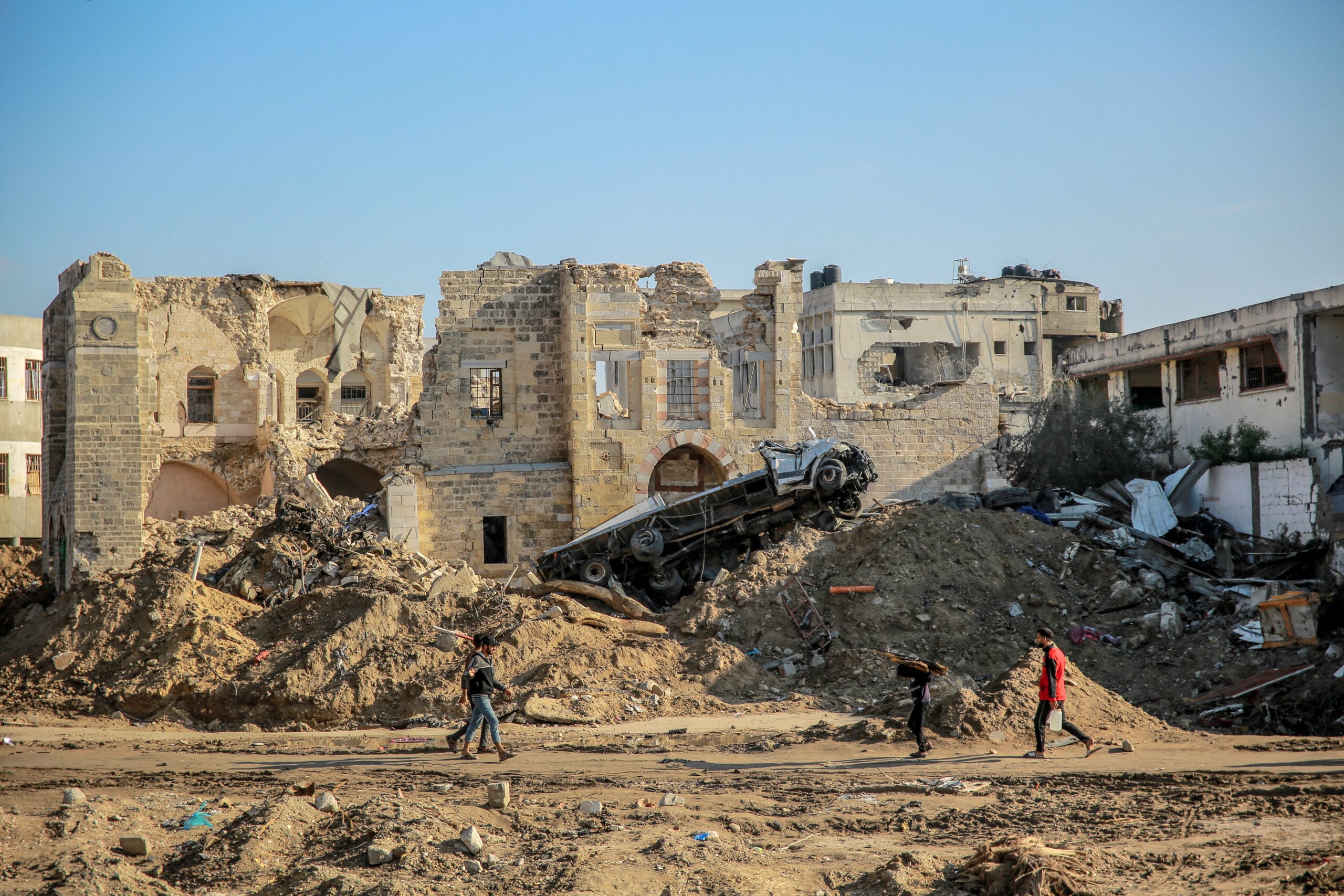
The war has inflicted a catastrophic blow to Gaza’s cultural life and heritage, with some of the most important cultural and religious landmarks in Gaza destroyed.10“Report of the Independent International Commission of Inquiry on the Occupied Palestinian Territory, including East Jerusalem, and Israel,” U.N. Doc. No. A/HRC/59/26, United Nations Human Rights Council, 59th Session, June 16-July 11, 2025, un.org/unispal/document/report-of-the-independent-international-commission-of-inquiry-on-the-occupied-palestinian-territory-including-east-jerusalem-and-israel-a-hrc-59-26/ Israel’s military campaign has resulted in the total or partial destruction of every university and college in Gaza and 11 libraries, including the total destruction of the Gaza Public Library, which housed 10,000 books in Arabic, English, and French. At least eight publishing houses and printing presses have been destroyed as well as several bookshops, including the three-story Samir Mansour bookstore which was severely damaged during an airstrike on October 10, 2023 and which contained thousands of books. Other cultural sites damaged or destroyed include the seventh century Great Omari Mosque, with a library dating back to the 13th century, the historic Hammam al-Samra, 1,500-year-old Byzantine mosaics, and Al-Qarara Cultural Museum.
PEN America has concluded that the attacks by the Israeli government as documented in this report, appear to have either targeted civilian infrastructure, including cultural heritage, or to have been indiscriminate. These attacks, whether intentional or reckless, breach international laws enacted to protect cultural property during war (specifically the 1954 Hague Convention for the Protection of Cultural Property in the Event of Armed Conflict), violate other international humanitarian and human rights laws, and constitute war crimes. Under international law, when war crimes—such as intentionally targeting civilians, using starvation as a weapon, causing extensive damage to property without a military justification, and willfully causing great suffering—are carried out as part of a widespread or systematic attack against a civilian population, and with knowledge of the attack, as they have been in Gaza, such acts constitute crimes against humanity.11Article 7 of the Rome Statute (see Prosecutor v. Kunarac, ICTY Appeals Judgment, 2002, paras. 86–91): icty.org/x/cases/kunarac/acjug/en/; Prosecutor v. Vlastimir Đorđević, Case No. IT-05-87/1-A, Appeal Judgment, 27 January 2014, International Criminal Tribunal for the former Yugoslavia, icty.org/x/cases/djordjevic/acjug/en/140127.pdf
With regard to cultural destruction, the International Criminal Court’s (ICC) Policy on Cultural Heritage states that crimes against or affecting cultural heritage “may themselves amount to crimes against humanity,” or provide evidence of such crimes, particularly given that “crimes against cultural heritage committed during [an] attack may suggest that the civilian population was the primary target of the attack, given the collective importance of cultural heritage for civilian communities as such.”12Office of the Prosecutor, International Criminal Court, “Policy on Cultural Heritage,” June 2021, 24, icc-cpi.int/sites/default/files/itemsDocuments/20210614-otp-policy-cultural-heritage-eng.pdf And while destruction of cultural heritage is not itself one of the underlying crimes required to prove genocide, it has in some cases been cited as evidence of genocidal intent.13Article 6 of the Rome Statute (see Prosecutor v. Krstić, ICTY Appeals Judgment, 2004, paras. 33–36; icty.org/x/cases/krstic/acjug/en/; Bosnia and Herzegovina v. Serbia and Montenegro, ICJ Judgment, 2007, para 190) icsid.worldbank.org/sites/default/files/parties_publications/C8394/Claimants%27%20documents/CL%20-%20Exhibits/CL-0189.pdf; Office of the Prosecutor, International Criminal Court, “Policy on Cultural Heritage,” June 2021, 31, icc-cpi.int/sites/default/files/itemsDocuments/20210614-otp-policy-cultural-heritage-eng.pdf; Application of the Convention on the Prevention and Punishment of the Crime of Genocide in the Gaza Strip (South Africa v. Israel) (Provisional Measures) (International Court of Justice, December 29, 2023) icj-cij.org/sites/default/files/case-related/192/192-20231228-app-01-00-en.pdf
PEN America calls on the Israeli government to immediately end its attacks on Palestinian cultural heritage and to observe its international law obligations to protect cultural property, and it calls for the widespread cultural destruction in Gaza to be investigated as war crimes, crimes against humanity, and evidence of genocidal intent. Our determination is based not only on an examination of single incidents but also of the overall pattern and scale of destruction and its cumulative impact, including the damage to cultural heritage.

This report examines the effect of the war on 36 cultural, historical, religious, and educational institutions and sites, and also includes three instances of deliberate book burnings and two cases of reported looting of archaeological artifacts. According to a comprehensive damage assessment report, 226 heritage sites and historical buildings in Gaza have been damaged, and emergency preservation efforts alone will cost an estimated €31.2 million (approximately $36.4 million).15 “Damage and Risk Assessment of Cultural Heritage under Attack in the Gaza Strip,” Centre for Cultural Heritage Preservation (CCHP) and Endangered Archeology in the Middle East and North Africa (EAMENA) , February 5, 2025, cchp.ps/index.php/en/372-damage-and-risk-assessment-of-cultural-heritage-sites-in-the-gaza-strip That February 2025 report estimated that this phase would last between 12-18 months, while full reconstruction is projected to cost €261 million (approximately $304 million) and take up to eight years.”16Sarvy Geranpayeh, “Amid desolation in Gaza, heritage experts are pushing a huge reconstruction effort,”The Art Newspaper, March 10, 2025, theartnewspaper.com/2025/03/10/gaza-heritage-experts-huge-reconstruction-effort After six additional months of war, it is extremely likely that these are significant under-estimates.
In response to PEN America’s request for information about the targeting of the specific cultural heritage sites, institutions and universities included in this report, the Israeli military cited the “unprecedented intermingling of Hamas within the civilian infrastructure,” and stated that it “does not aim to cause excessive damage to civilian infrastructure and strikes only out of military necessity.”17Israel Defense Forces (IDF) response, received via WhatsApp on December 21, 2024, on file with PEN America. The Israeli Defense Forces (IDF) response failed to provide information with respect to any of the specific instances of cultural destruction detailed in this report.
Hamas’ use of civilian infrastructure for military purposes, including the construction of hundreds of miles of tunnels, endangering civilians and cultural infrastructure, has been well documented and constitutes war crimes.18Patrick Kingsley, Natan Odenheimer, Aaron Boxerman, Adam Sella, and Iyad Abuheweila, “How Hamas Is Fighting in Gaza: Tunnels, Traps and Ambushes,” The New York Times, July 13, 2024, nytimes.com/2024/07/13/world/middleeast/hamas-gaza-israel-fighting.html The current Israeli assault on Gaza began in response to the October 7, 2023 coordinated attacks led by Hamas and other Palestinian armed groups on southern Israel that involved the killing and abduction of civilians, and resulted in over 1,100 civilians and military personnel killed and 251 individuals taken hostage, including from villages and an outdoor music festival.19“I Can’t Erase all the Blood from My Mind: Palestinian Armed Groups’ October 7 Assault on Israel,” Human Rights Watch, July 17, 2024, hrw.org/report/2024/07/17/i-cant-erase-all-blood-my-mind/palestinian-armed-groups-october-7-assault-israel Human rights organizations have deemed that the killings, cruel and inhuman treatment, hostage-taking, sexual violence, and other crimes—many of them documented by the perpetrators themselves—committed by Hamas and other Palestinian armed groups amount to war crimes and crimes against humanity.20“I Can’t Erase all the Blood from My Mind,” Human Rights Watch; “Israel/OPT: Amnesty International’s research into Hamas-led attacks of 7 October 2023 and treatment of hostages,” Amnesty International, December 2, 2024, amnesty.org/en/documents/mde15/8803/2024/en/ The violations of international law committed by Hamas must be fully and independently investigated and perpetrators held to account.
The fact that war crimes and crimes against humanity have been committed by Hamas neither releases Israel from its own obligations under international law nor justifies reckless, indiscriminate or targeted attacks on civilians and civilian infrastructure, including attacks on or affecting cultural heritage, cultural institutions, and universities. Even if all the tunnels built by Hamas are military objects and therefore lawful targets, the Israeli government is still obliged to distinguish them from civilian objects above ground, including cultural and educational institutions. According to international law, in each specific case the government of Israel must have a clear justification for an attack on a known military target, and it must not cause disproportionate civilian harm.
The most recent ceasefire in Gaza commenced on January 19, 2025, and included an agreement for Israel to permit humanitarian aid into Gaza and the phased release of hostages from Gaza in return for Palestinian prisoners held in Israel and the West Bank. On March 2, 2025, the government of Israel again blocked all humanitarian aid from entering Gaza, including food, baby formula, fuel and medicines, and on March 10, it cut off electricity to Gaza.21Niku Jafarnia, “Israel Again Blocks Gaza Aid, Further Risking Lives,” Human Rights Watch, March 5, 2025, hrw.org/news/2025/03/05/israel-again-blocks-gaza-aid-further-risking-lives; Lauren Izso, Nadeen Ebrahim, and Abeer Salman, “Israel cuts electricity to last facility in Gaza receiving Israeli power,” CNN, March 10, 2025, https://edition.cnn.com/2025/03/09/middleeast/israel-electricity-gaza-intl-latam/index.html On March 18, the Israeli military resumed its bombing of Gaza, ending the temporary ceasefire.22“Entire families wiped out as Israel bombs Gaza’s residential areas,” Al Jazeera, March 18, 2025, aljazeera.com/news/2025/3/18/killing-box-gaza-reacts-to-renewed-israeli-strikes
In May, an Israeli and U.S. backed entity, the Gaza Humanitarian Foundation (GHF) was established to deliver humanitarian aid, bypassing the U.N. delivery system. In August 2025, 41 U.N. human rights experts called for the dismantling of the GHF and for experienced U.N. and humanitarian organizations to be allowed to distribute aid in Gaza.23“UN experts call for immediate dismantling of Gaza Humanitarian Foundation,” Office of the U.N. High Commissioner for Human Rights, August 5, 2025, ohchr.org/en/press-releases/2025/08/un-experts-call-immediate-dismantling-gaza-humanitarian-foundation They noted that 1,400 civilians had been killed and over 4,000 injured as they sought food. At least 859 had been killed in the vicinity of GHF sites.
On February 4, 2025, President Donald Trump announced a proposal for the United States to “take over the Gaza Strip,” and forcibly displace its civilian population.24Michael D. Shear, Peter Baker, and Isabel Kershner, “Trump Proposes U.S. Takeover of Gaza and Says All Palestinians Should Leave,” The New York Times, February 4, 2025, nytimes.com/2025/02/04/us/politics/trump-gaza-strip-netanyahu.html On May 5, 2025, the Israeli cabinet approved a plan to take control of Gaza City, marking the government’s intention to further escalate hostilities and deepen the Government of Israel’s control of the territory.25David Gritten, “Israel security cabinet approves plan to ‘capture’ Gaza, official says,” BBC News, May 5, 2025, bbc.com/news/articles/cwy04km1zk0o The Israeli Defense Minister, Israel Katz, announced on July 13 that Israel planned to relocate 600,000 Palestinians to southern Gaza, with plans to extend this to all residents of Gaza.26Sanad Verification Agency and Federica Marsi, “Israel increased Rafah demolition to prepare for Gaza forced transfer plan,” Al Jazeera, July 13, 2025, aljazeera.com/features/2025/7/13/israel-increased-rafah-demolition-to-prepare-for-gaza-forced-transfer-plan This plan has been widely condemned as forcible transfer of a population, a crime under international law.27“Operation Gideon’s Chariots: Forced Displacement of Gaza’s Residents,” The Association for Civil Rights in Israel, May 11, 2025.
These proposals reflect a ruthless disregard for Gaza’s cultural heritage and underscore a dangerous narrative: the notion that Gaza has no culture, no history, and nothing worth preserving. This erasure of Gaza’s identity would not only constitute an extraordinary violation of Palestinians’ human rights, including their cultural rights and their right to self determination, but it would also be a denial of the cultural and historical contributions that Gaza and Palestinians have made, and will continue to make, to the world, even under the weight of occupation, closure, repression, and war.
President Trump’s proposal and the government of Israel’s ongoing attacks in Gaza should galvanize the international community to urgently press for a ceasefire and a permanent end to the war, the release of all hostages and political prisoners, and the immediate and urgent provision of sufficient humanitarian aid to Palestinians. The U.S. and other governments should immediately cease all transfers of offensive weapons to Israel until such time as the U.S. is confident they will not be used to commit war crimes or gross violations of human rights.
With the meaningful participation and leadership of Palestinians, the international community should prioritize the development and funding of a comprehensive plan for Gaza’s future that includes, as a key priority, the rebuilding and revitalizing of Gaza’s cultural heritage. In its initial phase, this plan must end the government of Israel’s closure and occupation of Gaza, ensure Palestinians’ human rights, and create an enabling environment for Palestinians to rebuild Gaza, including their cultural heritage and institutions.
The government of Israel and the international community must fully investigate all allegations of war crimes and violations of international law in relation to the destruction of Gaza’s cultural heritage and universities and hold perpetrators accountable. Hamas must fully cooperate with independent investigations of war crimes and human rights violations, both those it has committed and those committed by the Israeli military.
All victims of gross human rights violations should receive reparations and these should take into account and seek to redress cultural destruction. This should include the allocation of funds and expertise to expedite the rehabilitation of cultural sites, direct support to Palestinian cultural workers and organizations working to rebuild, and to those aiding cultural workers in Gaza, and support to recover any cultural artifacts that were looted or displaced.
Special attention should be paid to the role that writers, artists, and cultural professionals, along with all civilians, play in safeguarding the continuity of Gaza’s cultural heritage. They help to ensure the survival of cultural heritage but can also play an essential role in fostering the long-term rebuilding of communities that have been decimated by war. Safeguarding these individuals and enabling them to continue their creative work is essential for sustaining Gaza’s cultural resilience and, by extension, the broader struggle for Palestinians’ human rights.
In the longer term, members of the international community should take a multifaceted approach to protecting and supporting those who create, document, and preserve Palestinian culture. They should provide targeted livelihood support to Palestinian writers, artists, and cultural workers affected by the conflict, ensuring they can meet their basic needs and continue their work. They should facilitate the return of cultural producers to Gaza through support programs, including livelihood assistance and participation in restoration and cultural initiatives. Research and academic fellowships, scholarships, and exchange programs—along with visa assistance, housing, stipends, and psychosocial support—should be provided to cultural workers who have been displaced from Gaza.
The rebuilding of Gaza’s educational institutions and system must be an immediate and urgent priority for the international community. While universities are being rebuilt, students from Gaza and those displaced from Gaza should be permitted to study at universities in the West Bank and visas should be issued for them to study abroad. The rebuilding should include the restoration and replenishing of library collections, including school and university libraries.
Only through all these efforts can a path to meaningful reconstruction and justice begin, allowing Palestinians in Gaza to rebuild not only their homes and schools but also their society.
More broadly, PEN America urges the international community to recognize and recommit to the importance of preserving cultural heritage during conflict. Cultural heritage embodies the identity and history of communities, and its destruction during conflict, as the case of Gaza illustrates, has the potential to inflict lasting damage on affected communities. It is incumbent upon governments to strengthen legal protections, enforce accountability, and provide resources for the safeguarding of culture during armed conflict and for its post-conflict reconstruction.
Cultural heritage embodies the identity and history of communities, and its destruction during conflict, as the case of Gaza illustrates, has the potential to inflict lasting damage on affected communities.
Palestinian Culture and Cultural Destruction in Gaza
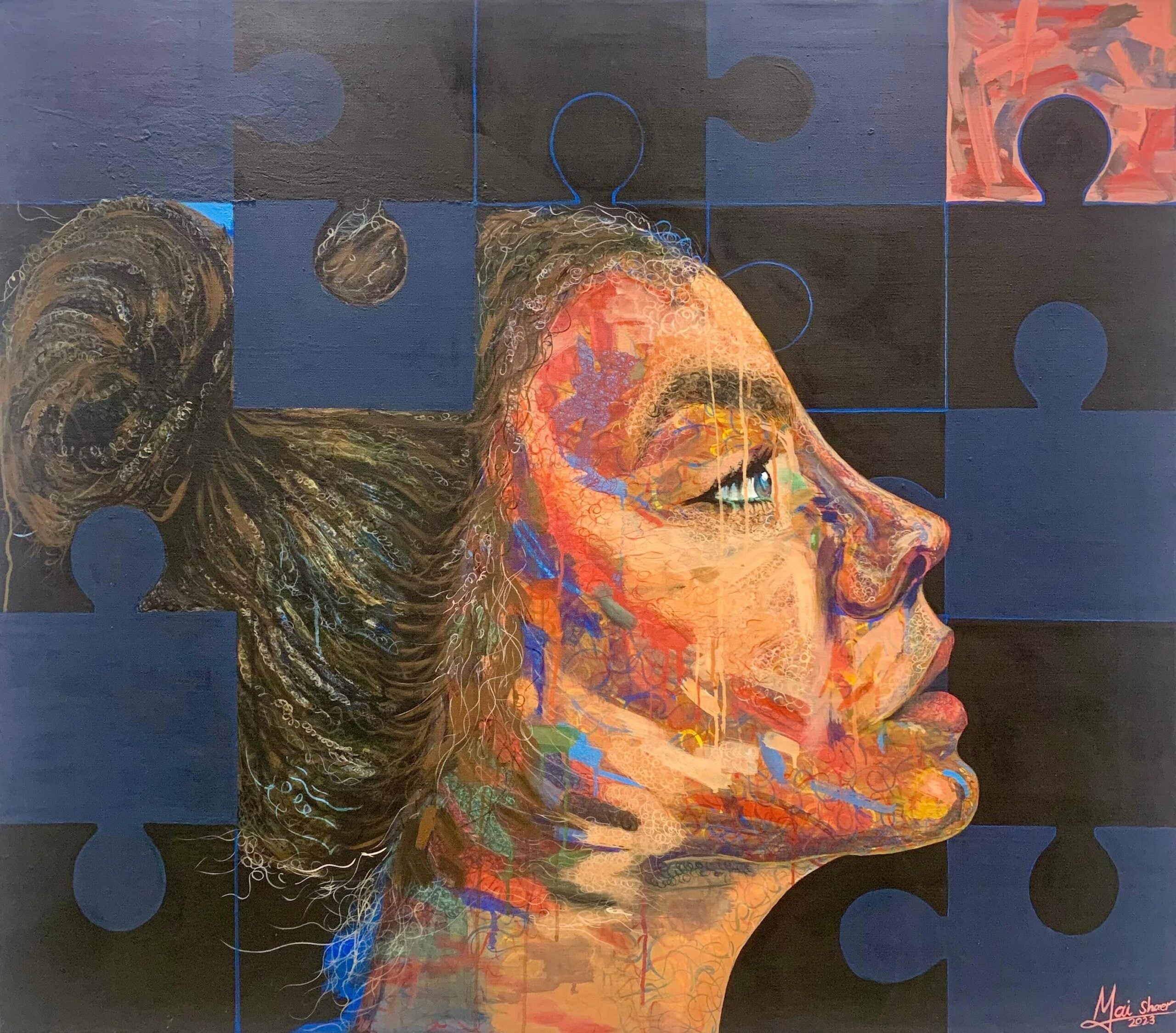
For the 18 years prior to the start of the current war on October 7, 2023, Palestinians were largely trapped in Gaza. They could leave only at the discretion of Israeli authorities in coordination with the Egyptian government while in Gaza they were at risk of human rights violations at the hands of Hamas, including restrictions on their freedom of expression.28“Gaza Strip,” Freedom in the World 2023, Freedom House. Writers and artists, among others, were deprived of meaningful opportunities inside Gaza and beyond.29“Gaza: Israel’s ‘Open-Air Prison’ at 15,” Human Rights Watch, June 14, 2022,hrw.org/news/2022/06/14/gaza-israels-open-air-prison-15 Mai El-Shaer, a 23-year-old visual artist who managed to flee Gaza in 2024, first to Egypt and then to a third country, described the challenges in making art in Gaza before the war: “The art scene in Gaza is not very open . . . The tools, materials, and resources are somewhat limited. You work with what’s available to you in Gaza.” El-Shaer added, “Many materials, of course, are blocked by Israel under the pretext that they could be used for non-artistic purposes, and so not everything is accessible. On top of that, traveling outside of Gaza was very difficult. Not everyone could easily travel or leave Gaza. . . . There were challenges you can’t overcome as an artist.”30Interview by PEN America, January 12, 2025 (video call). Mahmoud Jouda, a writer who also fled Gaza after his home was bombed, explained the constrained cultural context in Gaza, saying, “These obstacles were either related to the local community or to the de facto government, Hamas. We faced challenges when writing a specific article, expressing an opinion on Facebook, or through publications. There was censorship on writing.”31Interview by PEN America, January 12, 2025 (video call).
Theater director Hossam Madhoun, co-founder of Gaza’s Theater for Everybody, stated that cultural production in Gaza was challenging before 2023 for many reasons, including the Israeli occupation and blockade, poverty, and Hamas’ rule, which did not prioritize or value culture and actively sought to limit free expression and stifle criticism. Despite these barriers, Madhoun said there were many cultural producers trying to create space for their work, including writers, painters, and public intellectuals.

Madhoun, who fled to Cairo with his wife after October 2023, explained the importance of culture since the war began: “During the war, artists did not stop, theater makers, animators, painters, and writers did not stop creating, and many of them work with displaced children now to help them cope during this period. Films are being screened in displacement camps like al-Mawasi in Khan Younis, puppet maker Mahdi Karira is using tin food cans to make puppets, and artist Basel el-Maqousi continues working with children.”32Hossam Madhoun, interview by PEN America, August 21, 2024 (video call). For Madhoun’s writings during the war, see themarkaz.org/author/hossammadhoun/ In explaining why he is still making puppets, Karira said they “can tell beautiful things, tell our histories and stories to children.”33AFP, “Puppet maker turns tins into toys in ruins of war,” Arab News, April 28, 2024, arabnews.com/node/2500931/amp El-Shaer, citing the absence of educational and cultural services in Rafah, stated she “worked in children’s entertainment in schools and shelters to bring joy through art and theatre.”34Interview by PEN America, January 12, 2025 (video call).
Ahmed Alhussaina, vice president for financial and administrative affairs of Al-Israa University in central Gaza, which the Israeli military destroyed in January 2024,35Ahmed Alhussaina, interview by A Martínez, “Israel destroys hundreds of educational institutions in Gaza since the war started,” Morning Edition, NPR, January 24, 2024, npr.org/2024/01/24/1226534897/israel-has-destroyed-hundreds-of-educational-institutions-in-gaza-since-the-war lamented the loss of priceless, irreplaceable cultural and archaeological sites and artifacts and expressed his view that the destruction was so widespread it appeared deliberate. He said that “most of the places that have cultural value or archaeological value to the Palestinians [are] gone. I think it’s a deliberate act of deleting,” adding, “I don’t know how we’re going to get all that stuff back. These irreplaceable things . . . I don’t know how we’re going to preserve this sentimental and archaeological value of our culture and heritage, and everything that proves that there were people living there.”36Ahmed Alhussaina, interview with Natasha Lennard, “No University Left Standing in Gaza,” in Deconstructed, produced by José Olivares, podcast, February 9, 2024, theintercept.com/2024/02/09/deconstructed-gaza-university-education/.
Most of the places that have cultural value or archaeological value to the Palestinians [are] gone. I think it’s a deliberate act of deleting. . . I don’t know how we’re going to preserve this sentimental and archaeological value of our culture and heritage, and everything that proves that there were people living there.
Ahmed Alhussaina, vice president for financial and administrative affairs of Al-Israa University.
Untitled
by Mahmoud Jouda, translated from Arabic by Mosab Abu Toha
The death of a girl means that a tree in the garden of heart has withered, that a major malfunction has struck the mood of the dawn, and that someone will sleep in an undying eclipse, will not perform his morning practices.
The death of a girl means that a dance has ceased forever, a song has gone astray, a laugh muted after which countless smiles will die out.
The death of a girl means that someone will walk in the streets on his own, eyes welled up, heavy-hearted, and too melancholic and about to weep, people think he’s mad.
The death of a girl means there is a shortage in food for the impoverished, a raging thirst striking the throats of birds, a summer followed by no winter, and an everlasting arthritis in the joints of Time.
The death of a girl means that a poem will be unwritten, a painting will be unpainted, a love will be orphaned, an embrace will be postponed, and that there will be grief in a present tense that never stops.
Both El-Shaer and Jouda highlighted how much of their work was destroyed during the bombardment of Gaza. El-Shaer was not able to salvage any of her equipment or materials. She said, “I wasn’t able to take everything with me. I tried my best to bring as many pieces as possible—those that were closest to my heart, the ones I couldn’t bear to leave behind.”37Interview by PEN America, January 12, 2025 (video call). Jouda, whose home in al-Rimal in Gaza City (one of the first neighborhoods to be destroyed), was completely levelled, described the loss of his personal library. “I had a very diverse and beautiful library, and I lost everything—my entire collection,” he said. Jouda also lost the nearly completed draft of his novel, which he described as “so very dear to me.”38Interview by PEN America, January 12, 2025 (video call).
Our homes in the refugee camps were like small museums. Each of us had something passed down from our grandparents, something from their displacement in 1948, a process that’s now been going on for 76 years…my grandmother’s wedding dress and her scarf, which she had kept folded in braids. All of this was in my house. And now, it’s all gone.
Mahmoud Jouda, a Palestinian writer who fled Gaza and now lives in exile.
Jouda also highlighted an aspect of cultural destruction that he believes is largely invisible and whose value cannot be quantified. “Our homes in the refugee camps were like small museums. Each of us had something passed down from our grandparents, something from their displacement in 1948, a process that’s now been going on for 76 years. In my house, we had 18-carat gold from my grandmother. . . . I don’t know why they called it a “mukhall’ah” necklace with olive designs,” he said, adding that they also lost “my grandmother’s wedding dress and her scarf, which she had kept folded in braids. All of this was in my house. And now, it’s all gone. . . . I have a friend who lost 250 thawb from before 1948—traditional Palestinian dresses—he collected them and bought them with his own money. But unfortunately, the place was destroyed.”39Interview by PEN America, January 12, 2025 (video call).
All the Palestinians PEN America interviewed for this report said they believed that the destruction of civilian and cultural infrastructure was intentional. As evidence they cited Israeli official statements that Israel sought to make Gaza unlivable (some of which are cited later in this report), the scale of the destruction, the destruction of institutions that had not been targeted during previous conflicts, and the Israeli military striking protected targets whose locations were shared by international organizations and foreign governments.40Mathu Joyini, permanent representative of South Africa to the UN, letter dated May 29, 2024 from the Permanent Representative of South Africa to the United Nations addressed to the President of the Security Council, U.N. Doc. S/2024/419; Khalil Sayegh, interview by PEN America, August 14, 2024 (audio call); Akram Lilja, interview by PEN America, August 13, 2024 (video call); Akram Lilja and Jehad Abusalim, “Cultural Heritage Under Attack in Gaza,” The Jerusalem Fund for Education and Community Development, February 15, 2024, at 29:28, thejerusalemfund.org/2024/02/watch-now-cultural-heritage-under-attack-in-gaza/; Juliet Linderman, Martha Mendozan, and Cedar Attanasio, “U.S.-funded infrastructure in Gaza largely unscathed as death toll soars,” Associated Press, December 22, 2023, apnews.com/article/israel-palestinians-gaza-us-aid-projects-c294bf02cc3249421c181832c9d92c74
The most comprehensive damage assessment for heritage sites in Gaza so far has been conducted by the Endangered Archeology in the Middle East and North Africa (EAMENA) project based at Oxford University, working in collaboration with local Palestinian teams on the ground. According to the EAMENA assessment, the coordinates of 316 sites and historical buildings were accurately mapped and cross referenced with satellite imagery, showing that 226 sites have been damaged. Destruction in the north of Gaza has been particularly stark.41“Damage and Risk Assessment of Cultural Heritage under Attack in the Gaza Strip,” CCHP and EAMENA, 9. The cultural heritage institutions damaged include religious sites, monuments, museums, archeological sites, and buildings housing movable cultural property.42A UNESCO damage assessment verified damage to 75 sites. See “Gaza Strip: Damage Assessment,” UNESCO, last updated May 28, 2025, unesco.org/en/gaza/assessment
Gaza’s Culture Under Attack
Cultural heritage in Gaza is far more than the recognition and celebration of the past. It is a vital form of expression and resistance for Palestinians who have suffered from Israel’s closure of Gaza for nearly two decades, and from Hamas-imposed restrictions on human rights, including free expression.43“Gaza Strip,” Freedom in the World 2023, Freedom House, March 2023, freedomhouse.org/country/gaza-strip/freedom-world/2023 It sustains a sense of identity and continuity, especially for Palestinians whose mobility is restricted and who have largely not been permitted by the government of Israel to travel outside of Gaza. Palestinian writers and artists, including those interviewed for this report, describe how culture goes to the core of their Palestinian identity, their desire to preserve their history, and their ties to their land.
Culture goes to the core of [writers and artists’] Palestinian identity, their desire to preserve their history, and their ties to their land.
Artistic and cultural expression are also some of the few ways for Palestinians to connect the world to their struggle for survival during the war. Shareef Sarhan, an artist and co-founder of an artists’ collective and gallery that was partially damaged in an Israeli airstrike in November 2023, and then completely destroyed in April 2024, explains what art and culture mean in the war, saying that “People are losing their connection with the outside world, but art is able to play a role that the artist cannot … People can see their message and feel your situation … [art is] like an official spokesperson for them.”44Raja Abdulrahim, “Against a Canvas of Despair, Gaza’s Artists Trace Their Struggle,” The New York Times, February 18, 2024, https://www.nytimes.com/2024/02/18/world/middleeast/gaza-art-exhibition-west-bank.html
The decimation of Gaza’s universities, libraries, museums, and historical and religious sites by the Israeli military may have caused irreversible damage to the cultural and intellectual fabric of Palestinian society at local, national, and global levels.
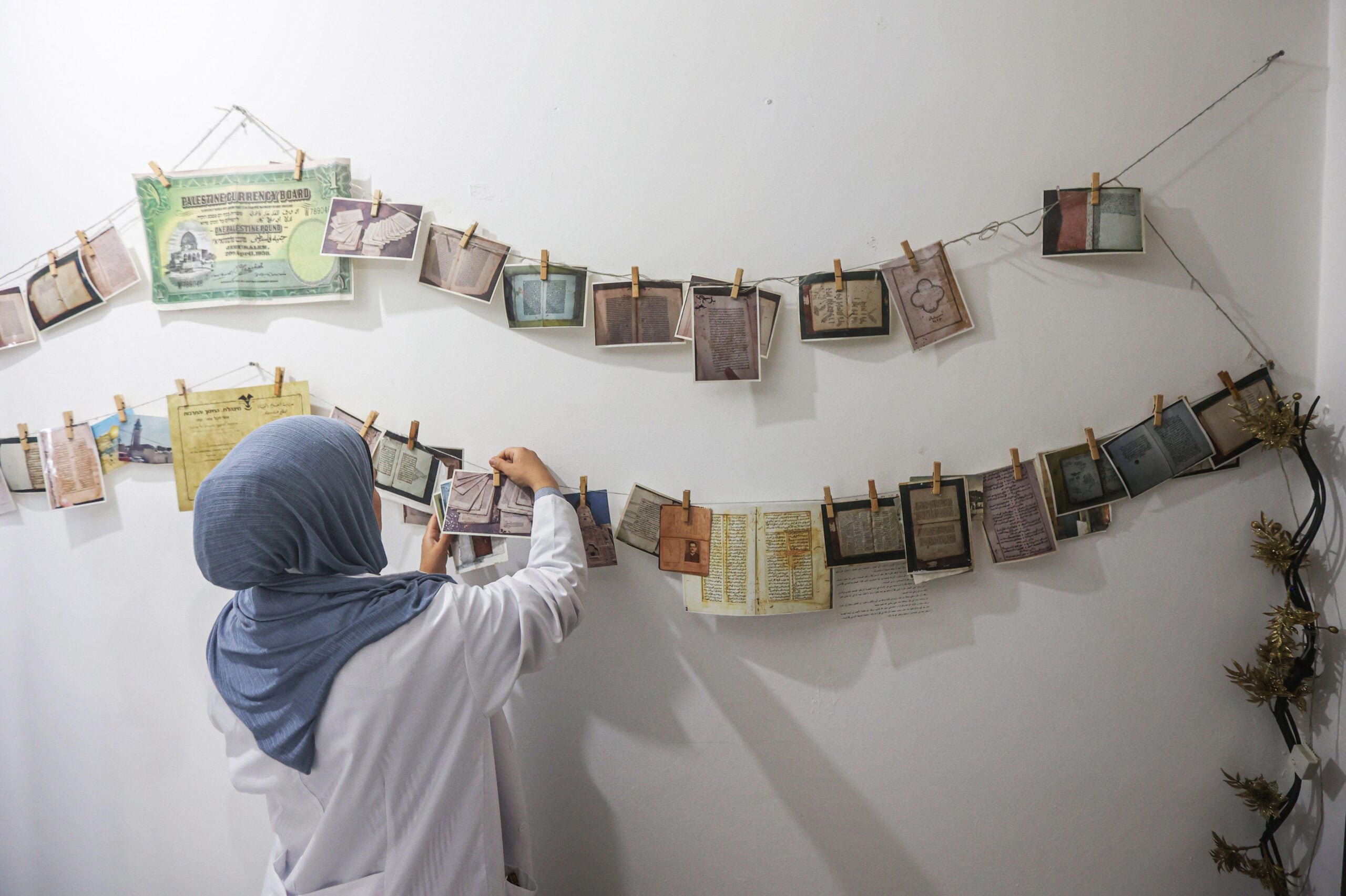
The decimation of Gaza’s universities, libraries, museums, and historical and religious sites by the Israeli military may have caused irreversible damage to the cultural and intellectual fabric of Palestinian society at local, national, and global levels. The destruction of libraries, archives, and museums has resulted in the loss of priceless works of cultural heritage, severing ties to the past and erasing records of Palestinian identity and history that go back hundreds of years. Tens of thousands of students are unable to continue their studies or complete their degrees due to the complete devastation of universities.
In particular, the deaths or exile of writers, artists, scholars, and cultural producers represent an irreplaceable loss —one that diminishes our shared cultural diversity and the preservation of history. Jouda, the writer who fled Gaza with his family after his home was completely destroyed in the Israeli bombardment, talked about the “many intellectuals, poets, and writers … . We lost a significant number of friends who were killed . . . without any justification.”45Interview by PEN America, January 12, 2025 (video call). While this report focuses primarily on the physical destruction of cultural heritage and institutions, PEN America has documented the deaths of at least 151 cultural figures in the war.46These numbers, collected by PEN America from media and other sources, do not purport to be a comprehensive accounting of all the deaths of Palestinian cultural figures and they are likely a significant undercount. The number of cultural figures includes literary writers, poets, filmmakers, playwrights, creative artists, translators, scholars, dramatists, singer-songwriters, historians, and storytellers who were killed between October 7, 2023 and June 2025. The loss to the academic community is no less catastrophic: at least 105 academics have been killed as of mid-2024.47Ibtisam Mahdi, “The decimation of Gaza’s academia is ‘impossible to quantify,’” +972 Magazine, July 26, 2024, 972mag.com/gaza-academia-destruction-universities/
In particular, the deaths or exile of writers, artists, scholars, and cultural producers represent an irreplaceable loss —one that diminishes our shared cultural diversity and the preservation of history.
Mosab Abu Toha, a Palestinian writer, poet, scholar, and librarian, is the founder of the Edward Said Public Library, the first English-language library in Gaza.48“Edward Said Public Library,” Edward Said Public Library, accessed December 6, 2024, web.archive.org/web/20241108105804/https://espl.ps/?lang=en He conceptualized the project in 2014 after walking through the ruins of the Islamic University of Gaza, where books were damaged in an Israeli airstrike.49Mohamad El Chamaa, “Gazans mourn loss of their libraries: cultural beacons and communal spaces,” The Washington Post, December 1, 2023, washingtonpost.com/world/2023/11/30/gaza-library-palestinian-culture/ The library, opened in 2017, was a vital space for literature and art, helping people in Gaza learn and connect. Three days after a ceasefire between Israel and Hamas was announced on January 19, 2025, eyewitnesses returning to Beit Lahia in north Gaza confirmed to Abu Toha that the library had been destroyed.50Mosab Abu Toha (@mosab_abutoha), “(Photos of after and before),” Instagram, January 22, 2025, instagram.com/p/DFIk0IlOLo8/?img_index=1
In October 2023, Abu Toha lost 31 family members in a single Israeli airstrike, and the home where his parents, brothers, and his family lived was destroyed.51Elisabeth Egan, “For a Raw Portrait of War, Look to Palestinian Poets,” The New York Times, November 22, 2024, nytimes.com/2024/11/22/books/palestinian-poets.html51 Attempting to flee Gaza with his wife and three young children after seeking shelter first in the Jabalia refugee camp and then in a school being used to shelter displaced Palestinians, both of which were bombed, he was detained and assaulted by Israeli soldiers.52Mosab Abu Toha, interview by Terry Gross, “‘My losses started the day I was born’: A poet on what it’s like to call Gaza home,” Fresh Air, NPR, October 15, 2024, npr.org/2024/10/15/nx-s1-5153581/gaza-israel-palestinian-poet-mosab-abu-toha He now lives in exile in the United States. He continues to write, he says, because, “Writing poetry is not a luxury. I’m writing poems as I pull memories from under the rubble of my bombed house.”53Mosab Abu Toha (@MosabAbuToha), “Writing poetry is not a luxury. I’m writing poems as I pull memories from under the rubble of my bombed house,” X, January 22, 2024, x.com/MosabAbuToha/status/1749530183038886227
Writing poetry is not a luxury. I’m writing poems as I pull memories from under the rubble of my bombed house.
Mosab Abu Toha, a Palestinian poet, scholar, and librarian of the Edward Said Public Library. In November 2023, he was detained by Israeli forces at a military checkpoint in Gaza after they identified him using facial recognition technology.54Sheera Frankel, “Israel Deploys Expansive Facial Recognition Program in Gaza,” The New York Times, March 27, 2024, nytimes.com/2024/03/27/technology/israel-facial-recognition-gaza.html Israeli soldiers took him out of Gaza to a detention camp in southern Israel before releasing him without charge after several days.55Mosab Abu Toha, “A Palestinian Poet’s Perilous Journey Out of Gaza,” The New Yorker, December 25, 2023, newyorker.com/magazine/2024/01/01/a-palestinian-poets-perilous-journey-out-of-gaza He now lives in exile in the United States.
The loss of Palestinian writers and artists killed in the war, and the exile of others, will have a far reaching impact on the Palestinian cultural landscape. Palestinian writers, artists, and scholars are not only important voices at the center of Gaza’s intellectual community but also essential carriers of the Palestinian story, identity, and collective memory. Artist Maisara Baroud has been posting black-and-white drawings on social media to let his friends know he is still alive.56See Maisara Baroud (@maisarart), Instagram, instagram.com/maisarart/?hl=en His project, titled “Still Alive,” now includes hundreds of works, reflecting life under siege, repeated displacement (over a dozen times), and severe hardship.57Bethan McKernan, “‘It felt like death was chasing us’: one Gaza family’s attempt to evade Israeli strikes – visualised,” The Guardian October 5, 2024, theguardian.com/world/ng-interactive/2024/oct/05/it-felt-like-death-was-chasing-us-one-gaza-familys-attempt-to-evade-israeli-strikes-visualised He told PEN America, “We can rebuild everything that was destroyed by the war, whether official or private cultural institutions, mosques, churches, hospitals, universities, [and] schools . . . but who will restore the soul if it has left the body?”58Maisara Baroud, interview by PEN America, September 27, 2024 (written).
We can rebuild everything that was destroyed by the war, whether official or private cultural institutions, mosques, churches, hospitals, universities, [and] schools . . . but who will restore the soul if it has left the body?
Maisara Baroud, a Palestinian artist whose project titled “Still Alive,” documents life under siege, over a dozen displacements, and severe hardship in Gaza.
The writers, artists, and other cultural figures who are still alive in Gaza face insurmountable barriers to maintaining their cultural lives and carrying on their work. Jouda described the challenges he faced: “The bombing was so random and widespread that we heard of entire areas being destroyed. For months, we were unable to meet, and the possibility of gathering seemed impossible due to the constant threat of being bombed.”59Interview by PEN America, January 12, 2025 (video call).
Relevant Legal Standards
The 1954 Hague Convention for the Protection of Cultural Property in the Event of Armed Conflict (the 1954 Hague Convention) is the most important international treaty governing the protection of cultural heritage during armed conflict and in the aftermath of military operations.60Even before the adoption of the 1954 Hague Convention for the Protection of Cultural Property in the Event of Armed Conflict, international law clearly protected cultural property as civilian property and could not be subject to direct attack or indiscriminate targeting. It obligates states to protect cultural property in their own territory, as well as in occupied territories. It prohibits the use of cultural property for military purposes and mandates that it be safeguarded from damage or destruction. The convention also establishes the concept of “protected cultural property,” which includes monuments, works of art, libraries, archives, and other items of cultural significance. The government of Israel ratified the 1954 Hague Convention in 1957. Palestine acceded to the convention in 2012.61“Accession” is the act whereby a state accepts the offer or the opportunity to become a party to a treaty already negotiated and signed by other states. It has the same legal effect as ratification. “Ratification” is the international act whereby a state indicates its consent to be bound to a treaty.
The First Protocol to the Hague Convention, also adopted in 1954, provides additional protections for cultural property, including during occupation. The Second Protocol to the Hague Convention was adopted in 1999. It establishes stricter penalties for the destruction or theft of cultural property and provides guidelines for the criminal prosecution of individuals involved in such acts. It also introduces the concept of “military necessity” as a limited justification for the targeting of cultural property, making clear that cultural sites are off-limits unless they are used for military purposes. Israel acceded to the First Protocol in 1958, while Palestine acceded in 2012. Palestine acceded to the Second Protocol in 2012.
In addition to the 1954 Hague Convention and associated protocols, the laws of war, formally known as international humanitarian law, seek to prevent unnecessary human suffering and are generally applicable when destruction of civilian property, including cultural heritage and cultural institutions, is concerned.62International Committee of the Red Cross, Customary International Humanitarian Law, ihl-databases.icrc.org/en/customary-ihl These rules apply in all wars and they are binding on all sides to the conflict, including state and non-state actors, and even if the other side violates the rules. International human rights law also remains applicable during war.
The relevant laws that govern the conduct of armed conflict and the applicable human rights standards are discussed in more detail in Appendix 1.
PEN America’s research has identified several tactics, described below, that appear to contribute to the magnitude of cultural destruction and that amount to violations of IHL and international human rights law, constituting war crimes.
Use of Explosive Weapons With Wide Area Effects
Gaza is one of the most densely populated areas in the world. On the eve of October 7, 2023, an estimated 2.3 million people were living there, in an area of just 140 square miles. A New York Times investigation in December 2023 showed that Israel routinely used 2,000-pound bombs in areas of southern Gaza that it had designated as safe zones, which created craters measuring at least 40 feet across.63Robin Stein, Haley Willis, Ishaan Jhaveri, Danielle Miller, Aaron Byrd, and Natalie Reneau, “A Times Investigation Tracked Israel’s Use of One of Its Most Destructive Bombs in South Gaza,” The New York Times, December 21, 2023, nytimes.com/2023/12/21/world/middleeast/israel-gaza-bomb-investigation.html Other investigations documented cases where the use of 2,000-pound bombs caused a high number of civilian casualties in Gaza.64For a summary, see: “MK-84 and other 2,000-pound bombs,” Responsible Statecraft, October 15, 2024, responsiblestatecraft.org/biden-letter-to-israel/ The use of these weapons also contributed to the damage and destruction of a variety of cultural heritage sites, universities, libraries, and museums.
In November 2023, a group of U.N. human rights experts raised concerns about “the use of powerful weaponry with inherently indiscriminate impacts, resulting in a colossal death toll and destruction of life-sustaining infrastructure.”65“Gaza: UN experts call on international community to prevent genocide against the Palestinian people,” Office of the U.N. High Commissioner for Human Rights, November 16, 2023, ohchr.org/en/press-releases/2023/11/gaza-un-experts-call-international-community-prevent-genocide-against
Weakened Safeguards for Civilians and Civilian Infrastructure, Including Cultural Heritage
On October 7, 2023, the day of the Hamas-led attack, the government of Israel changed its rules of engagement, explicitly weakening safeguards intended to protect civilians and by extension, civilian infrastructure, including cultural heritage. According to a New York Times investigation, these changes included adopting “flawed methods to find targets and assess the risk of civilian casualties; routinely fail(ing) to conduct post-strike reviews of civilian harms or punish officers for wrongdoing; and ignor(ing) warnings from within its own ranks and from senior U.S. military officials.”66Patrick Kingsley, Natan Odenheimer, Bilal Shbair, Ronen Bergman, John Ismay, Sheera Frenkel, and Adam Sella, “Israel Loosened Its Rules to Bomb Hamas Fighters, Killing Many More Civilians,” The New York Times, December 26, 2024, nytimes.com/2024/12/26/world/middleeast/israel-hamas-gaza-bombing.html The government of Israel also expanded its policy of “targeted” assassinations to include junior Hamas operatives, increasing the civilian damage it deems acceptable in its proportionality analyses in attacks.67Kingsley, Odenheimer, Shbair, Bergman, Ismay, Sheera Frenkel, and Adam Sella, “Israel Loosened Its Rules to Bomb Hamas Fighters, Killing Many More Civilians.”
As a result of this change in policy, civilian infrastructure and cultural objects have been destroyed. Some buildings were targeted by the Israeli military because Palestinian militants had used them as a base for military activity.68However, a legitimate military object is one where attacking it would provide a definite military advantage “in the circumstances ruling at the time.” Attacking any civilian building where Hamas had militants present at one point, after they have already left, is unlikely to be lawful. See International Committee of the Red Cross, Customary International Humanitarian Law, “Rule 8, Definition of Military Objectives,” https://ihl-databases.icrc.org/en/customary-ihl/v1 According to a statement from an IDF spokesperson, “damage to sensitive sites must be approved by senior commanders who take into account the impact of the damage to the structure on the civilian population, and this in the face of the military need to attack or demolish the structure.”69Oren Ziv, “‘I’m bored, so I shoot’: The Israeli army’s approval of free-for-all violence in Gaza,” +972 Magazine, July 8, 2024, 972mag.com/israeli-soldiers-gaza-firing-regulations/ However, interviews with soldiers show that such approval is seldom denied.70Ziv, “The Israeli army’s approval of free-for-all violence in Gaza.”; Kingsley, Odenheimer, Shbair, Bergman, Ismay, Sheera Frenkel, and Adam Sella, “Israel Loosened Its Rules to Bomb Hamas Fighters, Killing Many More Civilians.”
Adil Haque, professor of international law at Rutgers Law School, said in an interview with PEN America, “I do think that the Israeli military’s interpretation of IHL is extremely permissive and is designed to allow the military to inflict maximum damage and to consider as many things as possible to be military objectives, and to assign the highest possible value to military advantage.”71Adil Haque, professor of international law at Rutgers Law School, interview by PEN America, August 30, 2024 (video call). Professor Haque’s view is shared by Yesh Din, an Israeli human rights organization, which stated that “Israeli decision makers inside the government and the military, who are directly responsible for Israel’s use of force policy, have significantly expanded the harm caused to innocent civilians and civilian infrastructure.”72“The General Staff whitewashing mechanism: The Israeli law enforcement system and breaches of international law and war crimes in Gaza,” Yesh Din, July 9, 2024, yesh-din.org/en/the-general-staff-whitewashing-mechanism-the-israeli-law-enforcement-system-and-breaches-of-international-law-and-war-crimes-in-gaza/; according to the Office of the U.N. High Commissioner for Human Rights, “Israel’s stated intention to destroy ‘Hamas’ governance capabilities,’ and its targeting of civilian infrastructure and civilian administrators of the de facto authorities, indicated that targeting was expanded to a degree that could amount to the direct targeting of civilians and civilian objects,” see “Six-month update report on the human rights situation in Gaza: 1 November 2023 to 30 April 2024,” Office of the U.N. High Commissioner for Human Rights, 10.
Controlled Detonations
This report documents controlled demolitions at Al-Azhar and Al-Israa universities. Israeli forces’ destruction of civilian buildings after they had taken effective control of the premises appears to violate the Fourth Geneva Convention’s prohibition on the destruction of property without military necessity.73The Geneva Conventions do not mention cultural property but give the same protection to cultural property as they do to civilian property, meaning it cannot be targeted and “extensive destruction and appropriation of property, not justified by military necessity and carried out unlawfully and wantonly” is a grave breach of article 147 of the Geneva Conventions The Israeli government can only argue that the destruction was justified if it demonstrates that it was absolutely necessary and proportionate.74In both the cases of Al-Azhar’s Al-Mughraqa campus and Al-Israa’s Al-Zahra campus, Amnesty International’s investigation concluded that the Israeli military was in control at the time of the destruction. See “‘You Feel Like You Are Subhuman’: Israel’s Genocide Against Palestinians in Gaza,” Amnesty International, December 5, 2024, 222, amnesty.org/en/documents/mde15/8668/2024/en/ Roger O’Keefe, a professor of international law at Bocconi Law School in Milan and a foremost expert on the protection of culture during armed conflict, explained that the key question about military necessity would be, “Is there any feasible alternative? This is the real question.” He added, “Necessary means necessary, as distinct from convenient or mildly advantageous. So that test has to be taken really seriously. Is there a feasible alternative to the specific military action you are taking? It’s really the question of alternatives for obtaining a similar military advantage.”75Roger O’Keefe, interview by PEN America, September 18, 2024 (video call). It should be noted that Professor O’Keefe did not make this comment about any specific incident but rather was speaking in general about the legal standard. See also ICRC, “The principles of humanity and necessity,” icrc.org/sites/default/files/wysiwyg/war-and-law/02_humanity_and_necessity-0.pdf
Rhetoric by Israeli Officials
From an early stage in the war, concerns have been expressed that official rhetoric from some Israeli officials demonstrates the government of Israel’s policy and intent; in particular, that the language used by some government and military officials not only reflects dehumanization of Palestinian civilians, but may also help enable and legitimize the commission of grave crimes under international law.
On October 13, 2023, the International Committee of the Red Cross warned that “the parties must not neglect their legal obligations regarding the methods and means used to wage war.” This warning came amid incendiary rhetoric by Israeli government leaders, including at the highest levels of government and from some of the most senior officials during the already intense assault on Gaza.76Chantal Da Silva, “‘Nakba 2023’: Israel right-wing ministers’ comments add fuel to Palestinian fears,” NBC News, November 13, 2023, nbcnews.com/news/world/gaza-nakba-israels-far-right-palestinian-fears-hamas-war-rcna123909 This damaging rhetoric has continued throughout the war.
For example, Prime Minister Benjamin Netanyahu stated on October 7, 2023: “All the places where Hamas is organized, of this city of evil, all the places where Hamas hides, operates from—we will turn them into cities of ruins.”77Tovah Lazaroff, “Netanyahu: Gazans should flee, IDF to avenge ‘black day,’” The Jerusalem Post, October 7, 2023, jpost.com/arab-israeli-conflict/article-763179 In December 2023, he said, “This is a battle, not only of Israel against these barbarians, it’s a battle of civilization against barbarism.”78“Christmas message from PM Netanyahu,” Ministry of Foreign Affairs of Israel, December 24, 2023, gov.il/en/pages/christmas-message-from-pm-netanyahu-24-dec-2023
On October 9, 2023 then-Minister of Defense Yoav Gallant said, “We will end things inside Gaza . . . I have removed all restraints, attack everything, kill those who fight us, whether there is one terrorist or there are hundreds of terrorists, through the air, land, with tanks, with bulldozers, by all means, there are no compromises. Gaza will not return to what it was.”79“Database of Israeli Incitement to Genocide, 15 January 2024, Decision Makers,” Law for Palestine, January , 2024, law4palestine.org/wp-content/uploads/2024/01/1-Database-of-Israeli-Incitement-to-Genocide-15th-January-2024-DECISION-MAKERS.pdf (accessed Dec. 27, 2024), quote from Yoav Gallant, “The Patriots,” Channel 14 YouTube channel, episode posted October 9, 2023, 19:38–20:17. Additional examples are detailed in Mathu Joyini, permanent representative of South Africa to the UN, Letter dated 29 May 2024 from the Permanent Representative of South Africa to the United Nations addressed to the President of the Security Council,.
President Isaac Herzog made clear that he was not interested in differentiating between militants and civilians in Gaza, saying at a press conference to foreign media on October 12, 2023: “It’s an entire nation out there that is responsible. This rhetoric about civilians not aware, not involved – it’s absolutely not true. […] and we will fight until we break their backbone.”80“Israeli president accused of genocidal incitement will attend opening of Dutch Holocaust Museum,” The Rights Forum, March 7, 2024, https://rightsforum.org/en/israeli-president-accused-of-genocidal-incitement-will-attend-opening-of-dutch-holocaust-museum/
On May 6, 2025, Finance Minister Bezalel Smotrich, said that “Gaza will be entirely destroyed.”81Jason Burke and Julian Borger, “Gaza will be entirely destroyed, Israeli minister says,” The Guardian, May 6, 2025, theguardian.com/world/2025/may/06/hamas-israel-hunger-war-in-gaza
According to Diakonia International Humanitarian Law Centre, an expert group promoting respect for the laws of war, statements by senior Israeli political and military officials “demonstrate alarming disregard for the IHL rules designed to protect civilians from the ravages of war and . . . reveal reckless indifference to civilian suffering or even a desire to inflict harm on civilians.”82“Legal Brief on the 2023 Hostilities in Israel and Gaza,” Diakonia International Humanitarian Law Centre, December 5, 2024, 37, diakonia.se/ihl/news/legal-brief-on-the-2023-hostilities-in-israel-and-gaza/
Incidents of Cultural Destruction
It is difficult to obtain an accurate picture of the extent and magnitude of cultural destruction in Gaza because the government of Israel refuses to allow international journalists or independent experts to enter Gaza. UNESCO released a preliminary damage assessment in May 2025 conducted through remote monitoring since it cannot conduct on the ground assessments. UNESCO verified damage to 110 sites since October 7, 2023, including: 13 religious sites, 77 buildings of historical or artistic interest, 3 depositaries of movable cultural property, nine monuments, one museum and seven archeological sites.83“Gaza Strip, Damage Assessment,” UNESCO, May 28, 2025, unesco.org/en/gaza/assessment
The sites highlighted in this report do not represent all the sites that have been damaged or destroyed, but they do represent some of the most significant cultural and educational institutions in Gaza. They were also selected on the basis of the availability of credible information about the circumstances of their destruction. Where available, PEN America included information from the IDF about the rationale and justifications for attacks.
Libraries, Bookstores and Archives
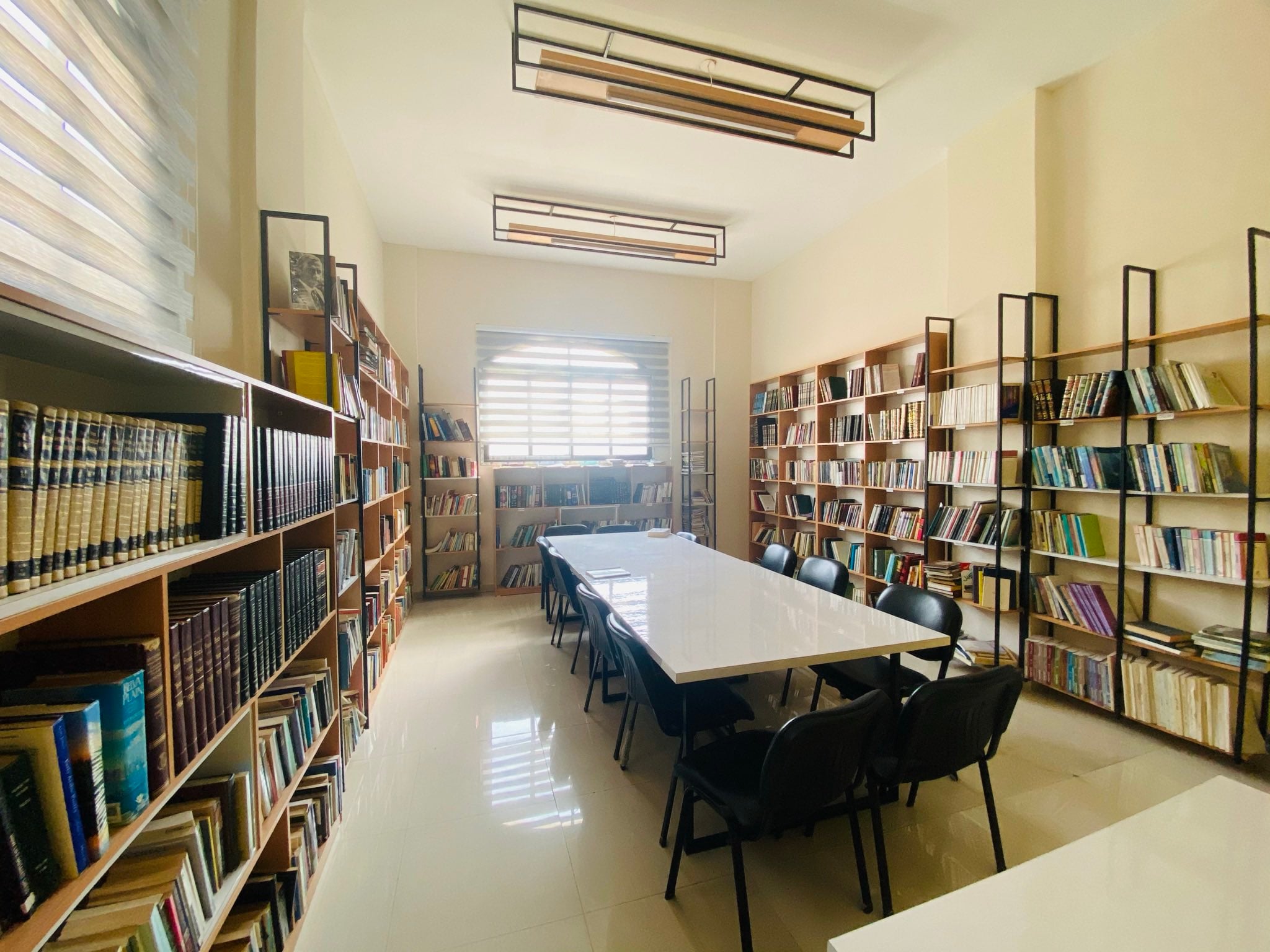
According to a 2010 survey by the Palestinian Central Bureau of Statistics, the most recent figures available, there were at least 13 libraries in Gaza.84Mohamed El Chamaa, “Gazans mourn loss of their libraries: Cultural beacons and communal spaces,” The Washington Post, December 1, 2023, washingtonpost.com/world/2023/11/30/gaza-library-palestinian-culture/ A report published in February 2024 (and subsequently updated) listed damage or complete destruction to 11 libraries, including the Gaza Municipal Library and the Edward Said Library.85“Israeli Damage to Archives, Libraries, and Museums in Gaza, October 2023–January 2024,”Librarians and Archivists with Palestine, February 1, 2024, librarianswithpalestine.org/gaza-report-2024/#libraries
The Third Preliminary Report on the Cultural Sector’s Damages, prepared by the Palestinian Ministry of Culture in January 2024, stated that eight publishing houses and printing presses and six public libraries had been affected by the war.86“The Third Preliminary Report on Cultural Sector’s Damages: The War on the Gaza Strip October 7, 2023 – January 7, 2024,” The Palestinian Ministry of Culture, January 7, 2024, palestineembassy.ie/wp-content/uploads/2024/01/The-Third-Preliminary-Report-on-the-cultural-Sectors-Damage-Gaza.pdf
Gaza Public Library
On November 27, 2023, during a short-term ceasefire between Israel and Hamas, the Municipality of Gaza confirmed the destruction of the Municipal Library building, stating that “targeting cultural centers aims to spread a state of ignorance in society.”87Municipality of Gaza (@munigaza), “It was affirmed that targeting cultural centers aims to spread a state of ignorance in society, the Gaza Municipality condemns the occupation’s destruction of the public library and the execution of thousands of books and documents,” X, November 27, 2023, x.com/munigaza/status/1729093364191203703 The library was founded in 1999 with funding from the World Bank; it contained 10,000 books in Arabic, English, and French. The library was in regular use by members of the community, including by schoolchildren, before the conflict broke out. “The library was a true beacon of culture in Gaza,” said Nasser al-Suwair, the former media director of the municipality.88Zainab Dabaa, “Gaza municipal library bombing ‘aims to destroy city’s memory and heritage,’” BBC Arabic, January 8, 2024, bbc.com/arabic/articles/cxe6d1lrz28o According to municipal authorities, the library was destroyed by an Israeli airstrike, but the precise date of the strike was unknown because many parts of Gaza were inaccessible during the fighting.89Mohamed El Chamaa, “Gazans mourn loss of their libraries: Cultural beacons and communal spaces,” The Washington Post, December 1, 2023, washingtonpost.com/world/2023/11/30/gaza-library-palestinian-culture/ The destruction of the library became known during a pause in the fighting in November 2024. The Washington Post reported that the IDF, asked to comment, did not address whether it had hit the library.90Mohamed El Chamaa, “Gazans mourn loss of their libraries: Cultural beacons and communal spaces,” The Washington Post, December 1, 2023, washingtonpost.com/world/2023/11/30/gaza-library-palestinian-culture/
Gaza City Archives
Gaza City’s Central Archives—containing 110,000 historical documents, maps, contracts, land ownership documents, photos, and more—were completely destroyed by Israeli airstrikes, according to the Gaza municipality.91Municipality of Gaza, “The archive contains documents dating back more than 100 years,” Facebook, November 29, 2023, facebook.com/munigaza/posts/690220183213268; See also Rula Shahwan, “The Gaza Archive and the ongoing destruction,” March 2024, Institute for Palestine Studies, Beirut, 2, palestine-studies.org/sites/default/files/attachments/policypapers/ورقة%20رلى%20شهوان%20063%20%281%29_0.pdf (in Arabic). In a video statement recorded November 29, 2023, Gaza City Mayor Yahya al-Sarraj said that on October 27 the IDF phoned the municipality and ordered it to evacuate the area. “The Central Archives building was directly hit, causing the burning of historically significant documents dating back over 150 years,” the mayor said, adding, “This destruction was particularly hard for us because it holds the memory of Gaza City.”92Dania Akkad, “100 days of war in Gaza: More than 23,000 dead and a society in ruins,” Middle East Eye, January 13, 2024, middleeasteye.net/news/gaza-war-100-days-more-than-23000-dead-society-ruins Researcher Rula Shahwan wrote that the archive was “an indispensable source of . . . information that documents past events and their outcomes, and is of great importance for understanding the city’s development over time. It also serves as a valuable resource for analyzing decisions made in the past, present, and future.”93Shahwan, “The Gaza Archive and the ongoing destruction.” See also “‘You Feel Like You Are Subhuman’: Israel’s Genocide Against Palestinians in Gaza,” Amnesty International, 217–219.
Edward Said Public Library
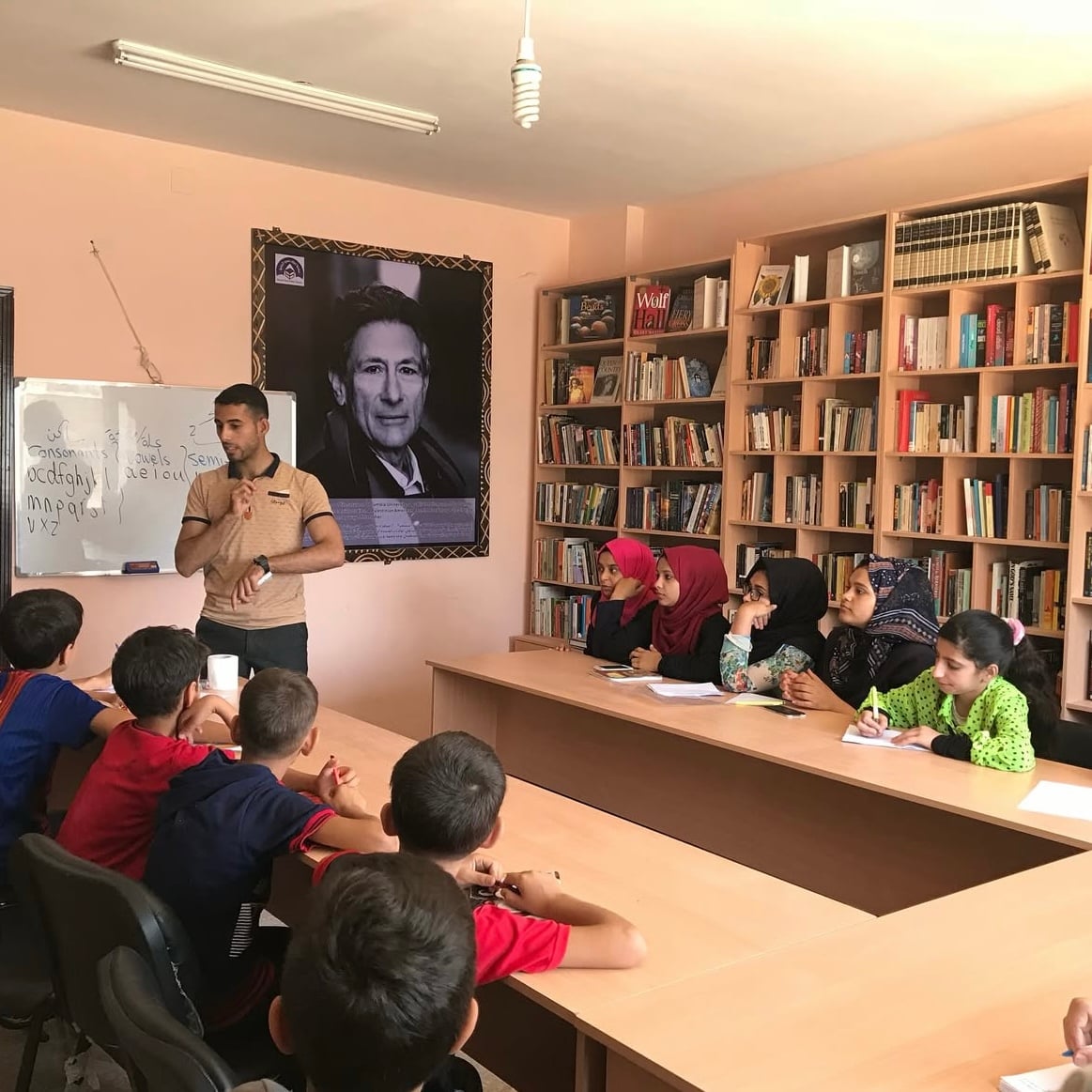
Founded in 2017 by poet Mosab Abu Toha, the Edward Said Public Library in Beit Lahia was Gaza’s first English-language library.94“Rescued from Rubble: Founding the Edward Said Public Library in Gaza,” The Center for Middle Eastern Studies | Harvard University, April 2020, cmes.fas.harvard.edu/event/rescued-rubble-founding-edward-said-public-library-gaza Abu Toha started learning English in fifth grade in Gaza, excelling in the subject and later majoring in teaching and literature at university; but, like many other Palestinian students in Gaza, he was never able to buy an original copy of any English-language book, in large part because the Israeli closure of Gaza imposes restrictions on the movement of goods.95Mosab Abu Toha, “Founding the First English-Language Library in Gaza,” LitHub, May 19, 2022, lithub.com/founding-the-first-english-language-library-in-gaza/ The Edward Said Public Library was part of Abu Toha’s vision to make literature a part of the city’s life, and to connect Palestinians in Gaza to the rest of the world.96“Edward Said Public Library: The Story of a Book Found Under Ruins,” College of Social and Behavioral Sciences at the University of Arizona, February 2020, sbs.arizona.edu/events/edward-said-public-library-story-book-found-under-ruins
On January 22, 2025, three days after the start of the January 2025 ceasefire, eyewitnesses who were able to return to the north of Gaza after months of displacement confirmed the destruction of the founding branch of the Edward Said Public Library in Beit Lahia.97Mosab Abu Toha (@mosab_abutoha), “(Photos of after and before),” Instagram. The destruction of the library’s second branch, opened in 2019 in Gaza City, was reported to Abu Toha several months earlier, the exact date of the destruction is unknown.98Mosab Abu Toha (@mosab_abutoha), “Statement on the destruction of the Edward Said Public Library in Gaza,” Instagram, January 22, 2025, instagram.com/p/DFJjwY1PA3m/?img_index=1 In a statement, Abu Toha wrote, “It took me around eight weeks to receive each box of books that friends and supporters were sending from the United States and Europe. A few people were sending a selection of books from their own home libraries, and I was planning to name certain shelves in the library in Gaza after them.” He added, “All the dreams that I and friends in Gaza and abroad were drawing for our children have been burnt by Israel’s genocidal campaign to erase Gaza and everything that breathes of life and love.”99Mosab Abu Toha (@mosab_abutoha), “Statement on the destruction of the Edward Said Public Library in Gaza,” Instagram.

Samir Mansour Bookstore
The three story Samir Mansour bookstore was severely damaged during an airstrike on October 10, 2023.100Sherouk Zakaria, “Gaza’s iconic bookshop damaged again in Israeli strike,” Arab News, October 13, 2023, arabnews.com/node/2390636/middle-east It had only recently been rebuilt with donations from a global fundraising campaign following the extensive damage it suffered after a May 2021 Israeli airstrike.101Alison Flood, “‘More than wonderful’ … Gaza bookshop to reopen after unexpectedly successful global campaign,” The Guardian, January 28, 2022, theguardian.com/books/2022/jan/28/gaza-samir-mansour-bookshop-reopening-after-global-campaign According to media reports, the bookstore contained a collection of thousands of books that included children’s fiction, science, philosophy, history, fiction and poetry.102Sherouk Zakaria, “Gaza’s iconic bookshop damaged again in Israeli strike,” Arab News, October 13, 2023, arabnews.com/node/2390636/middle-east
Al‑Nahda Press and Library
The Al‑Nahda Press and Library, based in northern Gaza, was a major cultural and educational institution and served as a key component of Gaza’s printing infrastructure. It printed school textbooks, university materials, and official documents for both local and international institutions. The Palestinian Ministry of Culture’s preliminary damage assessment report to UNESCO in December 2023 noted the destruction of the building.103“The Second Preliminary Report on Cultural Sector Damage: War on the Gaza Strip October 7, 2023 – December 6, 2023,” The Palestinian Ministry of Culture, December 6, 2023, arablit.org/wp-content/uploads/2023/12/English-.pdf
Universities
Higher education holds a special place in the intellectual and cultural life of Gaza. In the absence of opportunities and with severe restrictions on movement in and out of the territory, education provides a pathway to advancement for young people, a window onto the outside world, and a site of learning, professionalization, and inter-cultural exchange. Palestinians from Gaza are generally not permitted to travel to the West Bank to study at universities there, further restricting their access to education.104“Gaza Up Close,” Gisha, June 28, 2023, features.gisha.org/gaza-up-close/
Akram Lilja, a cultural heritage expert and the former director general of the Palestinian department of archeology, told PEN America that inter-cultural exchange projects within Gaza’s universities cultivated “tolerance, understanding, education, and open mindedness under conditions of closure.”105Akram Lilja, interview by PEN America, August 13, 2024 (video call). Gaza’s universities graduated many women, providing them with spaces to study and opportunities to work outside the home, exposing them to new role models, and nurturing their aspirations.106For example, in the Gaza Governorate in 2022, 25.5 percent of women had some post-secondary education, compared to 24.5 percent of men. See Palestine Central Bureau of Statistics, “Percentage Distribution of Individuals (15 years and above) in Palestine by Sex, Educational Attainment and Governorate, 2022,” pcbs.gov.ps/Portals/_Rainbow/Documents/Education2022-16E.html Before the conflict, 57 percent of students at the first university to be founded in the Gaza Strip, the Islamic University, were female, as were 65 percent of students at Al-Israa University.107Linah Mohammad, “Children make up nearly half of Gaza’s population. Here’s what it means for the war,” NPR, October 19, 2023, npr.org/2023/10/19/1206479861/israel-gaza-hamas-children-population-war-palestinians; Lennard, “No University Left Standing in Gaza,” (at 2:50).
The IDF has partly or completely destroyed all of Gaza’s universities and colleges,108Liam Stack and Bilal Shbair, “With Schools in Ruins, Education in Gaza Will Be Hobbled for Years,” The New York Times, May 6, 2024, nytimes.com/2024/05/06/world/middleeast/gaza-schools-damaged-destroyed.html; Refaat Ibrahim, “Gaza had educational justice. Now the genocide has wiped that out, too,” Al Jazeera, April 19, 2025, aljazeera.com/opinions/2025/4/19/gaza-had-educational-justice-now-the-genocide-has-wiped-that-out-too including the Islamic University, Al-Azhar University, Al-Aqsa University, University of Palestine, Al-Israa University, Gaza University, and Al-Quds Open University, leaving nearly 90,000 students largely unable to continue or complete their studies. At least 105 Palestinian academics have been killed. At least two of these scholars, Sofyan Taya and Refaat Alareer, were also targets of harassment and threats.109See the cases of Refaat Alareer and Sofyan Taya as reported in Ibtisam Mahdi, “The decimation of Gaza’s academia is ‘impossible to quantify,’” +972 Magazine, July 26, 2024, 972mag.com/gaza-academia-destruction-universities/ Alareer’s cousin told +972 Magazine that Alareer “had received many death threats online and via mobile phone from Israeli accounts” and that he had also received a phone call from a person who identified himself as an Israeli army officer; he told Alareer that the IDF knew where he was and would assassinate or detain him if he did not stop writing. Taya’s brother told the same magazine that Taya had feared for his life and “expected to be targeted.”110Mahdi, “The decimation of Gaza’s academia is ‘impossible to quantify.’”
The estimated losses due to damage to colleges and universities in Gaza exceed $720 million, according to the human rights documentation group Euro-Med Human Rights Monitor.111“Israel’s demolition of educational institutions, cultural objects in Gaza is additional manifestation of genocide,” Euro-Mediterranean Human Rights Monitor, February 16, 2024, euromedmonitor.org/en/article/6163/Israel’s-demolition-of-educational-institutions,-cultural-objects-in-Gaza-is-additional-manifestation-of-genocide
Gaza’s universities were home to some of its largest libraries. The library at the Islamic University held 130,000 volumes, while the Jawaharlal Nehru Library at Al-Azhar University contained more than 70,000 books. Both were severely damaged as a result of the war.112“The Fourth Preliminary Report on the Cultural Sector’s Damages,” Palestinian Ministry of Culture, 47. On file with PEN America; Video documentation from Al Jazeera further documents the damage to the Islamic University of Gaza library. See Al Jazeera Egypt, “Massive destruction at the Islamic University of Gaza,” Facebook, November 29, 2023, facebook.com/watch/?v=1339154640139148. Gaza’s universities were also home to cultural spaces and museums.
In an April 2024 statement about attacks on schools and universities in Gaza, a group of U.N. experts said, “With more than 80% of schools in Gaza damaged or destroyed, it may be reasonable to ask if there is an intentional effort to comprehensively destroy the Palestinian education system, an action known as ‘scholasticide.’”113“UN experts deeply concerned over ‘scholasticide’ in Gaza,” Office of the U.N. High Commissioner for Human Rights, April 18, 2024, ohchr.org/en/press-releases/2024/04/un-experts-deeply-concerned-over-scholasticide-gaza In May 2024, leaders from the Islamic University of Gaza, Al-Azhar University, and Al-Aqsa University came together to issue an open letter to affirm “their existence and collective determination” to resume teaching at their own institutions, despite the destruction of the higher education sector by the Israeli attacks.114“Emergency Committee of Universities in Gaza,” May 24, 2024, gazauniversities.org The key recommendations in their open letter include public pledges to rebuild Gaza’s universities; immediate support for online instruction; student scholarships and faculty fellowships; support for exiled students; and research cooperation.
The destruction of universities will have serious consequences for students and faculty. “Since the beginning of this war, my university and other universities here in the Gaza Strip were almost destroyed, we are talking not just the structure of the universities was destroyed, also the future of the students . . . were almost destroyed,” Hoda Hijazi, a student at Islamic University told Al Jazeera in a January 2024 interview.115“Gaza University destroyed: Israel accused of targeting education centers,” Al Jazeera English, January 20, 2024, video clip, YouTube, youtube.com/watch?v=nLcEt2L4DYc Dr. Imad Abu Kishek, the president of Al-Quds Open University, told +972 Magazine in July 2024 that the damage cannot yet be determined “while we are losing the essential element, the human beings—academics, technicians, workers, and students—on a daily basis.”116Mahdi, “The decimation of Gaza’s academia is ‘impossible to quantify.’”
Islamic University of Gaza
The Islamic University of Gaza was hit by an Israeli airstrike on October 9, 2023. In a video released by the IDF, four buildings appear to be hit by consecutive targeted air to ground missiles which explode on impact.117Brendan O’Malley and Wagdy Sawahel, “Israel bombs Gaza university, alleging use by military,” Unversity World News, October 12, 2023, universityworldnews.com/post.php?story=20231012162739531; Israel Defense Forces, “The IDF Struck an Important Hamas Operational, Political and Military Center in Gaza—the Islamic University,” press release, October 11, 2023, idf.il/en/mini-sites/idf-press-releases-israel-at-war/october-23-pr/the-idf-struck-an-important-hamas-operational-political-and-military-center-in-gaza-the-islamic-university/. The university said in a statement that the buildings of the Faculty of Information Technology, Community Service and Continuing Education, and the College of Sciences suffered extensive damage and that the university suffered heavy material losses.118The Islamic University of Gaza, “The Islamic University of Gaza suffered severe damage as a result of yesterday’s bombing of Gaza City,” Facebook, October 10, 2023, facebook.com/IUGAZA/posts/pfbid02riGhBicf6Jg2r4YNV9sGss9yewDQRPZ8WbuAjD6ih47emaH5x1GCKQapzxGZfjikl A mosque on campus was also reportedly destroyed.119“Israel’s demolition of educational institutions,” Euro-Mediterranean Human Rights Monitor. In late November, Al Jazeera published video footage showing the extent of destruction of the university, including the library.120“Watch: Photos taken around the Islamic University in Gaza show the extent of the destruction there,” Al Jazeera Arabic, November 28, 2023, video clip (in Arabic), YouTube, youtube.com/watch?v=4hR1EvMaf_s; Al Jazeera Egypt, Facebook (in Arabic), “Massive destruction at the Islamic University of Gaza,” November 29, 2023, facebook.com/watch/?v=1339154640139148; Additional damage at Islamic University was documented on Instagram and published by The Guardian, “Gaza City before and after: footage shows destruction wreaked by war,” Guardian News, November 16, 2023, video clip, YouTube, youtube.com/watch?v=grKsZU2T3Oc
Following the attack, the IDF said that the university was “an important Hamas operational, political and military centre” and claimed that it “was being used as a Hamas training camp for military intelligence operatives, as well as for the development and production of weapons.”121The IDF also claimed that Hamas “used university conferences in order to raise funds for terrorism” and that the university “maintained close ties with the senior leadership of Hamas.” IDF, “The IDF Struck an Important Hamas Operational, Political and Military Center in Gaza—the Islamic University.”
Even if Israeli officers had identified legitimate military targets in specific locations within the Islamic University, the extent of the damage raises concern that Israeli strikes failed to discriminate between specific military objectives and civilian objects, or that they caused disproportionate damage to civilian objects considering the military advantage gained from the strikes. Even if the claim that the university was used to produce weapons is true, assuming this production took place in a confined area, it does not necessarily turn the entire complex into a military objective. The government of Israel is obliged to take civilian damage into account in a proportionality analysis.
On December 2, 2023, the Palestinian Higher Education Ministry announced that the Islamic University’s rector, physics and applied mathematics scholar Sofyan Taya, was killed in an Israeli airstrike in Jabalia with his wife, parents, and five children.122“Israeli air strike in Gaza kills prominent scientist Sufyan Tayeh, Palestinian minsitry says,” Reuters, reuters.com/world/middle-east/israeli-air-strike-gaza-kills-prominent-scientist-sufyan-tayeh-palestinian-2023-12-02/; Mahdi, “The decimation of Gaza’s academia is ‘impossible to quantify.’” According to a report by +972 Magazine, his brother Nabil said that Taya expected to be targeted, “especially after many academic and administrative staff at the Islamic University were assassinated before him.”123Mahdi, “The decimation of Gaza’s academia is ‘impossible to quantify.’” At least 20 other Islamic University professors and deans have been killed in the war, but little is known about the specific circumstances of these deaths.124“Letter condemning the devastating military campaign in Gaza,” Middle East Studies Association, January 25, 2024, mesana.org/advocacy/committee-on-academic-freedom/2024/01/25/letter-condemning-the-devastating-military-campaign-in-gaza
Al-Azhar University
Al-Azhar University also appears to have been a significant target. According to Euro-Med Human Rights Monitor, Al-Azhar suffered Israeli airstrikes on October 11, November 4, and November 21, 2023, and both the university’s headquarters in Gaza City and its Al-Mughraqa branch were heavily damaged.125“Israel’s demolition of educational institutions,” Euro-Mediterranean Human Rights Monitor. University buildings were further damaged in a controlled detonation on December 8, 2023.126“‘You Feel Like You Are Subhuman’: Israel’s Genocide Against Palestinians in Gaza,” Amnesty International, 224.
Videos posted on social media, not verified by PEN America, in early November 2023 show the destruction of the university’s Al-Mughraqa campus by Israeli airstrikes.127Amal Jadou (@AmalJadou7), “URGENT: This is not a nuclear test. This is Israel bombing the campus of Al-Azhar University in #Gaza,” X, November 4, 2023, x.com/AmalJadou7/status/1720799802944840177; “Israeli air strikes target Gaza’s Al-Azhar University,” Middle East Monitor, November 6, 2023, middleeastmonitor.com/20231106-israeli-air-strikes-target-gazas-al-azhar-university/ Satellite images acquired by The New York Times dated between November 30 and December 2, 2023, indicate that there was significant damage to the university’s buildings, and show tanks in the Al-Mughraqa campus courtyard.128Josh Holder “Gaza After Nine Weeks of War,” The New York Times, December 12, 2023, nytimes.com/interactive/2023/12/12/world/middleeast/gaza-strip-satellite-images-israel-invasion.html Photographic and video evidence also shows the damage at Al-Azhar’s main campus in Gaza City.129Ghazal Golshiri, “All 12 universities in Gaza have been the target of Israeli attacks: ‘It’s a war against education,’” Le Monde, March 7, 2024, lemonde.fr/en/international/article/2024/03/07/all-12-universities-in-gaza-have-been-the-target-of-israeli-attacks-it-s-a-war-against-education_6592965_4.html ; Al Azhar University – Gaza [@alazharug]. Instagram, May 19, 2024, instagram.com/reel/C7KTJhvCymC/
An IDF spokesperson update from October 30, 2023, stated that armed militants were identified within the area of Al-Azhar University alongside a station for launching anti-tank missiles, but did not claim that any university buildings were being used by militants. The spokesperson confirmed that an airstrike on that target was launched.130“War Diary – 10/30,” Israel Defense Forces, October 30, 2023, idf.il/אתרי-יחידות/יומן-המלחמה/יומן-המלחמה-תמונת-המצב-לאורך-הימים/יומן-המלמה-חרבות-ברזל-30-10/, “During the night, IDF fighters in the Gaza Strip identified armed terrorists and an anti-tank missile launch position in the area of Al-Azhar University in the Gaza Strip and directed a fighter jet to attack them.” (In Hebrew; Hebrew translation by PEN America, original post reviewed by PEN America and available as archive link).
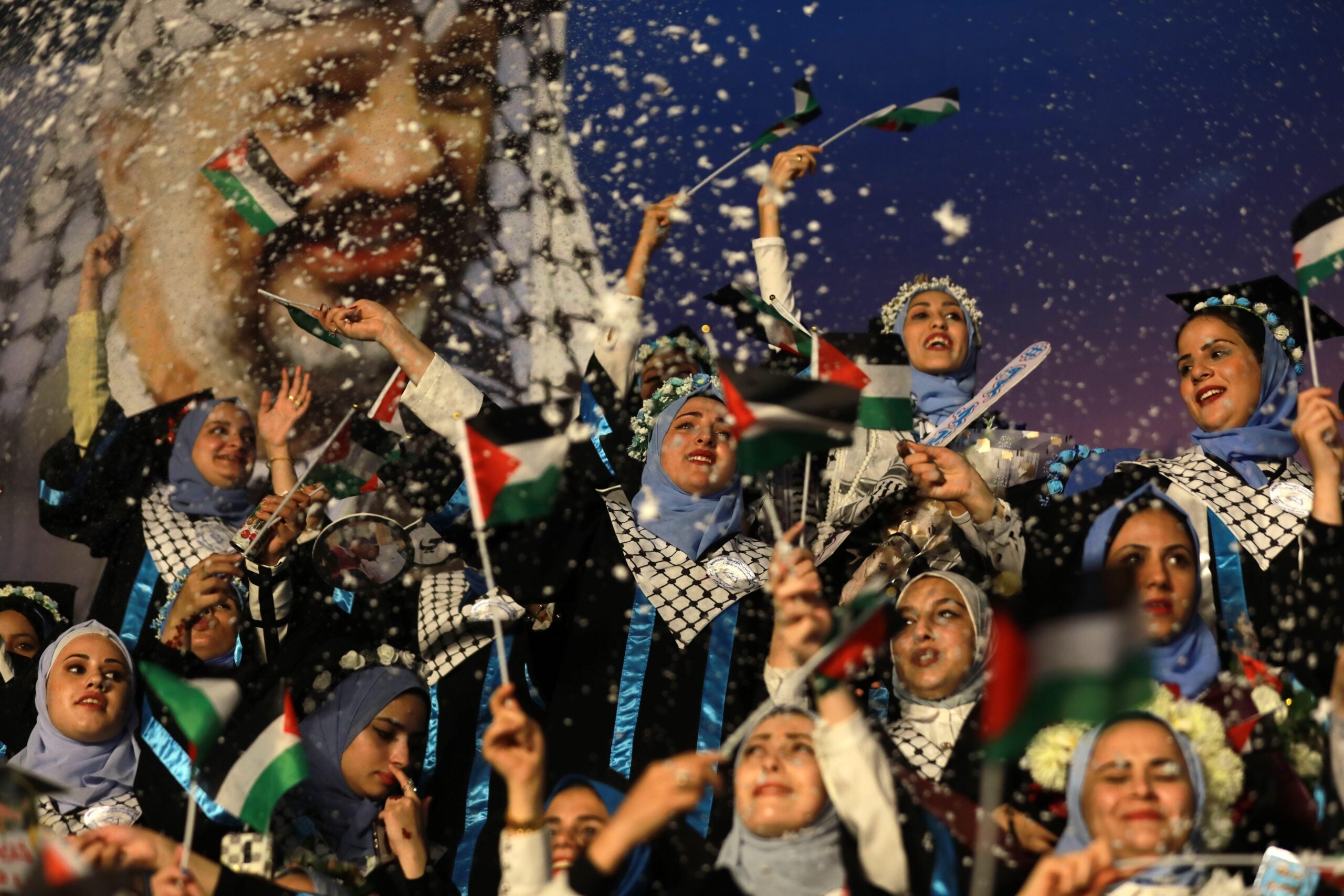
According to an Israeli soldier who spoke to the Israeli NGO Breaking the Silence, which collects testimonies from veteran soldiers, a mosque at Al-Azhar University had been bombed before soldiers entered the area. He said, “When we were inside the university, I don’t know why it pulled at my heartstrings that we had to bomb the mosque [that was on campus]. I wouldn’t want a synagogue to be treated that way, that’s what weighed on me. . . . I can’t say why they bombed where they bombed. In general I think everything was under the suspicion that there were tunnels there.”131PEN America correspondence with Breaking the Silence, December 24, 2024; “When they bombed the university, the mosque was blown up too,” (testimony 347093 concerning the northern Gaza Strip), Breaking the Silence, shovrimshtika.org/testimonies/database/347093 (In Hebrew, English translation by Breaking the Silence).
In addition to the airstrikes, further destruction of university property took place after Israeli forces already had boots on the ground. On December 8, 2023, the IDF spokesperson issued an update saying that troops of the Combat Engineering Corps’ 749th Reserve Battalion destroyed buildings “containing Hamas infrastructure” at Al-Azhar’s Gaza City campus.132However, based on satellite imagery analysis conducted by Amnesty International, it is more likely that these controlled detonations took place at the Al-Mughraqa campus. See “‘You Feel Like You Are Subhuman’: Israel’s Genocide Against Palestinians in Gaza,” Amnesty International, 226. The update shows unverified photos of weapons captured and adds that troops found a tunnel that ran from the university’s yard leading to a school approximately a kilometer away.133“Weapons found in Al-Azhar University,” Israel Defense Forces. On file with PEN America; Emanuel Fabian, “IDF says it destroyed buildings containing Hamas infrastructure at Gaza City’s Al-Azhar University,” Times of Israel, December 8, 2023, timesofisrael.com/liveblog_entry/idf-says-it-destroyed-buildings-containing-hamas-infrastructure-at-gaza-citys-al-azhar-university/ An investigation conducted by Drop Site that included information gathered from IDF soldiers’ social media accounts, provides further indications that the buildings were deliberately detonated by troops already exercising effective control of the area. For example, an operational officer on December 20, 2023, stated in his social media that: “a few days later, we assembled them and booby-trapped one of Gaza’s symbols of the future—Al-Azhar University in the northern part of the strip—and blew it up.”134Younis Tirawi and Sami Vanderlip, “‘Our Job Is to Flatten Gaza. No One Will Stop Us,’” Drop Site News, October 22, 2024, dropsitenews.com/p/israel-749-battalion-demolition-gaza?publication_id=2510348 PEN America previously reviewed the relevant FaceBook posts but they were subsequently removed or made private.
The destruction of buildings at the university cannot be justified by the presence of weapons or even a tunnel once Israeli troops were already in control of the university campus as indicated by the IDF’s statement.135According to reporting by The New York Times, an Israeli sergeant testified that soldiers found five tunnel entrances at Al-Azhar, but it is unclear which campus he was referring to. In any case, at the time that Israeli forces were in control of the campus, it is unlikely that destruction of university buildings was necessary to tackle the tunnel threat, as explained above. See Liam Stack and Bilal Shbair, “With Schools in Ruins, Education in Gaza Will Be Hobbled for Years,” The New York Times, May 6, 2024, nytimes.com/2024/05/06/world/middleeast/gaza-schools-damaged-destroyed.html The destruction of buildings by the Engineering Corps is therefore a potential violation of the prohibition on destruction of property in the Fourth Geneva Convention (Article 53)136Article 53 provides that immunity holds” except where such destruction is rendered absolutely necessary by military operations.” due to the likelihood, given the Israeli military’s apparent control of the area, that there were alternative means to tackle any military threat without the wholesale destruction of civilian buildings.137To justify its destruction of university buildings as military objectives, Israel would need to prove that they were making an effective contribution to military action by Hamas in the circumstances ruling at the time. Otherwise, university buildings would be civilian objects and it would be prohibited to destroy them unless absolutely necessary. According to Amnesty International, even if there were tunnels somewhere on the Al-Mughraqa campus, “the Israeli army should have explored an alternative that would have avoided its destruction, given the university’s protected status as cultural property.” See “‘You Feel Like You Are Subhuman’: Israel’s Genocide Against Palestinians in Gaza,” Amnesty International, 227.
Al-Israa University
In January 2024, Al-Israa University, the last institution of higher education in Gaza that was still intact, was substantially destroyed by Israeli forces. The university housed a library as well as a national museum with more than 3,000 rare archeological artifacts.
A video clip posted on X on January 17, 2024 by Hisham Abu Shaqrah, a cameraman for the Turkish news agency Anadolu Ajansı, shows that the buildings housing the university’s graduate studies and undergraduate programs were destroyed by a controlled detonation.138Hisham Abu Shaqra [@HShaqrah], X/Twitter, January 17, 2024, https://x.com/HShaqrah/status/1747726827991240715; Aaron Boxerman, Arijeta Lajka, and Riley Mellen, “Israel’s military says it will review its demolition of a university building in Gaza,” The New York Times, January 22, 2024, https://www.nytimes.com/live/2024/01/22/world/israel-hamas-gaza-news/israels-military-says-it-will-review-its-demolition-of-a-university-building-in-gaza; for additional analysis of satellite imagery from the site of Al Israa, see: “‘You Feel Like You Are Subhuman’: Israel’s Genocide Against Palestinians in Gaza,” Amnesty International, 229. According to a statement issued by the university, Israeli forces occupied the complex for 70 days, using it as a base. Also according to the statement, Israeli airforce planes destroyed the university’s museum and a mosque on its southern campus.139Israa University Gaza, Facebook, January 21, 2024, https://www.facebook.com/israaedu/posts/pfbid0E6xksZxLyLyd4H5isX8qaKYaoWbuJDdkynub3hQNFF3PqzrWYAm5WuqmkPze8Sxul (accessed December 27, 2024).
After the detonation, the IDF division commander responsible, Barak Hiram, who at the time was in charge of the 99th Division, said that the soldiers felt threatened due to intelligence about tunnels underneath the university.140The Israeli military published a map showing tunnels allegedly located underneath Al-Israa University, but the map location misidentifies the site, which is not the one for Al-Israa University, but rather for the Al-Azhar Al-Mughraqa campus. For additional details, see “‘You Feel Like You Are Subhuman’: Israel’s Genocide Against Palestinians in Gaza,” Amnesty International, 230. For the Israeli claims, see IDF, “אותרה מערכת תת קרקע ,המחברת בין צפון רצועת עזה לדרומה” February 26, 2024, idf.il/182672 (in Hebrew). Less than two months after the detonation, the Israeli media reported that Hiram was reprimanded because he had ordered the detonation without obtaining approval from the commander of the Southern Command.141Amir Bohbot and Tal Shalev, “Israeli general sanctioned for demolishing a Gaza university without approval,” The Jerusalem Post, March 13, 2024, jpost.com/israel-hamas-war/article-791394 Despite the reprimand, the IDF spokesperson’s office justified the detonation itself and said it was only the approval process which was faulty, not Hiram’s decision.142Bohbot and Shalev, “Israeli general sanctioned for demolishing a Gaza university without approval,” According to the IDF, “The destruction of the building and the approval process for the explosion were thoroughly investigated by the commander of the Southern Command and presented to the Chief of Staff. The investigation revealed that Hamas used the building and its surroundings for military activity against our forces, but the process of collapsing the building was done without the required approvals.”143Bohbot and Shalev, “Israeli general sanctioned for demolishing a Gaza university without approval,”
Ahmed Alhussaina, vice president for financial and administrative affairs of Al-Israa University, said in a January 2024 interview with NPR, “In a blink of an eye, everything just vanished: destroyed and disappeared. I hope things will end and we can rebuild again. That’s the only thing you can hope for, that it’s rebuilt and people can have a chance to go to school.”144Ahmed Alhussaina, interview by A Martínez, “Israel destroys hundreds of educational institutions in Gaza since the war started,” NPR, January 24, 2024, https://www.npr.org/2024/01/24/1226534897/israel-has-destroyed-hundreds-of-educational-institutions-in-gaza-since-the-war
Religious Institutions
The Israeli military has severely damaged religious buildings and cultural institutions and community spaces affiliated with Muslim and Christian organizations and serving both Christians and Muslims.
Khalil Sayegh, a Palestinian Christian political commentator interviewed by PEN America, expressed concern for the continuity of the Christian community in Gaza, which had dwindled from about 3,500 in 2006–2007 when Hamas came to power and closure was imposed by Israel, to less than 1,000 in 2023.145Alessanda Bajec, “Will Gaza’s Christian community survive Israel’s war?” The New Arab, January 10, 2024, newarab.com/analysis/will-gazas-christian-community-survive-israels-war; Rami Aljelda, “I’m a Palestinian Christian in Gaza. I want peace—for my homeland and my family,” America Magazine, December 20, 2023, americamagazine.org/faith/2023/12/20/christian-gaza-wartime-church-community-246754 “For the first time there’s a high likelihood that the Christian community will disappear, if not due to direct deaths from Israeli attacks then indirectly, due to forced displacement because of lack of health care services and medicines and shrinking spaces to practice their religious and cultural life,” he said.146Khalil Sayegh, interview by PEN America, August 14, 2024 (audio call).
Great Omari Mosque and Other Mosques
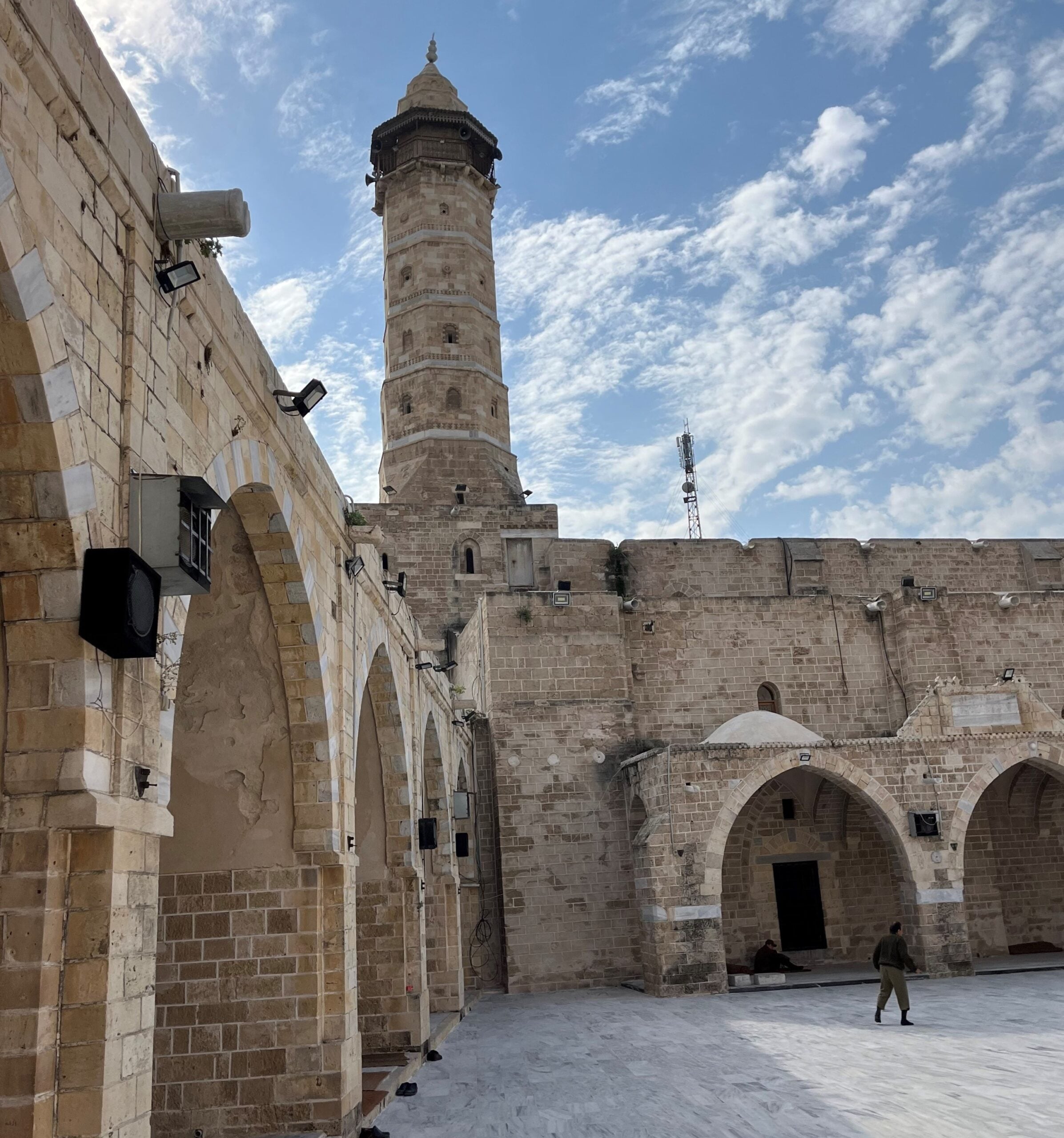
The Great Omari Mosque, the largest and oldest mosque in the Gaza Strip, was built in the seventh century CE by converting and expanding the structure of a fifth-century Byzantine church which stood at the site. It is not just an important site for religious practice, but it is also one of the most significant heritage landmarks in Gaza. The Great Omari Mosque library, which has existed since at least the 13th century, contained a significant collection of rare books, including works dating back to the 14th century. Over 200 manuscripts in the library were digitized from 2019 to 2022.147“Israeli Damage to Archives, Libraries, and Museums in Gaza, October 2023-January 2024,” Librarians and Archivists with Palestine, February 1, 2024, librarianswithpalestine.org/gaza-report-2024/ Some of the manuscripts had been moved to another location which was also severely damaged in the fighting.148Bora Erden, Graham Bowley, and Tala Safie, “Gaza’s Historic Heart, Now in Ruins,” The New York Times, May 28, 2024, nytimes.com/interactive/2024/05/28/arts/gaza-omari-mosque.html; “Damage and Risk Assessment of Cultural Heritage under Attack in the Gaza Strip,” CCHP and EAMENA, 65–66.
The mosque was largely destroyed in a strike on December 4, 2023, after its minaret was damaged in a November 16 strike.149“The Great Omari Mosque in Gaza’s old city centre has been hit in an Israel air strike,” Al Jazeera English, December 11, 2023, video clip, YouTube, youtube.com/watch?v=sxTGr8giBtg; “Six-month update report on the human rights situation in Gaza: 1 November 2023 to 30 April 2024,” Office of the U.N. High Commissioner for Human Rights; Bora Erden, Graham Bowley, and Tala Safie, “Gaza’s Historic Heart, Now in Ruins.” The mosque was indirectly damaged again in a July 2024 strike that hit the adjacent Al-Qaysariyya gold market.150Akram Lilja, interview by PEN America, August 13, 2024 (video call). An anonymous Israeli official confirmed the December strike to NPR and The New York Times, claiming that the mosque grounds contained a tunnel shaft and that Hamas fighters regularly used the mosque for cover.151Daniel Estrin, “Israeli strike leaves Gaza’s oldest mosque in ruins,” NPR, December 9, 2023, npr.org/2023/12/09/1218384968/mosque-gaza-omari-israel-hamas-war; Gaya Gupta and Aaron Boxerman, “Gaza’s largest mosque is reported damaged,” The New York Times, December 8, 2023, nytimes.com/live/2023/12/08/world/israel-hamas-war-gaza-news/gazas-largest-mosque-is-severely-damaged-by-israeli-strikes; See also Nir Hasson, “One of Gaza’s Oldest Mosques Damaged in Fighting; It Was Used by Hamas, IDF Says,” Haaretz, December 10, 2023, haaretz.com/israel-news/2023-12-10/ty-article/.premium/one-of-gazas-oldest-mosques-damaged-in-fighting-it-was-used-by-hamas-idf-says/0000018c-53d7-db23-ad9f-7bdf62f30000 However, the New York Times report specified that the IDF’s claims about the use of the mosque by Hamas fighters “could not be independently verified and the Israeli military did not respond to a request for evidence.”152Bora Erden, Graham Bowley, and Tala Safie, “Gaza’s Historic Heart, Now in Ruins.”
Akram Lilja, the cultural heritage expert, shared his view that “they hit the Al-Omari Mosque several times, not because Hamas was there, not because of military activity, but because the people of Gaza are spiritually tied to it as a center for social life.” He said the meaning of the mosque went far beyond its significance as an important religious site. A historical landmark and important public space in Gaza City, a place where children played football in its courtyard every afternoon and elderly people gathered to chat.153Akram Lilja, interview by PEN America, August 13, 2024 (video call). “I have been praying there and playing around it all through my childhood,” 45-year-old local resident Ahmed Nemer told Reuters, saying Israel was “trying to wipe out our memories.”154“Hamas says Gaza mosque destroyed, urges UNESCO to save heritage,” Al Jazeera, December 8, 2023, aljazeera.com/news/2023/12/8/hamas-says-gaza-mosque-destroyed-urges-unesco-to-save-heritage Two other historic mosques that were severely damaged during the conflict include the Mamluk-era mosque of Ibn Othman and the Zofor Domri mosque, both in Al-Shuja’iyya.155“Damage and Risk Assessment of Cultural Heritage under Attack in the Gaza Strip,” CCHP and EAMENA, 103–104; Akram Lilja, interview by PEN America, October 23, 2024 (video call); “Gaza Strip, Damage Assessment,” UNESCO, May 28, 2025, unesco.org/en/gaza/assessment; Hamdan Taha, “Destruction of Cultural Heritage in Gaza,” Jerusalem Quarterly 97 (Spring 2024): 54, palestine-studies.org/sites/default/files/jq-articles/Destruction%20of%20Cultural%20Heritage%20in%20Gaza.pdf
A Bellingcat investigation from June 2024 suggests that the Israeli government has regularly targeted mosques.156“Analysis Reveals Damage and Destruction of Cultural Heritage Sites in Gaza,” Bellingcat, June 26, 2024, bellingcat.com/news/2024/06/26/gaza-israel-destroy-destruction-damage-cultural-history-heritage-archaeology-conflict-war/ Using satellite imagery and open-source analysis, it found that at least 100 mosques have been damaged or destroyed during the conflict. Bellingcat found 10 of the 100 cases documented on video and was able to identify each of these 10 mosques and its name and location.157Email correspondence with Bellingcat, September 30, 2024, on file with PEN America. Three of them were destroyed by airstrikes (Abdullah Bin Omar Mosque, Gaza City; Khalid Ibn al-Walid Mosque, Khan Yunis; and Bilal Mosque, Khan Yunis) and seven were demolished via controlled detonation (Al-Dhilal Mosque, Bani Suheila; Omar Bin Abdulaziz Mosque, Abasan al-Kabira; Al-Quba Mosque, Khan Yunis; Istiqlal Grand Mosque of Indonesia, Khan Yunis; Ibrahium Khalil Rahman Mosque, Bani Suheila; Tamim al-Dari Mosque, Beit Lahia; and Al-Islah Mosque, Gaza City).158Email correspondence with Bellingcat, September 30, 2024, on file with PEN America; Al-Dhilal Mosque: Jake Godin (@jakegodin), X, January 8, 2024, x.com/JakeGodin/status/1744382452401946970 (on file with PEN America); Abdullah Bin Omar Mosque: Chris Osieck (@chrisosieck), “Geolocation of Israeli airstrike (0:12 in the video) on Abdullah Bin Omar Mosque in Gaza,” X, October 21, 2023, x.com/ChrisOsieck/status/1715726783360717198; Khalid ibn al-Walid Mosque: Chronology (@chronology22), “The ruins of the Khalid ibn al-Walid Mosque as a result of an Israeli airstrike on Khan Yunus in the Gaza Strip,” X, November 10, 2023, x.com/Chronology22/status/1723186343562350936; Omar Bin Abdulaziz Mosque: Younis Tirawi (@ytirawi), “Gaza | Imagine if this was a church or a synagogue?” X, April 11, 2024, x.com/ytirawi/status/1778542167612592554; Al Quba Mosque: Younis Tirawi (@ytirawi), “Israel’s 603rd combat Engineering Battalion published a long sum-up video showing them blowing up a mosque and tens of homes and residential buildings in Khan Younis,” X, February 6, 2024, x.com/ytirawi/status/1754924122348405080; Istiqlal Grand Mosque of Indonesia: Younis Tirawi (@ytirawi), ”Khan Younis | Israeli soldiers from the 66th battalion film the mosque with a drone, observing that it is completely empty with nothing in it, having already been destroyed,” X, May 13, 2024, x.com/ytirawi/status/1789978344311648368; Bilal Mosque: Israel Defense Forces (@idf), “ Khan Yunis: IDF troops from the Paratroopers Brigade encountered an armed terrorist cell and thwarted it,” X, February 7, 2024, x.com/IDF/status/1755149845562593524; Ibrahium Khalil Rahman Mosque: Younis Tirawi (@ytirawi), ”4/5,” X, February 8, 2024, x.com/ytirawi/status/1755623629801292073; Tamim Al-Dari Mosque: Free Palestine, “A video shared by Israeli soldiers documents the bombing of the Tamim Al-Dari Mosque, located west of Beit Lahia, northern Gaza,” Facebook, February 2, 2024, facebook.com/watch/?v=278317115269771; Al-Islah Mosque: My Israel, Facebook, January 18, 2024, at 1:01, facebook.com/watch/?v=207477392443994; for more information on the destruction of Al-Dhilal mosque and Istiqlal mosque, see “‘You Feel Like You Are Subhuman’: Israel’s Genocide Against Palestinians in Gaza,” Amnesty International, 230–233. In the case of Al-Islah mosque, the mosque and a portion of the Shuja’iyya Primary School for Girls next to it were demolished via a controlled detonation sometime between December 10 and 15, 2023.159“‘We’ve Become Addicted to Explosions’ The IDF Unit Responsible for Demolishing Homes Across Gaza,” Bellingcat, April 29, 2024, bellingcat.com/news/2024/04/29/weve-become-addicted-to-explosions-the-idf-unit-responsible-for-demolishing-homes-across-gaza/ An Instagram post by a member of the IDF’s 8219 Commando unit showing the mosque being prepared for demolition, claimed, “Every house, mosque and school has been used here for terror purposes: either as a place for terrorists, an explosives warehouse or a military base.”160“‘We’ve Become Addicted to Explosions,” Bellingcat, bellingcat.com/news/2024/04/29/weve-become-addicted-to-explosions-the-idf-unit-responsible-for-demolishing-homes-across-gaza/
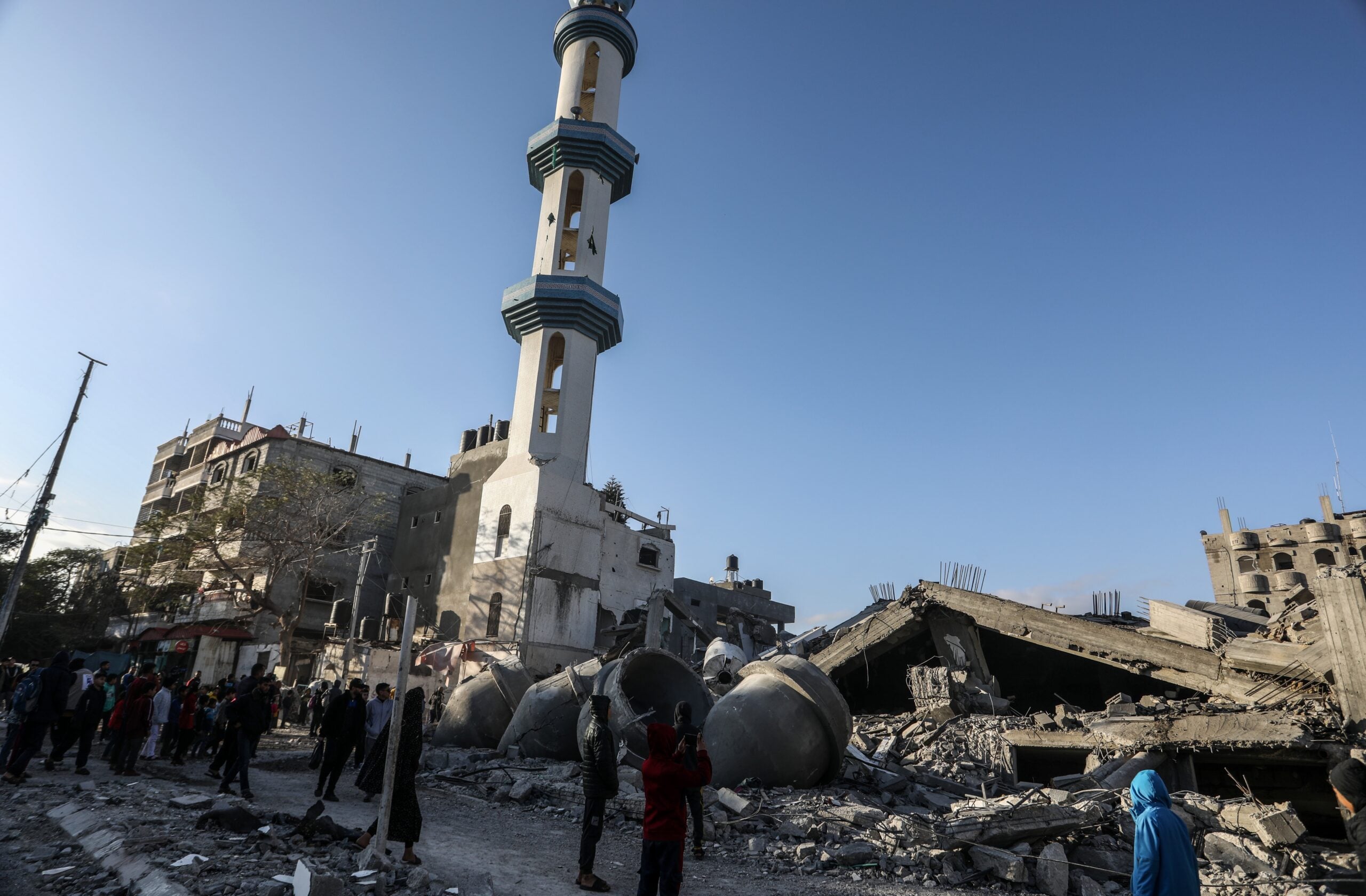
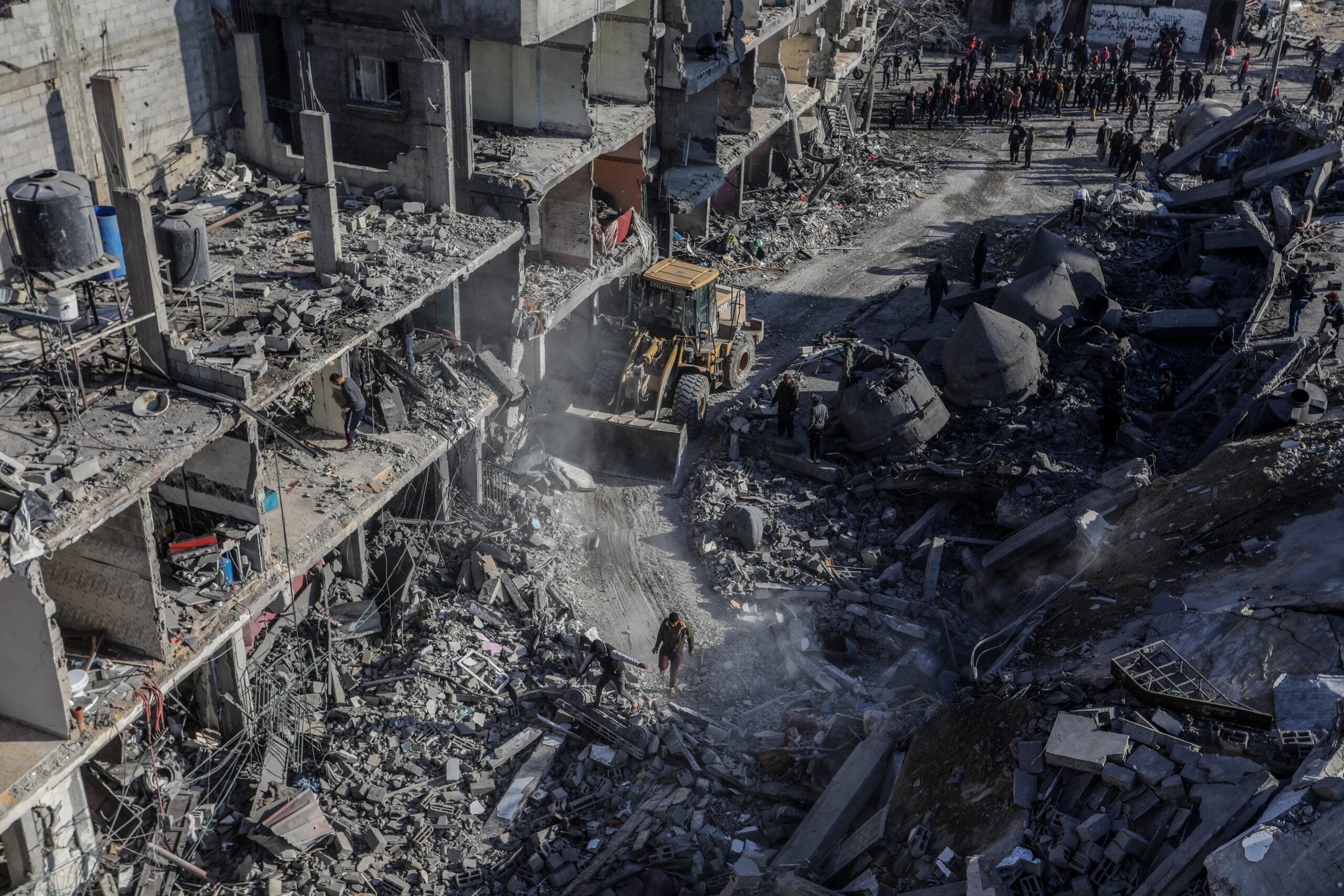
An Amnesty International investigation from September 2024 demonstrated that mosques were also affected by unlawful destruction of property in an area along the eastern perimeter of Gaza, which Amnesty said should be investigated as a war crime of wanton destruction.161“Israel/OPT: Israeli military must be investigated for war crime of wanton destruction in Gaza,” Amnesty International, September 5, 2024, amnesty.org/en/latest/news/2024/09/israel-opt-israeli-military-must-be-investigated-for-war-crime-of-wanton-destruction-in-gaza-new-investigation/ Based on an analysis of satellite imagery, Amnesty’s investigation shows that mosques in the Shuja’iyya area were destroyed along with more than 750 other structures, many of which were destroyed in late December 2023.162“Israel/OPT: Israeli military must be investigated for war crime of wanton destruction in Gaza,” Amnesty International.
The IDF released video evidence, which has not been independently verified, that appears to show that some mosques were used for military purposes. The videos appear to show that some mosques were used by Hamas to store weapons, to hide tunnel entrances, and to provide cover for the activities of its fighting forces.163IDF, “Weapons found in a mosque in Zaytun,” November 20, 2023, idf.il/en/mini-sites/israel-at-war/war-on-hamas-2023-resources/weapons-found-in-a-mosque-in-zaytun/; IDF, “RPG Training At a Mosque in the Jabalya Area,” December 11, 2023, idf.il/en/mini-sites/the-unrwa-hamas-connection/exploitation-of-unrwa-equipment/rpg-training-at-a-mosque-in-the-jabalya-area/;
Greek Orthodox Church of St. Porphyrius
All three active churches in Gaza have been damaged by the government of Israel’s military operations.164In addition to damage at the Orthodox St. Porphyrius Church compound and the Holy Family Catholic Church compound, a Baptist church also suffered significant damage. See Khalil Sayegh (@khaliljeries), “The Israeli army damaged Gaza’s only evangelical church, the Gaza Baptist Church, during the ongoing invasion of Gaza,” X, December 26, 2023, x.com/KhalilJeries/status/1739783721392255419 The Greek Orthodox Church of St. Porphyrius is the oldest active church in Gaza. A church has existed on that site since the fifth century, and the current building dates back to the 12th century. The compound was first hit by an Israeli airstrike on the evening of October 19, 2023, killing at least 18 people sheltering there, including children.165Talia Lakritz and Reem Makhoul, “Photos show Gaza’s Church of Saint Porphyrius, one of the oldest churches in the world, after the complex was damaged by Israeli airstrikes,” Business Insider, October 24, 2023, businessinsider.com/israel-gaza-war-church-airstrikes-damage-2023-10 About 450 Christians were taking shelter at the church because they had thought it would be a safe place.166Amnesty International, “‘Nowhere safe in Gaza’: Unlawful Israeli strikes illustrate callous disregard for Palestinian lives,” November 20, 2023, amnesty.org/en/latest/news/2023/11/israel-opt-nowhere-safe-in-gaza-unlawful-israeli-strikes-illustrate-callous-disregard-for-palestinian-lives/; “‘You Feel Like You Are Subhuman’: Israel’s Genocide Against Palestinians in Gaza,” Amnesty International, 112–114. The IDF said it had hit a nearby “command and control center” and that it was reviewing the incident.167“‘Nowhere safe in Gaza’: Unlawful Israeli strikes illustrate callous disregard for Palestinian lives,” Amnesty International. It later deleted without explanation a video of the attack that it had previously published.168“‘Nowhere safe in Gaza’: Unlawful Israeli strikes illustrate callous disregard for Palestinian lives,” Amnesty International.
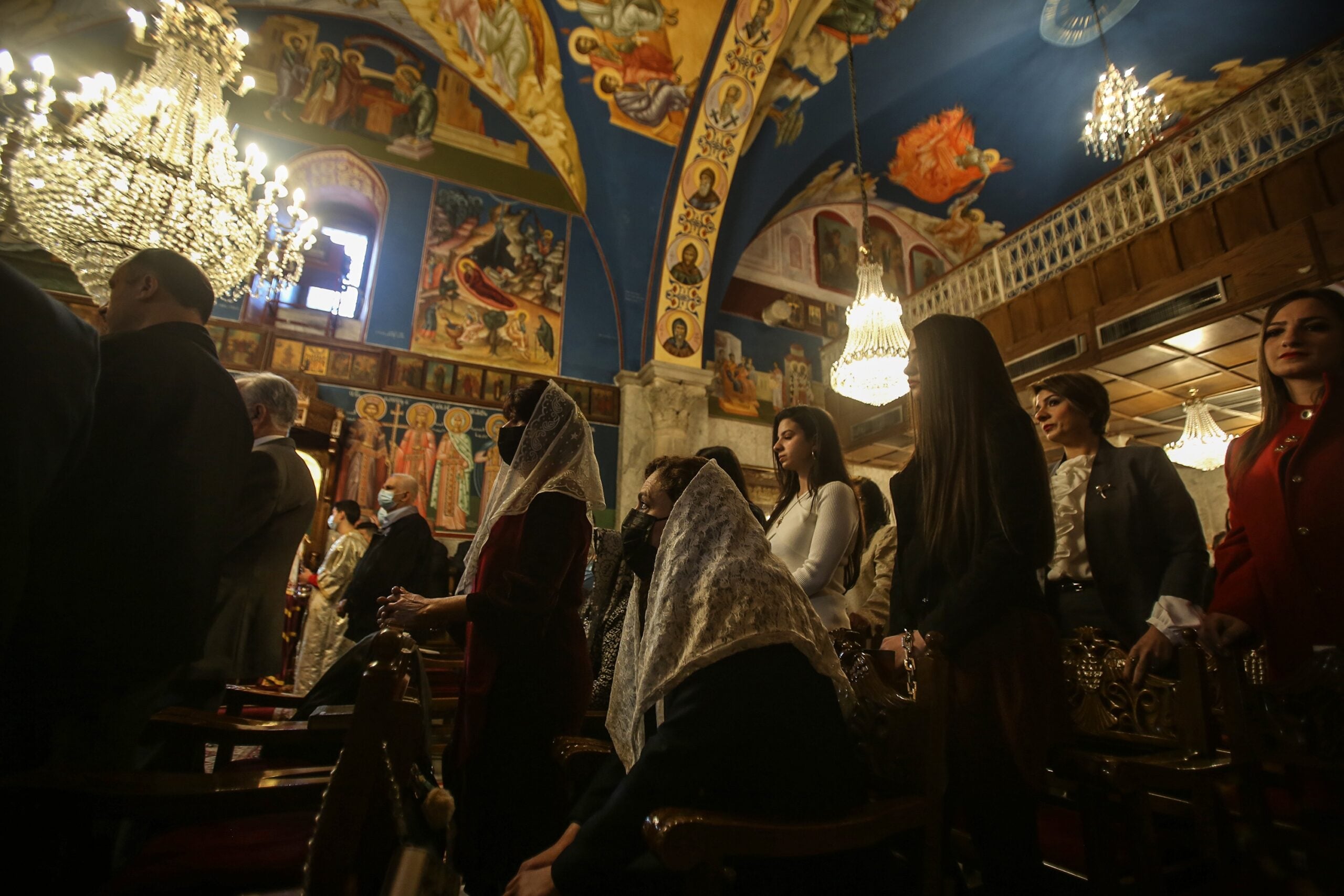
Videos show that the airstrike caused extensive destruction to the church and the surrounding site. According to an Amnesty International analysis of Google Earth satellite imagery, the epicenter of the strike was just outside the compound’s wall. Amnesty’s investigation concluded that the strike was an indiscriminate or direct attack on civilians and civilian objects and a possible war crime.169“‘Nowhere safe in Gaza’: Unlawful Israeli strikes illustrate callous disregard for Palestinian lives,” Amnesty International.
The Orthodox Patriarchate of Jerusalem condemned the targeting of churches and their institutions as a war crime.170Karen Zraick and Ameera Harouda, “Israeli Airstrike Hits Greek Orthodox Church Compound in Gaza City,” The New York Times, October 20, 2023, nytimes.com/2023/10/20/world/middleeast/israel-airstrike-gaza-city.html; “The Patriarchate of Jerusalem Condemns Israeli Airstrikes Targeting Humanitarian Institutions in Gaza,” Jerusalem Patriarchate, October 20, 2023, en.jerusalem-patriarchate.info/blog/2023/10/20/the-patriarchate-of-jerusalem-condemns-israeli-airstrikes-targeting-humanitarian-institutions-in-gaza/
Holy Family Catholic Church
The Holy Family Catholic Church compound and its affiliated institutions were hit by Israeli attacks several times. According to the Latin Patriarchate of Jerusalem, the majority of Christians in Gaza took shelter there after the start of the war.171“Gaza, 16th December 2023,” Latin Patriarchate of Jerusalem, December 16, 2023, lpj.org/index.php/en/gaza-16th-december-2023 On December 16, 2023, several IDF tank shells struck the Convent of the Sisters of Mother Theresa (Missionaries of Charity) and part of the church compound, which was home to more than 54 people with disabilities, rendering the shelter uninhabitable and displacing its residents, according to a statement by the Latin Patriarchate of Jerusalem.172“Gaza, 16th December 2023,” Latin Patriarchate of Jerusalem. Later that same day, an Israeli Defense Forces sniper killed a mother and her daughter inside the Holy Family Parish, “where there are no belligerents,” according to the Latin Patriarchate of Jerusalem’s statement.
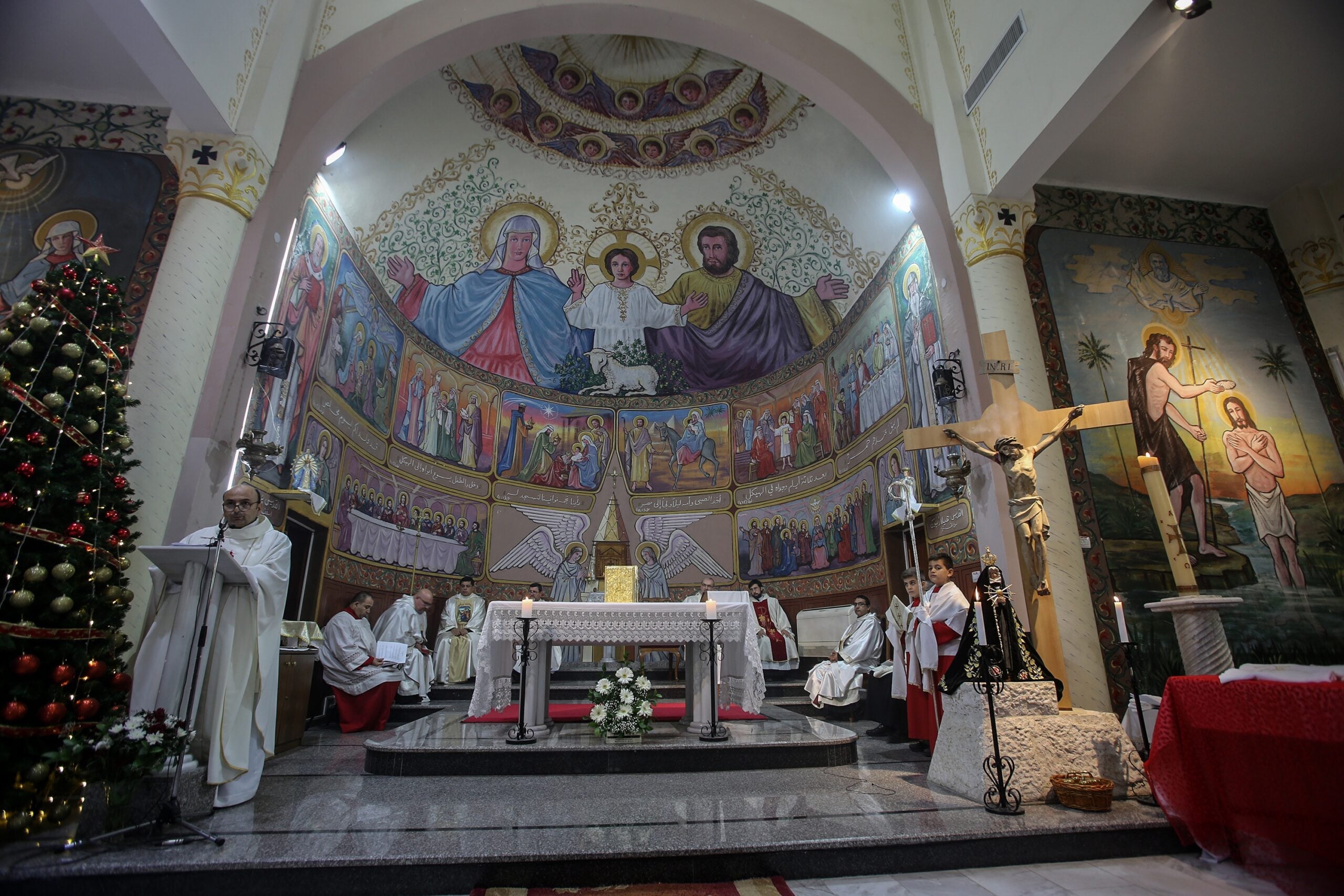
The IDF initially claimed that Hamas operated from the area and the soldiers suspected three people they saw in the vicinity to be Hamas spotters. But in January 2024, a spokesperson for the IDF said that the initial conclusion was unfounded, according to a report in The New Yorker, and that the examination of the incident was ongoing.173Claire Porter Robbins, “The Dilemma of Gaza’s Christians,” The New Yorker, January 24, 2024, newyorker.com/news/news-desk/the-dilemma-of-gazas-christians
The Holy Family Catholic School, where displaced people were sheltering, was hit by Israeli airstrikes that killed four people on July 7, 2024.174Lisa Zengarini, “Latin Patriarchate Decries Raid on Catholic School in Gaza,” Catholic Near East Welfare Association, July 8, 2024, cnewa.org/latin-patriarchate-decries-raid-on-catholic-school-in-gaza/ The Holy Family Church, the only Catholic church in Gaza, was shelled by the Israeli military on July 17, 2025.175Angela Giuffrida and Malak A Tantesh, “Israeli strike on Gaza church kills three and injures priest Pope Francis called daily,” The Guardian, July 17, 2025, theguardian.com/world/2025/jul/17/israeli-attack-on-church-in-gaza-injures-priest-pope-francis-called-daily; Freddie Clayton, “With sorrow and solidarity, Christians up pressure on Israel after deadly Gaza church strike,” NBC News, July 20, 2025, nbcnews.com/world/middle-east/pope-leo-gaza-israeli-strike-catholic-church-rcna219738 The shelling also damaged the church’s compound where hundreds of Palestinians had been sheltering. The Israeli government issued an apology for the attack and said it would investigate it.176Giuffrida and Tantesh, “Israeli strike on Gaza church kills three and injures priest Pope Francis called daily,”; Clayton, “With sorrow and solidarity, Christians up pressure on Israel after deadly Gaza church strike,”
YMCA
The YMCA building in Gaza City, which was sheltering hundreds of displaced people, was hit by Israeli strikes on December 16, 2023.177Reuters, “Israel bombards northern and southern Gaza, many reported dead,” CNBC, December 16, 2023, cnbc.com/2023/12/16/israel-bombards-northern-and-southern-gaza-many-reported-dead.html “The Israeli occupation forces kept shelling and firing on us while we were inside, eight people were killed and dozens injured, all of us are civilians, unarmed, innocent civilians,” a witness told Al Jazeera in a segment published six days later.178Jihad Abu Shanab, “Gaza in ruins: Palestinian testimony of YMCA destruction,” Al Jazeera English, December 22, 2023, youtube.com/watch?v=mwHG2YXaC_8 The YMCA building in Gaza City was established in 1952 and it offered a range of programs, including sports teams, women’s fitness classes, and mental health workshops for children and families.
Sayegh spoke of childhood memories attending summer camp at the YMCA. He said before the war the YMCA played an important role in the surrounding community: it hosted art, music, and youth programs, as well as English and French classes, and had a gymnastics hall and tennis and basketball courts. According to Sayegh, “It’s very clear that the targeting of cultural institutions was purposeful, due to the scale of destruction. If it was one or two institutions it would be something else, but it’s so many of them.”179Khalil Sayegh, interview by PEN America, August 14, 2024 (audio call).
Arab Orthodox Cultural Center
The Arab Orthodox Cultural Center (AOCC) in Gaza City underwent a major, costly renovation before reopening in 2021. It had a large theater, event space, lecture hall, gym, and outdoor space, and provided various classes and workshops to Palestinians as well as psychosocial and employment programs.180Joseph Hazboun, “From the West Bank to Gaza: The Situation in Palestine,” Catholic Near East Welfare Association, November 8, 2023, cnewa.org/from-the-west-bank-to-gaza-the-situation-in-palestine/ In 2011, the U.S. Agency for International Development (USAID) contributed $138,000 toward its construction.181Juliet Linderman, Martha Mendoza, and Cedar Attanacio, “Most U.S.-funded community projects in Gaza have been left unharmed, but at least 5 are damaged are destroyed,” PBS, December 22, 2023, pbs.org/newshour/world/most-u-s-funded-community-projects-in-gaza-have-been-left-unharmed-but-at-least-5-are-damaged-are-destroyed
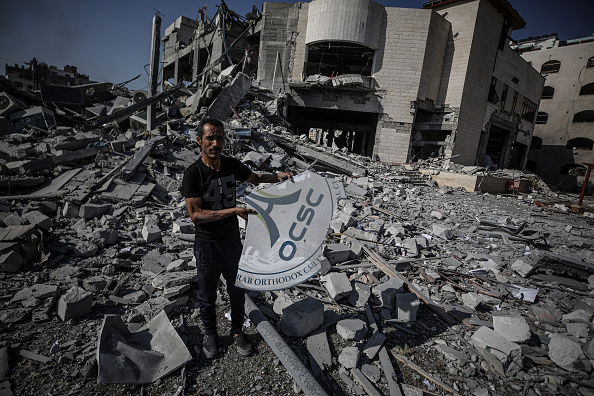
According to an Associated Press investigation into institutions that received U.S. funding and were destroyed in the war, satellite images from October 2023 “appear to show major damage to the center.” This is corroborated by photos and video from the site that show the building was nearly completely destroyed.182“Arab Orthodox Cultural Centre destroyed in air strike,” Friends of the Holy Land, October 31, 2023, friendsoftheholyland.org.uk/blog/arab-orthodox-cultural-centre-destroyed-in-air-strike; “The Patriarchate of Jerusalem: Israeli Shelling of Orthodox Cultural Center Embodies Unjustifiable Targeting of Civilian Infrastructure in Gaza,” Jerusalem Patriarchate, October 31, 2023, en.jerusalem-patriarchate.info/blog/2023/10/31/the-patriarchate-of-jerusalem-israeli-shelling-of-orthodox-cultural-center-embodies-unjustifiable-targeting-of-civilian-infrastructure-in-gaza/ A statement by the organization Friends of the Holy Land said the center was destroyed deliberately in an Israeli airstrike on October 30.183“Arab Orthodox Cultural Centre destroyed in air strike,” Friends of the Holy Land.
Joseph Hazboun, regional director of the Pontifical Mission in Jerusalem, said Israeli officials called the director of the center, where several thousand people had been sheltering, and ordered them to evacuate the building, which they did. “Several attempts by various parties were made in order to stop the bombing. Unfortunately . . . the building was bombed,” said Hazboun.184“Arab Orthodox Cultural Centre destroyed in air strike,” Friends of the Holy Land. There are conflicting accounts about the exact number of people sheltering at AOCC before it was evacuated.
The Patriarchate of Jerusalem said that the destruction of the AOCC was “a stark embodiment of Israel’s unwarranted determination to destroy the civil infrastructure and social service centers, as well as shelters for civilians trapped in the besieged enclave.”185“The Patriarchate of Jerusalem: Israeli Shelling of Orthodox Cultural Center Embodies Unjustifiable Targeting of Civilian Infrastructure in Gaza,” Jerusalem Patriarchate.
Buildings of Historical Significance, Museums, and Other Cultural Institutions
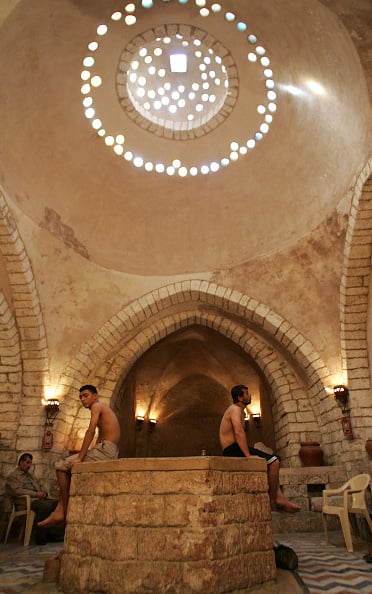
Hammam al-Samra
The historic Hammam al-Samra was located in the Al-Zaytoun neighborhood of Gaza City’s old town. An active bathhouse from the Ottoman era expertly restored in 2022, it was more than 750 years old and an important cultural heritage site and tourist attraction.186Palestine Chronicle Staff, “Photo Essay: Gaza’s Hamam al-Samra, A Thousand Year Later,” The Palestine Chronicle, May 24, 2022, palestinechronicle.com/photo-essay-gazas-hamam-al-samra-a-thousand-year-later/ It was destroyed by Israeli airstrikes on December 26, 2023.187“The Fourth Preliminary Report on the Cultural Sector’s Damages,”Palestinian Ministry of Culture, 60; Abdalhadi Alijla عبد الهادي العجلة (@alijla2021), “Isn’t it true that the Taliban and ISIS are known for destroying antiquities and cultural heritage sites?” X, December 27, 2023, x.com/alijla2021/status/1740001435960349142 Lilja, the cultural heritage expert, said that the structure was reduced to dust.188Akram Lilja and Jehad Abusalim, “Cultural Heritage Under Attack in Gaza” (at 41:12). Photos and videos show that it was completely destroyed, with many of the buildings around it still standing, suggesting it was specifically targeted.189“1,000-year-old Hamam al-Sammara destroyed by Israeli bombing in Gaza,” Middle East Eye, December 27, 2023, middleeasteye.net/live-blog/live-blog-update/historic-1000-year-old-hamam-al-sammara-destroyed-israeli-bombing-gaza 9; #القدس_ينتفض (@MyPalestine0), “Destruction of the historical Al-Samara Hammam in the old city of #Gaza,” X, December 26, 2023, x.com/MyPalestine0/status/1739600833153478687; يحيى صبيح | Yahya Sobeih (@yahyasobeih), “Al-Samara bath #Gaza,” Instagram, April 27, 2024, instagram.com/reel/C6Qv5YHLevo/?igsh=am1rM296MWdqbDMw According to a report by NPR, the Israeli military said it struck the hammam to target a Hamas squad and a network of tunnels inside.190Daniel Estrin and Abu Bakr Bashir, “A requiem for Gaza’s iconic sites, destroyed in the war,” Weekend Edition Sunday, February 4, 2024, npr.org/2024/02/04/1226295081/gaza-iconic-sites-destroyed-in-war
Qasr al-Pasha
The two-story fort Qasr al-Pasha in Gaza City was built in the mid-13th century. In the 17th century it was used by Ottoman rulers, giving it its current name, Pasha Palace. In 2010 it was turned into a museum by the Palestinian Ministry of Tourism, and its structure was considered an important landmark. A December 11, 2023, airstrike destroyed its three buildings, the walls, courtyard, and gardens.191Indlieb Farazi Saber, “A ‘cultural genocide’: Which of Gaza’s heritage sites have been destroyed?” Al Jazeera, January 14, 2024, aljazeera.com/news/2024/1/14/a-cultural-genocide-which-of-gazas-heritage-sites-have-been-destroyed According to Lilja, people familiar with Gaza’s cultural heritage did not think it would be attacked because of its cultural importance, and were shocked when it was destroyed.192Akram Lilja and Jehad Abusalim, “Cultural Heritage Under Attack in Gaza” (at 39:26). Qasr al-Pasha held hundreds of ancient objects and several unique sarcophagi. According to Jean-Baptiste Humbert of the French Biblical and Archaeological School in Jerusalem, “Our best finds were displayed in the Basha.” But they have little information about their fate, he added, asking, “Did someone remove the objects before blowing the building up?”193Guillaume Lavallee, “Gaza’s historic treasures saved by ‘irony of history,’” Al-Monitor, April 10, 2024, al-monitor.com/originals/2024/04/gazas-historic-treasures-saved-irony-history
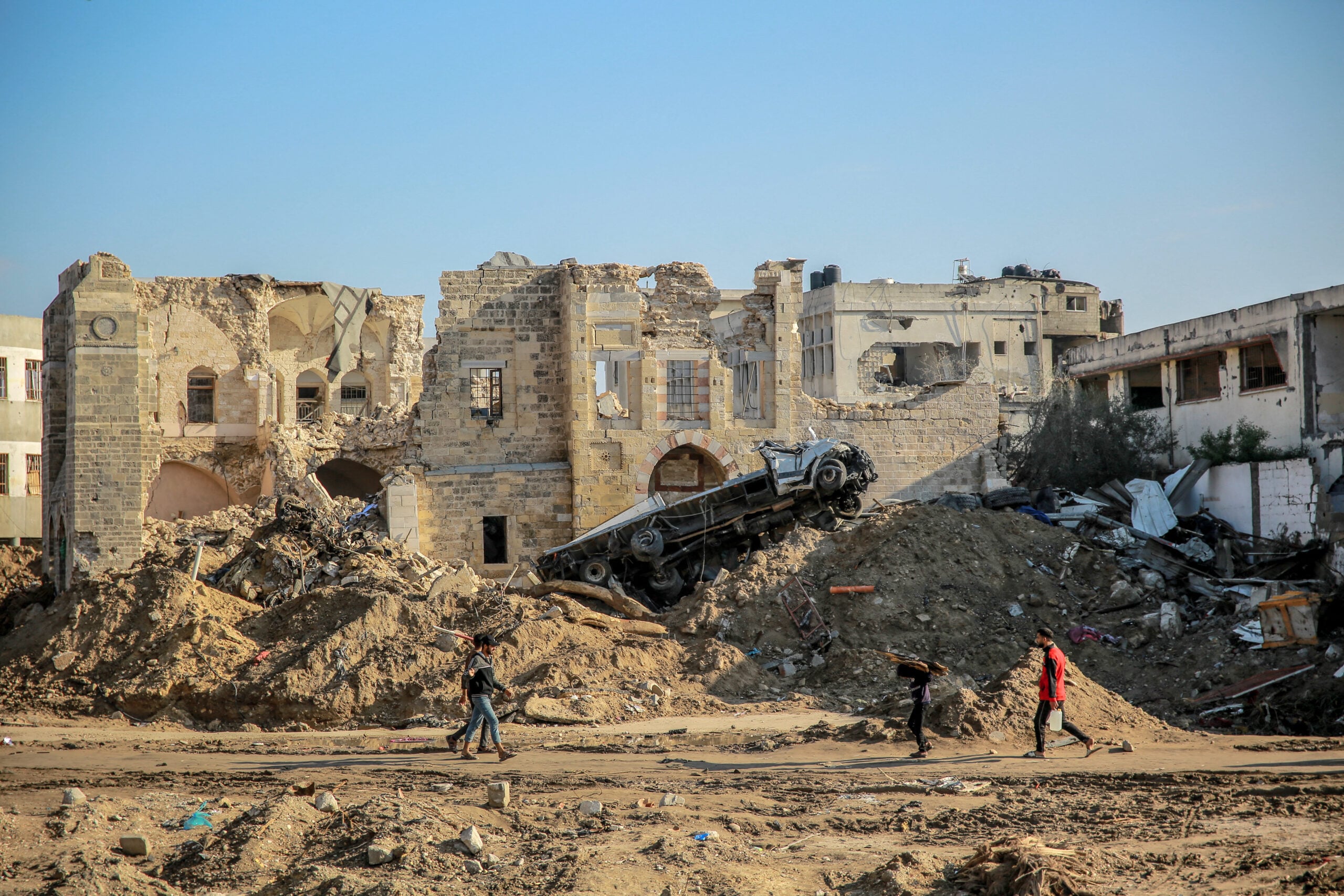
Manuscripts Center
Housed in a building adjacent to Qasr al-Pasha, the manuscripts center was a specialized center for manuscript conservation in Gaza, dedicated to the preservation and digitization of materials from the Omari Mosque library, and supported by several donors, including the British Library. It is regarded as one of the most important libraries in Gaza. The Manuscripts Center and its equipment appear to have been destroyed during multiple airstrikes in the area. The historic dome of Dar al-Saada, the building housing the manuscripts center, had recently been restored, partly funded by the British Council. Across the street from the manuscripts center was a historic 450-year-old fountain, the Sabil al-Refa’eyya fountain, renovated in 2016, which was also destroyed during the war.194“Damage and Risk Assessment of Cultural Heritage under Attack in the Gaza Strip,” CCHP and EAMENA, 97–98.
Al-Qarara Museum
Al-Qarara Cultural Museum, opened in 2016 north of Khan Yunis, contained 3,500 archaeological, historical, and folklore artifacts, some dating back as far as 4,000 BCE. It was damaged in October 2023 due to shelling next to the museum. According to Al Jazeera, the museum was given warning by Israeli forces to empty its contents and evacuate to the south of Gaza.195Indlieb Farazi Saber, “A ‘cultural genocide’: Which of Gaza’s heritage sites have been destroyed?” Al Jazeera; متحف القرارة الثقافي Al Qarara Cultural Museum, “The Al-Qarara Cultural Museum and its holdings in the Gaza Strip were severely damaged as a result of the aggression on Gaza, which targeted homes and mosques, which led to an explosion next to the museum in the town of Al-Qarara yesterday morning,” Facebook, October 14, 2024, facebook.com/museum.qarara/posts/pfbid0cKdrkE9jf5KSuGHPAkAEq13Ai4nsahR3tbMcjLSa2RPuMVYgQkkXAGwPeWnBnMoEl It is not clear how much of the collection was preserved. It was later damaged again when the IDF conducted an August 2024 operation in the area of Al-Qarara; as a result, most of the items in the collection “were destroyed.”196PEN America correspondence with Bellingcat; متحف القرارة الثقافي Al Qarara Cultural Museum, “Now we’re able to capture photos after entering the second time by Israel occupation to alqurara town where Al Bayaka (old city) and alqarara cultural museums of the Mayasem Association for Culture and Arts have suffered to many damages,” Facebook, August 28, 2024, facebook.com/museum.qarara/posts/pfbid02QHNzSHWRbe96FweZVnqPYCdwcF8vUUKmit6g5rhv9f4yGoGT9MxFpwpAXRtvUHXQl The walls of the museum’s courtyard were also destroyed at that time. The museum reported in September 2024 that despite significant losses, staff had rescued some of the artifacts.197 متحف القرارة الثقافي Al Qarara Cultural Museum, “A number of 2433 artifacts of Al-Qarara Cultural Museum were finally delivered by our team to a safer location,” Facebook, September 8, 2024, facebook.com/museum.qarara/posts/pfbid033UHCGDAQjfQ6uAbWeQrGxWS8hB8mg52pCdDFWRZLVqJvKMEV2bgWFmFAqVG5qwqal
Rashad al-Shawwa Cultural Center
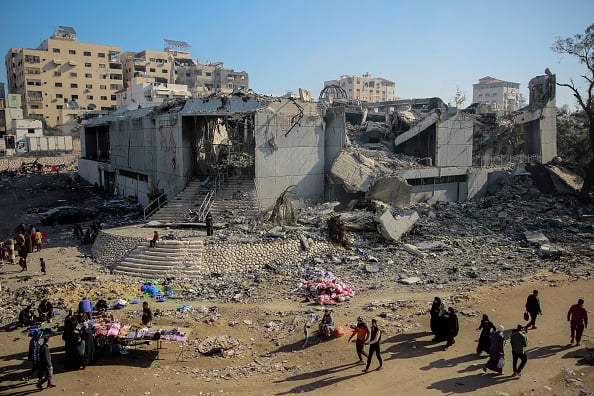
The Rashad al-Shawwa Cultural Center in Gaza City was one of Gaza’s central cultural institutions, a contemporary architectural landmark designed by Syrian architect Saad Mahfouz. It was completed in 1988, and included a large theater hall for events and performances, meeting halls, a gallery, a printing press, and a library. The center’s Tamari Sabbagh Library contained about 20,000 books. Its destruction was reported by the Gaza municipality during a temporary ceasefire between Israel and Hamas in November 2023.
According to reporting by Türkiye’s Anadolu Agency, the center sheltered thousands of displaced Palestinians during the war, but at the time of its destruction, displaced residents had already left and moved to the southern part of the Gaza Strip.198Muhamed Majid, “Humanitarian pause reveals destruction of ‘Rashad Al-Shawwa’ cultural center in Gaza by Israel,” Anadolou Agency, November 26, 2023, aa.com.tr/en/middle-east/humanitarian-pause-reveals-destruction-of-rashad-al-shawwa-cultural-center-in-gaza-by-israel/3064948 When asked by The Washington Post about the destruction of Rashad al-Shawwa library and the Gaza Municipal library, the IDF did not directly address whether it had hit the libraries.199Mohamed El Chamaa, “Gazans mourn loss of their libraries: Cultural beacons and communal spaces,” The Washington Post, December 1, 2023, washingtonpost.com/world/2023/11/30/gaza-library-palestinian-culture/
Al-Mathaf Hotel and Museum
Al-Mathaf hotel and museum hosted a private collection of important cultural heritage and archeological artifacts collected over three decades by Palestinian businessman Jawdat al-Khoudary. According to Akram Lilja, al-Khoudary lost dozens of artifacts to the conflict.200Akram Lilja, interview by PEN America, August 13, 2024 (video call). Al-Khoudary told AFP in an interview that his hotel and museum had been under Israeli control for months, and that “as soon as they left, I asked some people to go there to see what state the place was in. I was shocked. Several items were missing and the hall had been set on fire.” He said that Israeli forces “flattened the garden with bulldozers . . . I don’t know whether objects were buried (by the bulldozers) or whether the marble columns were broken or looted. I can’t find words.”201“Gaza’s archaeology experts say enclave’s historic treasures saved by ‘irony of history,’” Times of Israel, April 15, 2024, timesofisrael.com/gazas-archaeology-experts-say-enclaves-historic-treasures-saved-by-irony-of-history/
Book Burning and Looting
In May 2024, Palestinian journalist Younis Tirawi published a photo of an Israeli soldier in what appears to be a library in Gaza posing with a book and with a burning bookshelf behind him.202Younis Tirawi (@ytirawi), ”Exclusive: Israeli soldiers set fire Aqsa University [@AqsaUniversity]’s library in Gaza City and took pictures of themselves in front of the flames,” X, May 23, 2024, x.com/ytirawi/status/1793628894245118205 In May and August 2024, videos surfaced of Israeli soldiers burning the Quran in mosques in two separate incidents.203Younis Tirawi (@ytirawi), “[@tamerqdh] unveils alarming footage depicting Israeli soldiers burning Quran book within a mosque in Gaza.” X, May 21, 2024, x.com/ytirawi/status/1792941307452653740; “Video of Israeli forces burning the Quran and bombing Gaza mosque,” Al Jazeera, August 25, 2024, aljazeera.com/program/newsfeed/2024/8/25/video-of-israeli-forces-burning-the-quran-and-bombing-gaza-mosque Following expressions of public concern, including by PEN America,204“PEN America Alarmed by Images of Israeli Soldiers with Burning Books,” PEN America, May 24, 2024, pen.org/press-release/pen-america-alarmed-by-images-of-israeli-soldiers-with-burning-books/ the IDF said the Military Police had launched an investigation into the book burnings, and that the “severe” incidents are “inconsistent with the values of the IDF and its protocols.”205Emanuel Fabian, “IDF opens probe after social media posts show troops burning Quran, other books in Gaza,” Times of Israel, May 24, 2024, timesofisrael.com/idf-opens-probe-after-social-media-posts-show-troops-burning-quran-other-books-in-gaza/
PEN America’s research identified at least two cases of suspected looting that warrant further investigation. The first is the looting of archeological artifacts from Jawdat al-Khoudary’s Al-Mathaf museum and hotel, mentioned above.206In addition to Al-Khoudary’s interview mentioned above, Akram Lilja also indicated that Al-Mathaf was looted. see Akram Lilja and Jehad Abusalim, “Cultural Heritage Under Attack in Gaza” (at 1:19–1:20); Akram Lilja, interview by PEN America, August 13, 2024 (video call). The second, as described by Ahmed Alhussaina from Al-Israa University, is the looting of archeological artifacts from the university’s museum. In an interview with The Intercept, he said that “the small building next to the main campus building also was destroyed and looted . . . . They looted it before they destroyed it, and then they just booby trapped the building.”207Lennard, “No University Left Standing in Gaza,” (at 3:34).
Other reports have also surfaced that raise concerns about Israeli forces’ treatment of cultural artifacts during operations in Gaza. For instance, in January 2024, Eli Eskozido, director of the Israel Antiquities Authority (IAA), reportedly posted videos on Instagram of Israeli soldiers among artifacts in a storeroom in Gaza and a photo of artifacts on display in the Knesset, the origin of which is uncertain. The IAA did not respond to a media request for comment, but a spokesperson for the IAA told the Israeli media platform Walla that an archaeologist conducted an “initial examination” onsite and that “the items were left in place.”208Ziv Reinstein, “צפו: חיילים מצאו מחסן עם עשרות עתיקות בפעילות ברצועת עזה” Walla, January 21, 2024, travel.walla.co.il/item/3637678; Rhea Nayyar, “Video of Israeli Soldiers Handling Gaza Antiquities Raises Outrage,” Hyperallergic, February 7, 2024, hyperallergic.com/868269/video-of-israel-soldiers-handling-gaza-antiquities-raises-outrage/ The lack of access to Gaza by independent journalists has made it impossible to verify this information.
Also in January 2024, Birzeit University posted on social media that 3,000 artifacts from the national museum affiliated with the university had been stolen by the Israeli military.209Birzeit University [@BirzeitU] “The attack wasn’t only on the campus, but it was also against the national museum established by the university, containing more than 3 thousand rare artifacts which the Israeli occupation stole, and then bombed the museum to cover up for the crime,” X/Twitter, January 18, 2024, x.com/BirzeitU/status/1747919399590203701
Archeological Sites
Anthedon Harbor is one of the region’s most important archaeological sites and is on Palestine’s tentative list for nomination as a World Heritage Site.210“Anthedon Harbor,” UNESCO, April 2, 2012, whc.unesco.org/en/tentativelists/5719/ Excavations from 1995 to 2005 by French and Palestinian teams led by archeologist Jean-Baptiste Humbert revealed a series of unique archeological findings in the area of the ancient Greco-Roman port city of Anthedon: an Iron Age defensive wall, Achaemenid period houses, Roman and Hellenistic-era structures, and a Byzantine cemetery to their north. Following the site closely since 2022 through open-source investigations and based on the existing archeological documentation, the research agency Forensic Architecture (FA) was able to analyze the damage that Anthedon Harbor and its environs suffered during the conflict, concluding that the site has been “mostly destroyed.” According to FA, between October 8 and November 6, 2023, around the beginning of Israel’s ground invasion, the site was riddled with dozens of craters from airstrikes—with more than 30 craters eight to 16 meters in diameter across the area. Israeli forces later turned the area, adjacent to Al-Shati refugee camp, into what appeared to be a military outpost, likely using military bulldozers and tanks to terraform the area, the group found. A satellite image from December 10, 2023, showed more than 35 military vehicles onsite.211“Living Archaeology in Gaza,” Forensic Architecture, Updated December 19, 2023, forensic-architecture.org/investigation/living-archaeology-in-gaza; Media reports in 2013 indicated that Hamas had used the area for military training. See Sarvy Geranpayeh, “Gaza City archives among heritage sites destroyed in Israel-Hamas war,” The Art Newspaper, December 22, 2023, theartnewspaper.com/2023/12/22/gaza-city-archives-among-heritage-sites-destroyed-in-israel-hamas-war
Byzantine Mosaics
Another important archeological site is a 1,500-year-old Byzantine mosaic discovered underneath an olive grove east of Bureij in 2022. At the time of its excavation, experts said it was “one of the greatest archaeological treasures ever found in Gaza,”212Alys Davies, “Gaza farmer finds Byzantine mosaic while planting tree,” BBC News, September 12, 2022, bbc.com/news/world-middle-east-62950786 and it is listed in the Endangered Archeology in the Middle East and North Africa (EAMENA) archeological sites database. Satellite images from June 2024 indicate that there was extensive clearing activity of the orchards around it, including directly over the mosaic site itself, and a damage assessment by EAMENA and the Centre for Cultural Heritage Preservation indicates that it was “highly damaged.”213PEN America correspondence with Bellingcat, September 30, 2024. Bellingcat reached out to the IDF before the June operation near Bureij to ask if they were aware of the condition of the archeological site, but the IDF did not respond directly to the question. Jake Godin (@jakegodin), X, June 26, 2024, x.com/JakeGodin/status/1805963558754070688, on file with PEN America. See also “Damage and Risk Assessment of Cultural Heritage under Attack in the Gaza Strip,” CCHP and EAMENA. Situated about 1 kilometer from the border with Israel, the damage it suffered may have been the result of Israel’s campaign to expand its so-called “buffer zone” inside Gaza.214For context, see Amnesty International, “Israel/OPT: Israeli military must be investigated for war crime of wanton destruction in Gaza.” A separate mosaic—measuring 6 meters square—in a restored fifth-century Byzantine church in Jabaliya was also reportedly destroyed.215“Restored 5th-century Byzantine church reopens in Gaza,” Times of Israel, January 25, 2022, timesofisrael.com/restored-5th-century-byzantine-church-reopens-in-gaza/; Akram Lilja and Jehad Abusalim, “Cultural Heritage Under Attack in Gaza”; “Damage and Risk Assessment of Cultural Heritage under Attack in the Gaza Strip,” CCHP and EAMENA, 41. See also, Jake Godin (@godin.bsky.social), “Also visible in the new SkySat imagery is what appears to be damage to the structure covering the 1,700 year-old Byzantine Church archeological site in Jabaliya,” BlueSky, December 10, 2024, bsky.app/profile/godin.bsky.social/post/3lcxmq76bw22q
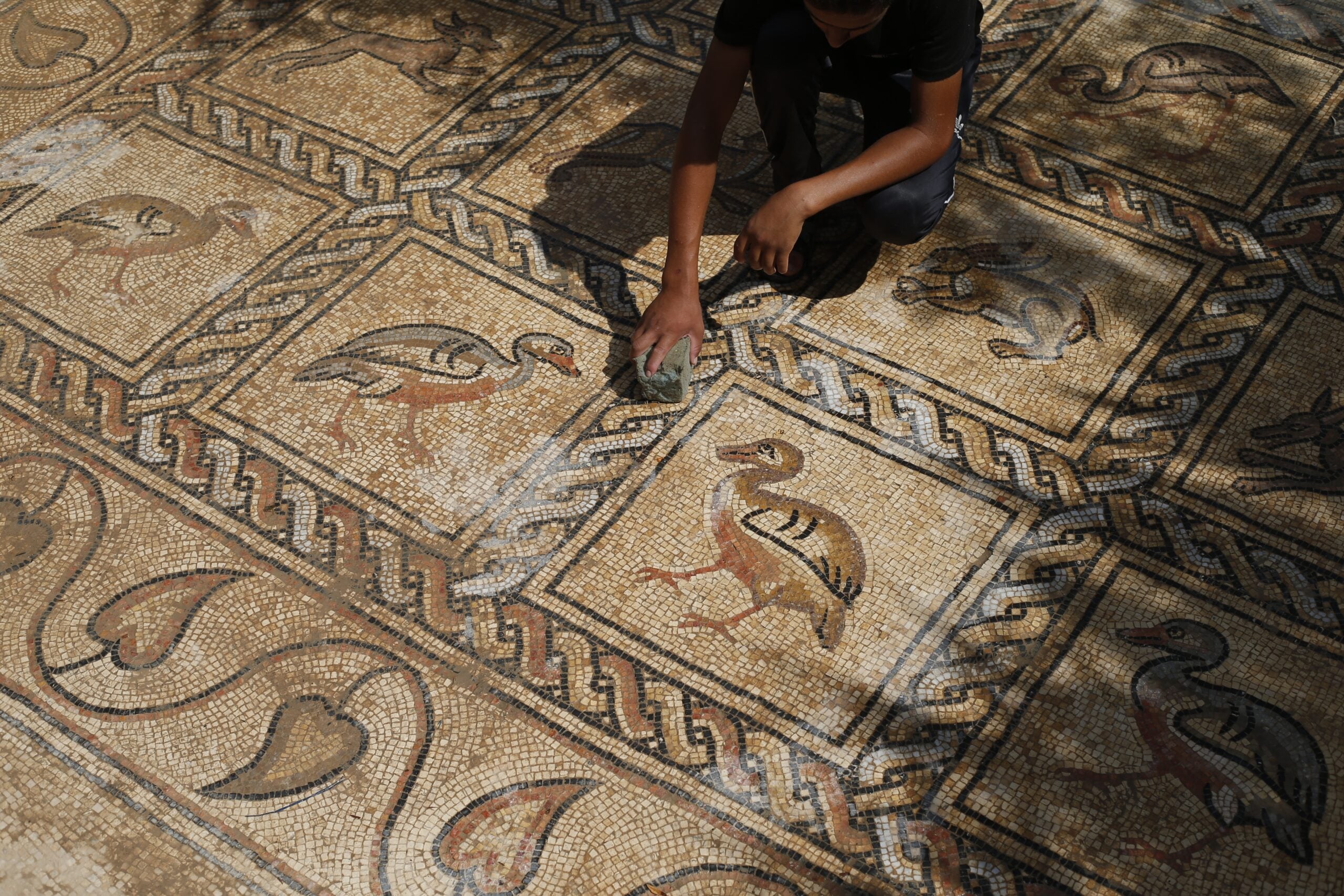
Conclusion
The destruction of Gaza’s cultural heritage is not merely collateral damage but an assault on the collective identity and historical presence of the Palestinian people. The loss of cultural producers—artists, writers, intellectuals, and scholars—and of archives, places of worship, libraries, and cultural landmarks severs ties to centuries of memory, knowledge, and community life, while the widespread devastation of homes, schools, hospitals, and essential infrastructure deepens a humanitarian and human rights crisis of immense scale.
Cultural expression serves as a bridge for dialogue, enables mutual understanding, and affirms our common humanity. For Palestinians, culture has long been a means of resistance and survival, a way of preserving identity through decades of displacement and occupation. The erasure of cultural life compounds the physical and human toll of war, threatening to strip them not only of their present but of their historical continuity and future self-determination. Protecting and restoring Palestinian cultural heritage is inseparable from the struggle for justice and human rights, their right to exist as a people, and the path to peace.
Recommendations
To All Parties to the Conflict:
- Agree to an immediate ceasefire and to a permanent end to the war.
- Immediately cease all indiscriminate or targeted attacks against civilians, including writers, artists, and cultural workers, and against civilian property in compliance with international humanitarian law and international human rights law, including cultural property as required by the 1954 Hague Convention.
- Guarantee the right of displaced Palestinians, including writers, artists and cultural workers to return to Gaza.
To the Government of Israel:
- Immediately permit humanitarian aid to enter Gaza.
- Immediately cease the targeting of cultural infrastructure and heritage sites, and comply with international obligations to protect these sites and other cultural institutions.
- Immediately cease the targeting of Palestinian journalists and ensure that they can safely report from Gaza.
- Allow the entry of researchers and guarantee the unimpeded transfer of materials and funding into Gaza for the rehabilitation and reconstruction of cultural sites, universities and schools; and for artistic and cultural production.
- Enable Palestinian students from Gaza and or displaced from Gaza to travel to universities in the West Bank to ensure that they can continue their studies.
- Cooperate with international investigations—and investigate all allegations—of serious violations of international humanitarian law and war crimes related to cultural heritage, cultural institutions, and universities, and hold those responsible to account.
- Allow international journalists unimpeded access to report from Gaza.
- Release Palestinians who have been arbitrarily detained for the exercise of their free expression, and ensure Palestinian detainees are treated in accordance with international law, are granted due process, and are tried in line with international fair trial standards.
To Hamas and Other Palestinian Armed Groups:
- Immediately release all civilian hostages, including remains of hostages. So long as hostages and prisoners of war remain in custody, ensure that they are treated in accordance with international law.
- End the practice of endangering civilians and cultural heritage by locating military objectives within or near densely populated areas, including cultural, religious, and educational property, and otherwise take precautions to protect civilians and civilian objects under their control from the effects of attacks, in accordance with international law.
- Cooperate with international investigations—and investigate all allegations—of serious violations of international humanitarian law and war crimes related to cultural heritage, cultural institutions, and universities, and hold those responsible to account.
- Respect, protect, and advance the rights to free expression and cultural rights in Gaza.
To the U.S. Government:
- Immediately cease all transfers of offensive weapons to Israel until such time as the U.S. is confident they will not be used to commit war crimes or gross violations of human rights. U.S. law prohibits the U.S. government from providing military assistance to foreign security force units that commit gross violations of human rights.216“About the Leahy Law,” U.S. Department of State, January 20, 2025, state.gov/bureau-of-democracy-human-rights-and-labor/releases/2025/01/leahy-law-fact-sheet
- Refrain from any actions that would violate the human rights of Palestinians, including by taking “ownership” of Gaza or any other effort that would forcibly displace Palestinians or otherwise deprive them of their human rights, including their cultural rights; and refrain from any action that would support attempts by the Israeli government to do the same.
- Rescind all sanctions imposed on staff of the International Criminal Court (ICC), and publicly reaffirm the U.S. government’s support for accountability mechanisms under international law. The U.S. should refrain from taking any actions that undermine the independence of the ICC or obstruct its investigations into grave international crimes.
- Allocate targeted reconstruction funding for the preservation, rehabilitation, and rebuilding of cultural and educational infrastructure in Gaza. U.S. support should prioritize initiatives led by local Palestinian institutions and cultural actors, and ensure that recovery efforts respect and protect cultural rights in accordance with international humanitarian and human rights law.
To the International Criminal Court:
- Consider adding the destruction of cultural and religious institutions and the use of cultural sites for military purposes to its ongoing investigation, including an evaluation of whether such destruction indicates or constitutes the war crime of wanton destruction or any other atrocity crime.
To Foreign Governments, Donors, and the U.N.:
- Immediately cease the transfer of offensive weapons to the government of Israel, comply with relevant international and national laws and/or policies on human rights obligations and ensure that there is not a substantial risk that weapons are used in the commission of serious IHL violations and human rights violations, including cultural destruction.
- Issue statements regarding the importance of protecting cultural heritage sites in Gaza and work to establish mechanisms to safeguard tangible and intangible cultural heritage from future destruction. This includes advocating for the inclusion of cultural heritage protections in ceasefire agreements and peacebuilding efforts.
- Provide emergency assistance grants for writers, artists, and cultural workers who are displaced, have lost homes and work, are injured, or who have experienced other hardships related to the conflict so they are able to meet their basic needs and continue to work.
- Provide for the means and opportunity for cultural producers to return to Gaza, including through programs for “returning artists,” livelihood support, participation in restoration programs, and other cultural and social programs. Support should prioritize initiatives led by local Palestinian institutions and cultural actors, and ensure that recovery efforts respect and protect cultural rights in accordance with international humanitarian and human rights law.
- Provide support for research, scholarships, and exchange programs for cultural workers and scholars affected by the war. These programs should include support to complete and comply with relevant visa requirements, short-term housing and stipends, opportunities for research, connection with other writers and artists, participation in literary events, and psychosocial support.
- Directly support Palestinian cultural organizations and organizations working to support cultural workers and creative production in Gaza.
- In the immediate post-war period:
- Rapidly allocate funds and expertise to support the expedited rehabilitation of cultural sites by Palestinians in Gaza. This would help revitalize Palestinian life and identity and constitute ways of supporting people and community resilience.
- Immediately allocate funds to support those writers, artists, and cultural workers who wish to return to Gaza.
- Support efforts to recover any cultural artifacts or objects that were looted, stolen, or displaced due to the conflict, with an emphasis on returning these items to Gaza and their rightful communities.
- Support the rebuilding of the education system in Gaza, which has been largely destroyed.
- Support the replenishing of library collections, including of school and university libraries, that have been damaged or destroyed.
- Provide support and expertise to develop a transitional educational system to compensate for learning loss while the physical infrastructure for educational facilities is being restored.
- While educational infrastructure is rebuilt, support arts and culture spaces that can provide educational support and trauma-healing spaces.
- Support the resilience of writers, artists, and cultural defenders so they can maintain the cultural threads and cohesion of Palestinian society in Gaza.
- Support grassroots Palestinian efforts that document cultural loss, as well as commemoration and digitization efforts, in addition to different types of reconstruction and financial support to restore cultural projects.
- Create a professional taskforce to document the heritage and cultural institutions and artifacts that were destroyed.
- Create a register of damages for properties lost during the war, with a view to future reparations.
- In the rehabilitation period:
- In collaboration with Palestinians in Gaza, provide dedicated support to cultural rebuilding and rehabilitation.
- Ensure that cultural heritage is given a central place in plans to revitalize the local economy of Gaza.
To the International Community:
- Recognize and recommit to the importance of preserving cultural heritage during conflict. Governments should strengthen legal protections, enforce accountability, and provide resources for the safeguarding of culture during armed conflict and as part of post-conflict reconstruction.
Methodology and Acknowledgments
Methodology
PEN America has been monitoring the deaths of writers, scholars, and journalists during the conflict and the Israeli military’s attacks against cultural heritage, libraries, museums, and other cultural institutions since October 2023.
In addition, PEN America staff and consultants conducted 24 online or written interviews and consultations with Palestinian cultural producers, including writers and artists affected by cultural destruction in Gaza between August 2024 and July 2025, and with experts in international human rights law and international humanitarian law and staff of human rights organizations. Where interviews were conducted in Arabic, these were translated into English. Some of these interviews included individuals who were still in Gaza or who had recently fled.
PEN America did not forensically analyze individual cases of damage to or destruction of specific cultural heritage sites and religious and cultural institutions. Organizations with expertise in documenting these types of attacks have analyzed a number of cultural sites, and PEN America reflects their findings in this report. PEN America has not independently verified open source video evidence, but where PEN America has drawn preliminary conclusions from these videos depicting the destruction of institutions and sites, we have consulted with experts in open source investigations to reach those conclusions.
We note that the closure of Gaza by the Israeli government to both the international media and non-governmental organizations, including those that document human rights violations, has impeded access to information about cultural destruction. As a result, PEN America relied on a handful of key sources that have conducted the most robust reporting. In addition, PEN America has relied on reports produced by other organizations that include documentation and evidence related to cultural destruction in Gaza, including UNESCO’s preliminary damage assessment and the May 2025 Report of the Independent International Commission of Inquiry on the Occupied Palestinian Territory, including East Jerusalem, and Israel.
Acknowledgments
PEN America is indebted to several earlier reports, including a Heritage for Peace report on cultural heritage from November 2023, the Palestinian Ministry of Culture Fourth Preliminary Report on the Cultural Sector’s Damages from February 2024, and the CCHP and EAMENA damage assessment of cultural heritage from February 2025, as well as monitoring by Librarians and Archivists with Palestine.
PEN America would like to thank all interviewees who agreed to participate in research for this report. We are particularly indebted to the Palestinian writers and artists from Gaza who shared their expertise and insights with us under unimaginable circumstances. We would also like to thank the following organizations and people for their advice, guidance, and information they shared: Amnesty International, Bellingcat, UNESCO, U.N. Human Rights, Forensic Architecture, Breaking the Silence, Gisha, Renad Qubbaj (Tamer Institute), and Alon Arad (Emek Shaveh).
The report was researched and written by Liesl Gerntholtz, director of the PEN/Barbey Freedom to Write Center, with research assistance from PEN America staff and consultants. The report was reviewed by PEN America staff and by three external reviewers who are experts in international law and/or the region.
Appendix 1. International Law and International Standards
This section sets out the relevant international human rights laws and international humanitarian laws, which have different but complementary roles during conflict:
- International human rights law sets out the fundamental rights and freedoms that all people are entitled to, regardless of the context, including the right to life, freedom of expression, and cultural rights.
- International humanitarian law (IHL) governs the conduct of hostilities and focuses on the protection of individuals who are not or are no longer taking part in the fighting, such as civilians, prisoners of war, and the wounded, as well as the protection of civilian property.
International Human Rights Law
International human rights law plays a critical and ongoing role during conflict, particularly those of a non-international nature, by ensuring the protection of human dignity, rights, and freedoms, even in times of war. It continues to provide protections that apply to individuals both in times of peace and during conflict.
The Right to Culture
The Universal Declaration of Human Rights, signed by all U.N. member states, including Israel and Palestine, guarantees “the right freely to participate in the cultural life of the community.” The International Covenant on Economic, Social and Cultural Rights (ICESCR), ratified by Israel in 1991 and by Palestine in 2014, guarantees the right of everyone to take part in cultural life. The Committee on Economic, Social and Cultural Rights (CESCR) found that states have a duty to preserve cultural property and that there is an obligation of “[p]reservation and presentation of mankind’s cultural heritage,” which includes a prohibition on its willful destruction.217O’Keefe, The Protection of Cultural Property in Armed Conflict (Cambridge: Cambridge University Press, 2006), 305.
International human rights law does not cease to apply during armed conflict or occupation, though IHL, as the specialized area of international law on armed conflict, may take priority in governing how the conflict should be conducted.218Treaty mechanisms and international courts have deliberated on how exactly the two bodies of law interact, but this is beyond the scope of this report. See also Christian Tomuschat, Human Rights and International Humanitarian Law, European Journal of International Law, Volume 21, no. 1 (February 2010): 15–23, doi.org/10.1093/ejil/chq003 The International Court of Justice (ICJ) has confirmed that international human rights law, including specifically economic, social, and cultural rights, also applies under occupation.219Office of the U.N. High Commissioner for Human Rights, “Protection of economic, social and cultural rights in conflict,” 3, ohchr.org/sites/default/files/Documents/Issues/ESCR/E-2015-59.pdf
The Right to Education
The right to education, including higher education, is recognized in the Universal Declaration of Human Rights from 1948 and the ICESCR. Education should enable “all persons to participate effectively in a free society, promote understanding, tolerance and friendship among all nations and all racial, ethnic or religious groups.”220G.A. Res. 2200A (XXI), International Covenant on Economic, Social and Cultural Rights, art. 13 (December 16, 1966). The CESCR has also recognized that the right to culture is “intrinsically linked” to the right to education, “through which individuals and communities pass on their values, religion, customs, language and other cultural references.”221Committee on Economic, Social, and Cultural Rights (CESCR), General Comment 21, “Right of Everyone to Take Part in Cultural Life, art. 15(1) of the CESCR,” United Nations Economic and Social Council, 43rd Session, November 2–20, 2009.
Recent international efforts have recognized the risks to education due to armed conflict. The Safe Schools Declaration is an inter-governmental political commitment endorsed by 120 states aiming to protect students, teachers, schools, and universities from the worst effects of conflict. According to the Guidelines for Protecting Schools and Universities from Military Use During Armed Conflict, which are linked to the declaration, schools and universities that have been abandoned or evacuated due to conflict should not be used by parties to the armed conflict in support of the military effort, except when there is no viable alternative. Schools and universities must never be destroyed as a measure intended to deprive the opposing parties to the armed conflict of the ability to use them in the future. Israel has not endorsed the Safe Schools Declaration, while Palestine did so in 2015.222“Safe Schools Declaration Endorsements,” Global Coalition to Protect Education from Attack, ssd.protectingeducation.org/endorsement/
The Right to Self-Determination
The right to self-determination is particularly important in the Palestinian context, where the State of Palestine is recognized to exist under international law, but does not exert sovereignty over any territory and Palestinian authorities are unable to guarantee the rights of Palestinians due to Israel’s occupation.223G.A. Res. 67/19 (November 29, 2012), docs.un.org/en/A/RES/67/19 The right to self-determination is contained in Article 1 of the International Convention on Civil and Political Rights (ICCPR) and in Article 1 of the ICESCR, which state that “[a]ll peoples have the right of self-determination” and to “freely determine their political status and freely pursue their economic, social and cultural development.” The right to self-determination is foundational to enabling people to practice and develop their culture.
International Humanitarian Law
The conflict in Gaza between Israel and Hamas is governed by international humanitarian law (IHL), which aims to limit the civilian suffering caused by war. Key IHL rules relevant to targeting during armed conflict are found in customary international law and in the First Additional Protocol of 1977 to the Geneva Conventions (Protocol I). Although the government of Israel has not ratified Protocol I, most of its provisions are considered to be part of customary international law,224International Committee of the Red Cross, Customary International Humanitarian Law, ihl-databases.icrc.org/en/customary-ihl which is binding for all parties to an armed conflict, whether they are states or non-state armed groups.225The basic rules informing our analysis are part of customary international law and they apply to the hostilities between Israel and Hamas (and other Palestinian armed groups) irrespective of whether the hostilities are occurring in the context of an international or a non-international armed conflict, an issue on which views diverge. Israel abides by the customary international law provisions in Protocol I.226According to the Israeli Ministry of Foreign Affairs, Israel “abides by all applicable rules of customary international law, including those embodied in conventions to which it is not a party (such as the 1977 Additional Protocols to the Geneva Conventions).” Israeli Ministry of Foreign Affairs, “Hamas-Israel Conflict 2023: Key Legal Aspects,” November 2, 2023, on file with PEN America. Hamas has never officially committed to the Geneva Conventions and the protocols, but it too is nonetheless bound by customary international law.227Under Article 96 of Protocol I, non-state actors may commit to apply the Geneva Conventions and the protocols to the Swiss government. Hamas has not made a declaration under article 96. See Human Rights Watch, “White Flag Deaths,” August 13, 2009.
IHL Protections for Cultural Heritage and Cultural Property
Additional sources of IHL relevant to the destruction of civilian and cultural property in conflict are contained in the 1949 Geneva Conventions, the 1954 Hague Convention for the Protection of Cultural Property in the Event of Armed Conflict, and the 1907 “Hague Regulations” (see below).228See especially: Geneva Convention Relative to the Protection of Civilian Persons in Time of War, August 12, 1949, 75 U.N.T.S. 287; Convention for the Protection of Cultural Property in the Event of Armed Conflict, May 14, 1954, https://www.unesco.org/en/legal-affairs/convention-protection-cultural-property-event-armed-conflict-regulations-execution-convention?hub=415; Convention (IV) respecting the Laws and Customs of War on Land and its annex: Regulations concerning the Laws and Customs of War on Land, October 18, 1907.
The fundamental IHL principles of distinction, proportionality, and precautions, described below, have implications for attacks on or near cultural property.229See ICRC, Customary International Humanitarian Law, “Rules 38–41.” The duty to take precautions means that if a commander directing an attack can use a means that is less likely to cause incidental harm to civilian objects, including cultural objects, they must do so. In proportionality analyses, the cultural value of the civilian object expected to be harmed in a planned attack should be taken into account. According to the military manual of the U.N. Educational, Scientific and Cultural Organization (UNESCO), “Since elements of . . . cultural heritage are often irreplaceable, only the promise of very considerable concrete and direct military advantage . . . will in practice be enough to justify an attack that is likely to cause incidental damage to cultural property.”230“Protection of Cultural Property: Military Manual,” UNESCO, 2016, 35, unesdoc.unesco.org/ark:/48223/pf0000246633 Special care must be taken by parties to conflict to avoid damage to buildings dedicated to religion, art, science, education, or charitable purposes, and to historic monuments, unless they are military objectives.231ICRC, Customary International Humanitarian Law, “Rule 38, Attacks Against Cultural Property.”
The 1954 Hague Convention for the Protection of Cultural Property in the Event of Armed Conflict, which the government of Israel has ratified and the state of Palestine has acceded to, includes special protections for movable or immovable cultural property which is specifically “of great importance to the cultural heritage of every people.”232Convention for the Protection of Cultural Property in the Event of Armed Conflict (hereinafter: the 1954 Hague Convention). Cultural property includes monuments of architecture, art, or history; archaeological sites; works of art; manuscripts, books, and other objects; and buildings that preserve or exhibit cultural property. The convention also prohibits theft, pillage, or vandalism directed against cultural property.233The 1954 Hague Convention on Cultural Property also has two protocols, which Israel has not ratified. More current definitions of cultural heritage take into account heritage of local significance as well as universal value and intangible cultural heritage.234“Destroying Cultural Heritage: Explosive Weapons’ Effects in Armed Conflict and Measures to Strengthen Protection,” Human Rights Watch and Harvard Law School, April 18, 2024, 2, hrw.org/report/2024/04/18/destroying-cultural-heritage/explosive-weapons-effects-armed-conflict-and
The Principles of Distinction, Proportionality, and Precautions
Some of the most fundamental IHL principles relevant to targeting, which are part of customary international law, include distinction, proportionality, and taking precautions in attack:
- Distinction refers to the duty to distinguish at all times between military objectives and civilians and civilian objects, and to direct attacks only at military objectives. Military objectives are defined as objects “which by their nature, location, purpose or use make an effective contribution to military action and whose total or partial destruction, capture or neutralization, in the circumstances ruling at the time, offers a definite military advantage.”235Protocol Additional to the Geneva Conventions of 12 August 1949, and Relating to the Protection of Victims of International Armed Conflicts (Protocol I), June 8, 1977, 1125 U.N.T.S. 3, Art. 52. Parties to the conflict must do everything feasible to verify targets are military objectives.236ICRC, Customary International Humanitarian Law, “Rule 16. Target Verification.” Civilians must never be attacked unless (and only while) they take a direct part in hostilities.
- The principle of proportionality prohibits launching an attack if the expected civilian harm is excessive in relation to the expected military advantage. Each party to the conflict must do everything feasible to assess the direct military advantage anticipated and the expected incidental civilian harm for each individual attack, and to weigh the anticipated advantage against the expected civilian harm to ensure it is not excessive.237ICRC, Customary International Humanitarian Law, “Rule 18. Assessment of the Effects of Attacks”; See also Diakonia IHL Centre, “Legal Brief on the 2023 Hostilities in Israel and Gaza,” 54.
- Parties to the conflict must take precautions with a view to avoiding, and in any event minimizing, incidental loss of civilian life, injury to civilians, and damage to civilian objects.238ICRC, Customary International Humanitarian Law, “Rule 15. Principle of Precautions in Attack.” This includes cultural heritage sites, religious buildings, libraries, and universities. Taking precautions includes choosing means and methods of warfare that will avoid or at least minimize incidental harm to civilians and civilian objects, for example by selecting appropriate weapons and adjusting the timing of an attack.239ICRC, Customary International Humanitarian Law, “Rule 17. Choice of Means and Methods of Warfare”; see also Report of the Independent Task Force NSM-20, 12 Taking precautions also means giving effective warnings prior to attacks.240ICRC, Customary International Humanitarian Law, “Rule 20. Advance Warning”; See also Diakonia IHL Centre, “Legal Brief on the 2023 Hostilities in Israel and Gaza,” p. 65. An attacker must do everything feasible to cancel or suspend an attack if it becomes apparent that the target is not a military objective, or if the attack will cause excessive civilian harm.241ICRC, Customary International Humanitarian Law, “Rule 19. Control during the Execution of Attacks.”
Conduct Endangering the Civilian Population
As part of their efforts to mitigate against the effects of attacks, all parties to conflict must avoid military conduct that endangers the civilian population. IHL prohibits endangering civilians and civilian objects by locating military objectives within or near densely populated areas.242ICRC, Customary International Humanitarian Law, “Rule 23, Location of Military Objectives outside Densely Populated Areas.” Article 58 of the First Additional Protocol to the Geneva Conventions states that “[p]arties to the conflict shall, to the maximum extent feasible . . avoid locating military objectives within or near densely populated areas.”243Protocol Additional to the Geneva Conventions of 12 August 1949, and Relating to the Protection of Victims of International Armed Conflicts (Protocol I), Art. 58. PEN America does not use the term “human shields” in this report because “human shielding” is a war crime distinct from the obligation to avoid locating military objectives in densely populated areas.
Destruction of Property
Destruction of property without military necessity is prohibited by customary international law, including as codified in the 1907 Hague Regulations and Article 53 of the Fourth Geneva Convention, which states: “Any destruction by the Occupying Power of real or personal property . . . is prohibited, except where such destruction is rendered absolutely necessary by military operations.”244ICRC, Customary International Humanitarian Law, “Rules 50-51”; Geneva Convention relative to the Protection of Civilian Persons in Time of War, art. 53. This standard should apply in Gaza to, for example, controlled detonations of university buildings and other instances of property destruction that occur in areas under the effective control of the Israeli military at the time.245Jeffrey Lovitky, “Rules Governing Property Destruction Outside of the Attack and Occupation Contexts,” Lieber Institute, United States Military Academy, May 31, 2024, lieber.westpoint.edu/rules-governing-property-destruction-outside-attack-occupation-contexts/ Even if Israel is not the occupying power in Gaza, as it claims (see below), Article 23(g) of the 1907 Hague Regulations prohibits destroying or seizing the enemy’s property, “unless such destruction or seizure be imperatively demanded by the necessities of war.”
Occupation Under International Law
The ICJ, U.N., the ICRC, and various international, Palestinian and Israeli human rights organizations have maintained that Gaza remains occupied by Israel, despite its withdrawal of ground forces in 2005, to the extent that Israel continues to exert control over the lives of Palestinians in Gaza.246“Gaza: Israel’s ‘Open-Air Prison’ at 15,” Human Rights Watch; “(Re)-introducing the functional approach to occupation,” Gisha, December 15, 2015, gisha.org/en/re-introducing-the-functional-approach-to-occupation/ At the same time, other actors—including Hamas and the Palestinian Authority—also have human rights obligations toward the civilian population.
The ICJ advisory opinion on the legal consequences of Israel’s occupation of the West Bank and Gaza, issued on July 19, 2024, held that “Israel’s withdrawal from the Gaza Strip has not entirely released it of its obligations under the law of occupation. Israel’s obligations have remained commensurate with the degree of its effective control over the Gaza Strip.”247Legal Consequences Arising from the Policies and Practices of Israel in the Occupied Palestinian Territory, Including East Jerusalem, Advisory Opinion, I.C.J. Reports 2024, 31 (July 19, 2024), icj-cij.org/sites/default/files/case-related/186/186-20240719-adv-01-00-en.pdf The opinion concludes that, according to international law, the government of Israel’s presence in the Occupied Palestinian Territory is unlawful.248“Summary of the ICJ’s Advisory Opinion of 19 July 2024,” Diakonia International Humanitarian Law Centre, July 29, 2024, https://www.diakonia.se/ihl/news/summary-icj-advisory-opinion-19-july-2024/
Israel rejects the ICJ’s finding that Gaza remains occupied following the withdrawal of its ground forces from the Strip in 2005.
Nonetheless, most of the legal standards applied in this report comprise a part of customary international law, which the government of Israel is bound by in its conduct whether or not it agrees that Gaza is occupied. Other articles of law, such as the prohibition in the Fourth Geneva Convention for the Occupying Power to destroy property unless absolutely necessary, have equivalents in other sources of law, such as Article 23(g) of the 1907 Hague Regulations in the case of destruction of property.
Atrocity Crimes
War crimes, crimes against humanity, and genocide are collectively referred to as atrocity crimes. The definition of war crimes is codified in the Rome Statute of the International Criminal Court (ICC), the world’s highest criminal court, in addition to other bodies of international law.249The Four Geneva Conventions of 1949 and Their Additional Protocols (1977, 2005) Intentional, indiscriminate, and disproportionate attacks harming civilians and civilian objects, when committed with criminal intent, are war crimes.250The laws of war governing both IACs and NIACs prohibit attacks on civilians and cultural property, but the specific crimes and thresholds under international law differ. The Rome Statute reflects these distinctions by assigning different sets of prosecutable offenses depending on the nature of the conflict. Wanton destruction—defined as extensive destruction and appropriation of property, not justified by military necessity and carried out unlawfully and wantonly—is also a war crime.
Directing attacks against “buildings dedicated to religion, education, art, science or charitable purposes, [or] historic monuments . . . provided they are not military objectives” is a war crime. Criminal intent includes violations committed intentionally or recklessly.
Destruction of religious or cultural sites, when it is widespread and systematic, may amount to persecution as a crime against humanity.251Roger O’Keefe, The Protection of Cultural Property in Armed Conflict, 350–351.
According to the U.N. Office on Genocide Prevention, destruction of property of cultural and religious significance is considered a potential indicator of genocidal intent.252U.N. Office of Genocide Prevention, “Framework of Analysis for Atrocity Crimes,” 2014, 19. Guidance from the Office of the Prosecutor of the ICC about prosecuting crimes affecting cultural heritage states that “the targeting of a group’s cultural heritage may constitute evidence of the perpetrator’s intent to destroy that group,” though attacks on cultural heritage do not per se constitute acts of genocide.253Office of the Prosecutor, International Criminal Court, “Policy on Cultural Heritage,” June 2021, 31, icc-cpi.int/sites/default/files/itemsDocuments/20210614-otp-policy-cultural-heritage-eng.pdf
The first ICC case to focus on the destruction of cultural property was the Al-Mahdi case, where a senior member of an armed group in Mali was found guilty of intentionally directing attacks against mausoleums and mosques in Timbuktu in 2012.254“Mali: ICC trial over destruction of cultural property in Timbuktu,” Amnesty International, August 22, 2016, amnesty.org/en/latest/press-release/2016/08/mali-icc-trial-over-destruction-of-cultural-property-in-timbuktu-shows-need-for-broader-accountability/; “Al Mahdi Case,” International Criminal Court, icc-cpi.int/mali/al-mahdi.
Israel—like the United States—is not a member of the ICC and rejects its jurisdiction. Palestine has been a member since 2015 and it has been argued that this gives the ICC jurisdiction over international crimes committed in Gaza.255“Situation in the State of Palestine,” (International Criminal Court, Pre-Trial Chamber I, Case No. ICC-01/18, para 100-108, February 5, 2021) icc-cpi.int/sites/default/files/CourtRecords/CR2021_01165.PDF Israel contested the ICC’s jurisdiction over the case brought by South Africa and in April 2024, the Appeals Chamber reversed a decision by the Pre-Trial Chamber and ordered it to reconsider the question of jurisdiction.256Mike Corder, “International court appeals panel orders judges to reconsider Israel’s jurisdiction challenge,” Associated Press, April 24, 2025, apnews.com/article/icc-israel-gaza-netanyahu-warrants-dc033cd3c13369a923463ab01c6138ba
Accountability
States are obligated to conduct impartial investigations into credible allegations of serious IHL violations, and to hold accountable anyone found responsible for war crimes.257“Obligations in terms of penal repression,” ICRC, March 2014, icrc.org/sites/default/files/document/file_list/obligations-in-terms-of-penal-repression-icrc-eng.pdf According to Article 28 of the 1954 Hague Convention for the Protection of Cultural Property, the convention’s High Contracting Parties commit to taking “all necessary steps to prosecute and impose penal or disciplinary sanctions upon those persons, of whatever nationality, who commit or order to be committed a breach” of the convention. Israel, having ratified the convention, is bound by this obligation.
The Need for Transparency
The lack of any obligation for a party to an armed conflict to be transparent about its targeting decisions is “a serious shortcoming of IHL,” according to international law expert Marco Sassòli.258Marco Sassòli, “Israel – Hamas 2023 Symposium – Assessing the Conduct of Hostilities in Gaza – Difficulties and Possible Solutions,” Lieber Institute, United States Military Academy, October 30, 2023, lieber.westpoint.edu/assessing-conduct-hostilities-gaza-difficulties-possible-solutions/ More transparent data sharing practices are promoted by the 2022 Political Declaration on Strengthening the Protection of Civilians from the Humanitarian Consequences Arising from the Use of Explosive Weapons in Populated Areas, endorsed by 83 countries, including the United States and Palestine but not Israel. The declaration calls on states to “[c]ollect, share, and make publicly available disaggregated data on the direct and indirect effects on civilians and civilian objects of military operations involving the use of explosive weapons in populated areas, where feasible and appropriate.” It also calls on states to facilitate the data collection work of the U.N., ICRC, and civil society, and for timely damage assessments that can help preserve evidence and assist in reconstruction and rehabilitation.
Appendix 2. Relevant Background
The current armed conflict between Israel and Hamas that started on October 7, 2023, with the Hamas-led attack on southern Israel by Palestinian armed groups, is the latest, longest, and most brutal round of fighting, following recent escalations in 2008, 2014, and 2021.
Hamas, which has both political and military wings, is a nationalist Islamist party founded in 1987 as an offshoot of the Muslim Brotherhood. To date Hamas has not recognized the legitimacy of Israel as a state. The United States, Israel, the United Kingdom and the European Union, among other countries, have designated Hamas a terrorist organization.
Hamas came to power in 2006—the last time parliamentary elections were held in the Occupied Palestinian Territory (OPT)—and its success was seen as a rebuke to the Fatah-controlled Palestinian Authority, viewed by many Palestinians as weak and corrupt.259“What is the Palestinian group Hamas?” Reuters, January 23, 2024, www.reuters.com/world/middle-east/what-is-palestinian-group-hamas-2023-10-30/ In the aftermath of the elections, Fatah took over the West Bank, and Hamas wrestled control of Gaza. In response, the Israeli government implemented a closure on Gaza in 2007, severely restricting the movement of people and goods by air, sea, and land, limiting possibilities for Palestinian economic development, and maintaining the geographical and political separation of the West Bank and Gaza as a stated policy goal.260“Area G: From separation to annexation,” Gisha, June 2020, https://gisha.org/UserFiles/File/publications/Area_G/From_Separation_to_Annexation_2020_EN.pdf; “Timeline of Gaza blockade: How it started; how it’s going,” Euro-Mediterranean Human Rights Monitor, July 23, 2023, https://euromedmonitor.org/en/article/5721/Timeline-of-Gaza-blockade:-How-it-started;-how-it%E2%80%99s-going Human rights organizations261“Israel must end its occupation of Palestine to stop fuelling apartheid and systemic human rights violations,” Amnesty International Canada, February 19, 2024, amnesty.ca/human-rights-news/israel-must-end-its-occupation-of-palestine-to-stop-fuelling-apartheid-and-systematic-human-rights-violations/ and the International Court of Justice262Legal Consequences Arising from the Policies and Practices of Israel in the Occupied Palestinian Territory, Including East Jerusalem, Advisory Opinion, I.C.J. Reports 2024, 31 (July 19, 2024), icj-cij.org/sites/default/files/case-related/186/186-20240719-adv-01-00-en.pdf have determined that the closure and occupation violate Palestinians’ human rights, including the right to freedom of movement, access to education and to work and have called for the government of Israel to bring an end to the occupation as rapidly as possible. Egypt has imposed its own restrictive travel policies on Palestinians at its border with Gaza, which have varied depending on the government in power.263“Timeline of Gaza blockade: How it started; how it’s going,” Euro-Mediterranean Human Rights Monitor
The October 7, 2023, attack on southern Israel constituted, at the time, the deadliest single-day attack of the Israeli-Palestinian conflict, and the largest single-day attack on Jews since the Holocaust. Human rights organizations have deemed that the killings, cruel and inhuman treatment, hostage-taking, sexual violence, and other crimes committed by Hamas and other Palestinian armed groups amount to war crimes and crimes against humanity.264“I Can’t Erase all the Blood from My Mind,” Human Rights Watch; “Israel/OPT: Amnesty International’s research into Hamas-led attacks of 7 October 2023 and treatment of hostages,” Amnesty International, December 2, 2024, amnesty.org/en/documents/mde15/8803/2024/en/
The coordinated attacks killed over 1,100 people—comprising Israelis, Palestinian citizens of Israel, and foreign nationals and including writers, educators, artists, and photographers, as well as soldiers; 364 civilians, the largest number at any site, were killed at the Nova Festival, an outdoor trance music festival.265“I Can’t Erase all the Blood from My Mind: Palestinian Armed Groups’ October 7 Assault on Israel,” Human Rights Watch, July 17, 2024, hrw.org/report/2024/07/17/i-cant-erase-all-blood-my-mind/palestinian-armed-groups-october-7-assault-israel Hamas and other Palestinian armed groups took 251 Israelis and foreigners, including children and older adults, hostage. To date, 146 have been freed or rescued, including 78 in an exchange deal for Palestinian prisoners in November 2023 and those released following the ceasefire implemented on January 19, 2025. Eighty-three have been confirmed dead and it is believed that 22 are still alive in Gaza.266Victoria Bisset, Júlia Ledur, and Leslie Shapiro “Monitoring the status of hostages still in Gaza after Hamas’s attack,” The Washington Post, accessed August 6, 2025, washingtonpost.com/world/interactive/hamas-hostages-israel-war-gaza/
Israel’s military campaign in response to the October 7 attacks started with a massive aerial bombardment of Gaza that lasted for several weeks. This was followed by a full-scale ground invasion on October 27. In the first week of the war alone, Israel dropped 6,000 bombs on the Gaza Strip.267Omar Abdel-Baqui, “Israeli Air Force Says It Has Dropped 6,000 Bombs on Gaza,” The Wall Street Journal, October 12, 2023, wsj.com/livecoverage/israel-hamas-war-gaza-strip/card/israeli-air-force-says-it-has-dropped-6-000-bombs-on-gaza-QK1aSnupiGqytMVO86PU The bombardment and subsequent ground offensive has reduced Gaza to rubble, and it also marks the largest displacement of Palestinians since the Nakba268Nakba is an Arabic word that means catastrophe in 1948 when 700,000 Palestinians fled or were forced from their homes and not permitted to return after the 1948 Arab-Israeli war that followed the establishment of the state of Israel.269Joseph Krauss, “Palestinians mark 76 years of dispossession as a potentially even larger catastrophe unfolds in Gaza,” Associated Press, May 14, 2024, apnews.com/article/israel-palestinians-hamas-war-nakba-history-b5cea9556e516655c25598d5dbe54192
As of September 10, 2025, nearly 65,000 Palestinians—men, women, and children—have been killed, and more than 163,000 wounded.270“Reported impact snapshot | Gaza Strip (10 September 2025),” U.N. Office for the Coordination of Humanitarian Affairs, September 10, 2025, ochaopt.org/content/reported-impact-snapshot-gaza-strip-10-september-2025 A U.N. analysis showed that nearly 70 percent of those identified over the six-month period between November 2023 and April 2024 were women and children.271Mallory Moench, “Nearly 70% of Gaza war dead verified by UN are women and children,” BBC News, November 8, 2024, bbc.com/news/articles/cn5wel11pgdo “Where verified deaths mirror the demographic makeup of a population at large, rather than reflecting the known demographic of combatants, this raises concerns that attacks failed to distinguish between military targets and civilians, raising concerns about compliance with the principle of distinction,” according to a November 2024 report by the Office of the U.N. High Commissioner for Human Rights. It also reflects an apparent failure to take all feasible precautions to avoid, and in any event to minimize, incidental loss of civilian life, injury to civilians and damage to civilian objects.272“Six-month update report on the human rights situation in Gaza: 1 November 2023 to 30 April 2024,” Office of the U.N. High Commissioner for Human Rights, November 8, 2024, ohchr.org/en/documents/reports/six-month-update-report-human-rights-situation-gaza-1-november-2023-30-april-2024
The U.N. Independent International Commission of Inquiry on the Occupied Palestinian Territory stated that “Israel has perpetrated a concerted policy to destroy Gaza’s healthcare system.”273“UN Commission finds war crimes and crimes against humanity in Israeli attacks on Gaza health facilities and treatment of detainees, hostages,” Office of the U.N. High Commissioner for Human Rights, October 10, 2024, ohchr.org/en/press-releases/2024/10/un-commission-finds-war-crimes-and-crimes-against-humanity-israeli-attacks
In addition, 670,000 children are out of school and have no access to formal education, and 90 percent of Gaza’s residents, an estimated 1.9 million people, have been repeatedly displaced from their homes.274“Reported impact snapshot | Gaza Strip (14 January 2025),” U.N. Office for the Coordination of Humanitarian Affairs; “45,000 first graders unable to start the new school year in the Gaza Strip,” U.N. Children’s Fund (UNICEF), September 9, 2024, unicef.org/press-releases/45000-first-graders-unable-start-new-school-year-gaza-strip-unicef; “Israel’s Crimes Against Humanity in Gaza,” Human Rights Watch, November 14, 2024, hrw.org/news/2024/11/14/israels-crimes-against-humanity-gaza Approximately 100,000 Palestinians fled south to Egypt, paying exploitative fees to Egyptian authorities to cross the border, before Israel invaded Rafah in May 2024, completing the encirclement of the territory and cutting it off from all sides.275Bill Frelick, “No Exit in Gaza,” The Hill, March 30, 2024, thehill.com/opinion/4565308-no-exit-in-gaza-left-with-no-other-options-residents-should-have-a-right-to-flee/; “ “A year of war in Gaza: 100,000 Palestinians fled to Egypt,” FRANCE 24 English, October 7, 2024, youtube.com/watch?v=PrmpSlXu6x8; Lisa Goldman, “The Cost of Leaving Gaza,” New Lines Magazine, February 28, 2024, newlinesmag.com/reportage/the-cost-of-leaving-gaza/
Ninety-two percent of Gaza’s housing units have been destroyed or damaged.276“Reported impact snapshot | Gaza Strip (14 January 2025),” U.N. Office for the Coordination of Humanitarian Affairs. By September 2024, it was estimated that 66 percent of the buildings in the Gaza Strip were likely destroyed or damaged.277“66% of the total structures in the Gaza Strip have sustained damage, UNOSAT’s analysis reveals,” U.N. Institute for Training and Research, September 30, 2024, unitar.org/about/news-stories/press/66percent-total-structures-gaza-strip-have-sustained-damage-unosats-analysis-reveals The U.N. Special Rapporteur on adequate housing, Balakrishnan Rajagopal, said, “The level of destruction in certain areas of Gaza, particularly northern Gaza, is approaching levels of 100%.”278Rami Ayari (@Raminho), “UN Special Rapporteur on @adequatehousing Balakrishnan Rajagopal: “The level of destruction in certain areas of #Gaza, particularly northern Gaza, is approaching levels of 100%. . . .” X, October 18, 2024, x.com/Raminho/status/1847348358458769462 According to a joint report by the World Bank, the European Union, and the U.N., the cost of damage to physical structures alone was around $18.5 billion at the end of January 2024.279“Gaza Strip Interim Damage Assessment,” The World Bank, the European Union, and the United Nations, March 29, 2024, thedocs.worldbank.org/en/doc/14e309cd34e04e40b90eb19afa7b5d15-0280012024/original/Gaza-Interim-Damage-Assessment-032924-Final.pdf In mid-May 2024, a U.N. official stated that rebuilding Gaza could cost around $50 billion and take more than 20 years.280Augusta Saraiva, “Rebuilding Gaza to Cost $50 Billion Over Two Decades, UN Says,” Bloomberg, May 2, 2024, bloomberg.com/news/articles/2024-05-02/rebuilding-gaza-to-cost-50-billion-over-two-decades-un-says
As of August 2025, 192 journalists have been killed in Gaza, and the Committee to Protect Journalists indicated that at least 24 journalists and media workers were directly targeted by Israeli forces, a war crime under international law.281“Israel-Gaza War,” Committee to Protect Journalists, last accessed August 12, 2025, cpj.org/full-coverage-israel-gaza-war/; “Israel kills Al Jazeera journalists in targeted Gaza City airstrike,” Committee to Protect Journalists, August 10, 2025, cpj.org/2025/08/israel-kills-al-jazeera-journalists-in-targeted-gaza-city-airstrike/ The Israeli military has stated that some journalists were members of militant groups, though it has provided little evidence for this and the Committee to Protect Journalists (CPJ) reported that the IDF, in response to its requests for comment, provided “questionable or no evidence” of links with Hamas.282“CPJ welcomes reports of Gaza ceasefire, calls for media access and war crimes investigations,” Committee to Protect Journalists, January 15, 2025, cpj.org/2025/01/cpj-welcomes-gaza-ceasefire-calls-for-media-access-and-war-crimes-investigations/ In July 2025, several major global media organizations issued an unprecedented joint statement about severe food shortages and the risk of starvation faced by Palestinian journalists, jeopardizing their ability to work and survive.283Nicole Meir, “Joint statement on Gaza from AFP, AP, BBC, Reuters,” Associated Press, July 24, 2025, ap.org/the-definitive-source/announcements/joint-statement-on-gaza-from-afp-ap-bbc-reuters/ They urged Israel to allow journalist movement in and out of Gaza and ensure adequate food supplies.284Meir, “Joint statement on Gaza from AFP, AP, BBC, Reuters,”
On December 29, 2023, South Africa submitted a case to the International Court of Justice (ICJ) in The Hague alleging that Israel violated the Convention on the Prevention and Punishment of the Crime of Genocide. The legal definition of genocide hinges on the intent to destroy, in whole or in part, a national, ethnic, racial, or religious group.285“Definitions of Genocide and Related Crimes,” U.N. Office on Genocide Prevention and the Responsibility to Protect, un.org/en/genocide-prevention/definition While the underlying crimes that can constitute genocide under the convention do not explicitly include the destruction of cultural property,286Efforts to include the destruction of cultural heritage in the convention at the time of its drafting, including from Raphael Lemkin, who coined the term “genocide” and campaigned for the establishment of the convention, were rejected. See Jeffrey Bachman, ed., Cultural Genocide: Law, Politics and Global Manifestations (New York: Routledge, 2019). South Africa argues that the government of Israel is “inflicting on [Palestinians] conditions of life intended to bring about their destruction as a group.”287Application of the Convention on the Prevention and Punishment of the Crime of Genocide in the Gaza Strip (South Africa v. Israel), Application Instituting Proceedings and Request for the Indication of Provisional Measures, Order of 29 December 2023, I.C.J. Reports 2023, 70 ¶ 43, icj-cij.org/sites/default/files/case-related/192/192-20231228-app-01-00-en.pdf These conditions have been carried out in part “through the destruction of Gaza’s universities, schools, courts, public buildings, public records . . . libraries, churches, [and] mosques . . . erasing entire oral histories in Gaza. It also cited “the killing of prominent and distinguished members of society.”288Application of the Convention on the Prevention and Punishment of the Crime of Genocide in the Gaza Strip (South Africa v. Israel), Application Instituting Proceedings and Request for the Indication of Provisional Measures, Order of 29 December 2023, I.C.J. Reports 2023, 168 ¶ 114, https://www.icj-cij.org/sites/default/files/case-related/192/192-20231228-app-01-00-en.pdf Israel, which ratified the Genocide Convention in 1950, disputes all allegations.289“Israel: South African genocide claims at ICJ are baseless,” The Jerusalem Post, January 11, 2024, jpost.com/international/article-781745
Appendix 3. Cultural Figures Killed in Gaza
These numbers, collected by PEN America from media and other sources, do not purport to be a comprehensive accounting of all the deaths of Palestinian cultural figures and they are likely a significant undercount. The number of cultural figures includes literary writers, poets, filmmakers, playwrights, creative artists, translators, scholars, dramatists, singer-songwriters, historians, and storytellers who were killed between October 7, 2023 and June 2025.
| Name | Date of Death | Profession |
|---|---|---|
| Khalil Al-Batsh | October 2023 | Scholar and translator |
| Mahmoud Al-Juberi (Al-Nabtashi) | October 2023 | Artist |
| Omar Abu Shawish | October 7, 2023 | Writer |
| Mohammad Abdulrahim Saleh | October 10, 2023 | Filmmaker |
| Saeed Dahshan (Said al-Dahshan) | October 11, 2023 | Writer |
| Sereen Al-Attar | October 11, 2023 | Scholar |
| Tayseer Ibrahim | October 12, 2023 | Scholar |
| Muhannad Al-Agha | October 12, 2023 | Artist |
| Ali Nasman | October 13, 2023 | Artist |
| Muhammed Dabbour Assad | October 13, 2023 | Scholar |
| Heba Ghazi Zaqqout | October 13, 2023 | Artist |
| Yousef Dawas | October 14, 2023 | Writer |
| Midhat Saidem | October 15, 2023 | Scholar |
| Abdullah Al-Aqad | October 16, 2023 | Writer |
| Jihad Al-Masri | October 17, 2023 | Scholar, historian, and writer |
| Maria Al-Mghari | October 17, 2023 | Artist |
| Mohammed Qureqa | October 18, 2023 | Artist |
| Islam Suleiman Haboush | October 19, 2023 | Writer |
| Jamilah Al-Shanti | October 19, 2023 | Scholar |
| Heba Abu Nada | October 20, 2023 | Poet and writer |
| Mahmoud Alnaouq | October 20, 2023 | Writer |
| Marwan Tarazi | October 20, 2023 | Artist |
| Eyad Al-Soalhi | October 21, 2023 | Artist |
| Roshdi Sarraj | October 22, 2023 | Filmmaker |
| Huda Al-Sosi | October 23, 2023 | Writer |
| Abdul Karim (Eid) Hashash | October 23, 2023 | Writer |
| Ibrahim Barhoum Abu Salah | October 23, 2023 | Scholar |
| Yasser Barbakh | October 23, 2023 | Writer and essayist |
| Nahed Al-Rafati | October 24, 2023 | Scholar |
| Nesma Abu Shaira | October 26, 2023 | Artist |
| Tareq Thabet | October 29, 2023 | Scholar |
| Khalil Abu Yahya | October 30, 2023 | Scholar |
| Halima Al-Kahlout | October 30, 2023 | Artist |
| Hassan Al-Radi’ | November 4, 2023 | Scholar |
| Tareq Dabban | November 4, 2023 | Artist |
| Amin Al-Bahtiti | November 5, 2023 | Scholar |
| Shahadah al-Buhbahan | November 6, 2023 | Poet and writer |
| Adham Hassouna | November 10, 2023 | Freelance journalist and scholar |
| Oraib Al-Raies | November 11, 2023 | Artist |
| Ilham Farah | November 13, 2023 | Artist |
| Rafet Lobad | November 17, 2023 | Scholar |
| Mustafa Al-Sawaf | November 18, 2023 | Writer |
| Nidal Qaddura | November 20, 2023 | Scholar |
| Raed Qaddura | November 20, 2023 | Scholar |
| Lubna Alyan | November 21, 2023 | Artist |
| Mohammad Hamo | November 23, 2023 | Writer |
| Thaer Al-Taweel | November 23, 2023 | Artist |
| Sofyan Taya | December 2, 2023 | Scientist, scholar, and academic |
| Nour al-Din Hajjaj | December 2, 2023 | Poet, writer, and novelist |
| Ismail Abu Sa’adah | December 5, 2023 | Scholar |
| Hazem Al-Jamali | December 5, 2023 | Scholar |
| Refaat Alareer | December 6, 2023 | Literary writer and poet |
| Saleem Al-Naffar | December 7, 2023 | Poet |
| Sharif Al-Assali | December 7, 2023 | Scholar |
| Mohammed Abu Nagi | December 9, 2023 | Artist and singer/songwriter |
| Shaher Yaghi | December 10, 2023 | Scholar |
| Ghazi Taleb | December 10, 2023 | Artist and storyteller |
| Ahmed Hamdi Abu Absa | December 12, 2023 | Scholar |
| Muhammad Hassounah | December 17, 2023 | Scholar |
| Mohammed Khattab | December 17, 2023 | Artist |
| Raed Dalol | December 17, 2023 | Writer |
| Saed Al-Ldaa | December 19, 2023 | Artist |
| Rizq Arrouq | December 22, 2023 | Journalist and scholar |
| Amro Marwan | December 29, 2023 | Artist and dramatist |
| Said al-Zebdeh | December 31, 2023 | Scholar |
| Saeed al-Badda | December 31, 2023 | Scholar |
| Wiesam Essa | January 1, 2024 | Scholar |
| Mohammed Al-Zomor | January 1, 2024 | Artist |
| Nasir Al-Yafawi | January 5, 2024 | Scholar |
| Nasser Ismael al-Yafaawi | January 6, 2024 | Scholar |
| Abdel-Nasir Al-Saqqa | January 7, 2024 | Scholar |
| Fadil Abu Hain | January 23, 2024 | Scholar |
| Hamdi Baroud | Abducted on January 27, 2024 | Scholar |
| Ahmed al-Kahlout | February 6, 2024 | Writer |
| Rahaf Huneidq | February 10, 2024 | Scholar |
| Ayman Alrafati | February 14, 2024 | Writer and journalist |
| Nasser Abu al Nour | February 20, 2024 | Scholar |
| Fathi Abo Gaban | February 25, 2024 | Artist |
| Saleem Al-Mbed | February 28, 2024 | Historian |
| Nour Hussam Al-Deni | March 13, 2024 | Artist |
| Naji Sharab | March 13, 2024 | Artist |
| Bassam Hassouna | March 21, 2024 | Writer and journalist |
| Ameer Abu Aisha | March 24, 2024 | Artist |
| Zinat Sharab | April 9, 2024 | Artist |
| Amna Homaid | April 24, 2024 | Journalist and poet |
| Mahdi Saed Hassunah | April 24, 2024 | Writer |
| Khalil Abu Tafish | April 26, 2024 | Artist |
| Azmi Abu Daqa | May 18, 2024 | Scholar |
| Ahmed Abu Labda | June 1, 2024 | Scholar |
| Ahmad Barod | June 9, 2024 | Artist |
| Khetam al-Wosifi | July 1, 2024 | Scholar |
| Abu Yasser Ahmed | July 1, 2024 | Scholar |
| Ilham Abu Jiab | July 13, 2024 | Artist |
| Anwar Nassar | July 15, 2024 | Scholar |
| Haitham Eid | July 21, 2024 | Artist |
| Abed Rabbo Salim | August 1, 2024 | Poet |
| Yusuf al-Kafarna | August 1, 2024 | Scholar |
| Yusuf Shehada al-Kahlout | August 10, 2024 | Scholar |
| Abd Rabbo Esleem | August 10, 2024 | Writer and poet |
| Arafat Abu Zayed | August 27, 2024 | Writer |
| Ibraheem Abo Nada | August 30, 2024 | Artist |
| Moeen Mohamed Ramadan Yusuf | September 1, 2024 | Writer |
| Rashad Abu Sakhila | September 2, 2024 | Poet |
| Mahmoud Salman Yunus | September 16, 2024 | Scholar |
| Mamdouh Abu al Husna | October 10, 2024 | Scholar |
| Hamza Abu Qenas | October 13, 2024 | Songwriter |
| Suhaib al-Hatoom | October 19, 2024 | Songwriter |
| Ashraf al-Jadi | October 24, 2024 | Scholar |
| Walid Oweida | November 12, 2024 | Scholar |
| Mahmud Al-Loh | November 12, 2024 | Scholar |
| Reham Ishneiwra | November 26, 22024 | Scholar |
| Wala Al-Efranjy | December 25, 2024 | Writer |
| Durgham Qreiqeh | March 18, 2025 | Artist |
| Fatma Hassona | April 16, 2025 | Writer and photographer |
| Amna Al-Salmi | June 30, 2025 | Artist |
| Ismail Abu Hatab | June 30, 2025 | Artist and filmmaker |
| Inas al-Saqa | Unknown | Playwright |
| Muhammed Atef Awad | Unknown | Scholar |
| Muhammad Al-Nabahin | Unknown | Scholar |
| Mohammed Awad | Unknown | Scholar |
| Ali AlQirinawi | Unknown | Scholar |
| Ibrahim Saidam | Unknown | Scholar |
| Mustafa Al-Laqta | Unknown | Scholar |
| Mustafa Al-Naqib | Unknown | Scholar |
| Naim Baroud | Unknown | Scholar |
| Azzu Affanah | Unknown | Scholar |
| Muhammad Bakhit | Unknown | Scholar |
| Salem Abu-Mukhdah | Unknown | Scholar |
| Wael Al-Zard | Unknown | Scholar |
| Maisara Al-Rayyes | Unknown | Scholar |
| Khaled Al-Ramlawi | Unknown | Scholar |
| Usama Al-Muzayni | Unknown | Scholar |
| Muhammad Abu-Zur | Unknown | Scholar |
| Yusuf Juma’a Salameh | Unknown | Scholar |
| Nida Affanah | Unknown | Scholar |
| Mu’min Shuwaydah | Unknown | Scholar |
| Siddiq Nassar | Unknown | Scholar |
| Ahmad Abu Saadah | Unknown | Scholar |
| Khalid Al-Najjar | Unknown | Scholar |
| Muhammad Al-Najjar | Unknown | Scholar |
| Muhammad Jamil Za’anin | Unknown | Scholar |
| Ismail Al-Ghamri | Unknown | Scholar |
| Walid Al-Amudi | Unknown | Scholar |
| Abdullah Al-Amudi | Unknown | Scholar |
| Muhammad Abu Amara | Unknown | Scholar |
| Yasir Radwan | Unknown | Scholar |
| Jihad Al-Baz | Unknown | Scholar |
| Muhammad Nassar | Unknown | Scholar |
| Iman Abu Saeed | Unknown | Oral historian and artist |
| Mohammed Al-Salik | Unknown | Artist |
| Saleh Al-Fishawy | Unknown | Artist and singer/songwriter |
Learn More
-
Freedom to Write Index 2025
For the first time ever, the Freedom to Write Index documented more than 400 writers in prison in 2025, including in the United States.
-
“Save Our Mother Tongue”
Beijing has silenced Mongolian voices, all the while expanding its arsenal of tactics to influence the information ecosystem.
-
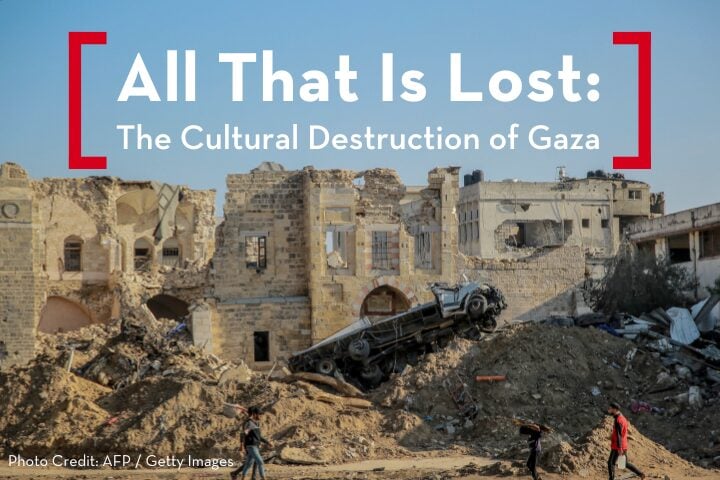
All That Is Lost
The war has inflicted a catastrophic blow to Gaza’s cultural life and heritage, erasing records of Palestinian history that go back hundreds of years.
-
Freedom to Write Index 2024
The number of writers jailed reached a new high, with at least 375 behind bars in 40 countries during 2024, compared to 339 in 2023.
-

Freedom to Write Index 2023
Introduction Authoritarian regimes instinctively understand the significant role that writers—and, by extension, free expression—play in promoting critical inquiry, fostering connections between people, and cultivating visions of a better world anchored in fundamental human rights. They recognize the power of words to affirm historical truths, develop or maintain culture, and hold individuals and institutions to account.…
-
Taming Culture in Georgia
Read “Protecting the Real Georgian Dream,” an introduction by PEN America President Ayad Akhtar >> წაიკითხეთ ეს მოხსენება ქართულად >> Читать доклад по-русски >> Download this report in English >> Introduction For many years, Georgians and the international community had high hopes that Georgia would be the democratic and rights–respecting foothold in a region of, at worst, authoritarian countries…