State legislatures are setting up tip-lines for anonymous reports about educators. Online vigilantes are scouring professors’ social media activity and syllabi to create watch lists, generate outrage, and call for their firing. Students are recording professors in class, sometimes to report them, sometimes to circulate the recording online, and sometimes both. At PEN America, we’re paying attention to the ways in which an increased sense of being watched is affecting freedom of expression and academic freedom, contributing to a chilled campus where suspicion and anxiety are running at high levels.
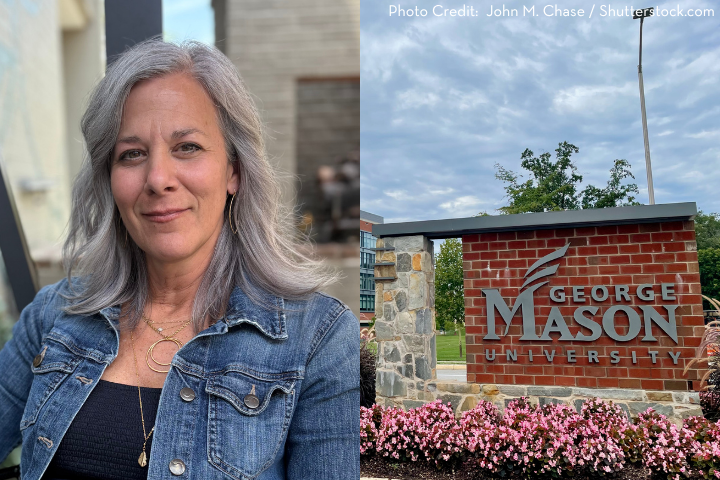
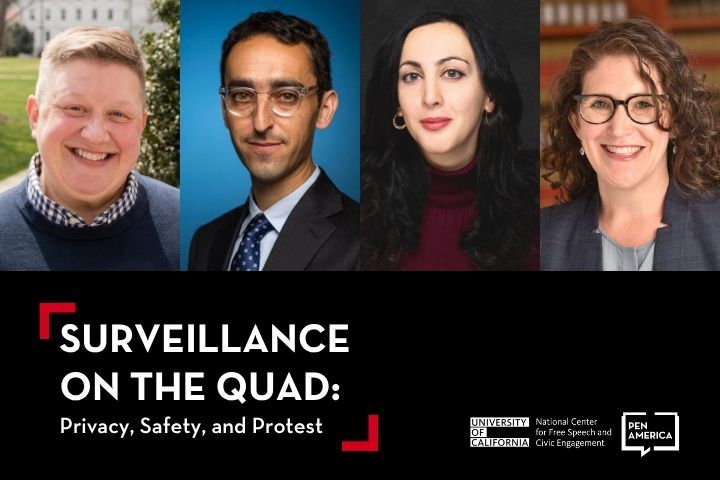
We joined forces with the University of California Center for Free Speech and Civic Engagement for a two-part panel series exploring the free expression implications of surveillance on college campuses. You can read about the first webinar, Surveillance on the Quad: Privacy, Safety and Protest, here. The second webinar of the series, Surveillance in the Classroom: Tip-Lines, Recording, and Social Media Campaigns ran on April 22, 2026 and was moderated by Sarah Brown, news editor at the Chronicle of Higher Education. It featured the following panelists:
- Heather Akou, President-Elect, Bloomington Faculty Council at Indiana University, Bloomington
- Isaac Kamola, Director, AAUP’s Center for the Defense of Academic Freedom
- Sarah Sobieraj, Professor of Sociology, Tufts University
Our speakers explored the interrelated phenomena of tip-lines, classroom recording, and online harassment in higher education, and the impact that these kinds of surveillance tactics have on classroom speech and instructor well-being.
Here’s what we learned.
Tip-lines, classroom recordings, and online harassment campaigns often operate in tandem.
Speaking from Indiana, Akou described the way that public syllabi and anonymous reporting tip-lines, both created in response to state legislation, have facilitated the harassment of scholars. Akou emphasized the way that these mechanisms allow anyone in the world, including people who have never set foot on IU’s campus or taken a class with a certain faculty member, to weigh in on their conduct or teaching, often anonymously.
Akou argues that these portals can encourage recordings in class and facilitate “crowdsourced doxing and harassment,” a kind of online abuse where a person’s private or sensitive information is shared online without their consent. According to Sobieraj, a media sociologist and professor at Tufts University who researches online abuse and the mediated information environment, “all it takes is one person with high-profile visibility to make a comment or a post, and that can, even without their intent, generate a firestorm for someone that can be really very difficult to handle.”
Instead of creating opportunities to sincerely navigate conflict or disagreement about course conduct or teaching, these surveillance tactics lead to a chilling effect in the classroom where professors and students alike may feel like certain topics or ideas are off limits.
‘Mythmaking by anecdote’ seeks to delegitimize higher ed.
Kamola quoted John K. Wilson when explaining how tip-lines, classroom recording, and online harassment campaigns utilize a kind of “myth-making by anecdote,” where classroom moments are plucked out of context and paired with stories “to create a narrative that universities are hostile to American values, that they’re weird and wacky.” These narratives don’t just smear individual professors: “These are bad faith claims that are being made by bad faith actors that are seeking to delegitimize what takes place within higher education.”
These ‘myths’ might be built from a short recording taken in a classroom and shared out of context, as in the high-profile case of Professor Melissa McCoul at Texas A&M University, or from something as minute as a professor “liking” a social media post from their personal account. Following the assassination of Charlie Kirk, Sobieraj explained the coordinated online effort by Kirk’s supporters to find these kind of “gotcha moments” where people, including academics, made critical comments about Kirk or people close to him. This led to the creation of a list, first called “Expose Charlie’s Murderers” and later “Charlie Kirk Data Foundation” with more than 60,000 names on it, which was posted online with personal information that fueled further harassment, doxing, and calls for firing. Beyond those who were being put on a list for the first time, this moment was particularly fraught for the 300+ academics who were already on Professor Watchlist, a website created by Kirk’s Turning Point USA. By the end of this cycle, more than 35 professors had been fired.
Tactics meant to limit teaching harm instructors outside the classroom, too.
Akou shared examples of the impact unvetted reports can have on faculty careers. “If you are accused, if there’s any investigation at all, it’s often very shallow. Some common punishments in the short term are forcing you to have a monitor in your classroom to see what you’re actually saying…and putting a letter in your file that gets flagged on your annual reviews. It’s kind of a ticking time bomb, because when you go up for promotion, or for post-tenure review, you can be terminated for having too many violations.”
Beyond the professional damage, Sobieraj emphasized the psychological, financial, and reputational harms that online harassment campaigns can have on faculty. These effects are amplified for younger scholars who are less likely to be able to rely on tenure, experience, or a track record, as well as those who are already marginalized or underrepresented in higher education, “because sometimes the things that are said about them map on really neatly to already existing circulating stereotypes about their behavior or proclivities.”
A strong institutional defense for academic freedom can help guard against pressure to surveil and censor.
A recurring theme in the conversation was the role of academic freedom. The speakers emphasized how institutions with robust policies, guided by principles of academic freedom, will be better prepared to support faculty and students to learn, navigate conflict, and be successful within higher education. As Kamola explained, “academic freedom does not mean I’m a professor and therefore can say whatever I want without consequences, right? Academic freedom is both an individual right and freedom, but it’s also a collective right. It means that we are part of a community of scholars, we follow certain professional ethics, there’s certain responsibilities that we adhere to, that I can’t say whatever I want in my classroom.” The principles of academic freedom can provide a backbone to guide institutional responses to external attacks and campaigns against faculty.
Planning ahead is key.
The panelists encouraged faculty to “band together” to support one another to take action and to develop policies with administrators to support faculty if they face an attack. “I think it’s critical to be thinking in advance, because it’s not a question of if this is going to happen to a member of your faculty, it’s when, right?” argued Sobieraj. These measures could include legal and psychosocial support as well as digital and physical security guidance. Kamola highlighted a policy on faculty harassment from the University of Massachusetts Amherst as a valuable model for other institutions because of the way that it clearly lays out procedures and coordinates across the institution’s different departments, and because its documentation process means faculty don’t have to repeatedly recount traumatic experiences.
As the conversation came to a close, the panelists also spoke to the values of resilience and courage in the face of risk. In response to a question from a panel attendee who asked whether she was scared of retaliation, Akou shared, “I walk into my classroom most days wondering if today’s the day that this discussion is going to get me fired…but I also am not going to stop myself from speaking out, because what’s the point? If I give up, I already know what the outcome will be.”