A family scholar’s experience with coordinated harassment shows why universities need stronger systems to protect scholar safety and academic freedom.
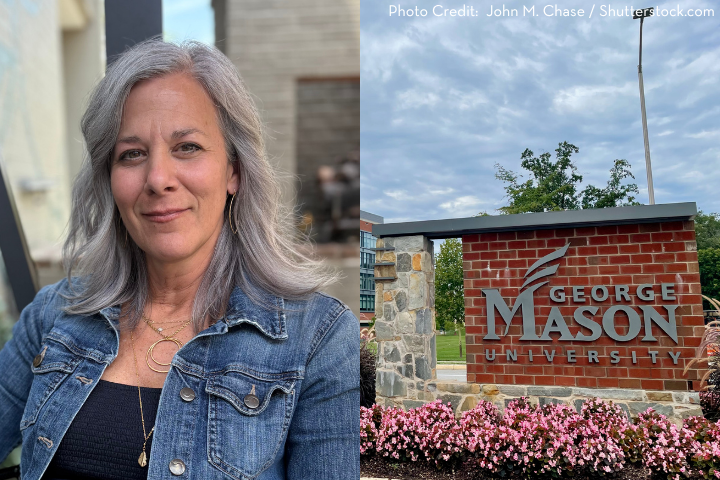
After a wave of critical coverage from right-wing media outlets in 2024, Dr. Bethany Letiecq began to receive a flood of online abuse and threats. Some were serious enough to involve police investigation–with one case even resulting in an arrest warrant.
“We were living with a police officer outside of our house, shades drawn, in a total lockdown,” she said.
Amid immediate concerns for her and her family’s safety, she also found herself asking: What is a university’s responsibility when one of its scholars is targeted for their work?
The escalation: “Hit after hit after hit after hit.”
Dr. Letiecq experienced this onslaught of online abuse after publishing a research paper on how structural forces like white supremacy, heteropatriarchy, and “marriage fundamentalism” shape inequality in family life. The paper was published in the Journal of Marriage and Family, a leading publication in the field, where it challenged the idea that married heterosexual households should be privileged through public policy–part of a body of work she has developed for over a decade.
“I’ve gotten hate emails over the course of my career,” Dr. Letiecq said. “This was markedly different because of the volume and because it was coordinated….it felt like somebody lit a fuse, and then hundreds of people started responding. And that felt incredibly overwhelming.”
First, she received calls from The College Fix, a conservative website that she knew would not earnestly engage with her work. Then a tweet from a sociologist who is prominent in the alt-right community amplified attention to her research. What followed was a wave of critical coverage–10 articles appeared on the same day. “Hit after hit after hit after hit,” is how she described the onslaught of attacks against her work. Following the media coverage, personal attacks escalated quickly. Her professional voicemail, inbox, and social media accounts were inundated with abuse. Some threats were serious enough for the university to investigate, and one threat led to an arrest warrant and a no-trespass order across George Mason University campuses.
She even later received a call from the FBI’s Domestic Terrorism Unit, notifying her of a death threat against her found on Telegram. Because the platform is internationally owned, the FBI said there was little they could do beyond alerting her.
For Dr. Letiecq, the experience reflected a critical shift in how universities should be thinking about scholar safety. Attacks can quickly spread across media outlets and social platforms, gaining momentum across interconnected online spaces and sometimes resurfacing months or years later, like the threat found on Telegram. “That just reminds us that these things have a life of their own now,” she said.
Institutional response: “I appreciated … this multi-layered response.”
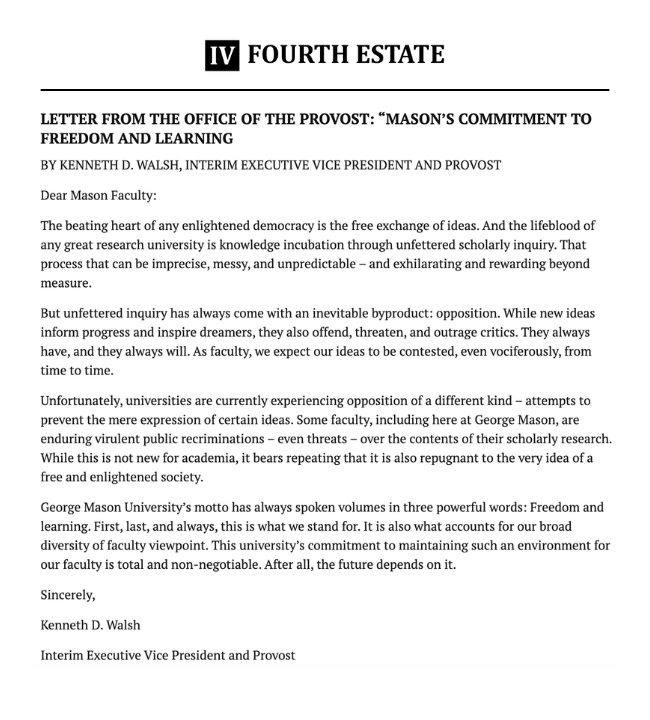
In the first few weeks of harassment, Dr. Letiecq began to make explicit requests for support from her university. Her administration authored a public statement affirming her academic freedom and right to conduct research. “They didn’t name me or the particulars of the case because they didn’t want–and I agree with this–to fuel it,” she said. But even without naming her, the statement mattered. “For those in my community who knew I was going through this, that statement was very affirming,” she said. It also became a tool for response. “I could use that statement and push it out there as a way to respond without responding.”
She also requested additional forms of support. A team of university staff monitored her email and social media accounts and provided daily reports. “They were watching it for me so I didn’t have to,” she said. The team coordinated with campus police to escalate the most serious threats and worked to reduce her public exposure by removing her syllabi and contact information from websites. She also shut down her voicemail and created what she described as a “hate inbox” to filter abusive messages without having to engage with them. These steps align with guidance in PEN America’s Online Harassment Field Manual, which recommends asking for help to monitor and document abuse by taking screenshots and saving links to social media messages, as well as saving emails, texts, and call records.
In addition to tightening her digital safety, she had to take measures to secure her and her family’s physical safety. On campus, she was escorted by campus police, and a panic button was installed in her office to provide a direct line to law enforcement. “I could be in my office and feel safe,” she said. At home, she also received police protection from the local police department, which stationed an officer outside her home for about two weeks during the initial wave of intense harassment.
She also received support from professional organizations like the National Council on Family Relations, who had published the research at the center of the controversy, and where Dr. Letiecq was serving as president. The organization’s Board of Directors issued a public statement supporting her and a colleague, and journal editors also spoke out. “I appreciated that there was sort of this multi-layered response to what was going on,” she said. “That was really helpful to me as a form of coping.”
I want to emphasize and model that this cannot only be privatized solutions. I purposely went to my administration, to the police, and to others to demand that they do that work and that it is their job–not my friends, not my family members.
Advocating for institutional support: “It is their job–not my friends, not my family members.”
Advocating for this level of support was not easy. “I might be [used to] advocating for others, but I’m not typically advocating for myself.” But Dr. Letiecq hopes that her experience can demonstrate the kinds of support that universities can and should provide to their faculty. “I want to emphasize and model that this cannot only be privatized solutions,” she said. “I purposely went to my administration, to the police, and to others to demand that they do that work and that it is their job–not my friends, not my family members.”
When faculty are under attack, university responses are often shaped by broader political context, including pressure from those tied to institutional governance, local or state politics, or online public discourse. During a public university governance meeting, Dr. Letiecq decided to confront officials who she saw encouraging attacks against her online. She played aloud a death threat that she received. “I did it purposefully,” she said. “To say: you people who are connected to this web are inspiring this. You need to denounce it immediately.”
That moment marked a shift from managing the crisis privately to demanding public accountability. “We have to expose that they are actually fomenting this level of hate and inciting this kind of violence toward faculty.” Research shows that increased visibility of scholars and their work correlates with heightened exposure to online harassment, particularly for women, LBGTQ+ communities, and people with minority backgrounds. This research also shows that women are less likely to receive support from their institutions when facing online abuse–despite the fact that adequate support from institutions is key to keeping scholars, particularly those from historically marginalized communities, in the field.
Continuing the work: “Universities have to develop a strategy”
Despite the risks, Dr. Letiecq continues her research and advocacy, and also now speaks publicly about coordinated harassment and helps to build networks to support scholar safety. She acknowledged that the level of institutional support that she received is far from the norm–even though her experience is not isolated–but emphasized that it is absolutely critical to ensuring that faculty stay in the field and continue to speak publicly about their research. “Universities have to develop a strategy,” Dr. Letiecq said. “This is not going away.”
Bethany Letiecq is a professor in the College of Education and Human Development whose research focuses on state-sanctioned inequities and administrative burdens experienced by nontraditional families, including mixed-status immigrant families, LGBTQ+ families, cohabiting couples, and single-parent headed families. She is faculty co-advisor to the Anti-Racist and Decolonizing Research (ARDR) Collaborative, and primary faculty of the ARDR and Qualitative Methods graduate certificate concentrations under Research Methods and the Critical Studies in Education graduate certificate. She serves on the editorial boards of the Journal of Marriage and Family and the Journal of Family Theory & Review. She is the Past-President of the Board of Directors of the National Council on Family Relations (President-elect 2021-2023; President 2023-2025), and is affiliated with the Council on Contemporary Families, the American Sociological Association, and the American Educational Research Association, among others. She currently serves on the Executive Committee of United Academics Local 6741 of the American Association of University Professors and the American Federation of Teachers, the President of the GMU Chapter of the AAUP, and President of the VA Conference of the AAUP.