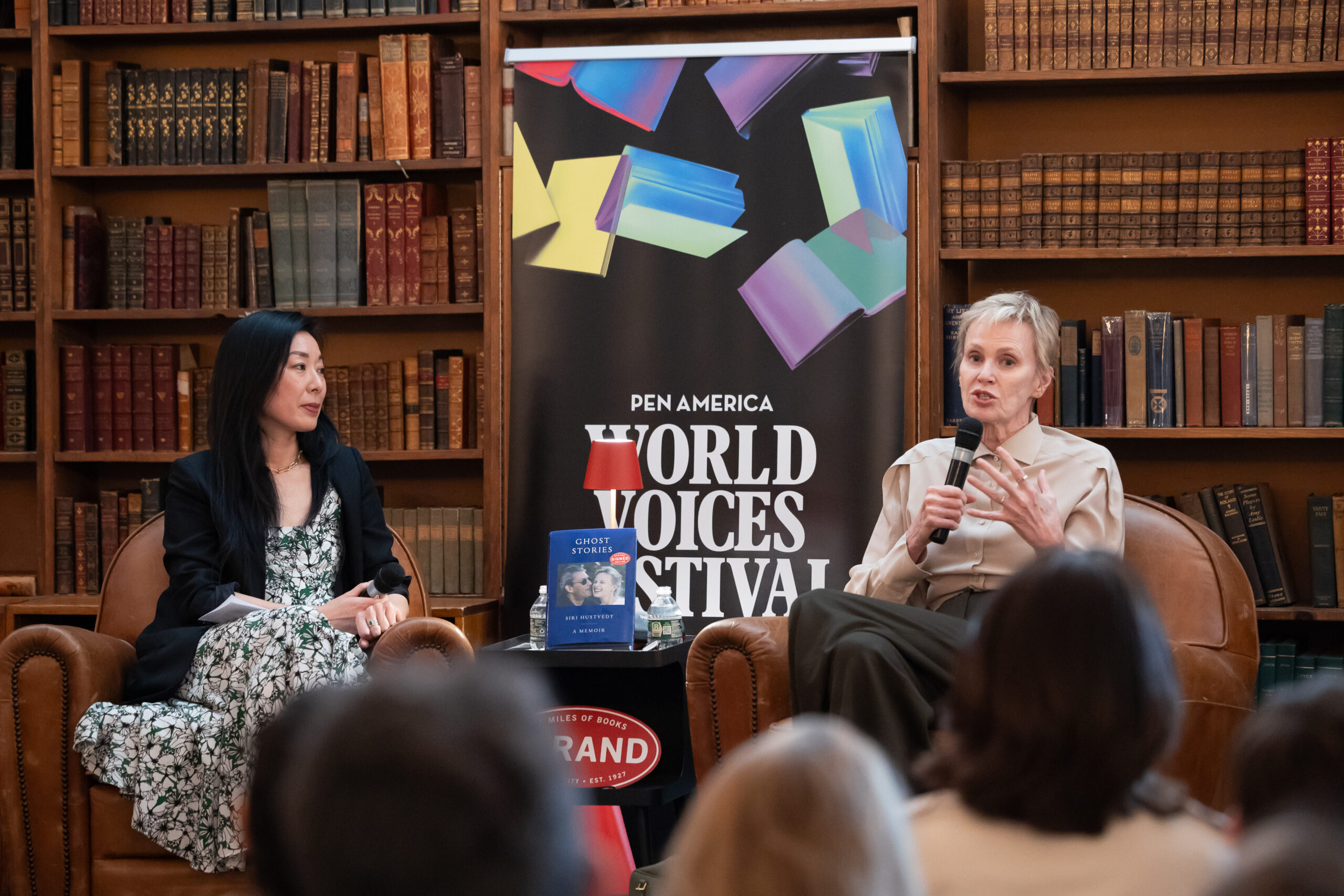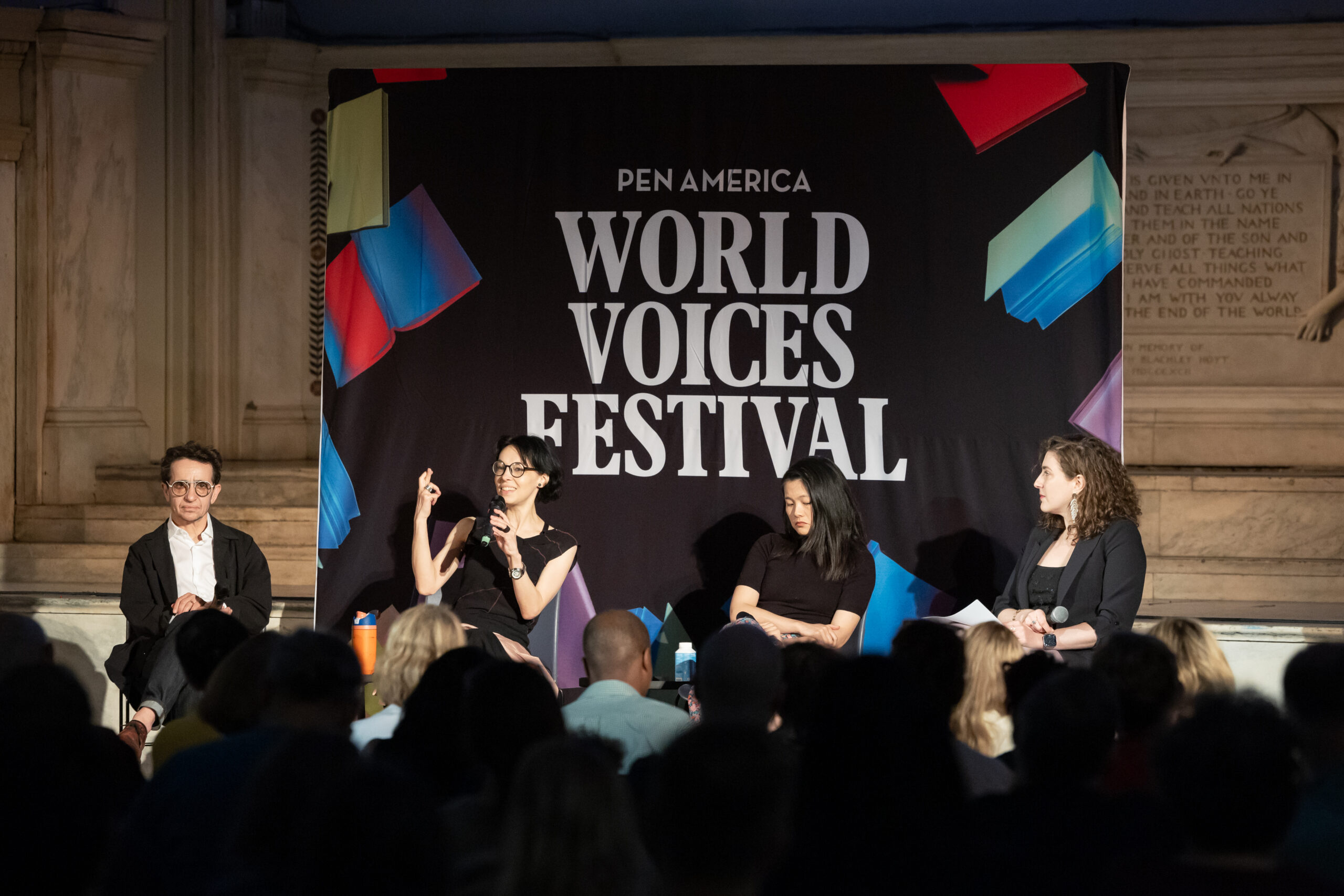
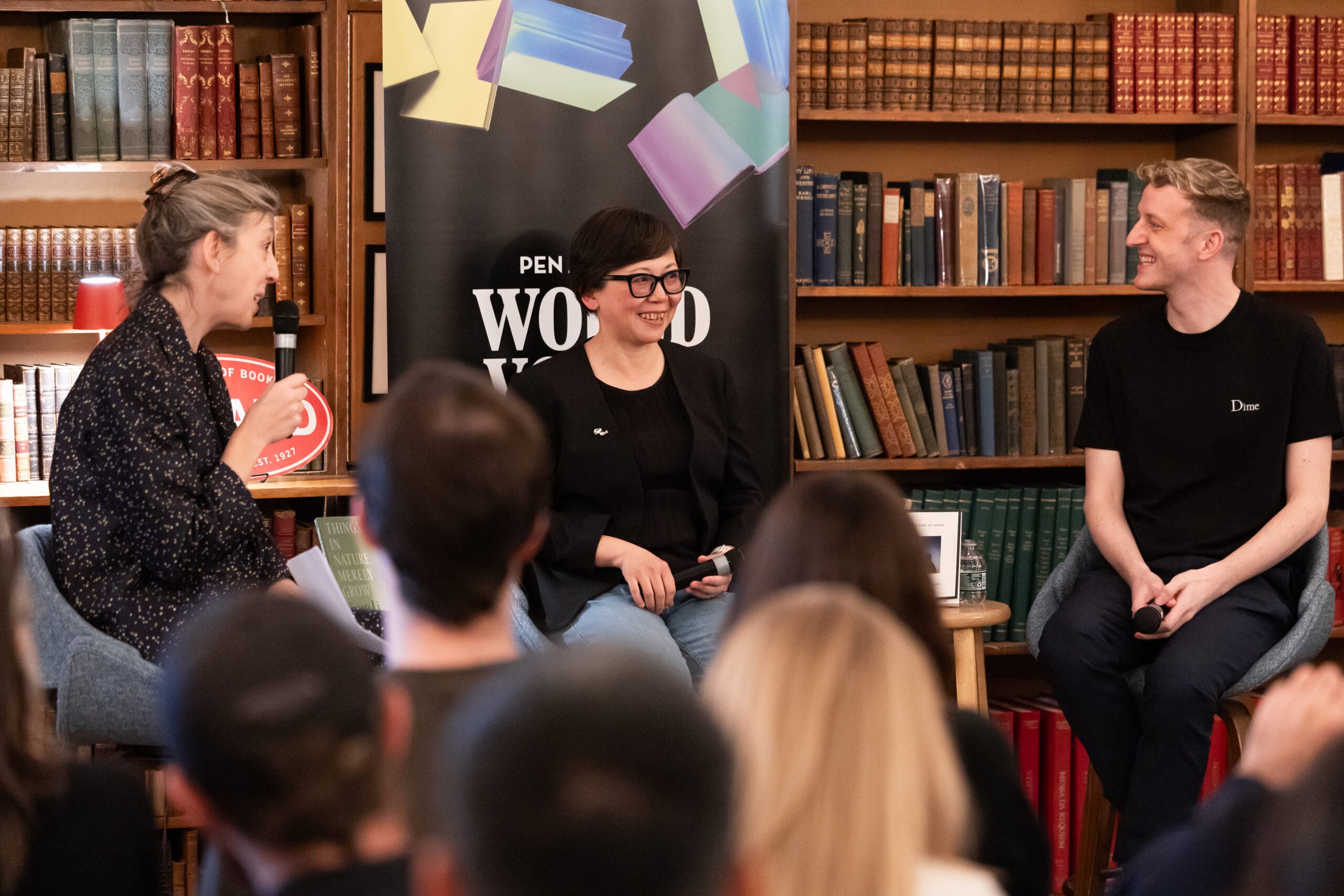
On the opening night of the 2026 World Voices Festival, authors Yiyun Li and Édouard Louis gathered for a sold-out conversation on writing about events so painful they seem to approach the limits of language. Li’s Pulitzer Prize–winning book, Things in Nature Merely Grow, explores the loss of her children to suicide, and in Collapse, Louis embarks on a mission to understand his seemingly deplorable brother in the wake of his death.
But neither of them take comfort in banalities, said Mitzi Angel, the editor of both Things in Nature Merely Grow and Collapse, who moderated the discussion at The Strand, titled “Out of the Abyss.” “One of the things I really want to celebrate here today is the extraordinary way in which you both infuse language with a kind of vitality and necessity that is up to the task,” she said.
In addition to reflecting on how and why they write about the pain they’ve endured, the two authors discussed the ways they think about facts, failure, and friendship. Here’s what they said.
On the Unknowability of the Other
Angel shared that one word came up for her again and again while reading Li and Louis’ books: “facts.” Louis said the facts that punctuate Collapse demonstrate his powerless attempts to learn who his brother was.
Louis: “People are like a black hole that we try to grasp. And the particularity of a black hole is that you cannot see it. Because it’s a black hole, it absorbs everything. But the only thing you can see is the light around the black hole that the black hole is absorbing. And you see the black hole through everything around it, but you will never see the black hole as such. That’s what happens when we try to know people.”
Li: “I have lived my life again and again facing that fact, that people are not knowable. Children are not knowable. You know them a little, and then they have their own lives and their own selves.”
On Writing and Failure
Angel later read a quote from Louis: “There’s a relationship between failure and truth, between failure and autobiography. … Being able to say ‘I fail’ is the ultimate autobiographical form.” She asked Li to respond to the quote, as Li writes in Things in Nature Merely Grow that to capture her son James through language was bound to be a partial failure.
Li: “I think this book started with the feeling that the words will fall short, whatever I put down will be a failure. But I think if we’re not afraid of failing, we’ll never become writers. I think that’s part of our being a writer — is we have to deal with that feeling of failure every day. … I so agree with you. ‘I fail’: That might be the best statement of all of us who write. But we write despite our failure, despite our feelings of having failed.”
Louis: “For me, the power and radicality and strength of autobiography is this moment where you read about someone’s life, and you recognize all the failures of this person, in what it is to be a mother, in what it is to be a man, in what it is to be a writer, in what it is to be a friend, and then you say, ‘I also fail.’”
On Literature as a Way Forward
Both writers described the process of writing about pain. Louis said that the perspective of Holocaust survivor Primo Levi — who said he did not survive and bear witness but rather survived so that he could bear witness — resonantes with him.
Louis: “I remember boys spitting on me at school and calling me [f-slur], and when the spit was dripping on my face, I was thinking, ‘One day, I will tell this story, and to tell this story will be my revenge.’ Storytelling was my revenge against violence, and so it means that there is a deep and strange and almost mystical connection between storytelling and surviving.”
Li: “My relationship with my writing is always to put something under anesthesia so I can analyze, I can write, I can think, even if it’s the most painful thing. I think that the anesthesia, for you, [Louis,] is probably the remove in time: ‘Now I’m going to think about my future.’ For myself, it’s removing my thinking self from my feeling self and saying, ‘I’m going to put myself, my life, my words under anesthesia.’”
On Friendship
The talk closed on a heartfelt note, with Louis and Li speaking about the centrality of friendship in their creative and personal lives.
Louis: “Friendship is not one aspect of my life. It’s the material of my life. … If The New York Times doesn’t like my book, and if Yiyun Li likes my book, I’m so much happier. That’s what matters. And then I will continue to do what I have to do, because people I trust and admire tell me to continue.”
Li: “I think friends are the people who can sit with me in the abyss rather than trying to get me out of the abyss. … We do laugh all the time, because life is so very terrible, and what can you do just to laugh with your friends? And I think that’s what friendship is. The most important thing is always to keep me laughing.”
Want more?
Check out the panelists’ books:
- Things in Nature Merely Grow by Yiyun Li
- Collapse by Édouard Louis