For 27 months, Iryna Levchenko‘s family did not have any contact with her. They were only able to make contact with the former journalist – who has been in Russian detention without charge since May 2023 – in August 2025 through a network of volunteers who regularly visit Ukrainian detainees.
Now, they can at least communicate via brief letters, but for the family it is not nearly enough.
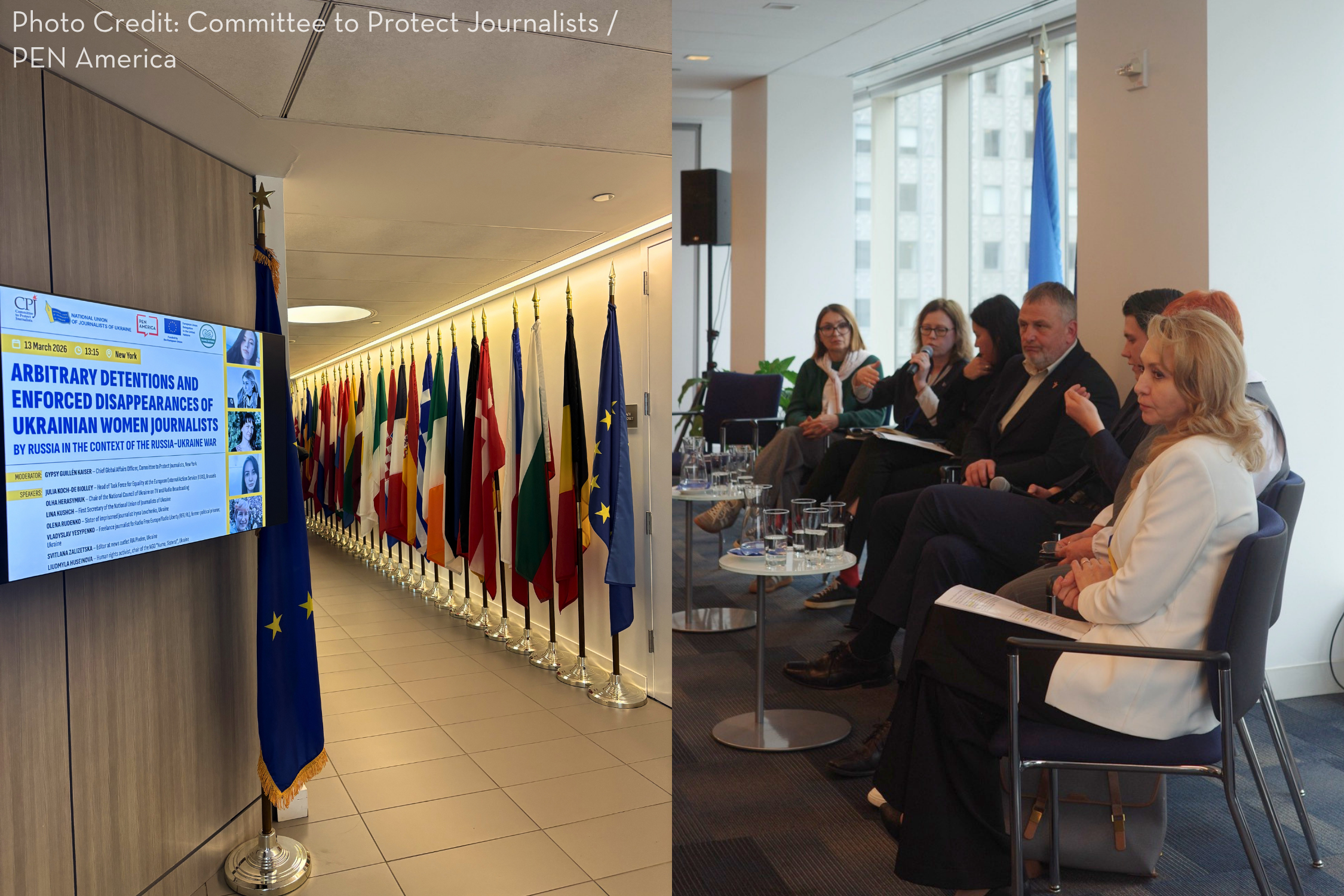
“We all wait for her,” said her sister, Olena Rudenko, speaking at an event focused on Russia’s use of arbitrary detentions and enforced disappearances of Ukrainian women journalists. The event, hosted by the National Union of Journalists of Ukraine (NUJU) in partnership with the Committee to Protect Journalists (CPJ), PEN America, and the European Union Delegation to the United Nations, took place during the 70th Session of the U.N. Commission on the Status of Women, which meets annually and promotes gender equality and the empowerment of women.
Levchenko’s case is part of a broader effort by Russia to control who gets to tell stories about Ukraine. Speakers at the event stressed that writers, journalists, news outlets, human rights organizations, and cultural institutions are all part of an ecosystem that challenges Russia’s efforts to dictate the narrative around the war.
“Inside Russia, authorities continue to increase the systematic repression by cracking down on independent media, journalists and media actors, and other critical voices,” said Tihamér Czika, Policy officer with the European External Action Service (EEAS). “Internal repression and external aggression go hand in hand.”
As well as imprisoning writers who speak out against the war within Russia, authorities are also continuing to kill and imprison Ukrainian journalists, writers, and cultural workers; and to target cultural heritage, targeting theaters, museums, and gathering spaces.
As of today, 21 journalists have been killed while working in Ukraine and at least 12 Ukrainian journalists are imprisoned by Russia. Four women – Iryna Danylovych, Iryna Levchenko, Anastasiya Glukhovska, and Yana Suvorova – are imprisoned for their reporting in Russian-occupied territories.
Other women writers have been killed. Viktoria Roshchina, a Ukrainian journalist, was reportedly tortured prior to her death in Russian captivity in 2024. Victoria Amelina, PEN Ukraine member and writer turned human rights investigator, died from a Russian strike in July 2023.
Despite the dangers they face, Ukrainian women, including journalists and writers, play an essential role in ensuring a public record of the war is created and preserved. During the event, multiple women shared their experiences, fears, and what they overcame to be able to tell the stories they gathered.
Stories create a public record.
Gypsy Guillén Kaiser, Chief Global Affairs Officer at the Committee to Protect Journalists
When surveyed about what they were most afraid of when reporting from the frontlines and occupied territories, Ukrainian women journalists answered “being imprisoned by Russian authorities,” according to Lina Kushch, the first secretary of the National Union of Journalists of Ukraine.
Svitlana Zalizetska, editor at news outlet RIA Pivden and colleague of imprisoned journalist Anastasiya Glukhovska, shared the threats her family faced and what she went through to escape Russian-occupied Melitopol. Because of her role as a journalist, early on in the occupation, Zalitzetska was placed on a wanted list of people not allowed to leave. To escape, she had to disguise herself as a doctor. When she was gone, attention turned toward her family: Russian authorities repeatedly raided her family home and used her father as leverage, detaining him to pressure her to return.
Drawing on their own experiences, two former imprisoned writers and activists – Vladyslav Yesypenko, Ukrainian journalist and the recipient of the 2022 PEN/Barbey Freedom to Write Award, and Liudmila Huseinova, a human rights activist and chair of the Ukrainian NGO “Numo, Sisters!” – described what imprisoned journalists are likely facing in Russian custody: torture, abuse, sexual violence, isolation, and denial of communication with their loved ones. In her three years behind bars from 2019 – 2022, Huseinova rarely got to see the sky.
Under these horrific conditions, imprisoned writers, journalists, and activists find ways to endure. During Huseinova’s time behind bars, she documented everything in a diary. In an interview with CPJ, Yesypenko discussed how the need to stay strong and alive for his family, friends, and other prisoners, alongside the knowledge the outside world had not forgotten and was fighting for him, helped him survive. Last Christmas, Levchenko, who remains imprisoned, wrote to her family that she had made snippets of Christmas decorations from tea bags.
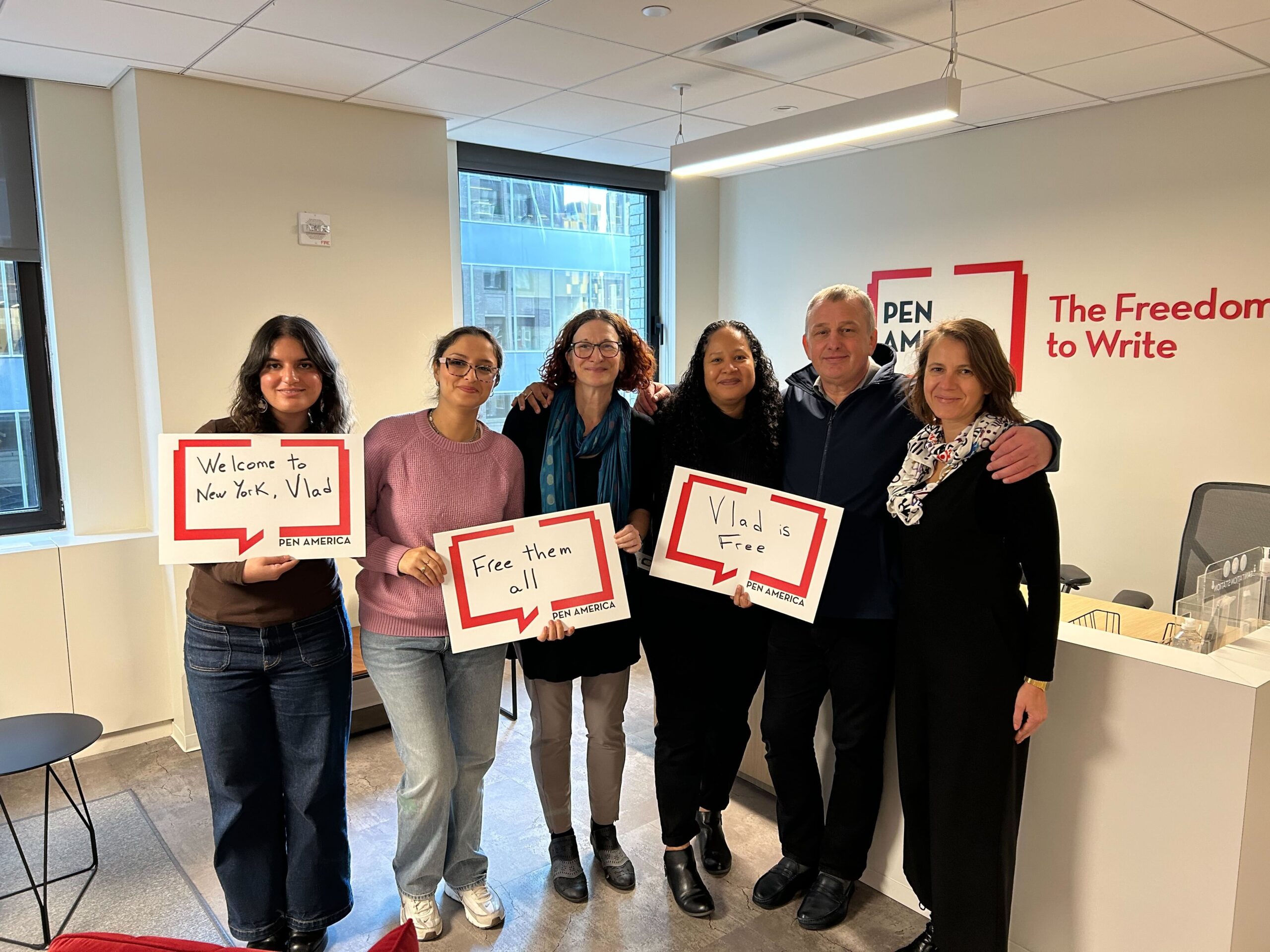
They, alongside their loved ones and colleagues, also find ways to continue fighting. Following her release, Huseinova began “Numo, Sisters!”, an organization that brings together and supports women impacted by war. Yesypenko, who was released from Russian captivity in June works tirelessly to free the writers and journalists who remain behind bars, including his RFE/RL colleagues that remain imprisoned: Farid Mehralizada (Azerbaijan) and Nika Novak (Russia). Rudenko continues to speak out for her sister, Iryna Levchenko, as does Zalizetska for her colleague, Anastasiya Glukhovska.
During the event, Olha Herasymiuk, Chair of the National Council of Ukraine on TV, reminded those assembled that “impunity is contagious” and that accountability for these war crimes is a matter of “memory, testimony, and freedom of the word.”
The panelists’ presence and continued work, however, remind us that solidarity, too, is contagious. All of us must continue to share these stories; push for increased support to writers, journalists, and cultural workers; and call for international accountability.