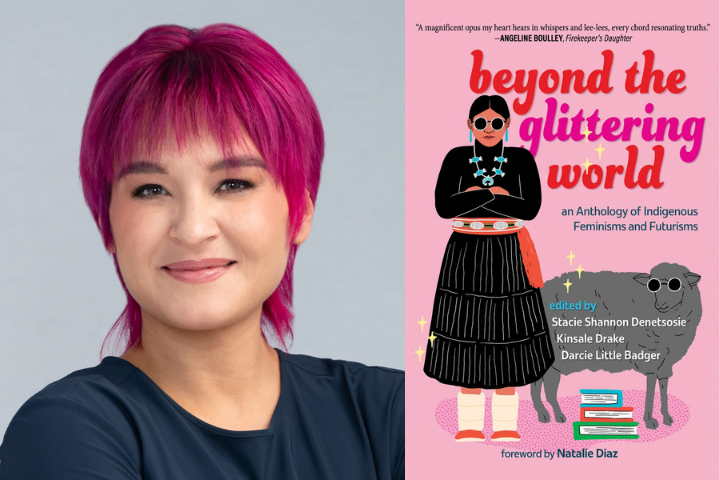
Beyond the Glittering World is a new anthology celebrating a rising generation of Indigenous storytellers. Weeks before it was published in November, Weber State University in Utah reached out to the co-editors, Stacie Shannon Denetsosie, Kinsale Drake and Darcie Little Badger, inviting them to speak on campus.
But as the preparations moved forward, it soon became clear that the invitation came with a dose of censorship. The speakers were asked to agree to a list of words and concepts that couldn’t be discussed, including: equity, diversity, & inclusion; anti-racism; bias; critical race theory; implicit bias; oppression; intersectionality; prohibited discriminatory practices; racial privilege; promoting stereotypes based on personal identity characteristics. The university attributed the list of forbidden topics as necessary to comply with HB 261, the state’s “anti-DEI” law.
It was at least the second time during the fall semester that the school imposed restrictions on an event on campus citing HB 261. Earlier, a conference on censorship was canceled after the administration tried to impose similar limits on what the speakers could discuss.
For Little Badger, Denetsosie, and Drake, the restrictions posed an immediate dilemma. Ultimately, Little Badger, a prize-winning Lipan Apache author, refused to agree to them and pulled out of the event, while her co-editors forged ahead. The episode highlights how, in a moment of intensifying political scrutiny, state censorship, and anti-DEI fervor, people who share the same commitments may chart different paths through the ambiguous thicket of censorship rules they’re confronted with. That uncertainty is an increasing part of authors’ and scholars’ considerations of how to navigate the expanding web of political and ideological control that has been overtaking higher education.
Little Badger went public with her decision, posting the list of banned topics on Instagram.“I felt bad, because clearly they wanted us to be there to talk to the students,” Little Badger said in an interview with PEN America. “But knowing our work, how would we be able to proceed with this?”
Denetsosie, a Citizen of the Navajo Nation, and Drake (Diné), wrestled with the same question, but decided to attend the event, because they wanted to be there for the students.
“I know people who work in the university setting at other institutions in Utah, and I asked them about it,” Denetsosie said in an interview with PEN America. “I believe that employees have to adhere to [restrictions triggered by HB 261], but they can’t make speakers adhere to that, because we are not employees of the institution – so it didn’t make sense.”
“I live and work in Utah, and I’m really familiar with HB 261 and the impacts that it’s had on not only multicultural programs, but women’s and LBGTQ programming, Dream centers, LGBTQ centers and BIPOC centers. As a Utahian, I felt that it was my responsibility to go and share differing perspectives than what was written in the contract, because they really had no standing to ask us to do that.”
When these laws are made, university administrators scramble to adhere to them, Denetsosie added. “I don’t really think that lawmakers understand the impact that these laws have on universities. It becomes a weird jumping-through-hoops situation.”
“I think that more than anything, I wanted to be there, and I also know Kinsale wanted to be there, for the students,” she said. “Utah students, especially indigenous students – speaking as someone who’s graduated from Utah institutions – it’s really hard to be seen or to feel represented in any way. I remember really wanting that as a young student.”
Little Badger also wanted to support the students, but she didn’t see how she could attend and adhere to the restrictions. It was a week before the event was going to take place before Little Badger was able to speak with someone from the university.
“The representative was very sympathetic, they really wanted us to go and speak, and advised me there were ways to work around this,” Little Badger said. “But the list of prohibited terms and concepts was so broad that there was no way we could talk about what we had written without touching upon these concepts. And personally, I will not censor myself. That’s not who I am as a storyteller and editor.”
“I often mention how diverse the voices in our book are – the authors are from a wide variety of Indigenous nations, challenging the misconception that Indigenous people are a monolith – and the first word on the list was ‘diversity.’ One poem by Heid E. Erdrich is even called ‘A Statement on Diversity and Inclusion. We couldn’t say the title,” she said. “There’s a story about a person in the future telling the story of their history of oppression. ‘Oppression’ is one of the words that’s banned.”
Denetsosie said the topics in question came up during the discussion, but she and the third co-editor decided to speak about them honestly.
“We did speak as if we were anywhere,” she said. “I prepared some questions for Kinsale about her poetry book and experiences co-editing the anthology, and she did the same for me.
“We talked about whatever themes were present in our books. It was a conversation between two writers. I did not simplify or couch my questions in any way.”
Little Badger’s social post, meanwhile, caught the attention of local media, and sparked a conversation that led to the Utah University System stating that Weber state was overcomplying with the law by imposing these restrictions. For the time being, at least, this signaled the list of restricted topics would not be required by potential speakers – a rare win for freedom of expression in today’s campus environment.
She was somewhat surprised at Weber State’s response.
“I guess I couldn’t believe that one person was able to cause enough of a wave to make this change,” she said.
Indeed, last month, a Republican lawmaker drafted a potential update to the law that would specifically exempt invited guests from anti-DEI requirements. While the law still poses significant challenges to free expression at universities in Utah, Little Badger’s act of protest may have at least made a little more space for honest, open conversation, on the state’s campuses.