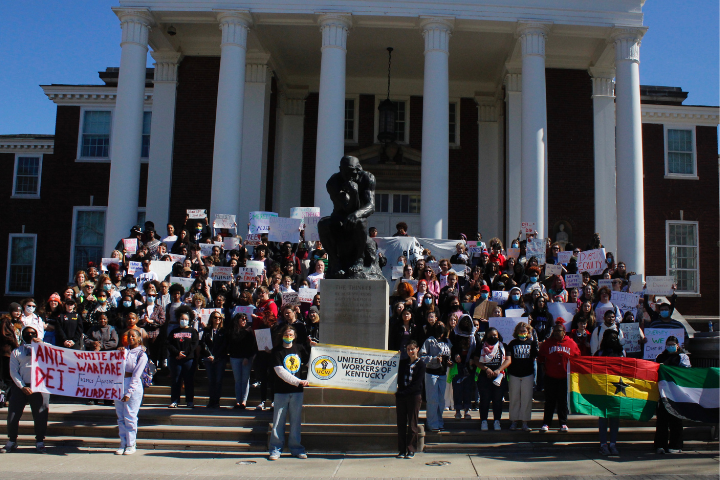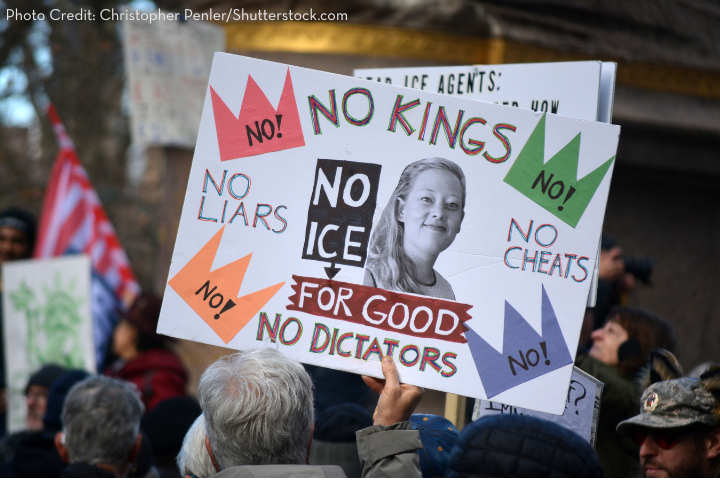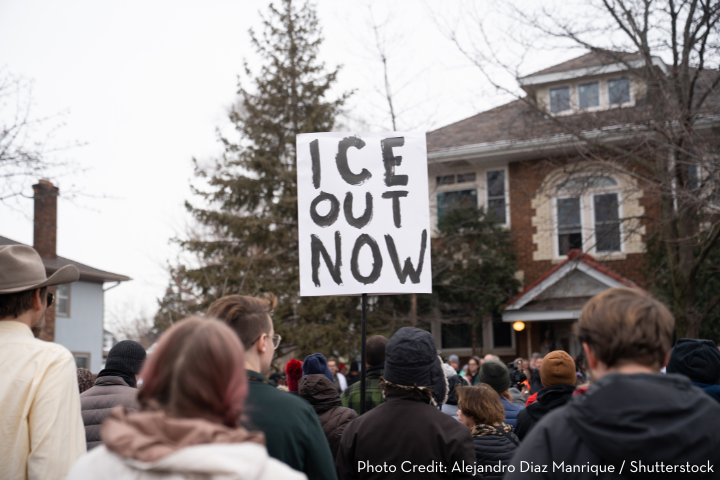
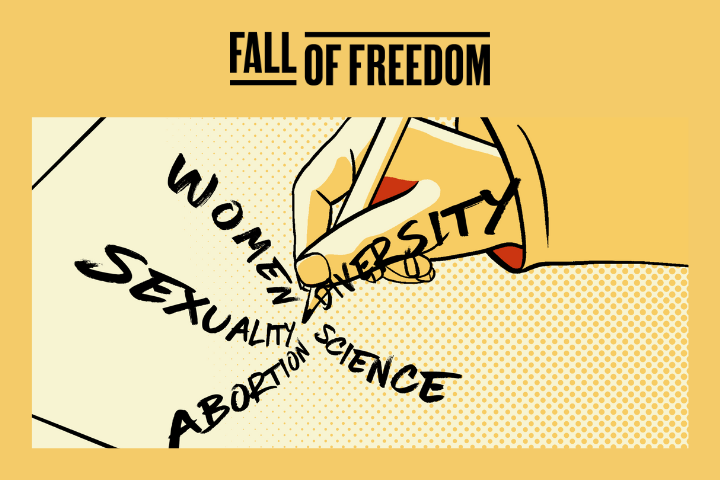
Recently, a group of artists including visual artist Dread Scott, playwright Lynn Nottage, and novelist Hari Kunzru called for events as part of a “Fall of Freedom” action in museums, libraries, book stores, theaters, and concert halls across the country – each independently organized but united in their defense of expression and art.
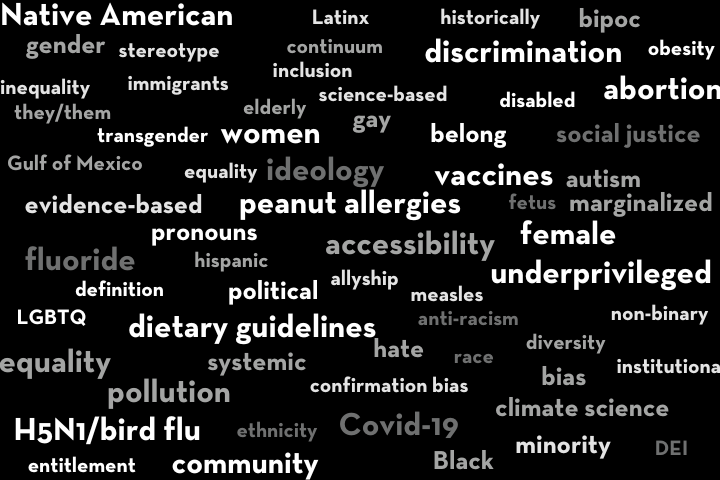
As part of the action, we invited PEN America members to speak to the moment by writing a poem using some of the more than 350 words banned or restricted by the federal government, or a piece of fiction or nonfiction responding to current threats to free expression and culture.
A Gnostic’s appeal
By Tom Gilbert
Words behind bars? Words within bodies? Is
there a difference? “Dwelling” is always
locked in a closed vessel, inferring busi-
ness as usual. Trapped is trapped, a maze
in time: a space of limitations. When
don’t we see life as crime? That cruel place of
entrapment, enslavement, correction? Pen
in pen seems rather redundant. What love,
stayed lost again (incarcerated time,
incarnated again), wishes to seek
blinded freedom through written words that rhyme,
and says what we dream about being: meek,
inheriting this earth, for what it’s worth,
once again, through a caged descended birth?
birdwatcher
By Barbara Marie Minney
quoth the raven “nevermore”
so why is this shit still happening
assigned male at birth
self-generated hate speech
directed at my identity
my own self-expression
suicide a slow climate-change death
no science-based vaccine in sight
cursed with both a head and a heart
face buried in the tits of my soul
i had a gender abortion
a fetus energy transition
of gender identity
emissions of lesbianism and bisexuality
a queer non-conforming activist
quoth the raven “nevermore”
At Risk
By Robert Erlandson
Historically, minorities have often been undervalued, underserved, and sometimes victims. Unconscious bias can promote inequities. People-centered discussions of federal policies such as race and ethnicity, subsidized housing, health disparity, and environmental concerns can foster a sense of belonging, and reduce stereotyping, so as to better serve our under represented.
biases toward
cultural differences
historically
creates stereotypesand vulnerable populations
Systemic Remediation
By A.S. King
Topics that have received recent attention from Congress
do not seem to have anything to do with the people who
live here; field drainage of empathy, all wind power.
Erasing books erases words. Erasing words erases people.
Woman, women, female, females, victim, victims—all of us
are illegals now, whether we’re pointing it out or cheering it on.
We can’t say “autism” anymore
but we can claim Tylenol caused it.
All the best clean things are gone. Clean water is banned.
So is the Gulf of Mexico. But I saw it last week. I flew right over it.
Just because they say we can’t say trauma anymore doesn’t mean
this isn’t traumatic. Gaslighting is telling a kid dying from a peanut allergy
that they are not allowed to say “peanut allergy.” The child died from
their own ideology. Peanuts are not a problem.
Topics of federal investigations are underrepresented.
Somebody find a toothpick; press the reset.
All vulnerable populations are banned. All humans are vulnerable.
You. You are banned. Prostitute! Queer! Advocate! Fetus!
More Than Seven Words You Can’t Say
By Steven Wishnia
Vulnerable shit
Entitlement piss
Diversity fuck
Transgender cunt
Fetus cocksucker
Evidence-based motherfucker
Science-based tits
Greenhouse-gas farts
Aviation-fuel art
Obesity opioids
Multicultural marijuana
Marginalized microplastics
Equitable ethanol
Nonconforming noncitizens
Men who have sex with intersectional immigrants
Men who have sex with membrane filtration
Men who have sex in low-emission vehicles
Men who have sex in low-income housing
Men who have sex with culturally responsive couches
Men who have sex with Trump’s mushroom penis
Men who have sex with Hitler’s one ball
(The other is in the Albert Hall)
Enola Gay
(She should have stayed at home yesterday)
Affirmative-action abortions
Underprivileged sediment
Pansexual peanut allergies
Diesel lesbian measles vaccine
Sustainable elderly women.
He Walks in Beauty
—after the old poems, and after the first born of the dead
By Shann Ray
Like the night.
He walks with bottles in his hands.
Inside the bottles are tears.
The bottles are blue
Like the night.
He walks, his wrists set
In steel pollution
Until he rests, home again where
He lays down in the yard looking up
After blue dusk
Becomes violet becomes black,
Holding his tribal sons’ trauma hands
Bearing remediation like the night.
He walks the way horses walk
Pacing forward until they canter then
Gallop over river,
Over plain, their beautiful thoughts his beautiful thoughts
Of mountains and sky and heavenly star fields
Enfolded inside him
Like the night.
The way he walks you see history
In his long stride,
All the women and men we never knew who were
Punched, kicked, raped, piked, impaled,
Forgotten like the night.
He walks carrying these children in his arms,
Each of their names happy
On his tongue and cherished star flower
Bat orchid and glacier lily
Like the night.
O woman, women, wind power and water storage
Alight with wings at the heart of the flower.
After he places each one in their mother’s bed
He walks the way bears walk but upright
Smelling of mulch and carrion, and the new biofuel
Of wood, rock, green moth moss and blue
Dust flower, ghost pipe, arrowleaf
And nightshade,
Hungry to eat the darkness
Like the night.
He walks in beauty like the night
With hands broken open
Like blossoms.
Death comes with a passport
by David L. Meth
A visa stamped in blood
Good for entry anywhere
Exit undetermined.
Death departs alone
And leaves its passport behind
Never to be renewed
But always to be reissued
When death is redesigned.
Time’s Up
By Megha Sood
Stuck in this state of a purgatorial chasm
sitting between the rim of dreams and pungent reality
We are witnesses to the unknown future
to avoid or to ignore—
has become our constant fatality.
Truth and lies dangling like a filigree thread
of justice, we hold in high regard,
a sad reflection of the dichotomy of our lives
We, as victims, are dealing with our eyes wide shut
awaiting a monster ready to devour;
who thinks diversity, equity, and inclusion
is an abominable curse.
Our destiny is in the hands of a mendacious president
who rules with an iron fist
seething with greed and lust,
judging everyone for their race and sexuality.
When all you are left in your heart
are stories of disgrace and disagreements
ripping the nation alive,
birthing monstrous divisiveness.
holding a lien to our souls through his white privilege.
Where the truth, a matter of discussion, has turned sour
facts are mirrored as impotent and vile
lies you spread have come back to haunt you
like a dirty swarm of flies.
Your shameless smirk makes us gag and throw our heads back in shame
when innocent souls are locked up in cages
unborn babies scrubbed from mothers
with their hands tied in the back.
How do you justify the sanctity of this nation
when the protectors start to devour?
When the sidewalks of this nation
laced with black and brown blood
screeching women wailing
whose wombs are scraped with force.
An endless succession of daily news reads
as a horror movie stuck on its reels
love reeking with pungent lies and stinking moments
leaving us feeling on the tip of a thousand needles and pins.
The incessant heap of your garbage lies
your lack of personal accountability,
your biased, avaricious behavior is not a reflection of the people
you constantly try to divide through your polarized politics.
Constant outpouring of disgust and despair
looming through the throbbing veins of this country
enough to make our ancestors turn in their graves
you frequently play it down as a mere hullabaloo.
Your time is up, and your throne is riddled with cracks
the pulverized dreams of those you thwarted
has come back to haunt you with more than you can ask.
Stripping off your lies and ambiguities
this undulation of truth will soon
wash over this nation, facing you as a threat.
Draining lies and perjury reeking in the high ranks
will leave you reflecting on your years
a scathing memory, you will deeply regret.
Artist as Witness
By Yahia Lababidi
I learned to write by listening. Poets were my first teachers, those who carried their hearts in their throats and spoke with a gravity that came from living close to suffering. Later came the prophets, whose courage revealed that clear sight is already a form of service. In time, I began to trust the silences that gather around wounded places and insist on being heard.
Gaza sharpened this education. It reduced the world to what cannot be ignored and showed how language falters when it stands before a life cut short. Each testimony felt like a summons. To write became a way of remaining spiritually alive. Silence would have felt like betraying the human family.
I discovered that witness is earned through attention. It asks you to allow another’s pain to travel through you. In difficult seasons, I turned to the poets who steadied my conscience. Darwish showed that tenderness can live beside anger. Writers from both sides of the divide reminded me that the heart can stay open even as the world narrows around it.
Art is faithful when it refuses forgetfulness. It gathers the names that might otherwise fade and keeps company with the living and the dead. I return to the page because it helps me remain human. Each sentence is a small act of care, a gesture toward what is fragile in us and indestructible, as well as a practice of staying awake in a time that invites the opposite.
The Dissident’s December
by Christopher Carter Sanderson
Last December my wife’s life was threatened and me and our eight-year-old son were attacked by a terrorist. He doesn’t like that my wife is an Episcopal priest. He doesn’t think women should be priests or that we should be free to worship as we choose. I’d been working on what I hope will be my second published novel for two years. And I kept writing it every day in every safe house we stayed in. Some days I could only write a sentence. On one particularly difficult day when a monastery rejected our request for help (you can’t make this stuff up) my writing consisted of reading back over one sentence, adding a carrot under it, and writing the word “it.” Two weeks ago the FBI interrogated me with no reason or warrant. I wrote for four hours the next morning. We got our son to school every day during all of this. My wife preached every Sunday at our church. The FBI had no reason other than the bad one that someone told then that I am a violent terrorist. I am not a terrorist of any kind much less a violent one. These fascists may have forced the label of “dissident writer” onto me. Two publishers are interested in my book. Will they shy away from me when they find out that I am on an FBI list? These experiences have been important artistic ones because they have proven that it still wouldn’t stop me from writing.
I’LL BE MISSED
by David L. Meth
TEACHER
As much as I don’t want to say this … I have to leave.
STUDENT
No surprise. In case you haven’t noticed, the KCIA is a couple of tables away … You can see our reflection in the their glasses.
TEACHER
Black leather bomber jackets, collars up. Black aviator glasses and their black hair slicked back. Even black coffee. Who would know? I’m American. I don’t think they’re going to do anything to me because I’ll be missed. Although the Peace Corps won’t miss me with all the colleges and universities closed. So I’m going to Japan to teach. I didn’t come 7000 miles to South Korea from New York to serve a fascist dictator whose repressive regime is supported by the U.S. government. Park Chung Hee declared martial law. Who knows when he will decide to re-open the schools—or if he will?
STUDENT
We will outlast him, as we outlast all dictators. But I can’t let the government keep me from publishing my newspaper. The censors black out half of every issue—at least the parts I direct their eyes to. They don’t know what they’re looking for, so I help them locate what they think they’re looking for and they black out what makes them happy.
(beat)
I’m sorry to see you go and will miss our English lessons and friendship.
TEACHER
I will, also.
STUDENT
May I tell you something very personal?
TEACHER
Of course.
STUDENT
Meeting with you is dangerous. I could be disappeared at any moment, day or night, and never see my wife and little children again.
TEACHER
Then why do you meet with me?
STUDENT
Because if I don’t tell you my story, I may never be able to tell it.
TEACHER
You’ll be missed, too.