
Should we call time of death on our democracy?
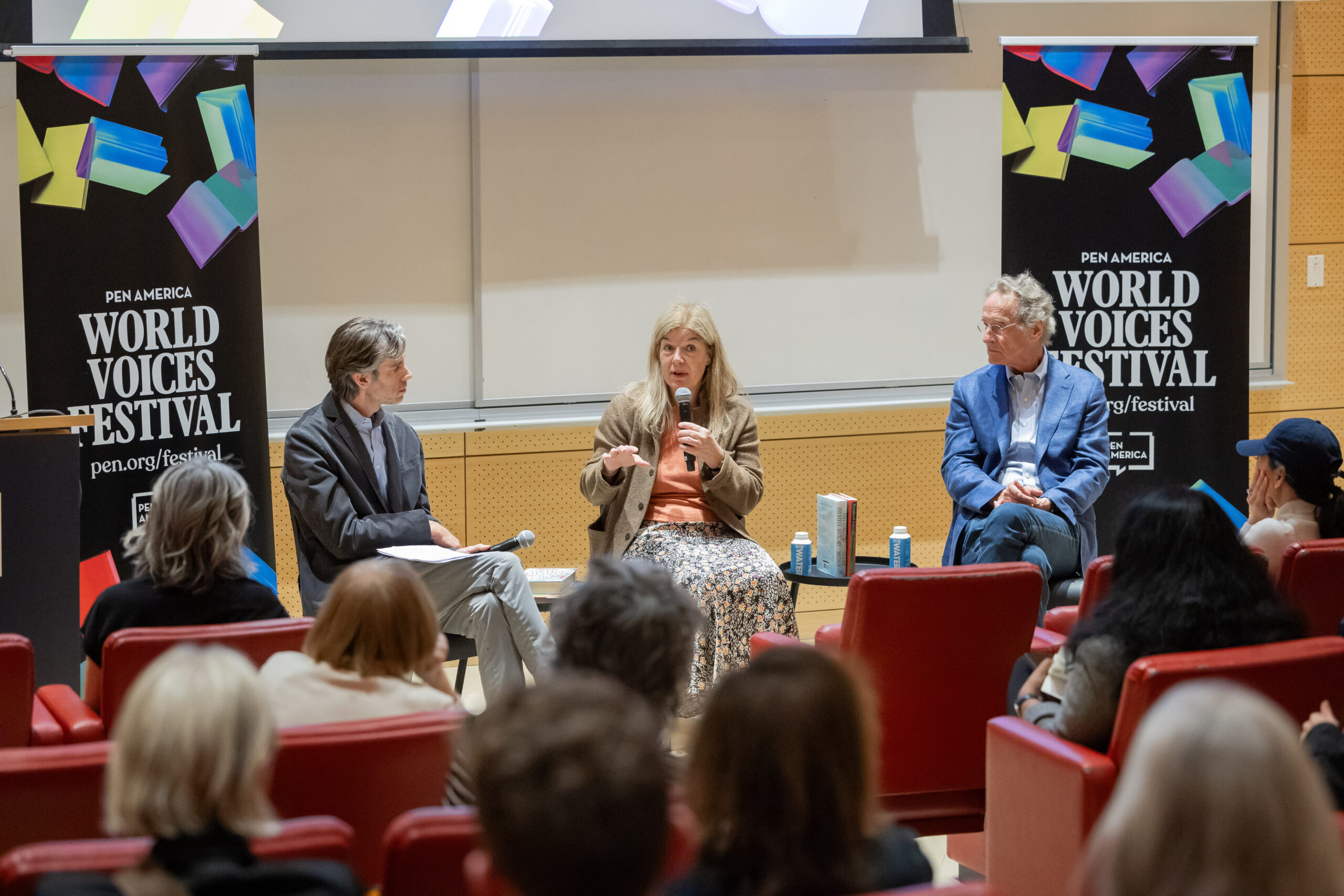
On the second day of the 2025 PEN America World Voices Festival, five writers and scholars gathered to address the rise of fascism in the U.S. Over the course of the session, the panelists — President of PEN International and novelist Burhan Sönmez, former PEN America President and novelist Francine Prose, novelist Gary Shteyngart, and professors Ruth Ben-Ghiat and Jason Stanley — also outlined where mainstream media has recently fallen short and how curiosity might serve as an antidote to authoritarianism going forward.
Jonathan Friedman, the Sy Syms managing director of U.S. free expression programs at PEN America, moderated the session, titled “On Autocracy and the Slow Death of Democracy.”
On whether “fascism” is an accurate descriptor of the U.S.
Prose: “I find myself using it every other word…so I can’t imagine living at this moment without it. It would be just missing an essential part of my vocabulary.”
Shteyngart: “I’m not a political scientist, like some people here, or a historian, so I can’t talk about, you know, ‘Are we in totalitarian stage three or authoritarian stage seven?’ It’s just fascism for me. I’m a simple man.”
Ben-Ghiat: “As a historian, it can be harder today to diagnose autocracy. … Of course, the ideologies, the xenophobia, the deporting people, disappearing people, you can find a long list of things that line up with fascism — but if we look for the one-party state of the past, we will be looking in vain.”
On evaluating the U.S. in a global and historical context
Sömnez: “In the 1950s, in Turkey, there was a new slogan in the political field. The right-wing movement suddenly created a phrase, promising the public: ‘We will make Turkey a little America.’… And now Turkey is not becoming a little America, but America is becoming a bigger Turkey.”
Ben-Ghiat: “Since January 20, I’ve been trying to figure out what is an application of the authoritarian playbook and what is new. … There are two new things. One is the speed at which things are being done. There is no parallel. … The other thing is we’ve got an unelected co-leader, Musk, who is creating a government within a government. … I’ve never heard of this before, so we are innovating the authoritarian playbook.”
Prose: “When I think about where we are now, the first image that comes to mind is of Kristi Noem standing in front of those cages in El Salvador, flashing her Rolex, and the way in which those cages were stacked was so reminiscent of Auschwitz. … The worst images of history have come back, and this time we’re doing it.”
Stanley: “My mother was a court stenographer in Manhattan Criminal Court, and she’s a Holocaust survivor, and she always pointed out how they talked about Black people in the United States: vast dehumanization. I don’t think it’s new, what we’re seeing. It’s flashier, but our prisons were already sites of immense horror.”
On the shortcomings of the media
Stanley: “The New York Times published op-ed after op-ed after op-ed about woke Marxists running the universities, and it was simply setting up the Trump attack. There was an intellectual betrayal.”
Prose: “It’s not just what’s being distorted, but it’s so much of what’s not being reported at all. Just as a quick poll, I’m wondering how many people in the audience know that the Reverend William Barber was arrested in the Capitol within the last week or even who the Reverend William Barber is. … This should be front-page news. He’s the heir of Martin Luther King. He’s one of the principal spokesmen of nonviolent resistance.”
Ben-Ghiat: “Another part of the equation with the media is that when you think about charismatic demagogues… One of the basic principles is that whatever the state-of-the-art media, technology, or information system is at that moment, they are able to use it incredibly effectively to have a direct, unmediated, seeming authentic connection with their followers and with the nation.”
On the need for heightened curiosity
Shteyngart: “The scariest article I’ve ever written was last year when I was sent on a cruise for a week. … I, as an intrepid reporter, would try to sit next to [people on board] and talk to them about everything and anything, and they had nothing to say. It was a lack of curiosity about everyone and anything.”
Prose: “For the past 30 or 40 years, classes have gotten bigger, [school] budgets have gotten smaller, and people have lost their ability to think, to process information, which is incredibly important, and to make judgments about what they’re hearing and what they’re being told.”
Ben-Ghiat: “You kill the curiosity, you kill the openness to dialogue, and that allows you to have authoritarian-style relations with others. … The key is that curiosity is very important to temper that, because that’s the creative spark, that’s free thinking.”
Want more?
Check out the panelists’ books:
Erasing History: How Fascists Rewrite the Past to Control the Future by Jason Stanley
Strongmen: Mussolini to the Present by Ruth Ben-Ghiat
Vera, or Faith by Gary Shteyngart
Lovers of Franz K. by Burhan Sonmez
1974: A Personal History by Francine Prose