In recent years when high-profile world events have sparked a flurry of social media posts by faculty, there’s been ongoing debate over how far academic freedom extends to faculty speech in the public sphere. The American Association of University Professors (AAUP) calls speech in non-scholarly contexts “extramural speech,” and notes it is “arguably the most controversial and most challenged aspect of academic freedom, as it does not necessarily relate to disciplinary expertise.” Extramural speech may include comments on social media or print media, participating in broadcast media (TV, radio, podcasts), and speaking on panels – essentially any instance where faculty speak outside of the classroom.
PEN America believes that it is necessary to protect professors’ extramural speech because of their special status as experts when it comes to weighing in on matters of public importance. Faculty members wear different hats – as educators, researchers, campus leaders, and private citizens. Clearly these personae overlap, and there are frequent instances when the line between official and private speech blurs.
Given this, colleges and universities should have robust policies that protect faculty from retaliation when speaking as private individuals and in non-scholarly contexts, even when such speech causes offense. Professors should be aware that social media posts have the potential to stoke controversy and strong reactions. However, unless a faculty member’s speech can be clearly shown to render them unfit to perform their duties, then social media posts should not be grounds for dismissal.
Institutions can help bring clarity to these debates by having a policy on academic freedom that details how they will treat professors’ extramural speech, and the process by which complaints can be made and will be investigated. Ultimately, barring evidence that the speech in question has a clear and direct ramification on a professor’s ability to fulfill their professional duties, the principle of academic freedom should be hewed to as a high standard.
Two cases illustrate the debates around these issues when it comes to social media posts, and the consequences for faculty that have resulted from colleges not protecting their academic freedom.
Muhlenberg College fires tenured professor over social media posts
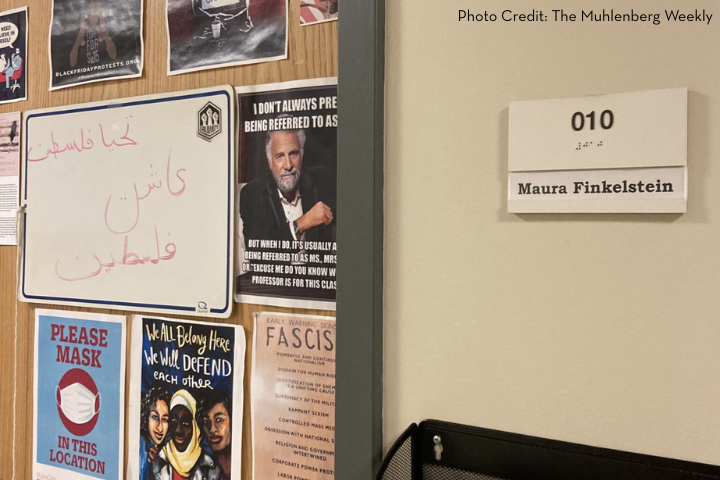
In May 2024, Muhlenberg College dismissed tenured anthropology associate professor Dr. Maura Finkelstein, revoking her tenure over comments she made about the Israel-Hamas war, specifically citing an Instagram post in which she reposted a statement from Palestinian-American poet Remi Kanazi. According to The Intercept, “Do not cower to Zionists,” Kanazi wrote on January 16. “Shame them. Do not welcome them in your spaces. Why should these genocide loving fascists be treated any different than any other flat out racist.” Finkelstein reposted the statement in January 2024 and a week later, she was suspended from campus and from teaching.
Finkelstein, who is Jewish, received tenure in 2021 from Muhlenberg, a school where roughly a third of the student body identifies as Jewish. This was not the only controversy surrounding the professor. During the 2023-24 academic year, people began to closely examine her speech, both in and out of the classroom. On October 10th, 2023, Finkelstein sent an email to the university community that was later cited in a public petition run by a group of Muhlenberg alumni, calling for her removal from the college. In that email, three days after the Hamas attack on October 7th, she wrote, “We must mourn all civilian deaths… But we cannot mourn without also acknowledging the fact that Israel is a settler colonial state.”
A week before Finkelstein was suspended, on January 18, 2024, Muhlenberg President Kathleen E. Harring sent a school-wide email stating that the Office of Civil Rights (OCR) was investigating a complaint against the school. A subsequent OCR resolution agreement with Muhlenberg did not prescribe any specific disciplinary action nor mention Finkelstein by name, although it did link to the public petition calling for her dismissal. In September 2024, in an Intercept article, Finkelstein revealed that she had been fired in May 2024. In early 2025, more than eight months after Finkelstein’s termination, Muhlenberg’s Faculty Personnel and Policies Committee concluded their review of the case, unanimously recommending “reconsideration of Professor Finkelstein’s termination.” In late June 2025, the AAUP formally censured Muhlenberg College, citing its hasty termination of Finkelstein, surveillance-driven enforcement, and policies that failed to protect academic freedom and due process.
What Does PEN America Think?
This case underscores how institutions can falter under public pressure instead of standing by the principles of academic freedom in a case involving vitriolic, but undeniably political speech. After Finkelstein made her remarks and online posts, alumni and donors criticized Muhlenberg, and a complaint was filed with the Office for Civil Rights. In the wake of these pressures, the college failed to vigorously defend this faculty member’s academic freedom. PEN America responded to Finkelstein’s dismissal in Inside Higher Ed by noting that academic freedom is meant to protect professors’ rights to free speech, even beyond the classroom and “even when some find what they say deeply offensive.” Political speech deserves particularly strenuous protection; not only is it a key tenet of speech protected by the First Amendment, but students and faculty on a campus must be able to engage in political speech to express themselves — foundational to research, teaching, and learning.
Defending academic freedom and refusing to fire a professor over their extramural speech does not mean the institution must remain passive when responding to impacted students. There is space to both uphold academic freedom and to listen to students’ concerns and demands. This may include mediated conversations, providing mental health resources, and continued education for everyone regarding the issues at hand. Refusing to bow to outside pressure, and providing support for the campus community, can send a strong message that it is possible to uphold academic freedom maximally and support an inclusive community at the same time.
If students’ complaints rise to the level that disciplinary action appears warranted, colleges should follow transparent procedures, clearly explain their reasoning, and prioritize dialogue between faculty and community members. Mediated conversations can foster mutual understanding, particularly around the charged and often decontextualized language of social media.
Rider University fires adjunct professor for her social media posts about Charlie Kirk
On September 10, 2025, Turning Point USA founder Charlie Kirk was assassinated while speaking at Utah Valley University. In the weeks that followed the murder, social media lit up with posts, both positive and negative, about Charlie Kirk. Some of those posts that were critical of Kirk, or even celebrated his death, resulted in discipline, including the firing of faculty and staff at colleges and universities across the country.
At Rider University in New Jersey, an adjunct faculty member, Kate Ecke, was fired on September 17, 2025, after posting comments about Kirk. One of Ecke’s posts allegedly said, “I don’t care that Charlie Kirk got shot. Kids are being slaughtered in their classrooms and the same people crying outrage for him have nothing to say when it’s children in body bags.”
Soon after, University President John R. Loyack sent an email to the Rider community stating that Ecke was fired because their “behavior did not reflect our expectations for respectful and civil engagement’” and that “’several individuals at Rider received a threat directed at our campus as a result of this individual’s actions,” according to The Rider News.
The campus paper offered further contextualization quoting a September 18 letter from Provost Kelly Bidle to the faculty stating, “the termination decision was not about differing viewpoints or the suppression of academic freedom, but academic freedom has its limits, particularly as it relates to extramural speech. Such speech, when accompanied by professional ethics, appropriate restraint and respect for others, remains a cornerstone of our mission. But community standards matter. Civil discourse matters. And safety certainly matters.”
In the same letter Bidle said that Ecke had identified herself as a faculty member at Rider University in her posts implying that a reader could infer that Ecke was speaking on behalf of the institution rather than as a private citizen. According to Ecke, she only identified herself as a faculty member at Rider in a completely different, earlier post from September 2, when she posted that she was teaching at Rider University with a photo of herself in a Rider T-shirt.
Rider’s AAUP chapter responded stating that the firing was a violation of the university’s stated obligation to academic freedom, and that they would take whatever steps they could to “right this wrong.”
What Does PEN America Think?
Although the Provost of Rider University claims that academic freedom does not protect this speech, it in fact does. According to AAUP’s FAQ on academic freedom, extramural speech is one of the four interrelated elements that comprise academic freedom. Faculties’ various roles – as educators, researchers, campus leaders and private citizens, overlap and definitive lines can be blurry. In this case Ecke’s social media posts were made as a private citizen, however, this case highlights the difficulty of differentiating when a faculty member is speaking as a private citizen as opposed to a representative of the university. This is why it is even more crucial that universities protect extramural speech from censorship or discipline by the university.
So when might discipline be warranted? AAUP states in their 1964 statement, “The controlling principle is that a faculty member’s expression of opinion as a citizen cannot constitute grounds for dismissal unless it clearly demonstrates the faculty member’s unfitness to serve. Extramural utterances rarely bear upon the faculty member’s fitness for continuing service.”
According to the report in The Rider News, there were no allegations that Ecke was unfit to teach, nor, according to a student interviewed, did her social media commentary enter into classroom discussions. Even if Rider University’s administration was offended by Ecke’s post, being fired for one’s social media commentary is both antithetical to claims to uphold academic freedom and a disproportionate reaction. Ecke’s status as an adjunct put her in a more precarious position, however, as adjuncts do not benefit from the job security protections that come with tenure or full-time status, she was left with fewer options for recourse.
While safety concerns should be taken seriously, these also must not become a pretext for censorship. Universities should instead rely on existing safety protocols and offer support or training for those targeted by harassment. There are safety trainings and resources that can provide education and support to anyone threatened for their social media. Institutions of higher education should have a process by which they evaluate extramural speech to determine if it meets the extremely high bar where a faculty is “unfit to serve” and it would warrant disciplinary action; barring evidence that the speech in question has a clear and direct ramification on a professor’s ability to fulfill their professional duties, concerns should be dealt with through conversation and dialogue, not through a sudden firing.
When colleges and universities fail to protect extramural speech, the chilling effect is immediate and far-reaching. Faculty may self-censor, avoiding public discourse and thus undermining the overall mission of higher education: to advance open inquiry, dialogue, and debate that enables intellectual exploration and innovation.
Disclaimer: Nothing on this website constitutes, nor should be construed, as legal advice on any matter. All content on the website is for informational purposes only. PEN America is not liable for any errors or omissions in the information and is not liable for any injuries or damages related to the display of the information on this website.
Campus Free Speech Guide
Get principled guidance for how campuses can best remain open to all voices.
-
The Law and Campus Free Speech
-
Hateful Speech and Expression on Campus
-
Speakers and Events on Campus
-

Faculty Speech and Expression
-
Campus Climate
-
Protests on Campus