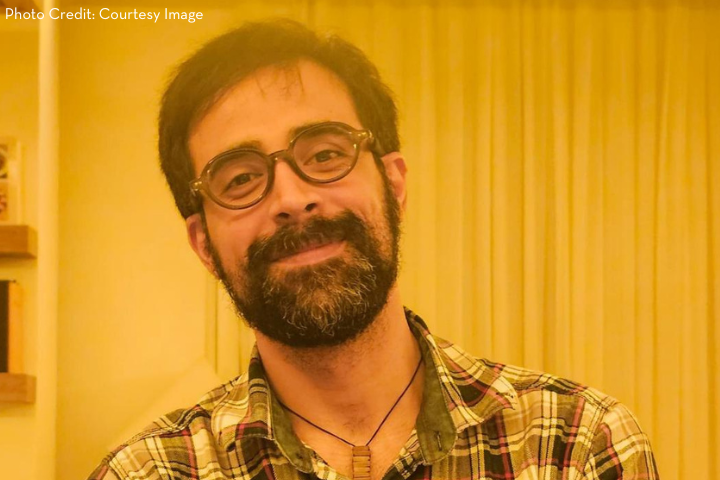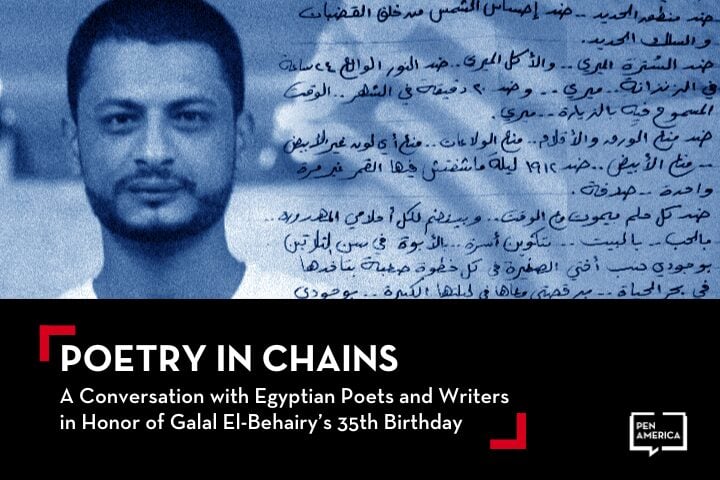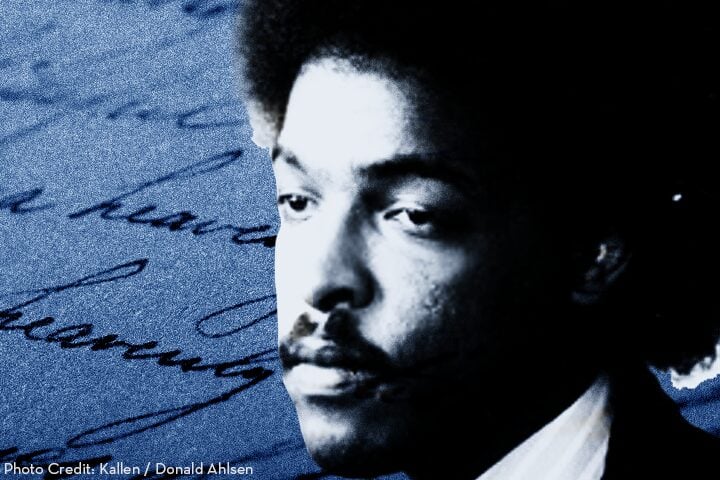
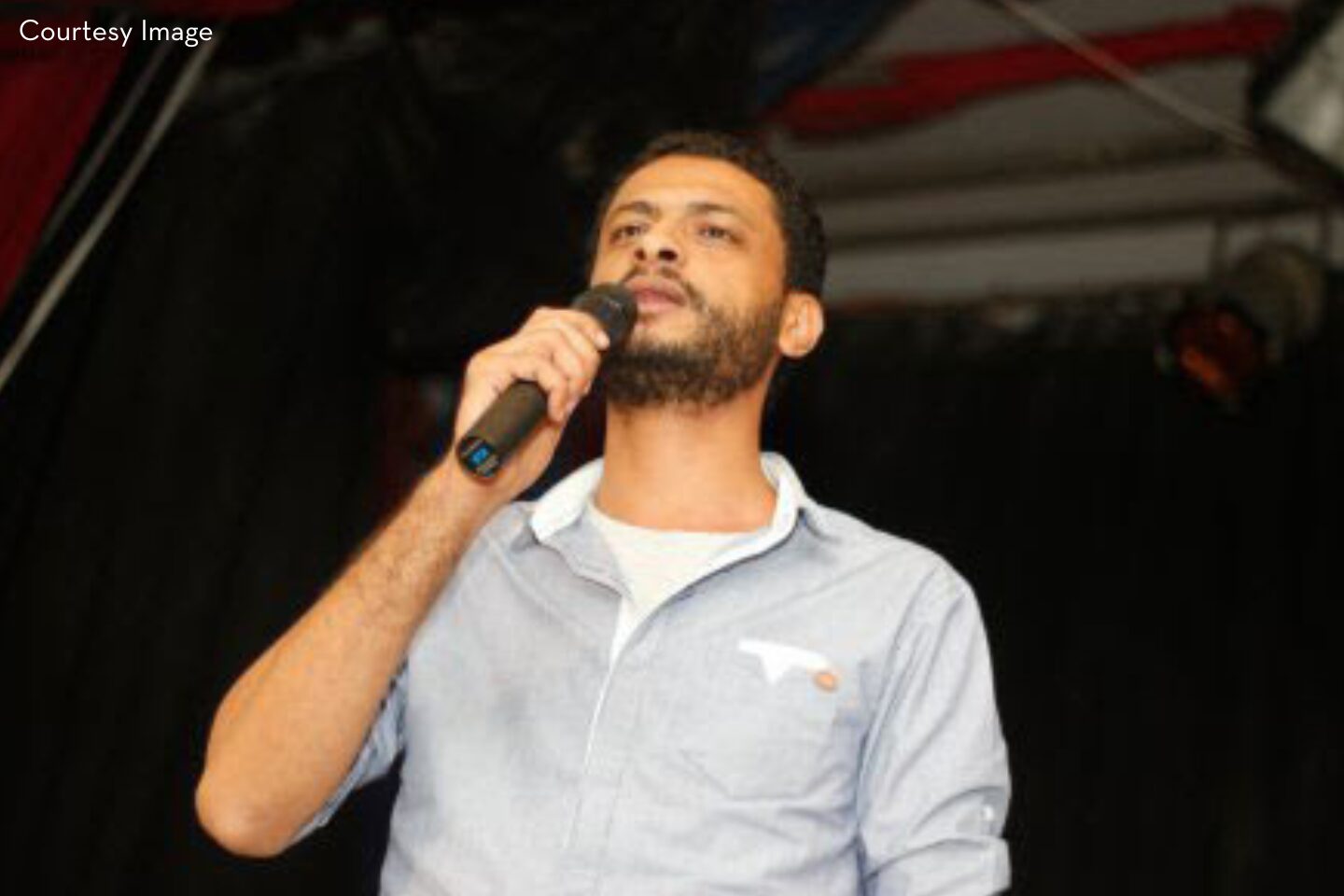
Eight years ago today, poet Galal El-Behairy was jailed in Egypt for writing song lyrics. The satirical song, “Balaha,” later performed by Ramy Essam has been viewed millions of times online and went viral for its clever lyrics mocking Egypt’s president Abdel Fattah El-Sisi.
The song uses metaphor and humor to highlight political corruption, economic hardship, and the absurdity of prolonged authoritarian rule. It plays on El-Sisi’s nickname “Balaha” which translates to “date,” and in Egyptian is used to mock someone as foolish, and celebrates the end of his supposed term limits:
“Oh shiny browny Mr. Date, 4 years have finally passed in disgrace.”
For those words, the man once called “the poet of Egyptian universities” was arrested, prosecuted before a military court as a civilian, and sentenced to three years in prison.
Despite the ridiculous miscarriage of justice, El-Behairy, now 36 and the 2025 PEN/Barbey Freedom to Write Award Honoree, completed his three-year sentence in 2021. Yet after those three years, he was not released. Instead, he faced new charges and since then has been in what amounts to indefinite pretrial detention with no end in sight. Each time one detention period expires, additional cases are pressed against him.
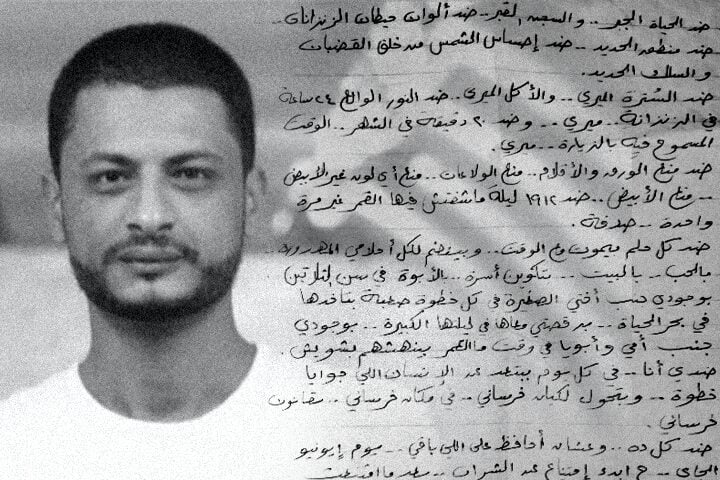
His words express isolation and emotional strain; he turned to writing as his only refuge, measuring his thoughts in the few “millimeters of ink left in [a] smuggled pen” and “unburdening” himself onto paper. El-Behairy remains trapped behind bars.
Years of indefinite detention have taken their toll beyond the constant turmoil of legal cases. El-Behairy has reached breaking points, suffering severe psychological distress and attempting to take his own life, all for song lyrics deemed a threat by the state.
In the face of all this, from the confines of Badr Prison Complex, El-Behairy continues to write. About his solitude, about the injustice against him, and about the years stolen from him.
In March 2023, he wrote:
“My voice betrays me and breaks inside;
In my silence is my death
Singing is a passion
My dear country, how
can I sing to you
If I saw my death
for one song”
But words alone cannot protect him from the harsh realities of life inside Badr Prison. Being denied medical care, allowed to see his family for less than an hour each month, trapped in deplorable living conditions, and lacking safe access to reading and writing materials have all damaged his well-being and mental health.
The award-winning poet, celebrated for his powerful words since a young age, now endures these conditions, away from his family.
El-Behairy must have access to quality medical care, as well as reading and writing materials to continue his work safely. He should be held in humane conditions, preferably in a prison closer to his family to allow for regular visits.
Above all, El-Behairy doesn’t belong in jail and must be freed.
El-Behairy’s case, and his bravery in the face of inhumane treatment and endless imprisonment is, unfortunately, just one example of the human cost of silencing dissent in Egypt.
Egypt has consistently ranked among the world’s top ten jailers of writers over the past six years, according to the Freedom to Write Index, underscoring the urgent need to defend writers in Egypt.
Egypt must pardon and release El-Behairy immediately, so he can get the care and attention he needs. More than that, Egypt should release all writers unjustly detained in its prisons.
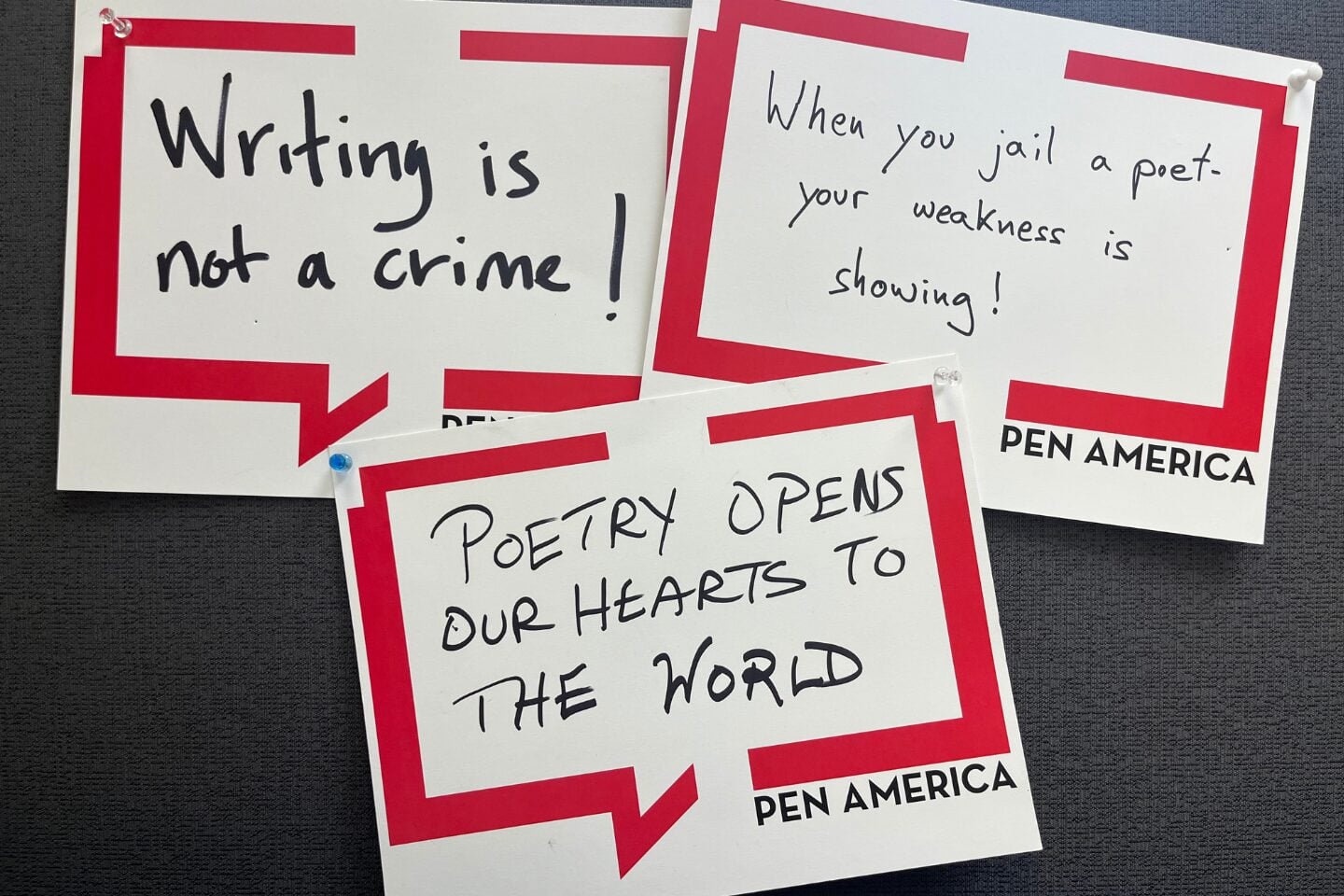
Share Galal El-Behairy’s story and poetry to show he is not forgotten.