
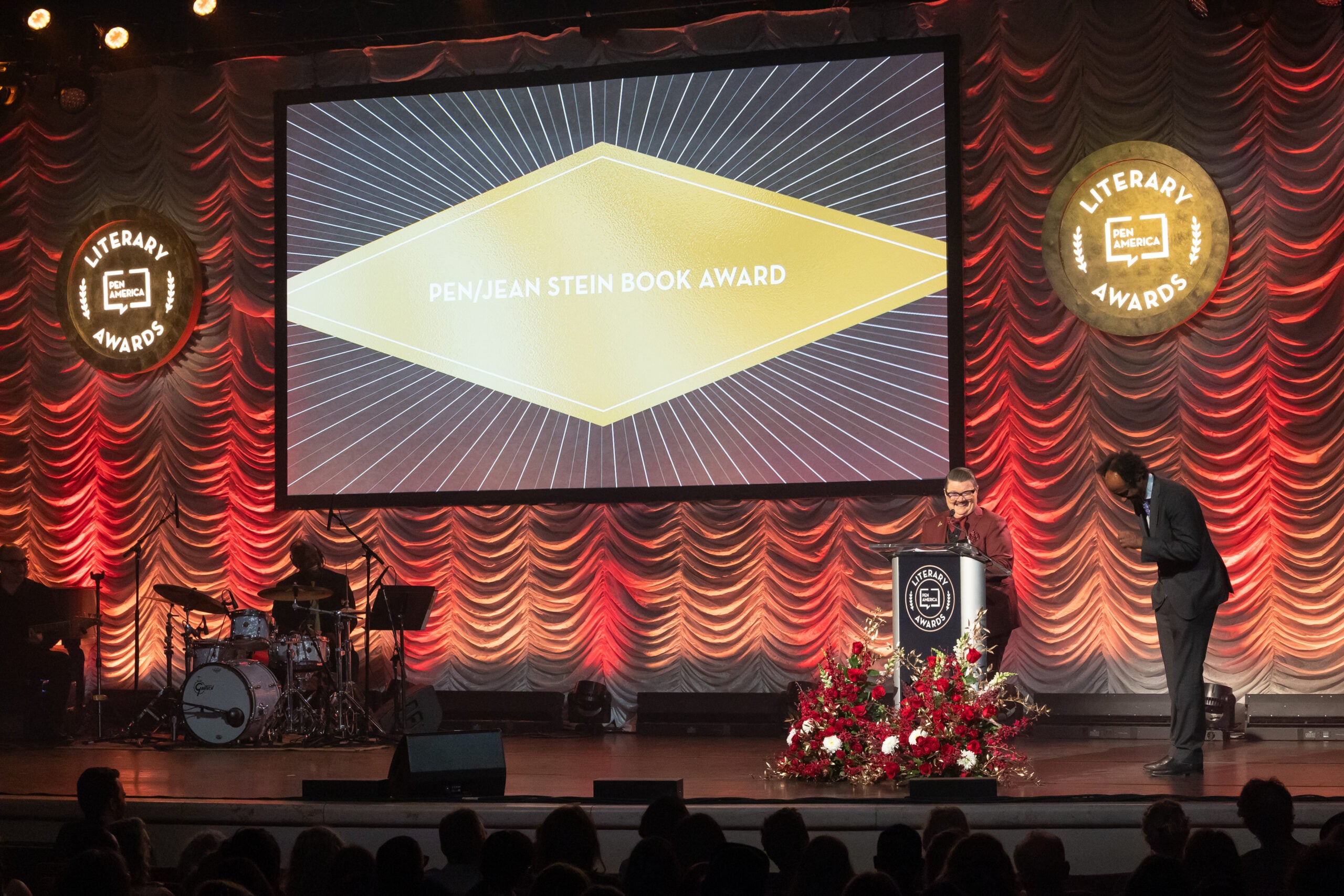
Cannupa Hanska Luger Wins PEN/Jean Stein Book Award for SURVIVA: A Future Ancestral Field Guide
PEN Open Book Award Went to Justin Haynes for Ibis, a Novel about Caribbean Migration
PEN/Weld Biography Award to Nicholas Boggs for James Baldwin Biography, Baldwin: A Love Story
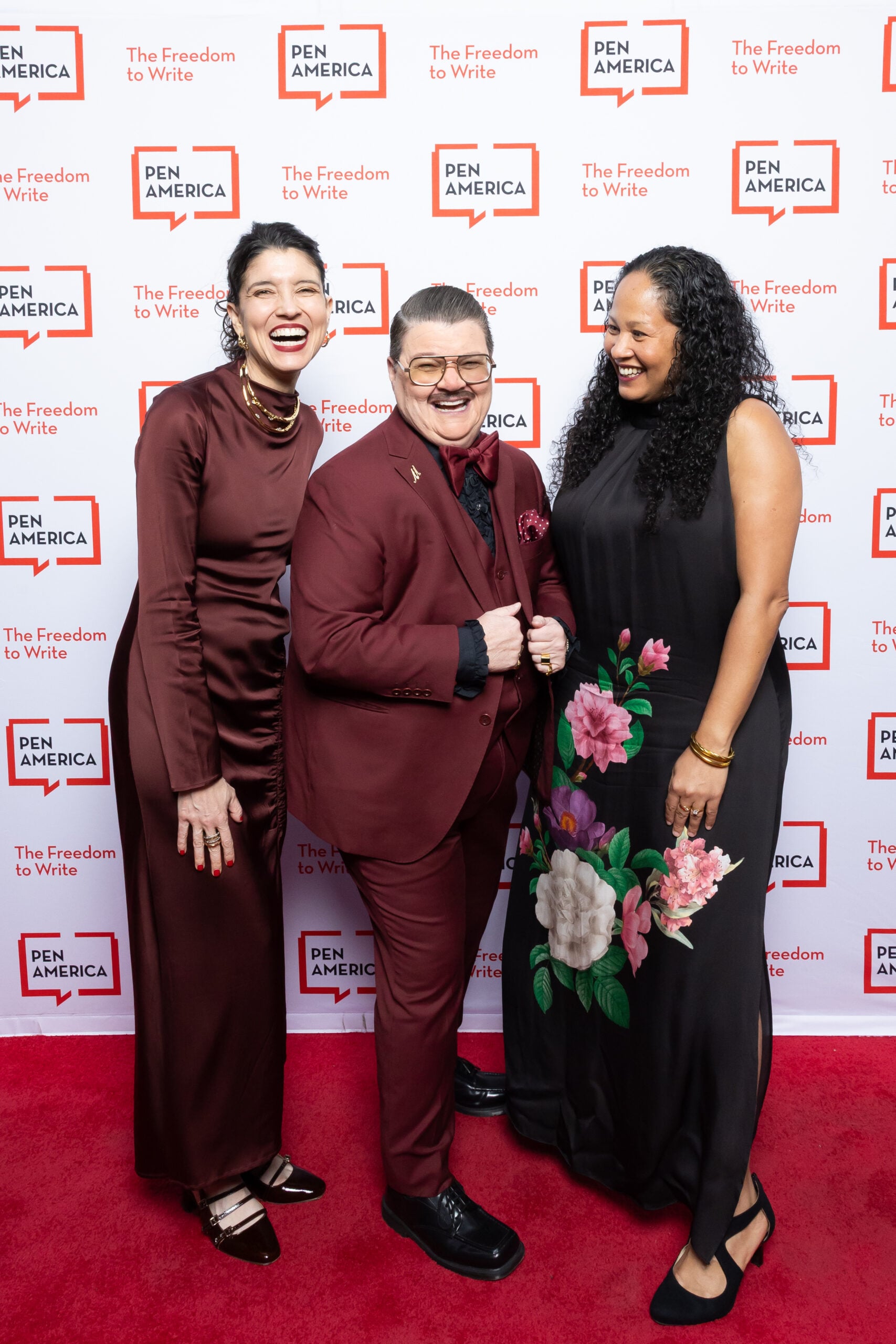
Host Murray Hill quipped: “PEN America knows that making this night is about joy, love, and celebration, and that is our most powerful resistance. So on that note, let’s start handing out the cash!”
Here is the link to select photos available to journalists to use.
(NEW YORK)—Against the climate of government censorship of words, books, and ideas, PEN America held its celebratory 62nd annual Literary Awards last night to honor some of the best writing and thinking of the past year across fiction, nonfiction, poetry, playwriting, and essays. Nearly $350,000 in prizes were conferred at the event known as “the Oscars for books.”
Comedian, author, producer, and actor Murray Hill (Somebody Somewhere), host for the ceremony, greeted an audience of star authors, publishing insiders, and book influencers by joking that the evening is indeed like the Oscars (“I agree, it’s like the Grammys but for tonight Beyoncé is Emma Straub…it’s like the Emmys but for people who don’t have TVs”). Then Hill struck a more serious tone, saying, “Governments are doing everything they can to squash diversity in our schools, our libraries, our businesses, and our halls of power, to prevent the exchange of new perspectives and the celebration of—and even the acknowledgement of—multiculturalism. But we all know that diversity is our greatest strength.”
Musical performances by Amber Iman (Broadway: Lempicka, Tony nomination); Nina Simone in Soul Doctor;Shuffle Along…) and the Ulysses Owens Jr. Band, led by the GRAMMY Award-winning drummer and percussionist, set a high-spirited tone as the audience cheered winners onstage.
Summer Lopez, co-CEO of PEN America, said: “Tonight, we came together to uplift our shared love of books and literature’s profound role in connecting people even as we witness in real time the relentless attacks on free expression by our government. Whether Jamaica Kincaid’s incisive essay collection, Nicholas Boggs’ intimate portrait of James Baldwin, Peter Beinart’s urgent search for a new narrative, or Cannupa Hanska Luger’s imagining of a decolonized future, the winners’ works emphasize the transformative power of storytelling.”
Clarisse Rosaz Shariyf, co-CEO of PEN America, said: “Literature’s capacity to create community—one of the beautiful, vulnerable things we fight for when we defend free expression—was on full display at the ceremony. Being in the room as magnetic performers brought career achievement winners Edwidge Danticat and Julia Cho’s audacious words to life was a magical experience. It’s an honor to recognize Cho’s unique theatrical voice and the sweeping force of Danticat’s mastery across genres on the global stage. These two artists connect us to our shared humanity.”
PEN America President Dinaw Mengestu, introducing the PEN/Jean Stein Book Award for an outstanding work with the promise “of enduring influence,” raised the ongoing spectre of book censorship in his remarks: “This prize, this ceremony, this organization of writers and readers, and all of us who are gathered here this evening, are a reflection of this multitude, this intertwining, layered body of style and form and aesthetics. One that despite being relentlessly under assault, cannot be taken away or diminished by any one person or any government.”
For his genre-bending work of Indigenous futurism, SURVIVA: A Future Ancestral Field Guide, Mandan/Hidatsa/Arikara/Lakota artist and writer Cannupa Hanska Luger won the PEN/Jean Stein Book Award. The evening’s largest monetary prize, presented to the author by Mengetsu and Hill, it recognizes the originality, merit, and impact of a book-length work of any genre, and confers $75,000 to its author.
Luger described the origin story of his book: “My wife 10 years ago bought me a US Military Survival Guide as a joke. These two black and white Helvetica textbooks came in. One said ‘Booby Traps’ and the other said ‘Survival.’ And I opened to page five and there was an acrostic poem and the A in ‘Survival’ was ‘Act like the Natives.’ I realized that it is full of Indigenous knowledge—militarized, weaponized, and recontextualized, and I wanted to fix that. In a world where it’s hard to fix things, I thought maybe I could fix this. I imagined my audience was in a future far from now. You proved me wrong.”
Journalist and author Adam Higginbotham (Midnight in Chernobyl, Challenger) presented the PEN/E.O. Wilson Literary Science Writing Award to neurologist, Boston University School of Medicine professor, and writer Pria Anand for The Mind Electric: A Neurologist on the Strangeness and Wonder of Our Brains, with judges citing the book as “science writing at its best,” with “wisdom, insight, and clarity that does not sacrifice poetry or beauty.”
The PEN/Diamonstein-Spielvogel Award for the Art of the Essay, also presented by Higginbothom, went to Jamaica Kincaid, a writer at the New Yorker for two decades, for Putting Myself Together: Writing 1974-, her collection of nearly five decades of writing, which the judges cited for a “combination of precision and soul, that rarest of combinations.”
Peter Beinart won the PEN/John Kenneth Galbraith Award for Nonfiction, presented by music journalist and author Dan Charnas (Dilla Time), for Being Jewish After the Destruction of Gaza: A Reckoning. The judges praised Beinart’s work as “a brave and vital contribution to contemporary American intellectual life, challenging readers to reckon with the demands of justice, equity, and accountability in the face of one of the most consequential and divisive issues of our time.”
Accepting the award, Beinart said: “I wanted to acknowledge that there are many Palestinian writers in Gaza and beyond who have the talent to win awards like this, but didn’t have the opportunities that I have had. I wrote my book because I believe there is another Judaism than the one being offered by the Israeli government and America’s most powerful Jewish organizations. It begins where Torah begins, with the recognition that all human beings, irrespective of religion, ethnicity, and race are created equal in the image of God.”
PEN/Jacqueline Bograd Weld Award for Biography winner Nicholas Boggs’ book Baldwin: A Love Story is the first major biography of James Baldwin in three decades, centering the impact of his personal relationships on his writing and life. “Boggs distills Baldwin’s life into a heart-throbbing ‘memory of love’ that echoes through the ages,” wrote the judges, calling it “a landmark achievement.”
Receiving the award from Charnas, Boggs said: “I’m honored to have spent my whole life writing about James Baldwin,” adding that he was grateful to be honored alongside other finalists’ “incredible books” — including that of Carla Kaplan, his “undergraduate professor [who] introduced [him] to feminist theory.”
Golden Globe-nominated actor and singer Emmy Rossum (Shameless) introduced a suite of awards and grants for translation, including the PEN Award for Poetry in Translation, given to Michael Martin Shea (for translating Theory of the Voice and Dream by Liliana Ponce from Spanish), and the PEN Translation Prize, given to Minna Zallman Proctor for her translation from Italian of The Leucothea Dialogues by Cesare Pavese. The judges wrote that Shea “deftly captures the essence of Ponce’s serial poems on creation and absence” and Proctor for her “consistently fresh and contemporary tone and rhythm” that “makes the book come alive for readers today.”
Justin Haynes won the PEN Open Book Award (given to an exceptional book-length work of any literary genre by an author of color) for Ibis, his debut, a cross-generational Caribbean story the judges celebrated for its “magical flair and wild, idiosyncratic audacity” as it “expose[s] the continuum between colonialism, slavery, and ongoing human trafficking” and “reminds us that the only way to confront a haunted past is to accept—with humor, humility, and invention—the simultaneity, interconnectedness, and mystery of survival.”
Accepting the award from bestselling author and civil rights litigator Qian Julie Wang (Beautiful Country: A Memoir of an Undocumented Childhood), Haynes, from Trinidad and Tobago, said: “I am standing here on the shoulders of giants” and referred to immigrant authors from Caribbean nations– Edwidge Danticat, Marlon James and Jamaica Kincaid. Describing the struggles of U.S. immigrants from the region, he said: “I am just grateful that I am able to share their story and help them become… citizens of the world.”
Aracelis Girmay won the PEN/Voelcker Award for Poetry Collection for Green Of All Heads, cited by the judges for “dreamlike” poems that give voice to loss and life while celebrating the Eritrean community and the African diaspora. “This book is a whisper of a book and I didn’t know if it would be met by a reader,” she said, then, reflecting on her own father’s death in 2020, she quoted from the poem Glory by fellow nominee Gbenga Adesina: ‘Glory of the eyes of my father/which, when he died, closed/inside his grave/and opened even more brightly/inside me.’” She concluded: “I’m so grateful for all the words that we can live inside.”
Jared Lemus won the $25,000 PEN/Robert W. Bingham Prize for Debut Short Story Collection for Guatemalan Rhapsody, which the judges praised as a “rare” debut that “arrives fully rendered and delivers a writer whose voice and talent promise even greater things to come.”
View the full list of the winners with judge’s citations, and grant recipients for writing.
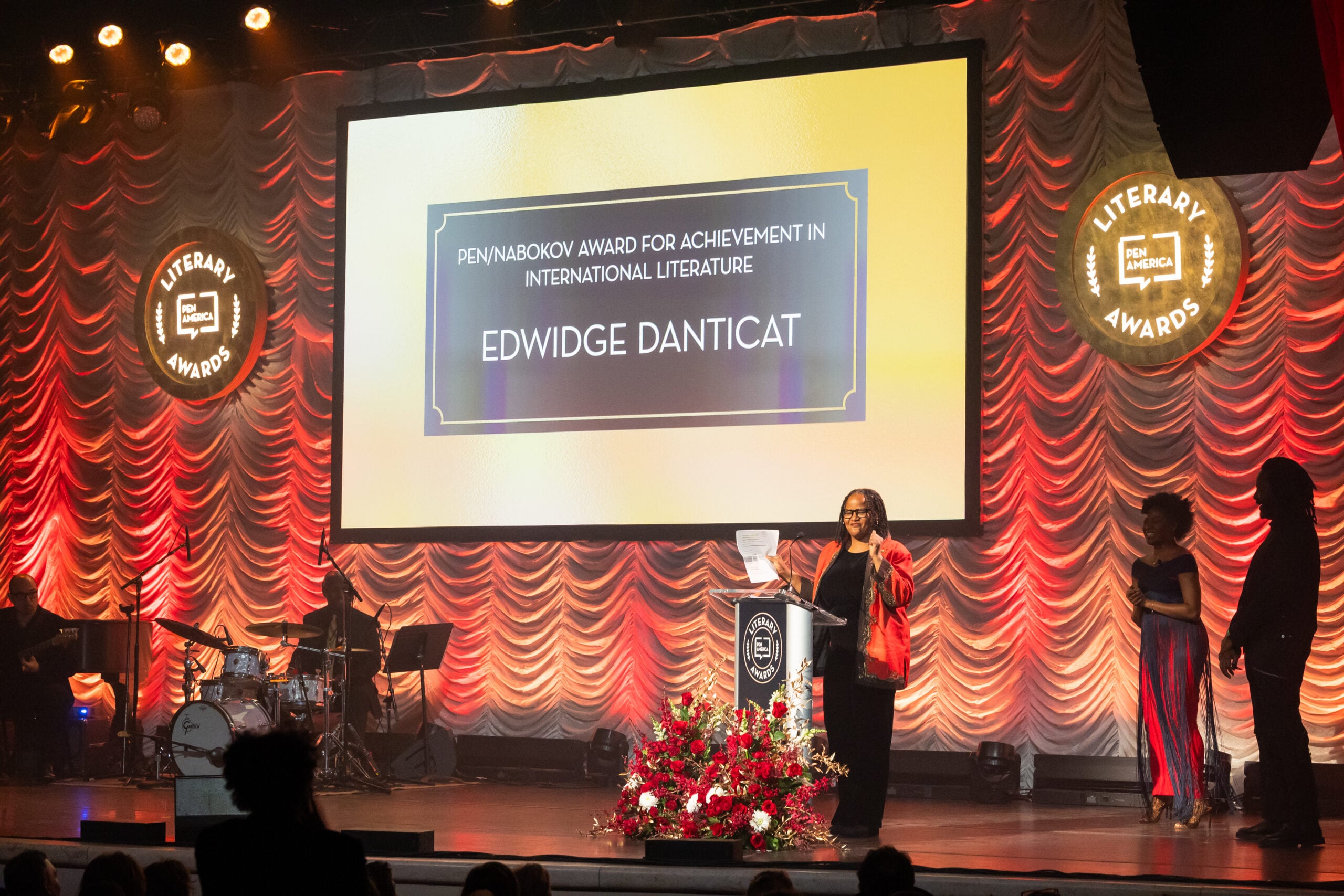
In celebration of Haitian-American novelist Edwidge Danticat’s (Everything Inside; Krik? Krak!; Brother, I’m Dying) PEN/Nabokov Award for Achievement in International Literature, Haitian-American actor Pascale Armand (Broadway: Eclipsed, Tony nomination) gave a world-premiere reading from Dèy, Danticat’s forthcoming novel (Knopf, August 2026). Set between Haiti, Brooklyn and Miami, Dèy follows a Haitian-American woman whose understanding of self is upended after a random act of violence on a sunny Florida day.
Man Booker Prize-winning author Marlon James (A Brief History of Seven Killings) introduced Danticat and her career achievement honor.
Danticat referred to the Haitian immigrant communities in the United States she writes about as now living “in fear of being abducted and disappeared.” She added: “Literature has helped me to reclaim so much of what I thought I had lost. It’s allowed me to build community and imagine beyond all I’ve been told was impossible.”
In honor of playwright Julia Cho’s (99 Histories; Office Hour; The Language Archive) PEN/Laura Pels International Foundation for Theater Award, actress Sue Jean Kim performed an excerpt from Cho’s play Aubergine, directed for the occasion by Obie Award-winner Eric Ting (The Far Country, The Comeuppance). Kim previously appeared in Cho’s play Office Hour (Public Theater) and performed in the New York premiere of Aubergine at Playwrights Horizons in 2016. Tony Award-winning playwright David Henry Hwang (M. Butterfly, Chinglish, Yellow Face) presented the award to Cho.
Cho said: “All my life, I’ve looked up to writers. They’ve been my heroes. You still are. So it’s really meaningful to be in a room full of writers and the people who love them. It’s been such a hard time and I have been filled with so much fear and sadness. And the reaction I had was the exact wrong one. I became quiet. I became silent. So most of all, thank you for waking me up. Thank you for reminding me who I am — that I’m a writer, that it’s the time now more than ever to write, and I will do my best to create work to be worthy of this honor.”
About PEN America
PEN America stands at the intersection of literature and human rights to protect free expression in the United States and worldwide. We champion the freedom to write, recognizing the power of the word to transform the world. Our mission is to unite writers and their allies to celebrate creative expression and defend the liberties that make it possible. Learn more at pen.org.
Press Contacts
Suzanne Trimel at PEN America: 201.247.5057, [email protected]
Blake Zidell, Adriana Leshko, and Caitlyn Tella at Blake Zidell & Associates: 917.572.2493, [email protected], [email protected], [email protected]