In late November, President Donald Trump snapped “quiet, piggy” at one female journalist and called a second “a terrible reporter.” His insults were undeniably disturbing, but they’re also just the tip of the iceberg. More and more frequently, reporters are facing intimidation, threats, doxing and impersonation attempts, and, in extreme cases, physical violence because of their work. Harassment is putting them at risk and straining their mental health, forcing some to self-censor or even quit their jobs.
And the impact isn’t just personal: Though specific journalists or newsrooms may appear to be standalone targets, abuse is often deployed as a part of a broader campaign to suppress a free and vibrant press.
In response to the rapidly escalating threat environment, PEN America and the Coalition Against Online Violence, a group of more than 90 organizations committed to supporting journalists attacked online for their work, created a guide to help news organizations protect their staff and freelancers, both online and off. The guide includes 12 best practices for organizational leaders and another five for direct supervisors. Among other strategies, the guide shows how to assess the scope of online harassment, create an internal task force to address abuse, and foster a supportive environment for reporters.
“By better protecting their staff and freelancers, news organizations can defend press freedom in the face of government, corporate, and individual efforts at intimidation and censorship,” the guide reads.
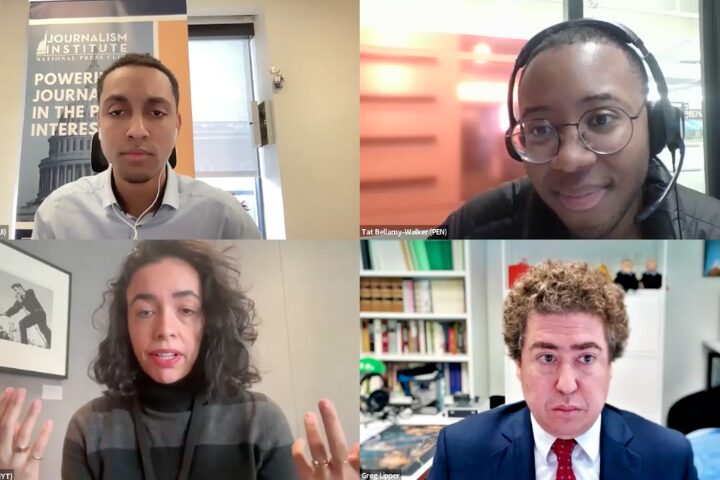
To launch the guide, Viktorya Vilk, PEN America’s director of digital safety and free expression, and Jeje Mohamed, a holistic safety and security consultant for PEN America, invited five industry leaders to talk about how they’ve implemented best practices in their own newsrooms.
Here’s what they said at the virtual session, titled “Leading the Way: Building Safer Newsrooms for Journalists”:
Dana Coester on Investing in Expertise
Over the course of a decade, Coester, the founder of the digital media outlet 100 Days in Appalachia, said she transformed “from sounding like Chicken Little carrying on about threats and safety all the time…to firmly leading with a rational, proactive, ongoing security posture.”
Coester highlighted her decision to hire a full-time security expert, who provides 100 Days in Appalachia with rapid, on-demand support ranging from threat assessment to field support. Though her team members had to fundraise before they could hire the expert, Coester affirmed that it’s been a worthwhile investment.
“Think of it as similar to how small newsrooms had to invest in social media staff or audience engagement staff where none existed before,” she said. “It simply makes sense now, especially if you can share those costs across networks, as we do.”
Check out Tip for Managers and Editors #5: Seek Internal and External Support to learn more about the kinds of experts that newsrooms can turn to for help.
Macollvie Neel on Speaking Out Against Abuse
Neel first connected with PEN America for advice on how to respond to online and offline threats that her newsroom, The Haitian Times, was facing after debunking conspiracy theories about Haitian immigrants. With support from multiple press freedom nonprofits, Neel was able to take steps to protect herself and others in her newsroom — and then took the unusual step of calling out what happened to The Haitian Times publicly.
“The fact that she chose to be so outspoken blew my mind,” Vilk said. “I wish that none of this had happened to Macollvie and her colleagues, but I’m deeply inspired by how she reacted to it during and since.”
Neel noted that many journalists are drawn to the profession because of their defiance, which she and her colleagues all leaned into when faced with attacks. “The team and I decided that we would definitely speak up and not be intimidated, be cowed,” Neel said.
For more guidance on speaking out against abuse, see Tip for Leaders #10: Issue a Statement of Support.
Brandon Quester on Building Procedures From the Ground Up
Quester said that the newsroom he founded and directs, the Arizona Center for Investigative Reporting, didn’t have sufficient safety policies or protocols in place prior to 2020. But when rampant misinformation about voter fraud flooded the state leading up to and after the election, it led to a heightened threat landscape for local journalists and other groups. Quester recognized that putting in place formal policies and infrastructure to better mitigate the risks couldn’t wait.
At first, the policies were “kind of bare bones,” he said. “A lot of what we talked about was, ‘How do we protect ourselves proactively on the digital front?’ … Obviously, a motivated actor can get around those protocols, but it takes people more time when you’re better prepared.”
Later, Quester also designed procedures for his staff in case an individual or organization did manage to bypass his safety measures. “The most important thing is that you have a list in front of you so that you can say, ‘Okay, this is a credible threat. Who do I start to need to contact internally?’ Do you contact HR? Do you contact your board of directors? Do you notify your colleagues in your newsroom?”
Quester added that his newsroom has also strengthened its relationships with external contacts, including local government officials, journalism associations, and interfaith groups that already have safety networks in place. The goal, he said, was to build and connect a coalition of safety practitioners across the state.
Go to Tip for Leaders #4: Develop Policies and Protocols for more advice on how to create living safety documents for a newsroom and distribute them to staff and freelancers.
Maritza Félix on Anticipating and Combatting Burnout
Félix, the founder and director of Conecta Arizona, a Spanish-language news service, said that over the past year, she and her coworkers have faced all kinds of abuse, ranging from online harassment to tear gas. But right now, a far less obvious threat is top of mind: the mental exhaustion of her reporters.
“In 2025, they have been reacting, they have been learning, they have been training,” Félix said. “They have had to be so resilient during 2025, but next year, they’re going to be so tired, they’re going to lower their guard just because of the burnout. And that’s something that I’ve been thinking a lot about.”
Félix said that local news organizations like her own must continue to brainstorm proactive ways to mitigate burnout as threats against journalists escalate. Check out Tip for Leaders #8: Foster a Supportive Environment for information on how to protect the mental wellbeing of newsroom employees.
April Alonso on Delegating Work to Supervisory Staff
Alonso, the co-founder of Cicero Independiente, joked that when she started to bolster her newsroom’s safety, her team couldn’t even remember the protocols she set for them. “They just knew, ‘Call April. She knows what to do. She remembers it,’” she said.
But Alonso recognized that she couldn’t be the only one to support her reporters. She’s since begun training Cicero Independiente’s editor on the newsroom’s safety procedures, which she hopes will soon become second nature to him. That way, digital safety work won’t always fall to the same person.
She emphasized that in order for newsrooms to run smoothly, reporters need to feel certain that their higher-ups want and know how to protect them. For more details on how to equip supervisors with the training they need to support their reporters, read Tip for Leaders #11: Provide Training and Build Capacity for Managers and Editors.